
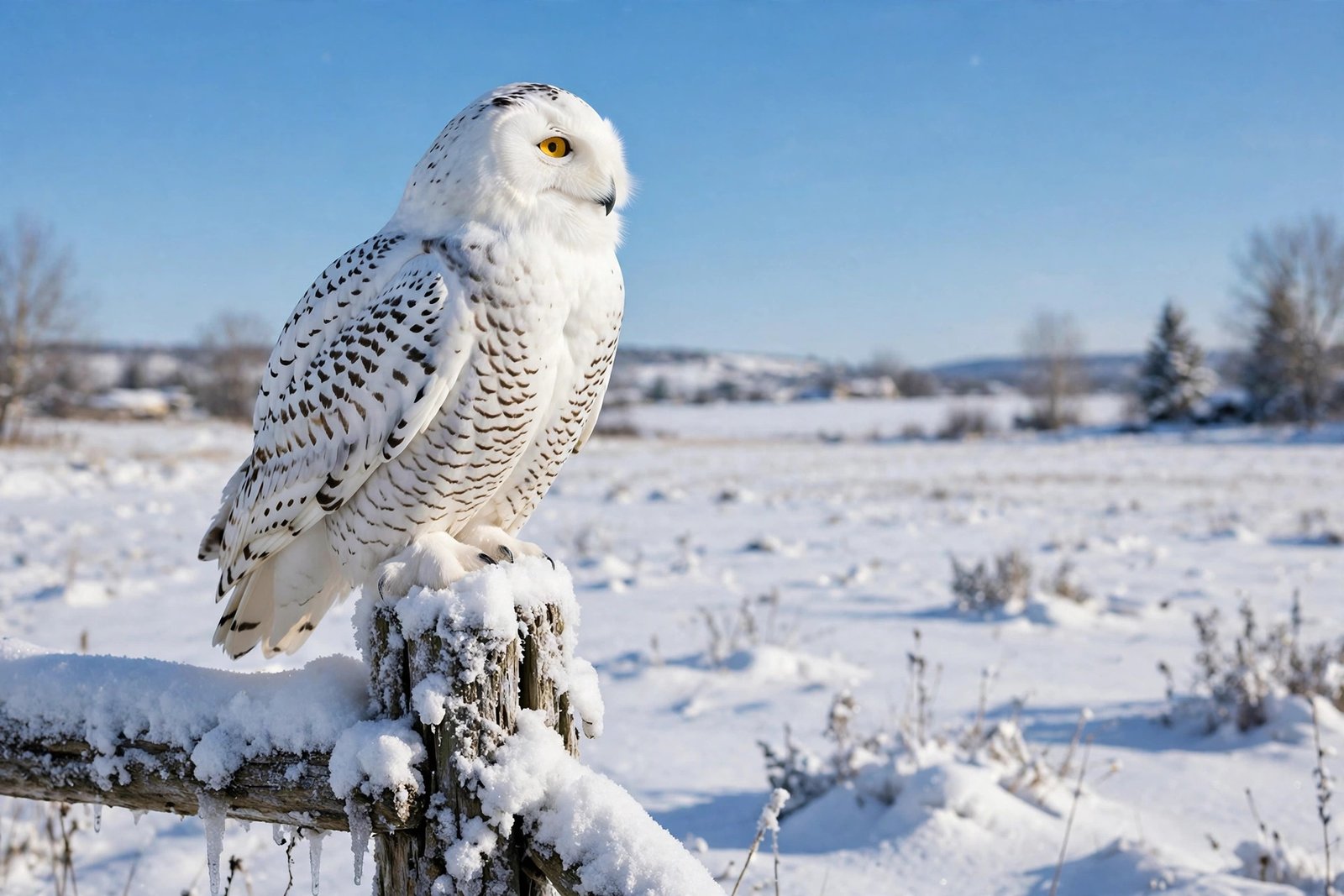
There is a moment every winter birder dreams about: you are driving a quiet country road in northern Michigan or Minnesota, scanning the fence posts and hay bales, when a flash of white catches your eye. You stop. You lift your binoculars. And there it is — a snowy owl, sitting upright and unbothered on a telephone pole, its yellow eyes fixed on the frozen fields. For a few minutes, the Arctic has come to you.
Snowy owls are among the most spectacular birds a person can see in the United States, and winter is the season to see them. Each year, some of these Arctic hunters travel south into the northern states, and in big years — known as irruption years — they arrive in numbers that make headlines. This guide explains why they come, where to look, when to go, and how to watch them without doing them harm.
What Makes a Snowy Owl Different
The snowy owl is unlike any other owl most Americans will ever meet. For a start, it hunts by day. While most owls are creatures of the night, the snowy owl lives in the Arctic tundra, where summer means twenty-four hours of daylight. It had to learn to hunt in sunshine, and it kept the habit when it travels south. That is good news for birdwatchers: you can look for snowy owls in the middle of the day, when the light is best and the bird is most active.
It is also a big bird. According to the Cornell Lab of Ornithology, snowy owls measure about 20.5 to 27.9 inches long, with a wingspan of roughly 49.6 to 57.1 inches and a weight of 1,600 to 2,950 grams. They are the heaviest owl species in North America, and their dense feathering — even their legs and feet are covered in feathers, like built-in snow boots — makes them look even bulkier than they are.
Look closely and you can often tell a male from a female. Adult males tend to be almost pure white, growing paler as they age. Females and young birds carry dark barring and speckles across their white plumage, giving them a salt-and-pepper look. Both have piercing yellow eyes and a black beak mostly hidden in facial feathers. In flight they are powerful and direct, usually staying low over open ground, wings beating with slow, deep strokes.
Their home is the treeless Arctic tundra of Alaska, Canada, and Greenland, where they nest on the ground, on a raised mound or ridge with a wide view in every direction. A female may lay anywhere from 3 to 11 eggs, according to the National Audubon Society, with larger clutches in years when prey is abundant. Almost everything about a snowy owl’s life revolves around one small animal: the lemming.
Why They Come South: The Irruption Mystery
Most winters, a modest number of snowy owls drift south into Canada and the northern United States. But some winters, they arrive in extraordinary numbers, turning up in places they are rarely seen. Birdwatchers call these events irruptions, and for years the cause was misunderstood.
The old assumption was that owls came south because they were starving — that a crash in lemming numbers on the tundra forced hungry birds to flee. The truth, researchers now believe, is almost the opposite. Irruptions happen after a boom, not a bust. When lemmings are plentiful in summer, snowy owls raise large families, and many more young owls survive to autumn than usual. With the tundra suddenly crowded, the young birds — mostly first-year owls — spread south in search of their own winter territories.
That is why irruption years bring mostly young, heavily speckled birds. The adults, with established territories, tend to stay put. And it explains why irruptions are so unpredictable: they depend on lemming cycles in a remote Arctic landscape that scientists can only partly monitor. No one can reliably predict a big year in advance, though Arctic breeding reports and early-season sightings give experienced watchers a sense of what may be coming.
The most famous modern irruption came in the winter of 2013–2014, one of the largest on record. Snowy owls poured into the Great Lakes and the Northeast in huge numbers, and single birds were reported as far south as Florida and the Gulf Coast — and one even reached Bermuda. It was a reminder that in a big year, a snowy owl can show up almost anywhere in the eastern United States, even in places where no one is looking for one.
Where to See Snowy Owls This Winter
When snowy owls come south, they look for landscapes that feel like home: wide-open, treeless country where they can sit high and scan for prey. That means coastal dunes and beaches, farm fields, grasslands, marsh edges, and — famously — airports, whose broad grassy expanses resemble the tundra. Here are the most reliable regions.
The Great Lakes. The Great Lakes shoreline is the heart of snowy owl country in the lower 48 states. In Minnesota, the Duluth harbor area and the Sax-Zim Bog region are prime spots, with open fields and coastal ice that attract hunting owls. In Michigan, the eastern Upper Peninsula — Chippewa County and the areas south of Sault Ste. Marie, including Rudyard and Pickford — has recorded some of the highest single-day counts anywhere, and Saginaw Bay and Fish Point are also strong. In irruption years, owls can be found in nearly every county in Michigan, usually along the Great Lakes coastline.
New England. The Atlantic coast from Maine through Massachusetts is another classic wintering ground. Snowy owls hunt the dunes and salt marshes, perch on beach fences and driftwood, and patrol the shoreline for ducks and other waterbirds. Coastal wildlife refuges and open beaches are the places to check first, especially at dawn and dusk.
The Northern Plains. North Dakota, Montana, and northern Wisconsin offer the wide-open grasslands and farm country that snowy owls love. In Wisconsin, the Goose Pond Sanctuary area and the state’s open prairies and agricultural fields are known wintering spots, and the birds are often found perched on utility poles along quiet country roads.
Anywhere in a big year. In a major irruption, all bets are off. Birds have turned up in the mid-Atlantic, the Ohio Valley, and the Pacific Northwest. If you live anywhere in the northern half of the country, it is worth checking local birding reports — a snowy owl could be a short drive away.
When to Go
The snowy owl season in the United States generally runs from late November or December through March, with January and February usually the best months. In northern Michigan, for example, the prime window is December through March, with the best odds in January and February. Birds that arrive early may settle into a winter territory and stay for weeks, returning to the same field or fence post day after day — which is why local birding reports are so valuable. A bird found on Tuesday is often in the same spot on Saturday.
Time of day matters too. Because snowy owls hunt by day, the best viewing is often in the morning, roughly 8 to 10 a.m., and again in the late afternoon, about 3:30 to 5 p.m., when the birds are actively moving and choosing hunting spots. Midday they often sit still for long stretches, digesting a meal or simply resting — which can still make for a wonderful sighting, since a motionless white owl on a dark fence post is surprisingly easy to spot once you know what to look for.
How to Spot One
Snowy owls are big and white, but they can still be surprisingly hard to find in a wide landscape. The trick is to think like an owl. Scan the high points: fence posts, telephone poles, hay bales, rooftops, dune crests, and the tops of small rises in open fields. In coastal areas, check the edges of beaches and the tops of dunes. On farmland, look along field edges and hedgerows. Drive slowly along country roads, and stop often to scan with binoculars — a white lump on a distant pole is easy to miss at highway speed.
Watch for movement, too. A snowy owl in flight is unmistakable: a large, white bird flying low and purposefully over open ground, wings broad and rounded. In winter fields they hunt voles, mice, and other small mammals, and along the coasts they take ducks and other waterbirds. Unlike most owls, they often hunt by watching from a perch and then swooping down, so a bird that has been sitting still for an hour may suddenly explode into action.
Two tools will transform your chances: a good pair of binoculars and a local sightings report. The Cornell Lab’s eBird platform and local Audubon chapter reports list recent snowy owl sightings, often with enough detail to point you to the right township or stretch of road. Project SNOWstorm, a research group that tracks snowy owls with GPS transmitters, also publishes maps and updates on the movements of tagged birds.
Watching Ethically: The Rules That Matter
Snowy owls are beautiful, and they are also vulnerable. A wintering snowy owl is often a young bird living on the edge of starvation, and every hunt matters. Birding ethics are not a nicety here — they can be the difference between a bird surviving the winter and not.
The most important rule is distance. Researchers with Project SNOWstorm and the Roger Tory Peterson Institute recommend staying at least 300 feet away — about the length of a football field. Use binoculars or a long camera lens instead of your feet. Never approach an owl on the ground, and never walk toward one to get a closer photograph.
Never try to flush an owl — to make it fly for a photo — and never bait one with mice or other food. Baiting teaches owls to associate people and roads with food, and it puts them at risk from traffic. Roadside hunting is already one of the leading causes of death for wintering snowy owls, so drive slowly and carefully in areas where they have been reported.
Watch for signs of stress: an owl that turns to stare at you, flattens its feathers, or shifts its posture is telling you that you are too close. Back away. And if you see someone baiting or harassing an owl, report it to the local department of natural resources. The bird you protect may be one that a dozen other people will enjoy watching, from a proper distance, all winter long.
What Science Is Learning From Them
Snowy owls are more than a winter thrill — they are a window into the health of the Arctic. Project SNOWstorm, founded by researchers including author and naturalist Scott Weidensaul, fits wintering snowy owls with lightweight, solar-powered GPS transmitters that record a bird’s location, altitude, and movements, sometimes as often as every thirty seconds, and send the data back over the cell phone network. The project’s interactive maps let anyone follow individual owls through the winter.
What the tracking has revealed is surprising. Snowy owls feed far more heavily on birds in winter than scientists once believed, and individual owls show strong loyalty to small winter territories, sometimes staying in the same few square miles for months. The research has also uncovered a hidden threat: the project’s necropsy and toxicology work has found widespread exposure to second-generation anticoagulant rodenticides — rat poisons that move up the food chain and sicken the raptors that eat poisoned rodents. It is a reminder that what happens in a farm field or a suburban backyard can reach all the way to an Arctic hunter.
That is part of what makes seeing a snowy owl feel special. You are not just watching a beautiful bird. You are watching a traveler from a landscape most of us will never visit, carrying a story about lemming booms and Arctic summers, about journeys of a thousand miles and winters survived on the edge. Keep your distance, bring your binoculars, and let the owl do what it came here to do.
Frequently Asked Questions
When is the best time to see snowy owls in the USA?
December through March, with January and February usually the best months. Early morning, around 8 to 10 a.m., and late afternoon, around 3:30 to 5 p.m., are the most active times, since snowy owls hunt by day.
Where are snowy owls most commonly seen in winter?
The Great Lakes region, especially northern Michigan, Minnesota, and Wisconsin, and the New England coast are the most reliable areas. In irruption years they can appear across the northern United States, sometimes as far south as Florida. Look in open country: farm fields, beaches, dunes, marshes, and airport grasslands.
Why do snowy owls come south some winters and not others?
Irruptions follow lemming booms on the Arctic tundra. When lemmings are plentiful, snowy owls raise many young, and the surplus of first-year birds spreads south in search of winter territories. The old idea that they come south because they are starving has been overturned by research.
How close can I get to a snowy owl?
Stay at least 300 feet away, about a football field, and watch with binoculars or a long lens. Never approach an owl on the ground, never try to flush it, and never bait it with food. If the owl stares at you or changes posture, you are too close — back away.
Related reading
- Florida Manatees: A Guide to the Gentle Giants
- The Bald Eagle Comeback: A Conservation Success Story
- Grizzly Bears of Yellowstone: A Wildlife Guide
Sources: Cornell Lab of Ornithology, All About Birds: Snowy Owl; National Audubon Society, Snowy Owl Field Guide; Project SNOWstorm; U.S. Fish & Wildlife Service: Snowy Owl; Plan Your Snowy Owl Watch in Michigan This Winter; Six Spectacular Winter Owls You Can See in Minnesota.