
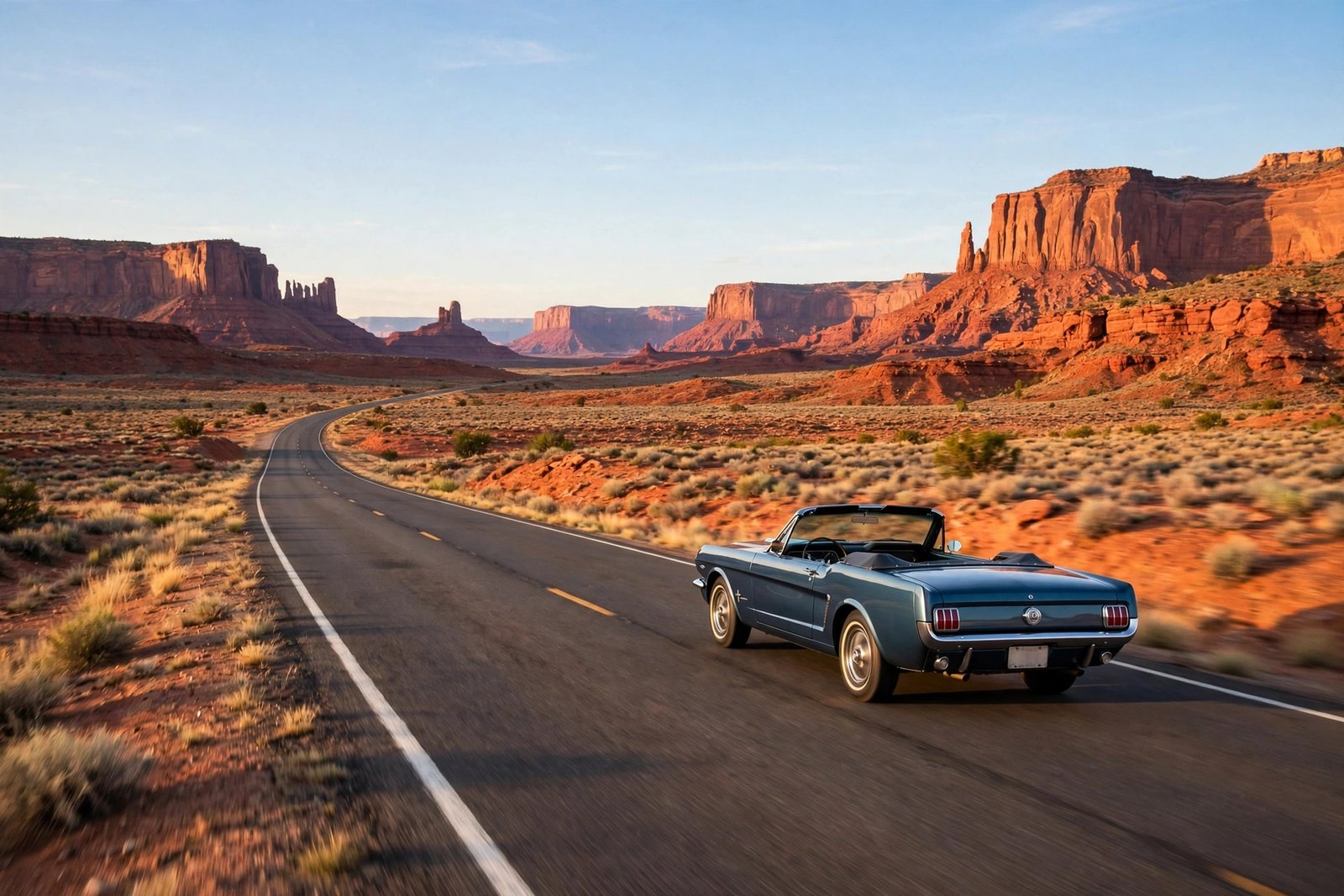
There is a particular kind of freedom that only exists behind the wheel of a car on an open American highway. It is the freedom to stop whenever something catches your eye, to take the long way on purpose, and to let the journey matter as much as the destination. No other country has turned driving into a way of life quite like the United States, and no other pastime captures the American spirit of independence the way the road trip does.
The American road trip is more than a way to get from one place to another. Over the past century it has grown into a full culture of its own, with its own food, its own architecture, its own music, and its own rituals. It gave rise to the motel and the diner, the drive-in movie and the roadside attraction, and it turned ordinary highways into legends. This is the story of how driving became one of America’s favorite ways to live, explore, and dream.
Before the Freeway: How America Learned to Drive for Fun
Long before the interstate highways existed, Americans were already falling in love with the automobile. In the early decades of the twentieth century, cars stopped being a luxury for the wealthy and became something ordinary families could own. As roads improved, people began to realize that a car was not just a machine for running errands. It was a ticket to see the country on their own terms, without a train schedule or a timetable telling them where to go.
Those early drivers were pioneers in every sense. The first road trippers often camped beside the road in tents, cooked over open fires, and fixed their own flat tires with hand tools. They called it autocamping, and it was equal parts adventure and inconvenience. There were few gas stations, few paved roads, and almost no places built to serve travelers. But the hardship was part of the appeal. Sleeping under the stars beside a dirt road felt like freedom to a generation that had grown up riding trains and trolleys.
As more families took to the road, small businesses sprang up to serve them. Gas stations, repair shops, cafes, and campgrounds appeared along the busiest routes. Towns that had once been quiet farming communities found themselves welcoming a steady stream of strangers in cars. The road trip was becoming an industry, and the open road was becoming a shared American experience.
The Spirit of the Mother Road
No road captures the romance of the American road trip better than U.S. Route 66. Established on November 11, 1926, the highway ran from Chicago, Illinois, to Santa Monica, California, passing through Missouri, Kansas, Oklahoma, Texas, New Mexico, and Arizona along the way. It was one of the original highways in the United States Numbered Highway System, and it quickly became known by affectionate nicknames like the Mother Road and America’s Main Street.
Route 66 was never the fastest way across the country, and that was exactly the point. It ran straight through the middle of small towns, past family diners and filling stations, and it carried everyone from Dust Bowl families heading west in the 1930s to postwar families on summer vacation. The road became a symbol of hope and movement, and it inspired a famous song, books, and movies that still shape how the world imagines America.
The highway was fully paved by 1938, and for decades it was the main artery of cross-country travel. But as the new interstate highways were built, traffic slowly drained away from the old two-lane road. Route 66 was officially removed from the United States Highway System in 1985. Yet the road never really died. Preservation groups saved its neon signs and old buildings, surviving stretches were marked as Historic Route 66, and travelers still follow the old route today. In 2026, communities along the highway are marking the road’s centennial, a century after it was first established.
Motels and Motor Courts: Sleeping on the Road
Every road trip needs a place to sleep, and the motel was invented to answer that need. The first campgrounds for automobile tourists were built in the late 1910s, simple municipal sites where travelers pitched their own tents. By the 1920s, landowners along busy highways began building small cabins for travelers, and these tourist courts became the ancestors of the modern motel.
The word motel itself comes from the Milestone Mo-Tel, built in 1925 in San Luis Obispo, California, on U.S. Highway 101. The name was a blend of motor and hotel, and it described a new kind of lodging perfectly: a place built for drivers, where you could park your car right outside your room door. The term caught on, and by the 1940s motor courts with rooms under a single roofline were appearing all along America’s highways.
Motels peaked in popularity in the 1960s, when rising car travel made the road trip a national habit. Their neon signs became landmarks in themselves, glowing promises of a clean bed, a hot shower, and a swimming pool. Some were shaped like teepees or castles, others boasted names that promised rest and adventure. Even as chain hotels at interstate exits took over much of the business, the classic roadside motel survived as a beloved piece of Americana, and many historic motels are now listed on the National Register of Historic Places.
Diners and Drive-Ins: Eating on the Move
Food is at the heart of road trip culture, and the roadside diner is its temple. Diners grew up along the highways to feed hungry travelers quickly and cheaply, serving coffee, pie, burgers, and breakfast all day long. The best diners felt like a second home, with chrome counters, vinyl stools, and a waitress who called everyone hon. To this day, pulling into a small-town diner for a slice of pie is one of the great pleasures of the open road.
The drive-in movie theater took the idea of eating and watching from your car and turned it into a night out. The first drive-in opened on June 6, 1933, in Camden, New Jersey, the invention of Richard Hollingshead. Moviegoers paid 25 cents per car, plus 25 cents per person, to watch the British comedy Wives Beware from the comfort of their own automobiles. Hollingshead had patented a ramp system that let every car see the screen, and the idea spread quickly. At their peak, drive-ins numbered more than 4,000 across the country.
Drive-ins were more than movie theaters. They were date spots, family outings, and teenage hangouts all rolled into one. Kids in pajamas watched cartoons from the back seat while parents enjoyed a rare evening out. Theaters faded as home video and multiplexes arrived, but a few hundred still operate today, and a summer night at the drive-in remains one of the most nostalgic experiences in American life.
Roadside Attractions: The Art of the Stop
Part of the joy of a road trip is the stop you never planned. America is dotted with roadside attractions built to catch the eye of a passing driver: giant statues, mystery spots, quirky museums, and signs promising the world’s largest ball of twine or the best pie in the state. These attractions were born from a simple idea. If you could get a driver to slow down, you could sell them a meal, a souvenir, or a night in your motel.
Some roadside attractions grew into genuine landmarks. The giant blue whale in Catoosa, Oklahoma, the Cadillac Ranch in Amarillo, Texas, and the countless dinosaur parks and ghost towns along the old highways all started as ways to lure travelers off the road. They worked because they understood something essential about road trip culture: the best trips are the ones with room for surprises.
Roadside attractions also reveal the playful side of the American character. They are unpretentious, homemade, and proud of it. In an age when travel is increasingly planned down to the minute, these strange and wonderful stops remind us that wandering is a legitimate way to travel, and that sometimes the detour is the whole point.
The Interstate Changed Everything
The biggest turning point in road trip history came on June 29, 1956, when President Dwight D. Eisenhower signed the Federal-Aid Highway Act of 1956. The law launched the Interstate Highway System, a network of high-speed, limited-access highways built to national standards. It increased the authorized system to 41,000 miles, set the federal share of construction costs at 90 percent, and created the Highway Trust Fund to pay for it all.
The interstates made long-distance driving faster, safer, and far more comfortable. A trip that once took days of winding two-lane driving could now be done in hours on a divided highway. Families could reach vacation destinations they had only dreamed of, and trucking and commerce were transformed. The Federal Highway Administration notes that the Interstate System became the backbone of transportation and commerce in the United States.
But speed came with a cost. The new highways bypassed the small towns that had thrived on roadside traffic, and many diners, motels, and attractions withered as cars sped past on the freeway. Route 66 itself was gradually replaced by interstates like I-40, I-55, and I-44. The trade-off defined the modern road trip. Interstates get you there fast, but the old highways are where the stories live. Many travelers today mix the two, using the interstate to cover ground and the back roads to find the soul of a place.
National Parks and the Great American Road Trip
No road trip tradition is more beloved than the journey to America’s national parks. Yellowstone became the world’s first national park in 1872, and the National Park Service was created in 1916 to care for these treasures. Today there are 63 officially designated national parks in the United States, from Acadia in Maine to Denali in Alaska, and they are among the most popular road trip destinations in the country.
The national park road trip has its own rituals. Families load up the car, drive for days, and collect stamps in their park passport books. They watch the sun rise over the Grand Canyon, hike among the giant sequoias, and spot bison in Yellowstone. The parks reward slow travel, and the roads that lead to them, through deserts, mountains, and forests, are often as beautiful as the destinations themselves.
For many Americans, a national park trip is a rite of passage, a way to show children the natural wonders of their own country. It connects the road trip to something deeper than sightseeing: a sense of shared heritage and a reminder that some of the most beautiful places on earth are public land, open to everyone with a car and a sense of curiosity.
The Modern Road Trip: Same Spirit, New Rules
Today’s road trips look different from the ones of the past, but the spirit is the same. GPS has replaced the folded paper map, streaming music has replaced the radio dial, and electric vehicles are beginning to share the highway with gas-powered cars. Travelers book motels from their phones and find roadside attractions through apps instead of billboards. Yet the core of the experience has not changed at all.
The modern road trip is also more diverse than ever. Van life has turned the road into a full-time home for a new generation of travelers. Food lovers plan entire trips around barbecue joints and taco stands. Photographers chase golden light across the desert, and families still pile into the car for the summer vacation, arguing over music and counting license plates.
What has not changed is the feeling. The road trip remains the most American form of travel because it is the most free. You choose the route, you set the pace, and you decide when to stop. In a world that moves faster every year, the open road still offers something rare: time, space, and the chance to discover a country one mile at a time.
If you are planning your first big drive, start simple. Pick one region, give yourself more days than you think you need, and leave room in the schedule for the unexpected. Book the first night’s stay in advance, then let the road decide the rest. Pack snacks, a paper map as a backup, and a playlist everyone can agree on. The best road trips are rarely the most efficient ones. They are the ones where you took the exit you had not planned, found a diner you will never forget, and arrived home with stories instead of just photographs.
Related reading
If you enjoyed this look at life on the open road, keep exploring: Route 66 facts and the story of the Mother Road, the history of American diner culture, and a guide to America’s 63 national parks.
Frequently Asked Questions
When was Route 66 established?
Route 66 was established on November 11, 1926, running from Chicago, Illinois, to Santa Monica, California. It was removed from the United States Highway System in 1985, but surviving sections are preserved and marked as Historic Route 66.
What is the oldest national park in the United States?
Yellowstone, established in 1872, was the first national park in the United States and the world. The National Park Service, which manages the parks today, was created in 1916.
When did the first drive-in movie theater open?
The first drive-in theater opened on June 6, 1933, in Camden, New Jersey. It was created by Richard Hollingshead, who charged 25 cents per car plus 25 cents per person for admission.
What law created the Interstate Highway System?
President Dwight D. Eisenhower signed the Federal-Aid Highway Act of 1956 on June 29, 1956. The law authorized 41,000 miles of interstate highways, with the federal government paying 90 percent of construction costs.
Where does the word motel come from?
The word motel is a blend of motor and hotel. It comes from the Milestone Mo-Tel, built in 1925 in San Luis Obispo, California, which was the first lodging to use the term motel as its name.