
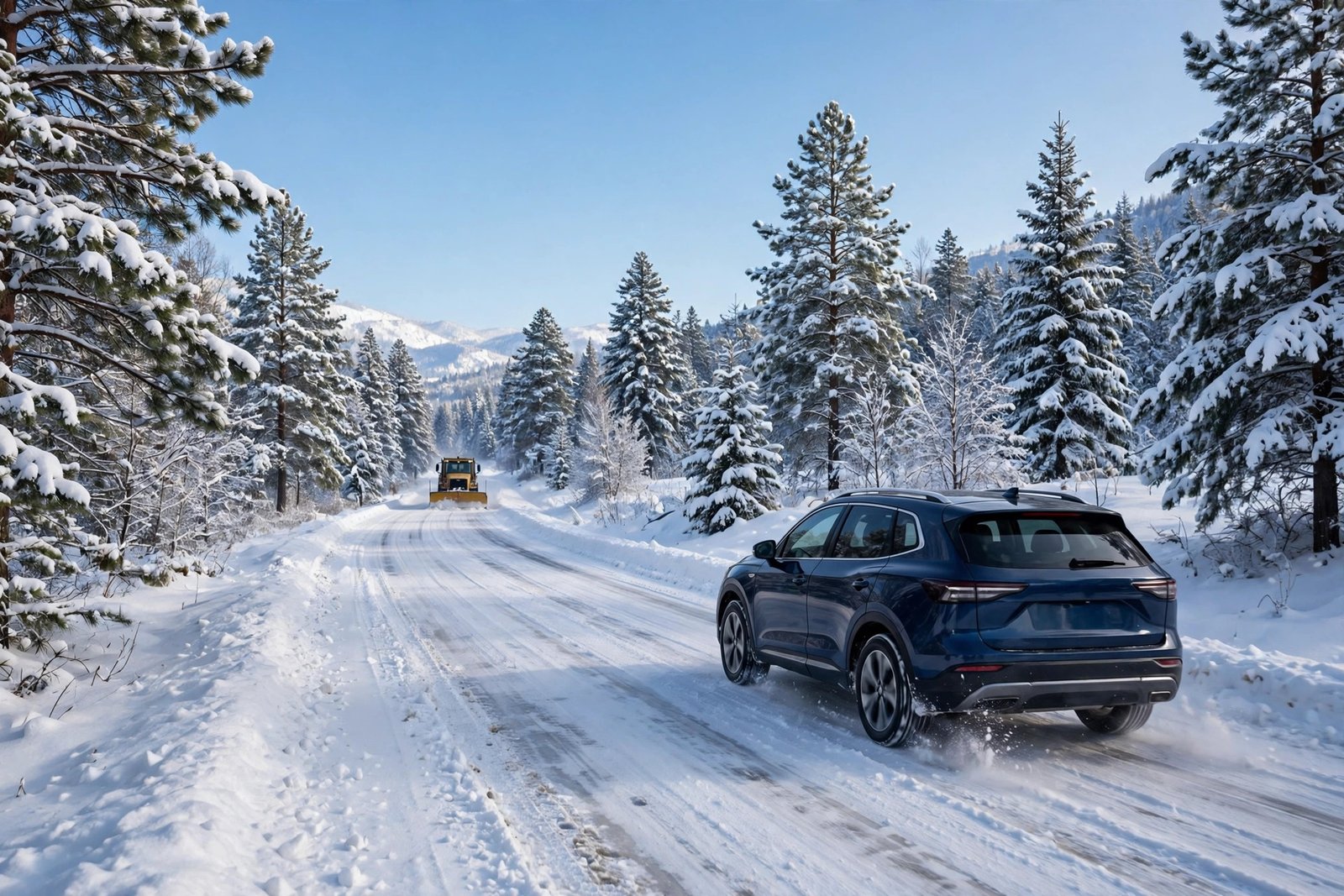
Winter driving in the United States is a different skill from driving the rest of the year. The same road you drive every day can turn treacherous overnight when snow, sleet, or freezing rain arrives. The National Highway Traffic Safety Administration puts it plainly: it is harder to control or stop a vehicle on a slick or snow-covered surface, so slow down and leave more room. In 2021, NHTSA reported an estimated 121,156 police-reported crashes that occurred when snow or sleet conditions were present at the time of the crash. Most winter crashes are preventable, and the habits that prevent them are simple.
This guide pulls together the official advice from NHTSA, AAA, and state transportation departments into one practical checklist: getting your car ready, how to drive when the roads are bad, what to do when your car slides, and what to pack in case you get stuck.
Before you leave: check conditions and know when to stay home
The safest winter drive is the one you do not take. That is the first piece of advice from both AAA and NHTSA. Before any trip in winter weather, check the forecast and the road conditions for your whole route, not just your starting point. In most states, you can call 511 or check the state’s 511 website for current road conditions and closures. The Minnesota Department of Transportation, for example, advises drivers to get current conditions by calling 511 or visiting 511mn.org before getting in the vehicle.
If a travel advisory says it is not safe to drive, do not drive. Give yourself extra travel time, and if the weather gets worse while you are out, change your plans rather than pushing through. Tell someone where you are going and when you expect to arrive.
Get your car ready before the first storm
Winter car care is mostly about the parts of your car that cold weather punishes first: the tires, the battery, the wipers, and the fluids.
Tires matter most. NHTSA advises checking tire pressure at least once a month and before long trips, when the tires are cold, meaning they have not been driven on for at least three hours. AAA notes that tire pressure typically falls by about one PSI for every 10 degrees Fahrenheit the temperature drops. Inflate each tire to the pressure recommended by your vehicle’s manufacturer, listed in your owner’s manual and on a label on the driver’s side door frame. Do not inflate to the pressure listed on the tire itself. That number is the maximum the tire can hold, not the recommended pressure.
Tread depth matters just as much. NHTSA’s minimum is 2/32 of an inch on all tires, including the spare. AAA recommends tread at least 4/32 of an inch deep for the best stopping power, and suggests the quarter test: insert a quarter into the tread groove, and if the tread does not reach the top of Washington’s head, it is time for new tires. If you live somewhere with regular heavy snow, consider dedicated snow tires, and check NHTSA’s tire safety ratings before you buy.
Battery. Cold weather cuts battery power, and engines need more of it to start. AAA notes that at 0 degrees Fahrenheit, a good battery has about 35 percent less starting power than in warm weather, and batteries three to five years old have much less starting power in cold conditions. Have a mechanic test your battery and charging system before winter.
Wipers, fluid, and lights. Replace wiper blades that leave streaks, and fill the washer fluid reservoir with a winter formula that will not freeze. Check that all your lights work, because in winter your lights are as much about being seen as about seeing. Clear snow and ice from the whole car before you drive, including the hood, roof, trunk, and lights. Snow left on the roof can slide forward and block your windshield.
Fluids and fuel. Top off your engine oil, coolant, and brake fluid, and use coolant that provides antifreeze protection down to the lowest temperatures you are likely to encounter. Keep your gas tank at least half full through the winter, which helps prevent fuel lines from freezing and gives you a margin of safety if you are delayed with the engine running to stay warm.
Slow down and leave much more space
If there is one rule that matters more than any other on a snowy road, it is this: slow down. Speed limits are set for dry roads in good weather. On snow and ice, the safe speed is well below the posted limit, and most snow and ice related crashes happen because a vehicle is traveling too fast for the conditions, according to AAA. Cut your speed early, before a turn or an intersection, not while you are in it.
Following distance matters just as much as speed. On a dry road, the usual guidance is three to four seconds behind the vehicle ahead. On snow and ice, AAA advises increasing that to eight to ten seconds, and some AAA guidance puts the minimum at five to six seconds. To count it, pick a fixed point such as a road sign, and count the seconds until you reach it after the car ahead passes it.
Stopping distances on ice are dramatically longer than on dry pavement. Brake early, brake gently, and keep a generous gap, so that you never need a sudden stop in the first place.
Turn off cruise control on any slippery surface. Cruise control cannot feel the road, and if your car hits a slick patch with cruise control engaged, the system may keep the throttle on while a wheel loses traction. Accelerate gently, brake gently, and steer smoothly. Sudden jabs break traction, and once traction is gone, you are a passenger.
How to drive on snow and ice
Driving on snow is a matter of rhythm: slow, smooth, and patient. Accelerate slowly from a stop, and if your wheels start to spin, ease off the gas rather than pressing harder. If you are starting on a hill, build a little momentum on the flat ground before the climb, and do not stop halfway up if you can avoid it. Going down a hill, slow down before the descent and use a low gear to let the engine help control your speed.
Turns deserve extra care. Slow down before you enter a turn, not while you are in it, and steer smoothly through it. Braking in the middle of a turn on a slippery road is one of the easiest ways to lose control. Avoid unnecessary lane changes, because each change takes you across the ruts and ridges where traction is worst.
Be especially careful on bridges and overpasses. They freeze before other surfaces because cold air circulates above and below them, and the road leading up to a bridge can look fine while the bridge itself is icy. Slow down before every bridge when temperatures are near freezing, and cross at a steady, reduced speed. The same caution applies to shaded stretches of road, where ice can linger after the sun has melted it elsewhere.
Black ice: the danger you cannot see
Black ice is one of the most feared hazards in winter driving. It is not black at all. It is a paper-thin, nearly invisible glaze of transparent ice that forms over asphalt, letting the dark pavement show through, so the road looks wet rather than frozen. It forms most often overnight and in the early morning, and it is most common on bridges, overpasses, and shaded roads.
There are a few clues that can warn you. If the road looks wet and shiny but the tires of the vehicles ahead are throwing no spray at all, you may be driving on ice rather than water. If you do hit black ice, stay calm, ease off the gas, and do not slam on the brakes. Hard braking on ice turns a slide into a spin. Steer gently in the direction you want the car to go, and wait for the tires to find grip again. The best defense is prevention: slow down before a bridge or a shaded stretch, and if conditions are right for black ice and you do not need to be out, stay home.
What to do when your car starts to skid
Skids are frightening, but they are recoverable if you know what to do. The first rule is to stay calm. Panic is what turns a small slide into a crash.
If your rear wheels lose grip and the back of the car starts to slide sideways, ease your foot off the gas and steer in the direction you want the front of the car to go. This is the advice from the Minnesota Department of Public Safety and from NHTSA. Do not overcorrect, and do not jerk the wheel. Small, smooth corrections are what bring a car back under control.
Your brakes matter too. If your vehicle has antilock brakes, known as ABS, NHTSA says to apply firm, continuous pressure to the brake pedal and hold it. The pedal may pulse or vibrate under your foot, and that is normal. Do not pump ABS brakes. If your vehicle does not have ABS, which is rare in modern cars, pump the brakes gently if you feel the wheels starting to lock up.
Snowplows: give them room to work
Snowplows are your friends in winter, but they are large, slow, and hard to see around. NHTSA advises drivers not to crowd a snowplow or travel beside the truck. The Minnesota Department of Transportation puts a number on it: stay back at least 10 car lengths behind the plow, and never drive into a snow cloud. The road behind a snowplow is the safest road available, because it has just been cleared. Passing a plow can be dangerous, since wing plows extend several feet beyond the truck and the plow may turn with little warning. The same courtesy applies to tow trucks and emergency vehicles: slow down and move over for flashing lights.
Pack a winter emergency kit
Even a well-prepared driver can get stuck, whether in a snowdrift, a traffic jam, or a breakdown in freezing weather. A winter emergency kit turns a bad situation into a manageable one. NHTSA and AAA agree on the essentials, and most of them are things you probably already own.
- Snow removal and traction: an ice scraper, a snow brush or broom, a small shovel, and a bag of sand, salt, or non-clumping cat litter to spread under the drive wheels if you get stuck.
- Safety and light: jumper cables, a flashlight with extra batteries, reflective triangles, road flares or emergency markers, and a fully charged phone with a car charger.
- Warmth: blankets, warm clothing, hats, and gloves for every passenger, since a car that will not start cannot keep you warm for long.
- Food and water: bottled water and non-perishable snacks for everyone in the car, including pets.
- First aid and medication: a first aid kit and any personal medications you might need if you are delayed for hours.
- Distress signal: a brightly colored cloth or red bandana to tie to your antenna or hang from a window, so rescuers can spot you.
If you get stuck or stranded
If your car gets stuck in snow, straighten the wheels and accelerate slowly. Spinning the tires fast only digs you in deeper. Spread sand or cat litter under the drive wheels for traction, and clear snow away from the wheels and the exhaust pipe. If you are not making progress after a few tries, stop and call for help.
If you are stranded and cannot drive on, stay with your vehicle. Your car provides shelter, it is easier for rescuers to find than a person on foot, and walking for help in a storm is dangerous. Turn on your hazard lights, tie a bright cloth to the antenna, and call 911 if you need help. Keep your phone on so you can stay in touch with emergency responders, and turn on the interior light at night so rescuers can find you.
Be careful about carbon monoxide. Clear snow from your exhaust pipe before running the engine, and run the engine only sporadically, just long enough to stay warm. Never run a vehicle for a long period with the windows up or in an enclosed space. Crack a window for ventilation.
Sources for the guidance in this article: NHTSA’s winter driving tips, AAA’s tips for safe winter driving, AAA’s tips for driving in freezing rain and ice, the Minnesota Department of Transportation’s winter driving tips, the Minnesota Department of Public Safety’s winter driving reminders, NHTSA’s winter driving guidance via the U.S. Army.
Related reading
- Winterize Your Home: November Checklist USA
- Thanksgiving Travel Forecast 2026: AAA 81 Million
- Thanksgiving Turkey Food Safety 2026 Guide
FAQ
How much should I slow down in snow?
There is no single safe speed for snow. The rule from NHTSA and AAA is to drive well below the posted speed limit and to cut your speed early, before turns and intersections.
How much following distance do I need on icy roads?
On dry roads, three to four seconds behind the vehicle ahead is the usual guidance. On snow and ice, AAA advises increasing that to eight to ten seconds, and some AAA guidance puts the minimum at five to six seconds. Count it by picking a fixed point, such as a sign, and timing how long it takes you to reach it after the car ahead passes it.
What should I do if my car starts to skid?
Stay calm, ease your foot off the gas, and steer in the direction you want the front of the car to go. Do not slam on the brakes, and do not jerk the wheel. If your car has antilock brakes, apply firm, continuous pressure to the brake pedal and hold it. The pedal may pulse, and that is normal.
Should I use cruise control in winter?
No. Do not use cruise control on snow-packed or icy roads, or on any slippery surface. Cruise control cannot feel the road, and if your car hits a slick patch with cruise control engaged, the system may keep the throttle on while a wheel loses traction.
What should I keep in a winter emergency kit?
An ice scraper, snow brush, and small shovel, a bag of sand or cat litter for traction, jumper cables, a flashlight with extra batteries, reflective triangles or flares, a first aid kit, blankets and warm clothing, bottled water and non-perishable food, and a phone charger. Keep the kit in the car all winter, and check it at the start of the season.