
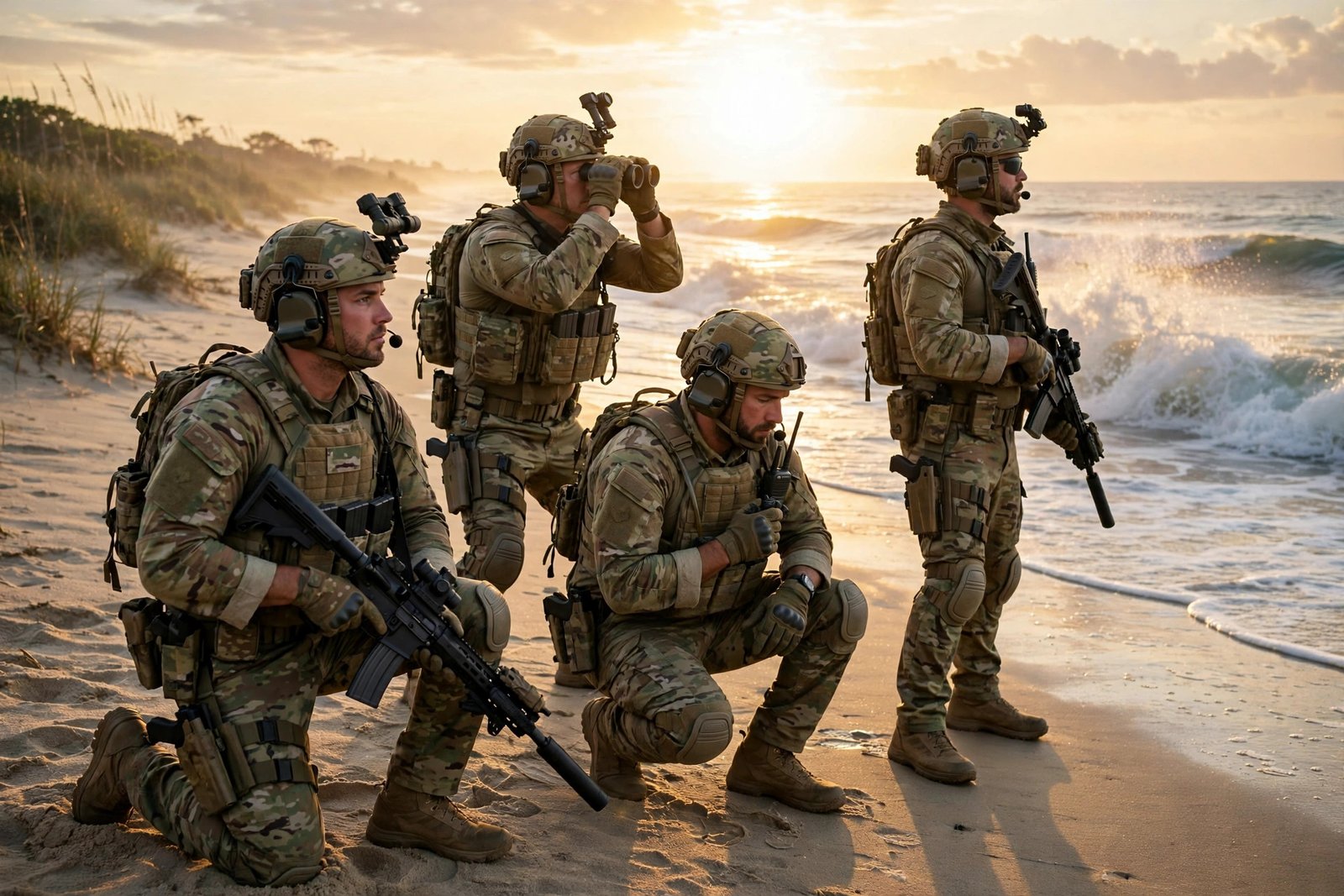
Few military units carry the weight of a single word the way the Navy SEALs do. Say the name in almost any room in America and people picture the same thing: elite operators moving silently through the dark, doing jobs that most of us only read about afterward. The reputation is real, and it was earned the hard way, over eight decades of war and missions that never made the news. The story begins on the beaches of World War II, runs through the jungles of Vietnam, and continues today wherever the United States needs a small team to do an impossible job. This is how America’s most famous special forces came to be, what it actually takes to earn the Trident, and what the SEALs do now.
The Frogmen of World War II
The SEALs were not born in a single ceremony. They grew out of a problem the Navy faced in the early years of World War II: nobody knew what the beaches looked like where American troops were about to land. Amphibious landings were the great gamble of the war, and sending thousands of men ashore blind was a recipe for disaster. The Navy needed swimmers who could slip in ahead of the fleet, study the beach, clear obstacles, and guide the landing craft in. In August 1942, selected Army and Navy personnel assembled at the Amphibious Training Base at Little Creek, Virginia, to begin Amphibious Scouts and Raiders training. Their mission was simple to describe and brutally hard to do: reconnoiter the objective beach, hold a position on it before the landing, and guide the assault waves ashore. The first group included Phil H. Bucklew, later known as the “Father of Naval Special Warfare.” That group saw combat in November 1942 during Operation Torch, the Allied landings in North Africa.
At the same time, another lineage was forming. In September 1942, seventeen Navy salvage men arrived at Little Creek for a one-week course in demolitions, explosive cable cutting, and commando raiding. From that small seed grew the Naval Combat Demolition Units, the NCDUs. Under Lieutenant Commander Draper Kauffman, NCDU training was established at Fort Pierce, Florida, in June 1943. By April 1944, thirty-four NCDUs had deployed to England to prepare for Operation Overlord, the Normandy landings. On D-Day itself, NCDU men went in with the first waves to blow gaps in the obstacles the Germans had planted on the beaches, working under direct fire. NCDUs also served in the Pacific, clearing boat channels after landings from Biak to Borneo, and in southern France in August 1944.
Out of the NCDUs came the Underwater Demolition Teams, the UDTs, the famous “frogmen.” The first UDTs were formed in late 1943, and they served in nearly every major Pacific landing of the war. They swam in at dawn, sometimes under fire, to map reefs, measure water depth, and blast channels through coral so landing craft could get through. The Office of Strategic Services also contributed swimmers, its Operational Swimmers joining UDT-10 in 1944. When the war ended, the UDTs stayed. They served in the Korean War, where they added inland raids against railroads, bridges, and tunnels to their work, and they kept the hard-won skills of the frogmen alive through the 1950s.
From UDTs to SEALs: Kennedy’s 1962 Order
By the late 1950s, the world had changed. The Cold War was turning into a series of small, shadowy conflicts, and the Navy’s senior leaders began to ask whether the UDTs could be expanded into something more. In 1958, Chief of Naval Operations Admiral Arleigh Burke suggested developing a covert capability. In September 1960, he directed a study of the Navy’s options for unconventional warfare, and an Unconventional Activities Working Group was formally established. The conclusion was that the Underwater Demolition Teams were the right foundation for a force that could fight on land and in the air as well as at sea.
President John F. Kennedy gave the idea its final push. Shortly after taking office, he directed the military to build a much larger capacity for unconventional warfare, telling Congress that he wanted forces oriented toward “non-nuclear war, paramilitary operations, and sub-limited or unconventional wars.” The Navy answered in January 1962 by commissioning two new teams: SEAL Team One on the West Coast, based at Coronado, California, and SEAL Team Two on the East Coast, based at Little Creek, Virginia. The first commanding officer of SEAL Team One was Captain David Del Giudice, who took command on January 1, 1962, and Lieutenant John Callahan took command of SEAL Team Two on January 6, 1962. The teams were drawn largely from UDT veterans, but their mission was broader than anything the frogmen had done before. As the U.S. Naval Institute recounts, the new teams focused on commando-style raiding launched from the sea or through the air, and the training that forged them evolved directly from the UDT tradition.
The name itself tells the story. SEAL is a contraction of Sea, Air, and Land, the three environments in which the teams were expected to operate. The acronym was first used by the Navy’s Unconventional Activities Committee, whose recommendations led to the teams’ formation. It was a promise as much as a label: wherever the fight was, a SEAL team could get there and work there. The official history published by Naval Special Warfare Command traces today’s operators directly to those World War II predecessors.
Vietnam: The War That Defined the SEALs
The SEALs were created with Cold War contingencies in mind, but it was Vietnam that truly defined them. The first SEALs arrived in South Vietnam in late 1962 as advisers, and SEAL Team One began regular deployments a year later. The war in Vietnam was exactly the kind of conflict the teams had been built for: a grinding guerrilla war fought in rivers, jungles, and villages, where small, fast, self-reliant units mattered more than massed formations. SEAL platoons ran direct-action raids, ambushes, reconnaissance patrols, and riverine operations in the Mekong Delta, often at night and often outnumbered. They worked alongside the South Vietnamese, trained local forces, and gathered intelligence deep in hostile territory.
Vietnam also proved the concept. The war forged the modern identity of the teams: the emphasis on small-unit tactics, on operating with minimal support, on the bond between men in a platoon, and on the idea that a handful of superbly trained operators could achieve results far out of proportion to their numbers. When the war ended, the SEAL teams shrank, but the structure survived, and the lessons of Vietnam shaped everything that came after. The teams that exist today are, in a very direct sense, the children of the Vietnam-era SEALs.
BUD/S and Hell Week: Earning the Trident
Every SEAL begins the same way, as a volunteer who has to survive the hardest training course in the American military. Candidates must first pass a demanding physical screening test, then attend Naval Special Warfare Preparatory School before entering Basic Underwater Demolition/SEAL training, universally known as BUD/S. The course runs about six months at Naval Amphibious Base Coronado in California, and it is divided into three phases: physical conditioning, combat diving, and land warfare. Each phase pushes candidates harder, with timed tests that get more demanding every week.
The most famous part of BUD/S comes in the first phase, in the fourth week. It is called Hell Week, and the name is not an exaggeration. For five and a half days, candidates train almost continuously, with a total of only about four hours of sleep across the entire week. They run more than 200 miles, paddle boats through heavy surf, carry logs as a team, endure long sessions in cold ocean water, and do physical training for more than twenty hours a day. The point is not cruelty for its own sake. Hell Week is designed to find out who can keep thinking, keep working as part of a team, and keep going when the body has nothing left. As Britannica notes, only about a quarter of a typical candidate class completes BUD/S training.
Those who finish BUD/S are not yet SEALs. Graduates go on to SEAL Qualification Training, where they learn advanced skills including parachuting, close-quarters combat, and cold-weather operations, and then they join a team for further training before deploying. Only when the full pipeline is complete does a sailor earn the Special Warfare insignia, the golden Trident, and the title of Navy SEAL.
The pipeline is open to anyone who can meet the standard. In January 2016, the Department of Defense opened all combat roles, including the Navy SEALs, to women, with no separate or lowered standards. Since then, a small number of women have entered the SEAL pipeline, and in recent years women have reached further into the selection process than ever before. As of the latest publicly available information, no woman has yet completed BUD/S, but the door is open and the standard is the same for everyone who walks through it. In 2021, the first female sailor graduated from the naval special warfare pipeline as a special warfare combatant-craft crewman, one of the small-boat operators who insert and extract SEAL teams.
The Modern SEAL Teams and What They Do
Today’s SEALs are part of Naval Special Warfare Command, headquartered in Coronado, California. The force is built around eight numbered SEAL Teams, numbered 1, 2, 3, 4, 5, 7, 8, and 10, along with the Naval Special Warfare Development Group, known as DEVGRU and often still called SEAL Team Six. Each SEAL Team is made up of platoons of about sixteen operators, and each platoon is a self-contained fighting unit.
The mission set is wide. SEALs conduct direct-action raids, special reconnaissance, counterterrorism operations, foreign internal defense, and the training of partner forces around the world. They operate from the sea, from the air, and on land, often in places where a larger force could not go unnoticed. They work in deserts, jungles, mountains, arctic cold, and dense cities. Much of their work is classified, and the public learns about it only years later, if ever.
Some missions do become public, and they have become landmarks in American history. In 2009, SEALs rescued Captain Richard Phillips of the cargo ship Maersk Alabama from Somali pirates, ending a standoff that had gripped the country. SEALs have fought in Afghanistan and Iraq since the first days of those wars, hunting high-value targets, rescuing downed aircrew, and supporting conventional forces in some of the hardest fighting of the conflicts. Their story is on display at the National Navy UDT-SEAL Museum in Fort Pierce, Florida, the only museum dedicated solely to preserving the history of the SEALs and their predecessors, located on the original training grounds of the Navy’s first frogmen.
Operation Neptune Spear: The Raid in Abbottabad
The most famous SEAL mission in history took place on May 2, 2011, when operators from DEVGRU flew into Abbottabad, Pakistan, to kill Osama bin Laden, the founder of al-Qaeda and the mastermind of the September 11 attacks. The operation, code-named Neptune Spear, was led by the CIA and coordinated through Joint Special Operations Command, with about two dozen SEALs flying in aboard two stealth-modified Black Hawk helicopters, supported by the Army’s 160th Special Operations Aviation Regiment. The raid lasted about forty minutes. Bin Laden was killed in the compound, and the SEALs collected a large trove of documents and computer files before flying out. President Barack Obama had authorized the mission days earlier, and he announced bin Laden’s death to the nation that night. Military.com’s account of the operation describes how the team trained for the raid using a full-size replica of the compound, and HISTORY’s timeline lays out the night hour by hour. The mission ended a manhunt that had lasted nearly a decade, and it made the SEALs household names around the world.
Neptune Spear was extraordinary, but in an important sense it was also typical. The skills it demanded, night helicopter infiltration, close-quarters combat in an unfamiliar building, the discipline to collect intelligence under fire and get out clean, were the same skills SEALs train for every day.
Why the SEALs Still Matter
More than sixty years after their founding, the SEALs remain the Navy’s primary special operations force, and their relevance has only grown. The world the United States faces today is full of the small, ambiguous conflicts the SEALs were designed for: counterterrorism, hostage rescue, and crises that need a precise answer rather than a large one. New technologies have changed the tools, from better boats and drones to advanced communications, but the core of the job has not changed since Fort Pierce in 1943.
That is the real history of the Navy SEALs. It is not a single raid or a single hero. It is an unbroken line from the frogmen who cleared the beaches of Normandy to the operators working tonight in places we will not hear about for years.
Related reading
Keep exploring America’s military power and history with these stories from Famus News: US Aircraft Carrier Fleet: America’s Power at Sea, B-52 Stratofortress: America’s Legendary Bomber, and US Space Force Explained: America’s Newest Military Branch.
FAQ
When were the Navy SEALs founded?
The SEAL Teams were commissioned in January 1962, with SEAL Team One on the West Coast and SEAL Team Two on the East Coast. Their roots go back much further, to the Scouts and Raiders, Naval Combat Demolition Units, and Underwater Demolition Teams of World War II.
What does SEAL stand for?
SEAL is a contraction of Sea, Air, and Land, the three environments in which the teams operate. The name was first used by the Navy’s Unconventional Activities Committee in the early 1960s.
How long is Hell Week in BUD/S training?
Hell Week lasts five and a half days. Candidates train almost continuously during that time, getting only about four hours of sleep in total, while running more than 200 miles and enduring cold-water and log-carry evolutions.
Can women become Navy SEALs?
Yes. Since January 2016, all combat roles in the U.S. military, including the Navy SEALs, have been open to women. Female candidates must meet the exact same standards as men, and no woman has yet completed the full BUD/S pipeline, though women have progressed further into selection in recent years.
What was Operation Neptune Spear?
Operation Neptune Spear was the May 2, 2011 raid in which Navy SEALs from DEVGRU, also known as SEAL Team Six, killed Osama bin Laden at his compound in Abbottabad, Pakistan. The mission was led by the CIA and lasted about forty minutes.