
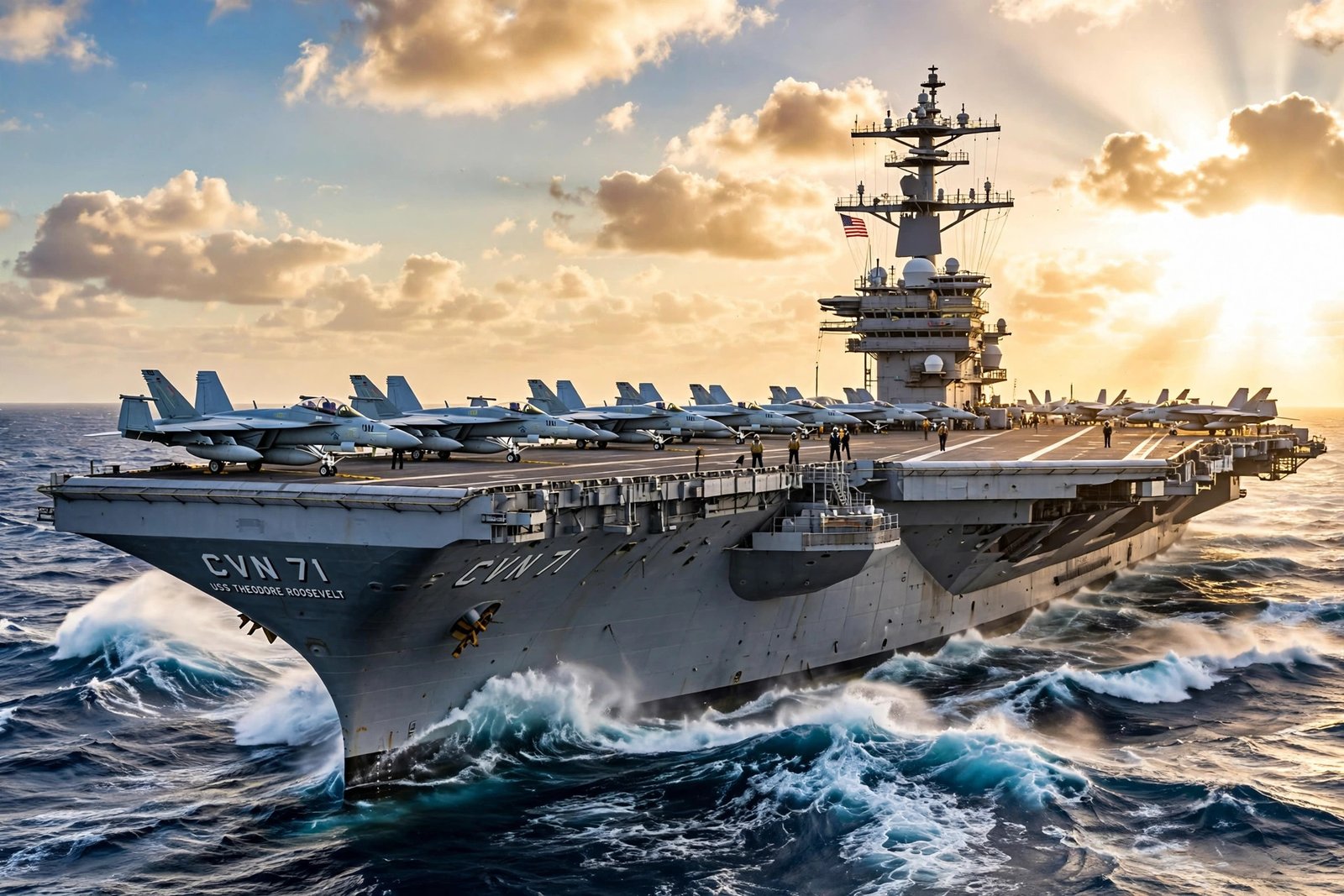
There is no more visible symbol of American power than an aircraft carrier. When a crisis flares anywhere on Earth, one of the first questions in Washington is always the same: where are the carriers? The answer is usually that one is already nearby, or on its way, carrying enough firepower to reshape events without a single soldier setting foot on foreign soil.
As of late 2026, the United States Navy operates 11 nuclear-powered aircraft carriers. That is more than every other navy on the planet combined, and the gap is not close. No other country operates more than three. Each American carrier is essentially a floating airbase, a small city, and a statement of intent all at once, able to sail anywhere in the world and stay there for months without refueling.
Eleven Ships, and a Law That Says So
The number eleven is not an accident, and it is not a round-number coincidence. Federal law requires the Navy to keep at least 11 operational aircraft carriers. Section 8062(b) of Title 10 of the U.S. Code sets that floor, and the Navy counts ships in routine maintenance as operational for the purposes of the law. The requirement has survived decades of budget debates, which tells you how seriously Congress takes it.
According to the Congressional Research Service, the current force consists of 11 nuclear-powered carriers: ten Nimitz-class ships, designated CVN-68 through CVN-77, that entered service between 1975 and 2009, and one Gerald R. Ford-class ship, USS Gerald R. Ford (CVN-78), commissioned on July 22, 2017. The CRS report on the Ford-class program, updated in December 2025, is the most authoritative public accounting of the fleet, and it confirms the same picture that the Navy’s own listings show.
But eleven ships on paper does not mean eleven ships ready to sail at any given moment. The fleet operates on a rough rhythm of thirds: at any time, about a third of the carriers are deployed, about a third are training or working up for deployment, and about a third are in maintenance. A carrier that has just come home from a long deployment needs months of upkeep, and some maintenance periods last years. That is why the number matters so much. With eleven hulls, the Navy can generally keep two or three carriers forward deployed at all times. Drop to eight or nine, and the math starts to break.
Meet the Fleet: The Ten Nimitz-Class Workhorses
The backbone of the fleet is the Nimitz class, ten ships built by Newport News Shipbuilding in Virginia between the late 1960s and the 2000s. The ships, in order, are USS Nimitz, USS Dwight D. Eisenhower, USS Carl Vinson, USS Theodore Roosevelt, USS Abraham Lincoln, USS George Washington, USS John C. Stennis, USS Harry S. Truman, USS Ronald Reagan, and USS George H.W. Bush. Their hull numbers run consecutively from CVN-68 through CVN-77.
Each Nimitz-class carrier is about 1,092 feet long, roughly the length of three football fields laid end to end, with a flight deck 252 feet wide. The Navy’s fact file lists the class at approximately 97,000 tons at full load, while other reference works put the figure above 100,000 long tons. Either way, these are the largest warships ever built until the Ford class arrived.
Power comes from two A4W nuclear reactors driving four shafts, giving the ships speeds of more than 30 knots and, in practical terms, unlimited range. A nuclear carrier does not need to refuel for 20 to 25 years, which means it can cross oceans at full speed without stopping for fuel. That is a freedom no conventionally powered warship enjoys, and it is the reason the Navy has built nothing but nuclear carriers since the last conventional carrier, USS Kitty Hawk, was decommissioned in 2009.
Running one of these ships takes a small town. The Navy counts roughly 3,000 to 3,200 sailors in the ship’s company, plus about 1,500 more in the embarked air wing and several hundred in other roles. All told, around 5,000 people live and work aboard when the ship is deployed.
The Nimitz class has been the face of American naval power for half a century. USS Nimitz herself, the lead ship, was commissioned in May 1975, which means she has been in service for more than 51 years. In 2026 she made a final voyage from the Pacific around South America and through the Strait of Magellan to the East Coast. Her retirement, now set for March 2027, will close a remarkable chapter.
The Ford Class: A New Generation Takes Over
USS Gerald R. Ford (CVN-78) is the first of a new class designed to replace the Nimitz ships one by one. She was procured in fiscal year 2008, commissioned on July 22, 2017, and reached initial operational capability in December 2021. Her first full deployment began in October 2022, and she has since deployed to the Mediterranean, the Caribbean, and the Red Sea.
The Ford class keeps the basic Nimitz hull shape but changes almost everything under the skin. The most talked-about change is the Electromagnetic Aircraft Launch System, known as EMALS, which replaces the steam catapults that have launched naval aircraft since the 1950s. Instead of a burst of steam, EMALS uses a linear electric motor, the same kind of technology behind high-speed maglev trains, to accelerate aircraft smoothly off the deck. It puts less stress on airframes, can launch lighter aircraft like drones that steam catapults would tear apart, and can be fine-tuned for each aircraft type.
On the landing side, the Advanced Arresting Gear replaces the old hydraulic braking system with electronically controlled braking that adjusts in real time as an aircraft catches the wire. Together, EMALS and the arresting gear are designed to let the Ford class generate about 25 percent more sorties, meaning launches and recoveries, than a Nimitz-class ship.
The promise was tested in early 2026. In February, the Ford conducted a stress test of its launch and recovery systems in the Caribbean, and Chief of Naval Operations Adm. Daryl Caudle told reporters at the Tailhook Symposium that the ship generated sortie rates between 120 and 130 percent of the Nimitz class. For comparison, the Pentagon’s testing office puts the Nimitz-class rate at about 120 launches and recoveries in a 12-hour day of flight operations, with a surge capability of 240 sorties over 24 hours. On those numbers, the Ford was producing roughly 160 sorties in the same 12-hour period.
The new class also needs fewer sailors. The Ford is designed to operate with several hundred fewer crew members than a Nimitz-class ship, thanks to automation, a redesigned island, and advanced weapons elevators that move bombs and missiles from the magazines to the flight deck far faster than the old systems. The Congressional Research Service estimates the design cuts about $4 billion in operating and support costs over each ship’s 50-year life compared with the Nimitz class.
None of this came cheap or easy. The Ford’s final procurement cost was about $13.3 billion, according to the Congressional Research Service, and the ship’s early years were marked by reliability problems with EMALS, the arresting gear, and the weapons elevators. Those growing pains are now largely behind her, and the Navy is pressing ahead with the rest of the class.
A Floating Airbase: What a Carrier Actually Carries
What makes a carrier different from every other warship is the air wing. A typical embarked carrier air wing flies around 60 aircraft, though the ships can carry more. The mix usually includes three or four squadrons of F/A-18E and F/A-18F Super Hornet strike fighters, a squadron of F-35C Lightning II stealth fighters, EA-18G Growler electronic warfare jets, E-2D Hawkeye airborne early warning aircraft with their distinctive radar domes, and MH-60 Seahawk helicopters for anti-submarine work and search and rescue. Logistics flights are handled by C-2 Greyhounds, which are being replaced by CMV-22 Osprey tilt-rotor aircraft.
The flight deck is where the magic happens, and it is one of the most dangerous workplaces on Earth. Launching and recovering aircraft at the same time, day and night, in all weather, requires choreography of a kind found nowhere else. Deck crews wear color-coded jerseys so everyone can tell at a glance who does what: yellow for aircraft directors, green for catapult and arresting gear crews, red for ordnance handlers, purple for fuel crews, blue for aircraft handlers, and brown for plane captains. A single mistake can be fatal, and the crews drill constantly to make sure it is not.
Below decks, the ship is a self-contained world. There are hangar bays for aircraft maintenance, machine shops that can fabricate parts at sea, a hospital with operating rooms, a post office, a gym, chapels, and enough food storage to feed 5,000 people for months. The ship makes its own fresh water by desalinating seawater, and its nuclear reactors generate enough electricity to power a small city. In a disaster, a carrier can even provide power and fresh water ashore, which is why carriers are often among the first assets sent to help after hurricanes and earthquakes.
The Carrier Strike Group
A carrier almost never sails alone. She is the centerpiece of a carrier strike group, a formation that typically includes a guided-missile cruiser, several guided-missile destroyers, and sometimes an attack submarine lurking below. The escorts defend the carrier from air, surface, and submarine threats, while the carrier’s aircraft extend the group’s reach hundreds of miles in every direction.
The strike group commander, usually a rear admiral, embarks on the carrier with a staff, turning the ship into a floating headquarters. From the carrier, the admiral can direct air strikes, coordinate with allied forces, and manage a crisis in real time, all while the group moves at more than 30 knots.
The Navy’s carriers are homeported in two main places: Naval Station Norfolk in Virginia on the East Coast, and Naval Air Station North Island in San Diego on the West Coast. One carrier, USS George Washington, is forward-deployed to Fleet Activities Yokosuka in Japan, the Navy’s only carrier permanently based overseas. That ship is America’s on-call presence in the Western Pacific, able to respond to events in Asia far faster than a carrier sailing from California.
Why Carriers Matter to American Power
Carriers matter for a simple reason: they let the United States bring serious military power to bear anywhere in the world without asking anyone’s permission. A carrier strike group in international waters needs no host nation’s approval, no overflight rights, and no airbase on foreign soil. It is sovereign American territory that moves.
That matters in a crisis. When a conflict erupts or an ally is threatened, a carrier can arrive off the coast within days and immediately begin flying missions, whether that means deterring an aggressor, protecting shipping, striking targets ashore, or evacuating American citizens. The mere presence of a carrier can change the calculations of everyone involved, which is why their movements are watched so closely around the world.
Carriers also matter because they are the backbone of American alliances. When a carrier visits a partner nation’s port or exercises with allied navies, it is a tangible demonstration that the United States will show up.
And then there is the simple arithmetic of competition. China is building carriers of its own, including the Fujian, which uses an electromagnetic catapult similar to EMALS. Russia operates one aging carrier, and other nations operate a handful of smaller ships. But no other navy comes close to eleven nuclear-powered supercarriers, each carrying an air wing larger than most countries’ entire air forces. That gap is the product of decades of investment, and it is not one a rival can close quickly.
The Handoff: Nimitz Retires, Kennedy Arrives
The fleet is in the middle of a generational handoff. USS Nimitz was originally scheduled to retire in 2026, but in March of that year the Navy extended her service to March 2027 so the fleet would not drop to ten ships before her replacement arrived. That replacement is USS John F. Kennedy (CVN-79), the second Ford-class ship, which reached preliminary acceptance in September 2026 and is due to be delivered to the Navy in March 2027.
Behind the Kennedy, the pipeline continues. USS Enterprise (CVN-80) was procured in fiscal year 2018, USS Doris Miller (CVN-81) in fiscal year 2019, and two more ships, CVN-82 and CVN-83, are planned. The Navy’s long-term goal, laid out in its shipbuilding plans, is a fleet of 381 manned battle force ships, including 12 aircraft carriers. Getting there will take decades, and it will require steady funding from Congress, but the direction is clear.
There is also debate about the future of the carrier itself. Some critics argue that long-range missiles make big carriers vulnerable, and that the Navy should spread its airpower across more, smaller ships. The Navy’s answer is that the carrier has survived every prediction of its obsolescence since the 1940s. The Ford class, with its electrical power reserves and room for unmanned aircraft, is built to keep adapting.
For now, the fleet sails on. Eleven nuclear-powered carriers, each one a floating airbase, a small city, and a statement that American power can arrive anywhere, any time, and stay as long as it takes. That is what the fleet is for, and it is why the number eleven is written into law.
Frequently Asked Questions
How many aircraft carriers does the United States have?
The U.S. Navy has 11 aircraft carriers in commission, all of them nuclear-powered. Ten are Nimitz-class ships and one, USS Gerald R. Ford, is the first of the new Ford class. Federal law requires the Navy to maintain at least 11 operational carriers.
What is the newest U.S. aircraft carrier?
USS Gerald R. Ford (CVN-78), commissioned on July 22, 2017, is the newest carrier in service. The next ship, USS John F. Kennedy (CVN-79), is due for delivery in March 2027.
How many aircraft does a carrier carry?
A typical carrier air wing flies around 60 aircraft, including F/A-18 Super Hornets, F-35C stealth fighters, EA-18G Growlers, E-2D Hawkeye early warning aircraft, and MH-60 Seahawk helicopters. The ships can carry more when the mission requires it.
Why are U.S. carriers nuclear-powered?
Nuclear reactors give carriers effectively unlimited range and let them sail at high speed for weeks without refueling. A nuclear carrier only needs refueling once every 20 to 25 years, and it can generate enough electricity to power all of the ship’s systems.
Which country has the second-largest carrier fleet?
No other navy operates more than three aircraft carriers, and most of those are far smaller than American supercarriers. The United States operates more carriers than the rest of the world combined.