
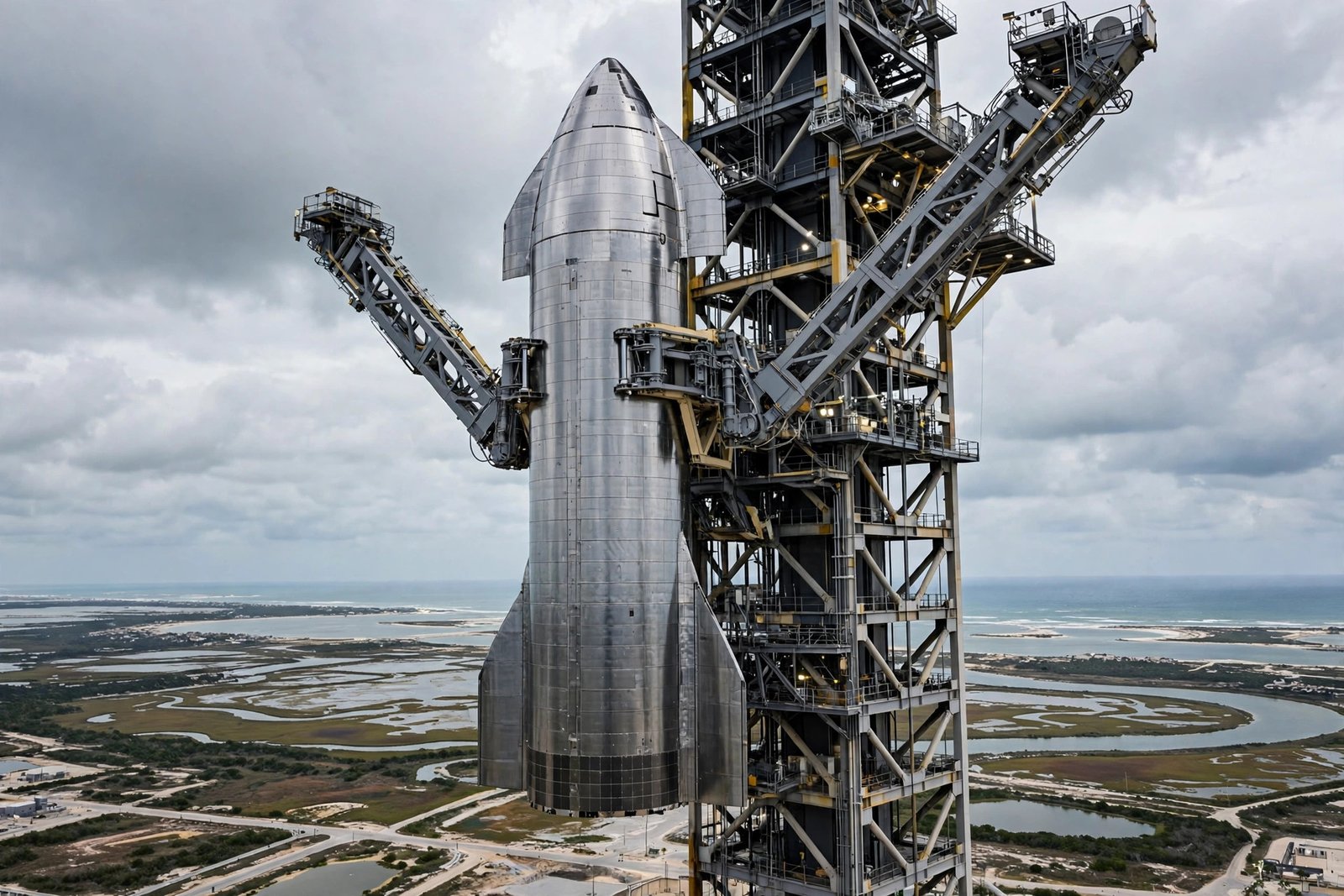
On Saturday afternoon, November 14, 2026, a stainless-steel spacecraft the size of a 17-story building fell out of a cloudy Texas sky, flipped itself upright, fired its engines, and slowed to a hover beside a launch tower. Then two giant mechanical arms closed around it and held it still, hundreds of feet above the ground. SpaceX had just done something no one had ever done before: it had caught a spacecraft returning from orbit.
The moment capped a mission that began the day before, when Starship lifted off from SpaceX’s Starbase facility in South Texas on Friday, November 13, 2026. Over the next 22 and a half hours, the ship circled Earth 14 times, released 26 Starlink satellites, and then came home to the same launch pad it had left. For a company that has spent a decade chasing the dream of a fully reusable rocket, it was the biggest single step yet.
It was not a perfect flight: the Super Heavy booster failed to return and was lost over the Gulf of Mexico. But the ship itself — the part that reaches orbit, survives reentry, and has to come back in one piece — made it home. That is the hard part, and now SpaceX has proved it can be done.
What Happened on Flight 15
Flight 15 was the 15th integrated test flight of the Starship system, and the most ambitious one yet. According to SpaceX’s own account of the flight, Starship lifted off from Pad 2 at Starbase on Friday, November 13, powered by the Super Heavy booster’s 33 Raptor engines. The ascent went as planned, followed by hot-staging — when Starship’s own engines ignite while it is still attached to the booster, pushing the two stages apart.
Minutes after liftoff, the booster turned back, relighting 32 of its planned 33 engines for the boostback burn home. But the burn ended early because of low fuel mass, and the booster’s guidance system triggered an automated abort. Instead of returning to the tower, the booster diverted to an offshore landing spot over the Gulf of Mexico, executed a landing burn while hovering above the water, and was then destroyed when its flight termination system activated. SpaceX said the root cause was under investigation.
The ship, meanwhile, was having a much better day. After a normal ascent burn, Starship reignited a single Raptor engine for an orbital insertion burn and settled into orbit — only the second time a Starship upper stage had reached orbit. Then it deployed all 26 Starlink V3 satellites it was carrying. SpaceX reported contact with every satellite soon after deployment.
Then came the long wait: a coast phase around Earth lasting more than 20 hours while the flight control team monitored the ship’s systems. Only when it had proved itself healthy in orbit did SpaceX commit to bringing it home. A single Raptor engine relit for a deorbit burn about 21 and a half hours into the flight, nudging the ship out of orbit and starting its plunge back through the atmosphere.
The final minutes were the most dramatic. Starship streaked back over the Gulf Coast, flew a swooping maneuver out over the Gulf of Mexico, and lined up on the launch site it had left 22.5 hours earlier. Breaking through the clouds, it fired three Raptor engines for the landing flip and a slow descent, and the tower’s arms closed around the ship and caught it. Mission elapsed time at the catch: 22 hours, 32 minutes, and 34 seconds.
SpaceX announced the result on X: “Mechazilla catches Starship! Congratulations to the entire SpaceX team on this incredible achievement!” At Starbase, crowds along the Gulf Coast erupted as the charred ship hung in the tower’s arms, engines silent. It had survived the round trip.
What Is Starship, Exactly?
Starship is the name SpaceX gives to both the whole rocket system and the upper-stage spacecraft itself, which can get confusing. The bottom half is Super Heavy, a 72-meter-tall first stage powered by 33 Raptor engines burning liquid methane and liquid oxygen. The top half is Starship, a 52-meter-tall ship powered by six Raptor engines — three for the atmosphere and three vacuum-optimized versions for space. Together they stand 124 meters tall, about 407 feet, with a diameter of 9 meters. SpaceX describes the system as the world’s most powerful launch vehicle ever developed, designed to carry more than 100 metric tonnes to orbit in a fully reusable configuration.
Both stages are made largely of stainless steel — unusual for a rocket, but cheap, strong, and better at handling reentry heat than aluminum. That is one reason the ship that came home on Saturday looked so scorched: steel can take the punishment, and it shows the scars.
Starship is designed to be a general-purpose workhorse: the same basic vehicle is meant to launch satellites, carry cargo and eventually up to 100 people on long-duration flights, serve as a lunar lander for NASA’s Artemis program, and one day carry crews to Mars. SpaceX also plans to refuel Starships in orbit with tanker versions of the same ship. None of that works, though, unless the ship can come back and fly again — which is why Saturday’s catch mattered so much.
How Mechazilla Caught a Spacecraft From Orbit
The catch system is officially the launch tower, but almost everyone — SpaceX included — calls it Mechazilla: a steel tower fitted with two enormous mechanical arms, nicknamed the “chopsticks,” that slide up and down on rails. The arms stack Starship onto Super Heavy before launch and catch the stages when they come home.
Catching a booster is one thing — SpaceX had already done that several times, starting in October 2024. A booster separates just a few minutes after liftoff, still relatively close to the launch site and moving far slower than orbital speed. Catching the ship is a different problem entirely: Starship has to survive a full day in space, shed almost all of its orbital speed — roughly 17,000 miles per hour — endure the blazing heat of reentry, and then fly itself back to a tower it left 22 hours earlier.
The return sequence is a choreography of burns and maneuvers. First, the deorbit burn: a single Raptor engine fires for about ten seconds, lowering the ship’s orbit just enough that Earth’s atmosphere can grab it. Then comes entry, the long, glowing descent in which the ship’s heat shield and steel body absorb temperatures that would destroy an ordinary aircraft. Starship steers itself with four aerodynamic flaps, like a skydiver adjusting their body, to aim at the Texas coast.
In the final minute, the ship goes supersonic, then transonic, then subsonic, shedding speed all the way down. It flies a last swooping turn out over the Gulf and back toward the pad, bleeding off energy. Then three Raptor engines ignite for the landing flip — swinging the ship from its belly-first reentry attitude to vertical — and throttle down for a slow, controlled descent. Small fittings near the top of the ship, called catch pins, engage the tower’s arms, which close around them.
There is no landing gear. No legs, no runway, no ocean splashdown. The ship simply hangs in the arms, ready to be lowered onto a mount, inspected, and — in the future SpaceX envisions — refueled and flown again within days. Shifting the landing hardware off the rocket and onto the ground is the whole point: every kilogram of legs saved is a kilogram that can be cargo instead.
The Booster That Didn’t Make It Back
It is worth being honest about what Flight 15 did not achieve. SpaceX had hoped to recover both stages, which would have marked the first full recovery of an orbital launch system. That did not happen — the Super Heavy booster was lost minutes after liftoff, and the reason matters.
According to SpaceX, the booster’s boostback burn ended early because of low fuel mass. With the burn cut short, the booster was not in the right place to come back to the tower, so its guidance system aborted the return and diverted it to a safe offshore spot over the Gulf of Mexico. The booster executed a landing burn over the water before its flight termination system was triggered. Nobody was hurt, and nothing on the ground was at risk — the abort worked exactly as intended, even though the recovery did not.
That is a meaningful distinction. The booster is the simpler half of the system: it never reaches orbit, never endures reentry heating, and never spends a day in space. The ship is the hard half. SpaceX lost a booster it has already caught before, and recovered a ship it had never caught before. The program moved forward on Saturday, even with the booster in the Gulf.
Still, the booster failure is a real setback: rapid reuse depends on recovering both stages, every time. SpaceX said the root cause of the low fuel mass warning was under investigation, and the fix will need to be proved on the next flight.
Why Reusability Changes Everything
Rockets have always been the most expensive part of spaceflight, and for most of history they have also been disposable — millions of dollars of precision engineering, burned up or dumped in the ocean after a single use. The Space Shuttle reused some parts, but it needed months of refurbishment between flights and never delivered the cheap, frequent access to space it promised.
SpaceX changed that equation with the Falcon 9, whose first stage now routinely lands on a drone ship or back at the launch site and flies again. Reuse is a major reason launch costs have fallen sharply over the past decade. But Falcon 9 only reuses its first stage. The upper stage — the part that actually reaches orbit — is still thrown away on every flight.
Starship is the attempt to finish the job. If both stages can be caught, inspected, refueled, and reflown quickly, the cost of putting mass into orbit could fall by an order of magnitude or more. That is what makes the Starlink deployment on Flight 15 more than a footnote: Starship carried 26 of the larger Starlink V3 satellites in a single launch, a load no other rocket in service can match. Cheap, heavy lift turns satellite constellations, space stations, and lunar bases from expensive one-offs into infrastructure.
The catch also matters for how fast SpaceX can fly. A ship that lands in the ocean needs a recovery fleet, a tow back to port, and weeks of work before it can fly again. A ship that hangs in the tower’s arms is already home: it can be lowered onto a mount, inspected where it stands, and stacked for another flight. That is the “airline-like” tempo SpaceX has promised since the program began — land, refuel, fly again.
What Comes Next for Starship
The most immediate next step is doing it again — and doing it with both stages. SpaceX has not announced a date for the next Starship flight, but the tower at Starbase now holds a flown orbital spacecraft for engineers to study in detail. Every scorch mark on the returned ship is data about what reentry does to the vehicle, and it will shape the next round of heat shield work.
Beyond the test program, the biggest customer waiting on Starship is NASA. The space agency is working with SpaceX to develop a lunar lander version of Starship — the Human Landing System — to carry astronauts from lunar orbit to the Moon’s surface and back during the Artemis campaign. Under NASA’s revised Artemis plans, announced in October 2026, the agency is targeting a crewed lunar landing in 2028, with Starship’s lander meeting the Orion spacecraft in Earth orbit before the combined stack heads for the Moon. NASA requires an uncrewed demonstration of the lander first.
There is also the commercial side. SpaceX has said Starship cargo flights to the lunar surface could begin as early as 2028, and it continues to develop the orbital refueling system — tanker Starships filling a depot in low Earth orbit — that long-range missions will need. The 26 Starlink satellites on Flight 15 were a preview: a fully reusable Starship could deploy a whole constellation in a handful of launches.
None of this is guaranteed. Starship still has to prove it can fly the same ship twice, catch both stages on the same day, and do it on a schedule that looks like an airline rather than a science experiment. But the hardest maneuver in the whole architecture — bringing a spacecraft home from orbit and catching it in midair — is no longer a theory. It happened on a cloudy Saturday in Texas, and the ship is sitting in the tower to prove it.
Frequently Asked Questions
When did SpaceX catch Starship?
Starship launched from Starbase, Texas, on Friday, November 13, 2026, and was caught by the tower’s arms on Saturday, November 14, about 22 and a half hours later, after 14 orbits and 26 Starlink deployments.
What is Mechazilla?
Mechazilla is the nickname for SpaceX’s launch tower at Starbase, Texas. Its two large mechanical arms, also called the “chopsticks,” stack Starship onto its booster before launch and catch the returning stages after flight, holding the vehicle suspended above the ground.
Has SpaceX caught a rocket before?
Yes — SpaceX had caught Super Heavy boosters with the same tower arms since October 2024. Flight 15 was the first time the Starship upper stage itself, returning from orbit, was caught. The booster on this flight was lost after its boostback burn ended early.
Why is catching Starship important?
Catching the ship makes full reusability possible: if both stages can be recovered and reflown quickly, the cost of reaching orbit drops sharply and launches can happen far more often — for satellites, NASA’s Artemis Moon program, and future Mars missions.
What happens next?
SpaceX will study the recovered ship, investigate the booster failure, and prepare for the next test flight, aiming to recover both stages on the same mission. NASA is counting on a version of Starship to land astronauts on the Moon, with a crewed landing targeted for 2028.
Related reading
Keep exploring American space power and the technology shaping the country’s future:
- NASA’s Artemis Moon Program: America’s Return to the Moon
- US Space Force Explained: America’s Newest Military Branch
- US Missile Defense System Explained: How America Stays Protected
For the fullest picture of the flight, see the Associated Press report on the catch, NPR’s coverage of the historic recovery, and NASA’s overview of the Human Landing System program.