
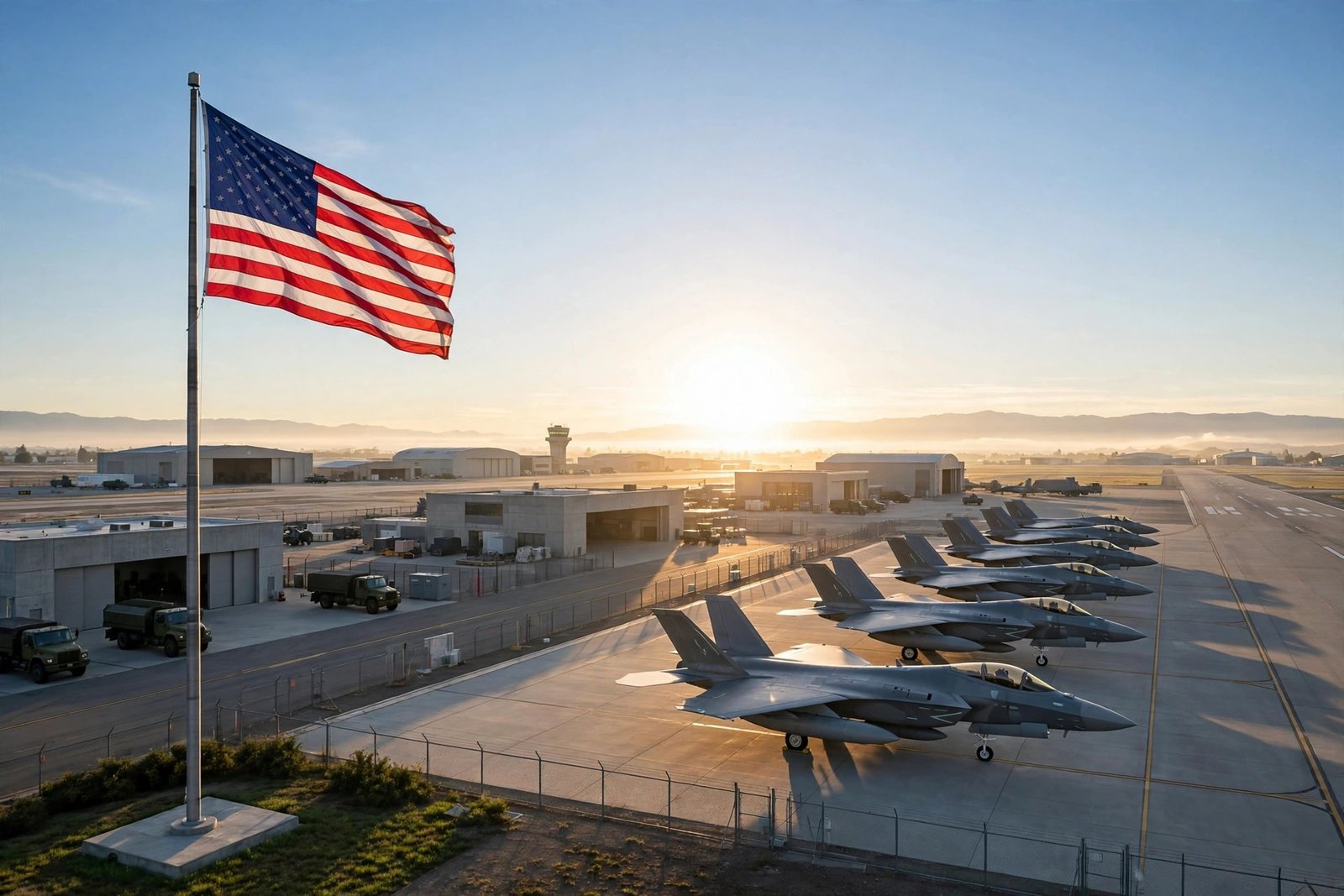
Somewhere in the world, right now, an American flag is flying over a military base in a foreign country. In fact, it is flying over hundreds of them. From the airfields of Germany to the ports of Japan, from the deserts of the Middle East to the islands of the Pacific, the United States maintains the largest network of overseas military bases in human history, a footprint no other nation has ever matched.
These bases are the physical backbone of American power. They let the United States move troops, aircraft, and ships to almost any crisis within hours, reassure allies, and deter rivals. They are also expensive and controversial, and the debate over them has run for eighty years: does this network make America safer, or tie the country to more trouble than it is worth?
How Big Is the Network?
The most commonly cited figure is about 750 overseas military bases in roughly 80 countries and territories, a count that comes from the research of David Vine of American University and the Quincy Institute. Other estimates run higher, above 800 sites, because the total depends on what you count: a giant air base and a small cooperative security location are very different things, and the Pentagon’s own inventory does not always include every facility.
The Pentagon’s own numbers tell a different story: the Department of Defense Base Structure Report for fiscal year 2024 counted approximately 6,473 military sites worldwide, including installations at home, with the Army accounting for the largest share at 3,820 sites, followed by the Air Force at 1,619 and the Navy at 722. The Congressional Research Service, using narrower criteria, found at least 128 bases in 51 countries in 2024. The wide range reflects different definitions of what a base is.
What is not in dispute is the scale: the United States operates more foreign military bases than every other country on Earth combined, about 70 to 85 percent of the world’s total.
Roughly 170,000 to 173,000 active-duty American troops are stationed overseas. The largest concentrations are in Japan, with about 53,000 troops, Germany, with about 35,000, and South Korea, with about 28,500. Those three countries also host the most American base sites: 120 in Japan, 119 in Germany, and 73 in South Korea, according to Pentagon data.
How It Started: World War II and the Cold War
The network was born in war: during World War II, the United States built airfields, ports, and supply depots across the globe, and when the war ended in 1945 it kept many of those wartime facilities as permanent bases.
The Cold War gave the network its purpose and shape: American bases ringed the communist world, in Western Europe to defend NATO allies, in Japan and South Korea to anchor the Pacific, and in the Middle East to guard oil supplies. They were political promises, proof the United States would defend its allies, and they let American forces respond to a crisis in hours instead of weeks.
When the Soviet Union collapsed in 1991, many expected the bases to close. Some did, especially in Europe. But most stayed, with new missions replacing the old ones: deterring regional threats, fighting terrorism after September 11, supporting allies in Asia as China rose, and keeping sea lanes open.
In 2004, the Pentagon formalized the system into three tiers: Main Operating Bases, large permanently staffed installations like Ramstein Air Base in Germany; Forward Operating Sites, smaller facilities maintained with rotating personnel; and Cooperative Security Locations, bare-bones sites that American forces can use when needed.
Why America Keeps Troops Abroad
The official reasons have stayed consistent for decades: deterrence, because a base on an ally’s soil signals that striking that ally means fighting the United States; reassurance, because allies hosting American troops are less likely to doubt American commitments; and speed, because a squadron in Japan can respond to a crisis far faster than one sailing from California.
Bases also do quiet, everyday work: joint training with allied militaries, surveillance and intelligence, storing equipment and fuel, and medical evacuation. Ramstein, for example, is a key medevac hub, with wounded service members from across Europe, Africa, and the Middle East passing through its hospital on their way home.
There is also an economic side: bases bring jobs and spending to host communities, and host nations often share the costs. South Korea contributed billions toward building Camp Humphreys, and Japan pays billions each year in host-nation support. These arrangements are renegotiated regularly and are often a source of political argument.
Camp Humphreys: The Largest Overseas Base
If one base captures the scale of the network, it is Camp Humphreys in South Korea. Near Pyeongtaek, about 40 miles south of Seoul, it is the largest overseas United States military base in the world, covering 3,454 acres with some 500 buildings. It cost about 11 billion dollars to build and is home to Desiderio Army Airfield, the busiest United States Army airfield in Asia, with an 8,124-foot runway.
Camp Humphreys is the headquarters of United States Forces Korea and the United Nations Command, the organizations that would command allied forces if war broke out on the Korean Peninsula. The base is about 60 miles from the Demilitarized Zone that divides North and South Korea, close enough to matter and far enough south to be harder to hit in an opening attack.
The base is the product of a 2004 agreement to move American forces south of the Han River. The move was completed in 2018, when United States Forces Korea relocated from Yongsan Garrison in Seoul to Humphreys, consolidating the roughly 28,500 American troops in South Korea into a single modern hub. With its schools, shops, and housing, Humphreys looks like an American suburb transplanted to the Korean countryside.
Ramstein: The Airlift Hub of Europe
In Europe, the anchor is Ramstein Air Base in Germany, the largest United States air base in Europe and headquarters for United States Air Forces in Europe and NATO Allied Air Command. The 86th Airlift Wing, the host wing, flies transport aircraft across Europe, Africa, and the Middle East, moving troops, supplies, and equipment wherever they are needed.
Ramstein sits at the center of the Kaiserslautern Military Community, the largest American community outside the United States. The base is also a communications and logistics hub and a key link in the medical evacuation chain. During the 2021 evacuation from Afghanistan, Ramstein processed tens of thousands of evacuees, a reminder of how a base built for one purpose can suddenly serve another.
Germany hosts 122 American base sites, more than any other country except Japan, according to Pentagon data. Ramstein’s role has only grown as NATO has refocused on deterring Russia in Eastern Europe, with American forces rotating through Poland and the Baltic states from hubs in Germany.
Kadena and the Pacific Anchor
Across the Pacific, the anchor is Kadena Air Base on Okinawa, Japan, the largest and most active United States Air Force base in East Asia, home to the 18th Wing, the Air Force’s largest combat wing, and more than 20,000 American service members. From Kadena, American aircraft can reach the Taiwan Strait, the South China Sea, and the Korean Peninsula in hours, which is why it is often called the keystone of the Pacific.
Japan hosts the largest number of American troops overseas, about 53,000, and the bases are a constant presence in Japanese politics. Okinawa hosts the majority of the American military presence in Japan, and local opposition has been a political force for decades, with residents complaining about noise, accidents, and crime. Plans to relocate some Marines from Okinawa to Guam have been discussed for years, but progress has been slow.
Guam is a key part of the network: Andersen Air Force Base and Naval Base Guam sit on American territory in the Western Pacific, so the United States needs no host nation’s permission to operate there. As tensions with China have grown, Guam has become more important as a forward sustainment point for air and naval power, and the Pentagon has invested heavily in its defenses.
The Middle East and Beyond
In the Middle East, the largest American installation is Al Udeid Air Base in Qatar, home to the United States Central Command’s Combined Air Operations Center, which coordinates air operations across the region. Al Udeid has been the hub for American air campaigns from Afghanistan to Iraq to the fight against ISIS, and it remains central to operations in the region.
American forces are also present in smaller numbers across the Middle East, in Bahrain, home to the Navy’s Fifth Fleet, and in Kuwait, a logistics hub, among other locations. The Pentagon’s official inventory has long been criticized for omitting well-known facilities in places like Iraq, Syria, Kosovo, and Saudi Arabia, one reason independent researchers arrive at higher totals.
Elsewhere, the network includes Naval Support Facility Diego Garcia in the Indian Ocean; bases in Italy, including Naval Air Station Sigonella and Aviano Air Base; and a growing presence in Africa, centered on Camp Lemonnier in Djibouti, the only permanent American base on the continent.
What It Costs
Running this network is expensive, though the exact cost is debated like the count of bases. The Quincy Institute estimated the annual cost at about 55 billion dollars a year, or about 80 billion dollars with personnel included. Other estimates range from 50 to 70 billion dollars annually, roughly comparable to the entire State Department budget.
Those figures cover construction, maintenance, operations, and supporting troops and families abroad. Host nations offset some of the expense: Japan and South Korea pay billions annually in host-nation support, and Germany contributes rent-free land and infrastructure. Critics argue the costs are still too high for a country with pressing needs at home. Supporters answer that the bases cost far less than a major war deterrence might prevent, or than building the ability to respond from the United States alone.
The Debate: Deterrence or Overreach?
The argument over the bases is as old as the bases themselves. Supporters point to South Korea, not invaded since 1953, to NATO Europe, which faced down the Soviet Union without a major war, and to Japan, which has relied on the American alliance for eighty years. In this view, the bases are the reason the postwar order has held.
Critics argue the network is a legacy of wars long over, that it entangles the United States in other countries’ disputes, and that it breeds resentment in host communities. They point to Pentagon studies estimating about 20 percent excess base capacity, and to the fact that the last full round of base closures at home was in 2005, with Congress blocking further rounds since. They also note that bases can become targets: American installations in the Middle East have been attacked repeatedly.
Local opposition is a recurring part of the story. In Okinawa, protests against the bases have shaped elections and national politics. In South Korea, the expansion of Camp Humphreys displaced farming families and sparked years of protest. In the Philippines, the United States was expelled from its bases in 1991, only to return decades later under new access agreements as China grew more assertive in the South China Sea.
What Comes Next
The network is changing, even if it is not shrinking. The focus is shifting toward the Indo-Pacific, with new access agreements in the Philippines and Papua New Guinea, investment in Guam, and a lighter, more dispersed footprint designed to survive long-range missiles. In Europe, the war in Ukraine has renewed the case for a larger American presence. In the Middle East, the footprint is smaller than at the height of the wars in Iraq and Afghanistan, but the hubs remain.
Political pressure is also constant: presidents of both parties have questioned the cost and pressed allies to pay more, and some have talked about bringing troops home. So far, the network has endured, because every president has discovered how hard it is to give up the ability to act anywhere in the world at short notice.
Whether that ability is worth its price is a question Americans will keep arguing about. What is certain is that the network exists, that it is larger than any rival’s, and that for eighty years it has been the clearest expression of American power: not just the weapons, but the willingness to station them, and the people who operate them, far from home.
Related Reading
Keep exploring the tools of American power:
- F-35 Lightning II: America’s Fighter Jet Power
- US Navy Aircraft Carriers: Power at Sea
- US Aircraft Carrier Fleet Power
Frequently Asked Questions
How many US military bases are there around the world?
About 750 overseas bases in roughly 80 countries and territories, according to the most widely cited independent estimate from the Quincy Institute and researcher David Vine. The Pentagon’s Base Structure Report counts about 6,473 sites worldwide including domestic installations, while the Congressional Research Service counted at least 128 bases in 51 countries using narrower criteria. The exact number depends on what counts as a base.
What is the largest US military base overseas?
Camp Humphreys in South Korea is the largest overseas United States military base, covering 3,454 acres near Pyeongtaek, about 40 miles south of Seoul. It cost about 11 billion dollars to build, houses some 500 buildings, and serves as the headquarters of United States Forces Korea.
Why does the United States have bases in other countries?
The main reasons are deterrence, reassurance of allies, and speed of response. Bases let American forces respond to a crisis in hours, signal to rivals that an attack on an ally means fighting the United States, and support joint training, intelligence, logistics, and medical evacuation for allied militaries.
Which countries host the most US troops?
Japan hosts the most, with about 53,000 American troops, followed by Germany with about 35,000 and South Korea with about 28,500, according to Defense Department personnel data. Japan, Germany, and South Korea also host the most American base sites.
Do other countries have overseas military bases?
Yes, but far fewer. Britain, France, Russia, and China together have roughly 195 overseas bases by most estimates, about a quarter of the American total. The United States operates more foreign military bases than every other country on Earth combined, about 70 to 85 percent of the world’s total.