
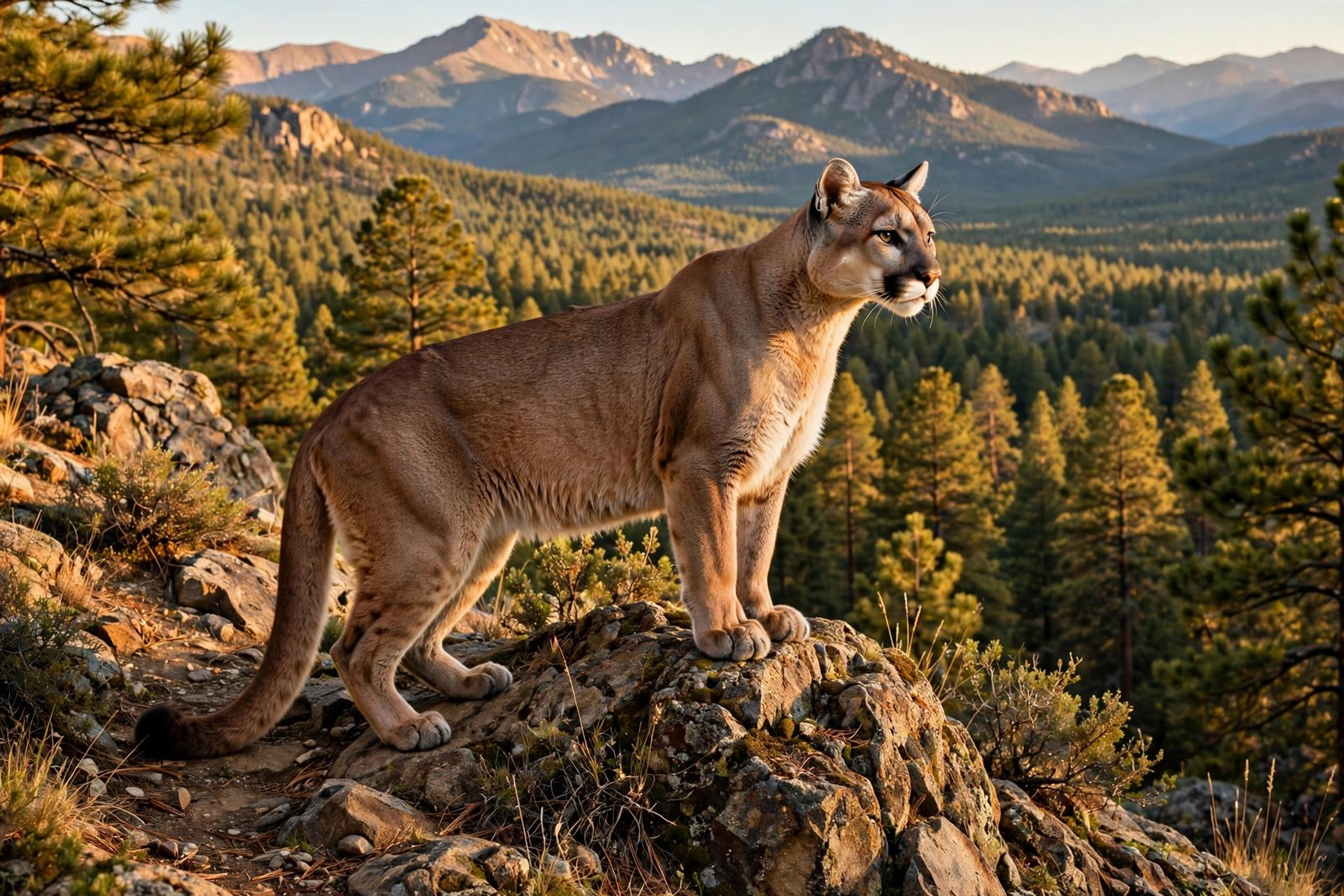
You will probably never see one. That is the point. The mountain lion is the ghost cat of America, a powerful predator that lives in the hills and canyons all around us yet stays almost entirely out of sight. Hikers walk trails where lions slept the night before. Trail cameras catch them padding through suburbs at 2 a.m. And still, most Americans will go their whole lives without ever locking eyes with one in the wild.
Known also as the cougar and the puma, this is the most widespread big cat in the Americas, and one of the most successful predators on the continent. It hunts deer in the Rockies, stalks through the swamps of Florida, and has been spotted on the edges of cities from Los Angeles to Denver. As more Americans move into lion country, knowing how the animal lives is the best way to share the landscape with it safely.
One Cat, Many Names
Ask three Americans what to call this animal and you may get three different answers. In the West it is a mountain lion. In the East it is a cougar or a panther. In much of South America it is a puma. All of these names describe the same animal: Puma concolor.
The National Park Service notes that the mountain lion is the second-largest cat in North America, after the jaguar, and the fourth-largest cat in the world, after the tiger, the lion, and the jaguar. An adult stands about two to three feet tall at the shoulder and measures six to seven and a half feet from the tip of its nose to the end of its long tail, according to the National Park Service at Grand Canyon. Males in Yosemite typically weigh 130 to 150 pounds, while females weigh 65 to 90 pounds, though big males in the northern Rockies can be heavier.
Its coat is a plain, tawny brown, without spots or stripes in adults, which helps it vanish into dry grass, rock, and brush. Kittens are born with spots that fade as they grow. The tail is long and heavy, with a dark tip, and it works like a counterweight when the cat leaps or turns at speed. Its round head, erect ears, and powerful hind legs are built for one thing above all else: the ambush.
The Widest Range of Any Land Mammal in the Americas
No other land mammal in the Western Hemisphere covers as much ground. Mountain lions live from the Canadian Yukon in the far north to the southern Andes of South America, a range that spans two continents. Within the United States, they are most common across the West, from the forests of Washington and Oregon through the Rockies and the desert Southwest, and they also survive in Florida and parts of Texas.
They are generalists when it comes to habitat. The National Park Service describes them living in forests, prairies, deserts, swamps, and even near beaches, wherever there is cover to hide in and prey to hunt. They favor steep canyons, rock outcroppings, dense brush, and forested slopes, places where they can move unseen. In Grand Canyon National Park, most lions live both inside the park and on the surrounding Forest Service lands.
That range has shrunk dramatically from what it once was. Before European settlement, mountain lions lived across nearly all of North America. Hunting, trapping, and bounties wiped them out of virtually the entire eastern United States except for parts of Florida by the early 1900s. The West kept its lions because the country there is rougher, emptier, and harder to hunt in. In recent decades, dispersing young lions have been confirmed as far east as Missouri, though no breeding population has re-established itself in the East outside Florida.
Built to Hunt
The mountain lion is an ambush predator, and everything about its body serves that strategy. It does not chase prey across open ground the way a wolf pack does. Instead, it stalks, using cover and patience, creeping closer until it is within striking distance, then exploding into a short, powerful rush. The National Park Service at Grand Canyon describes the sequence plainly: the lion stalks its prey until it finds an opportunity to pounce, taking down large animals with a fatal bite to the back of the neck.
A mountain lion can leap many times its own body length, and its powerful hind legs and retractable claws are built for springing onto prey. The bite targets the base of the skull or the throat, a quick and efficient kill.
Lions are mostly active at dawn and dusk and through the night, resting in shade or dense brush during the day. They are solitary hunters, and after a kill they often drag the carcass to a sheltered spot, eat their fill, and then cover what remains with leaves and dirt, returning over several days to feed. Researchers at Valles Caldera in New Mexico found that lions there spend an average of three to four days consuming an elk or deer, and four to five days hunting for the next meal. On average, a cougar makes a large kill roughly every two weeks.
What Mountain Lions Eat
Deer are the staple of the mountain lion diet across most of North America. In the West, mule deer are the most common prey, and lions also take elk, including calves, and occasionally moose. In Redwood National and State Parks, black-tailed deer and Roosevelt elk are the main prey. In Florida, the panther hunts white-tailed deer and wild hogs.
The menu is wider than deer alone: bighorn sheep, mountain goats, porcupines, rabbits, raccoons, and even mice, with young lions often starting on smaller prey. They will also eat carrion when it is available, and they are not above taking livestock, which is where most conflict with people begins. A lion that learns to kill sheep or calves can become a serious problem for a rancher, and state wildlife agencies often have to remove such animals.
By keeping deer and elk in check, lions shape the whole landscape: remove a top predator, and the effects ripple through the food web.
A Solitary Life
If wolves are the socialites of the predator world, mountain lions are the introverts. With the exception of a mother with her kittens, they live alone. They do not form packs or prides. Two adult lions seen together are almost always a mother with her young, or a male and female briefly paired for mating.
Each lion defends a territory, or home range, and those ranges are enormous. The National Park Service reports that home ranges can vary from 10 to 300 square miles depending on how much prey is available, and in some places a male’s range can reach 500 square miles. In the Santa Monica Mountains near Los Angeles, researchers tracked males holding about 150 square miles and females about 50. In Redwood National Park, radio-collared females held ranges of 47 to 73 square miles, while males roamed 130 to 275 square miles. Adult males are territorial and may kill other adult males that intrude.
That need for space is the lion’s biggest modern challenge: as suburbs and highways carve up the landscape, young lions must cross roads and neighborhoods to find their own range, and many are killed by cars. Researchers at Valles Caldera found young males disperse 50 to 400 miles from where they were born, and females 20 to 150 miles. Those long journeys are how new populations start, and also how lions die.
Raising Kittens
Everything about raising young falls to the mother. She dens in a secure spot with ample rock or vegetative cover, often on a steep slope that is hard to reach, and gives birth to a litter of one to four kittens after a gestation of about three months. The kittens are born blind and helpless, and their spotted coats help them blend into dappled shade.
While the kittens are small, the mother may stay at the den for up to six weeks; as they grow she brings them meat, then takes them on hunts to teach them to stalk and kill. Kittens stay with their mother for 18 to 24 months, a long apprenticeship for a predator that must learn everything about hunting alone. By the time they leave, they have to know how to find prey, make a kill, and avoid other lions.
Life is hard for a young lion: disease, starvation, fights with other lions, and encounters with people all take a toll, and wild lions live about 10 to 13 years, according to the National Park Service. The mother is fiercely protective, which is one reason agencies warn people never to approach a lion with young.
The Florida Panther: A Cousin on the Edge
The Florida panther deserves a brief mention because it is the same species, Puma concolor, living a very different life. It is the only breeding population of mountain lions left in the eastern United States, confined to the swamps and forests of South Florida. Unlike the western lion, the Florida panther is listed as endangered under the Endangered Species Act, and it survives in a landscape squeezed by development, roads, and a rising human population.
The panther’s story is one of slow recovery from the brink, helped by habitat protection and wildlife crossings built to let panthers cross highways safely.
Living Alongside Lions: Staying Safe
Encounters are rare and attacks rarer still: since 1986, California has recorded 19 verified attacks, three of them fatal, and the state notes a person is far more likely to be struck by lightning. Still, in lion country, it pays to know the rules.
Before you head out, hike in groups when you can, especially at dawn and dusk. Keep children within arm’s reach and never let them run ahead. Make noise as you walk, keep pets on a leash, and do not leave pet food outside at home.
If you see a mountain lion, the National Park Service advises: do not run. Running can trigger the cat’s instinct to chase. Instead, hold your ground or back away slowly while facing the animal. Make yourself look bigger by raising your arms and opening your jacket. Speak firmly and loudly. Pick up small children without bending over or turning away. If the lion behaves aggressively, wave your arms, shout, and throw rocks or sticks.
If a lion attacks, fight back. Do not play dead. People have successfully fought off mountain lions with rocks, sticks, trekking poles, jackets, and their bare hands. Try to remain standing and face the animal, and protect your head and neck. After any encounter, report the sighting to a ranger or your state wildlife agency right away, and if someone is hurt, call 911.
Conservation: Stable, But Under Pressure
Globally, the mountain lion is listed as Least Concern by the International Union for Conservation of Nature, and in the western United States its populations are generally considered stable. That is a conservation success story of sorts: a predator that was hunted nearly to extinction in the East still thrives across the West.
But stable does not mean safe: the National Park Service identifies habitat fragmentation and loss as the main long-term threats across the West. Roads kill dispersing young lions, housing developments cut territories into pieces too small to support a breeding animal, and in Southern California, lions hemmed in by freeways have shown signs of inbreeding.
Management varies by state: most western states manage lions as a game species with regulated hunting seasons, while California voters banned sport hunting in 1990 and the state manages them as a specially protected mammal.
Why the Ghost Cat Matters
The mountain lion matters for reasons that go beyond its own survival. As the top predator across much of the West, it keeps deer herds healthy by culling the sick and the weak, and it shapes the behavior of prey animals in ways that let vegetation recover. Its presence is a sign that an ecosystem still has room for wildness.
It is also a reminder of what America almost lost: a century ago, this cat was gone from the entire eastern half of the country. Whether it returns will depend on decisions made one community, one highway crossing, and one rancher at a time.
So if you hike in lion country, go prepared, stay alert, and count yourself lucky if you catch a glimpse of tawny fur melting into the brush. The ghost cat saw you long before you saw it.
Related Reading
Keep exploring America’s wild predators and the landscapes they roam:
- Florida Panther Comeback Guide
- American Black Bear Guide
- Grizzly Bears of Yellowstone Wildlife Guide
Frequently Asked Questions
What is the difference between a mountain lion, a cougar, and a puma?
There is no difference. They are all the same animal, Puma concolor. The name changes by region: mountain lion is common in the West, cougar and panther in the East, and puma in South America. It is also called a catamount in parts of New England.
Are mountain lions dangerous to people?
Attacks are extremely rare. Mountain lions are shy and usually avoid people. The California Department of Fish and Wildlife notes that a person is far more likely to be struck by lightning than attacked by a mountain lion. Hikers in lion country should still know the safety rules.
How big do mountain lions get?
Adult males typically weigh 130 to 150 pounds and females 65 to 90 pounds, according to the National Park Service at Yosemite, though some large males are heavier. They stand about two to three feet tall at the shoulder and measure six to seven and a half feet from nose to tail tip.
Where do mountain lions live in the United States?
They are most common across the western United States, from Washington and Oregon through the Rockies and the desert Southwest, and they also live in Florida as the Florida panther and in parts of Texas.
What should I do if I see a mountain lion while hiking?
Do not run. Hold your ground or back away slowly while facing the animal. Make yourself appear larger, speak firmly and loudly, and pick up small children without bending over. If the lion acts aggressively, shout and throw rocks or sticks. If it attacks, fight back with anything at hand. Report the sighting to a ranger afterward.