
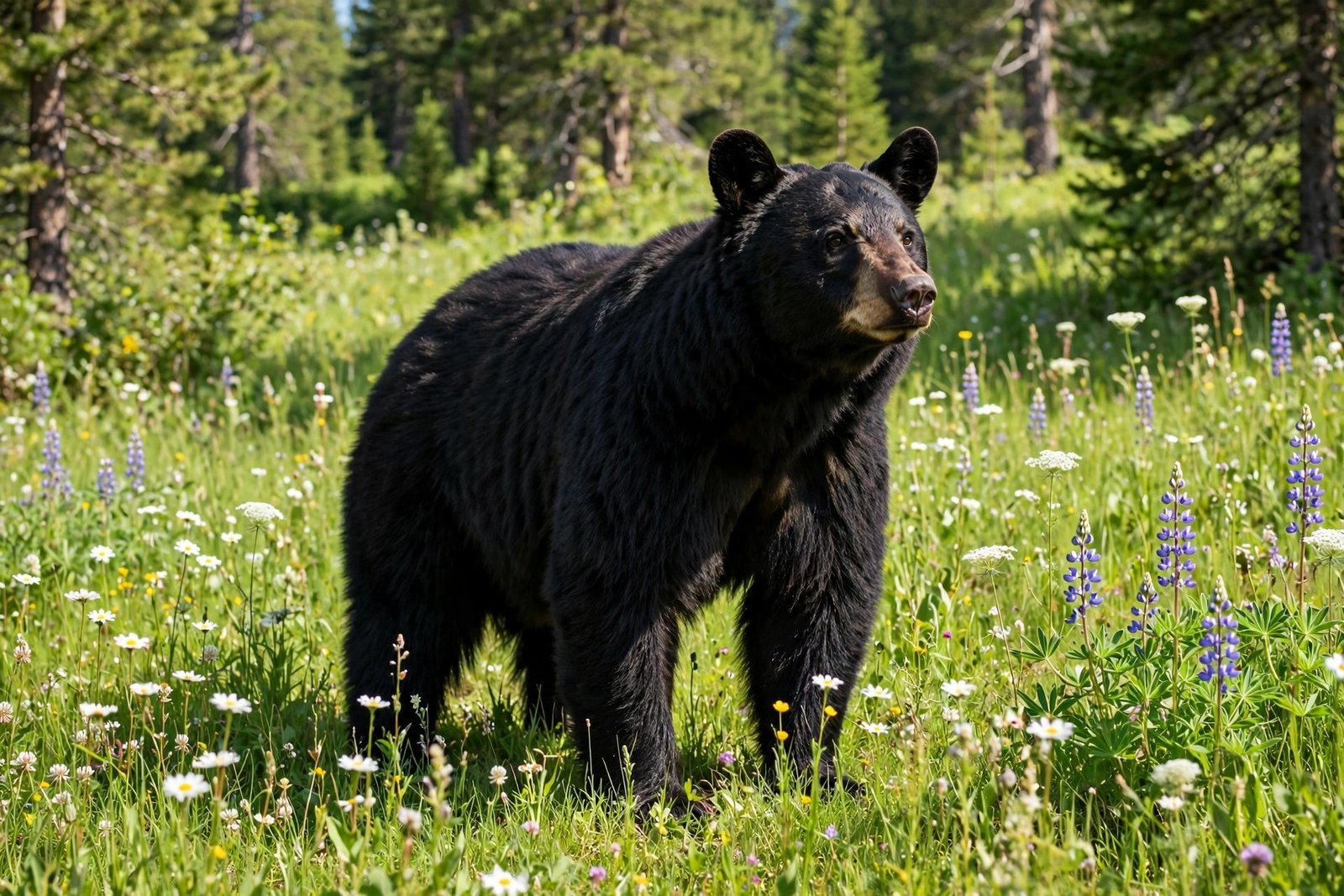
If you have ever hiked in the mountains of North America, you have probably walked through black bear country without knowing it. The American black bear is the continent’s most common and most widely distributed bear, and it lives in forests from Alaska and Canada through the United States to Mexico. It is also one of the most misunderstood animals in North America. People picture a big black bear, but the animal in front of them might be brown, cinnamon, or even blonde. They picture a fierce predator, but the bear is mostly eating berries. They picture a deep sleeper, but in a mild winter it might not sleep at all.
How to Recognize a Black Bear
The American black bear, Ursus americanus, is the smallest bear species in North America, and the only bear species found in many eastern states. Adults are normally five to six feet long and two to three feet high at the shoulder, according to the National Park Service page on black bears of the Blue Ridge Parkway. Weight varies enormously with sex, age, season, and food supply. The Park Service gives a typical range of 100 to 400 pounds, while bears in rich food country can weigh far more. In Great Smoky Mountains National Park, a typical adult male weighs about 250 pounds in summer and a typical adult female a little over 100 pounds, but both can nearly double their weight by fall, and bears over 600 pounds have been documented in the park.
Color is the least reliable way to identify one. Despite the name, a black bear’s fur can be black, brown, cinnamon, or even blonde, and the U.S. Fish and Wildlife Service species profile for the American black bear notes that in the East the bears are nearly black, while in the West they range from black to cinnamon, sometimes with a white blaze on the chest. There is even a nearly white population on islands in British Columbia, known as spirit bears, and a blue-gray phase near Yakutat Bay in Alaska. The snout is usually tan or grizzled.
The reliable field marks are shape, not color. Compared with a grizzly or brown bear, a black bear has no shoulder hump, a straighter facial profile, longer ears, and shorter front claws. It also has a straighter snout and a higher, more rounded forehead. If you see a bear with a pronounced shoulder hump and a dish-shaped face, you are looking at a grizzly, not a black bear. In most of the eastern United States, though, any bear you see will be a black bear, because grizzlies no longer live there.
Range and Habitat
Black bears live in 41 of the 50 U.S. states, from Alaska to Mexico and from the Atlantic to the Pacific, according to the National Park Service page on black bears in Kenai Fjords National Park. They are found across Canada as well. That range makes them the most widely distributed bear on the continent, and one of the great conservation comebacks in American wildlife history. A century ago, hunting and habitat loss had pushed black bears out of much of the eastern United States. Today, thanks to regulated hunting, habitat protection, and reintroduction programs, they have returned to forests across the East, the Midwest, and the South.
What Black Bears Eat
Black bears are omnivores, and plants make up most of their diet. The Park Service describes a diet that changes with the seasons: grasses and forbs in spring, leafy green plants and fruits in summer, and berries and nuts, especially acorns, in fall. Insects, including ants, bees, and grubs, add protein, and bears will also eat fish, small mammals, and carrion when they find it. More than 75 percent of the diet is vegetable matter, according to the Kenai Fjords page, with the rest made up of animal matter such as decaying carcasses, fish, small marine animals, and insects.
Bears are also gardeners, though they do not know it. By eating berries and passing the seeds through their digestive systems, they spread native plants across the forest. By cleaning up dead fish and animals, they recycle nutrients. The Fish and Wildlife Service’s guide to being bear aware notes that bears help disperse native plant and berry seeds through their foraging, clean up dead fish and animals, and keep hornet nests in check. A forest with bears is a healthier forest.
Senses, Climbing, and Swimming
Do not be fooled by a bear’s shuffling walk. Black bears are powerful, fast, and agile animals. They can run up to 30 miles per hour in short bursts, far faster than any human, which is why running from a bear is never a good idea. They are excellent climbers, using their curved claws to scale trees quickly, and cubs climb to escape danger almost as soon as they can walk. They are also strong swimmers, crossing rivers and lakes without hesitation.
Their most remarkable sense is smell. A black bear’s sense of smell is far better than a dog’s, and bears can detect food from a long distance away. That is why a cooler left out at a campsite, a bird feeder in a backyard, or a bag of trash on a porch is not just an invitation, it is a dinner bell a bear can hear from far down the mountain. Their eyesight and hearing are reasonable, roughly comparable to a human’s, but smell is the sense that runs a bear’s life.
Family Life: Cubs and Mothers
Cubs are born in the winter den, usually in late January or early February, while the mother is still in her winter sleep. One to four cubs are born in a litter, each weighing only eight to eleven ounces at birth, blind and nearly hairless. They nurse through the winter and grow quickly on their mother’s rich milk. Females with newborn cubs usually emerge from their dens in late March or early April, and the cubs stay with their mother for about a year and a half, learning where to find food, how to climb, and how to stay safe.
Hibernation: The Long Winter Sleep
Black bears do not truly hibernate in the way some other animals do. They enter a long period of dormancy, sometimes called torpor, in which their metabolism slows, their heart rate drops from 40 to 70 beats per minute to as low as 8 to 12 beats per minute, and their body temperature falls slightly. During the entire period, they do not eat, drink, or pass solid waste, recycling body wastes instead and waking in spring with surprisingly little loss of muscle mass or strength.
How long a bear sleeps depends on where it lives. In Alaska, bears may hibernate for about seven months. In the southern Appalachians, bears typically settle into dens between late October and mid-December and may wake after only a month or two, and in a particularly mild winter they may not den at all, foraging for food throughout the season. In Florida, where winters are warm, bears may not hibernate at all.
How Long Do They Live?
In the wild, black bears typically live 12 to 15 years, though some live much longer. The Park Service gives an average lifespan of 15 to 25 years in some parks, and bears have been known to live to 30 years in the wild. The biggest threat to a wild bear is not another animal. Adult black bears have no real predators except humans and, occasionally, other bears. Male bears have been known to kill cubs, which is one reason mothers keep their young close.
Bears and People: A Shared Landscape
Black bears are generally shy and wary of people. The Fish and Wildlife Service notes that in most cases black bears are not a threat to people, but they do deserve respect and attention. Attacks are rare. When they do happen, they are almost always linked to food, to cubs, or to a bear that has been surprised at close range. A bear that has learned to eat human food is the most dangerous kind, because it has lost the fear that keeps both species safe.
That is why the rules in bear country are so strict, and why they are enforced. In Great Smoky Mountains National Park, willfully approaching a bear within 50 yards, or 150 feet, or any distance that disturbs it, is illegal, and violations can result in fines and arrest. Feeding a bear is also illegal, with fines up to 5,000 dollars and up to six months in jail in the Smokies. Those numbers are not there to punish visitors. They are there because a single fed bear can become a problem for an entire campground.
Staying Safe on the Trail
The National Park Service’s bear safety guidance is consistent across parks, and it is worth learning before you hike. The National Park Service bear safety page and the Blue Ridge Parkway bear safety page lay out the same core advice, and it works.
First, be alert and make noise. The last thing you want is to startle a bear, so talk, sing, or clap as you hike, especially when you are alone, near a noisy creek, or rounding a blind corner. A bear that hears you coming will usually leave long before you see it. Hike in groups when you can, and keep children close.
Second, keep your distance. If you see a bear, do not approach it, and do not let it approach you. If your presence causes the bear to stop feeding, change direction, or watch you, you are too close. Use binoculars or a telephoto lens for a better look, never your feet. Stay at least 50 yards away in national parks, and farther if the bear has cubs or is feeding.
Third, store food properly. In campgrounds, use the metal food lockers provided, and store all food, coolers, scented toiletries, and trash out of sight in a closed vehicle or a bear-proof container. Never bring food into your tent, and never leave food unattended, even for a minute. In the backcountry, use bear-resistant canisters or the cable systems provided at campsites, and cook and eat away from where you sleep.
What to Do If You Meet a Bear
If a bear surprises you, stay calm. Do not run. Running can trigger a chase response, and a bear can outrun you easily. Identify yourself by talking calmly so the bear knows you are a human and not a prey animal. Remain still, stand your ground, and slowly wave your arms. Pick up small children immediately. Do not scream or make sudden movements, and never imitate bear sounds.
If a bear charges, stand your ground. Most charges are bluff charges, in which the bear rushes forward and then turns away at the last second. Look big, raise your arms, and keep yelling. If the bear backs away, back away as well, because it may be guarding food or cubs. If you are carrying bear spray, begin to deploy it when the bear comes within 20 yards, aiming slightly downward in front of the approaching bear.
The one rule that surprises people is what to do if a black bear actually attacks. Unlike with a grizzly, do not play dead. The Park Service is explicit: if you are attacked by a black bear, do not play dead. Try to escape to a secure place such as a car or building. If escape is not possible, fight back aggressively with any object available, concentrating your blows on the bear’s face and muzzle. A black bear that attacks a person may consider the person as prey, and fighting back is your best chance.
Where to See Black Bears
Some of the best places to see black bears are the national parks of the eastern United States. Great Smoky Mountains National Park, on the Tennessee-North Carolina border, has the densest black bear population in the country, with about two bears per square mile, and bears can be seen at all elevations of the park. The Blue Ridge Parkway, which runs through Virginia and North Carolina, is also prime black bear country, and the Park Service’s page on the parkway’s black bears is a good place to start planning a visit.
FAQ
How big do American black bears get?
Adults are normally five to six feet long and two to three feet high at the shoulder. Weight varies widely: the Park Service gives a typical range of 100 to 400 pounds, with males larger than females and both sexes gaining much of their weight in fall. Bears over 600 pounds have been documented in Great Smoky Mountains National Park.
Are black bears always black?
No. Despite the name, their fur can be black, brown, cinnamon, or blonde, and there is even a nearly white population in British Columbia and a blue-gray phase in Alaska. Color alone cannot identify a black bear; look instead for the lack of a shoulder hump, the straight facial profile, and the longer ears.
What should I do if I see a black bear?
Stay calm, do not run, and keep your distance, at least 50 yards in national parks. Talk calmly so the bear knows you are human, slowly back away while keeping the bear in view, and never get between a mother and her cubs. If the bear approaches you, make yourself look large and make loud noise to scare it away.
Should I play dead if a black bear attacks?
No. The National Park Service advises that if you are attacked by a black bear, do not play dead. Try to escape to a car or building, and if you cannot escape, fight back aggressively with any object available, aiming for the bear’s face and muzzle. Playing dead is advice for grizzly bear attacks, not black bears.
How long do black bears hibernate?
It depends on the climate. In Alaska, bears may hibernate for about seven months, while in the southern Appalachians they may den for only a month or two, and in warm places like Florida they may not hibernate at all. During hibernation, a bear’s heart rate can drop to as low as 8 to 12 beats per minute.