
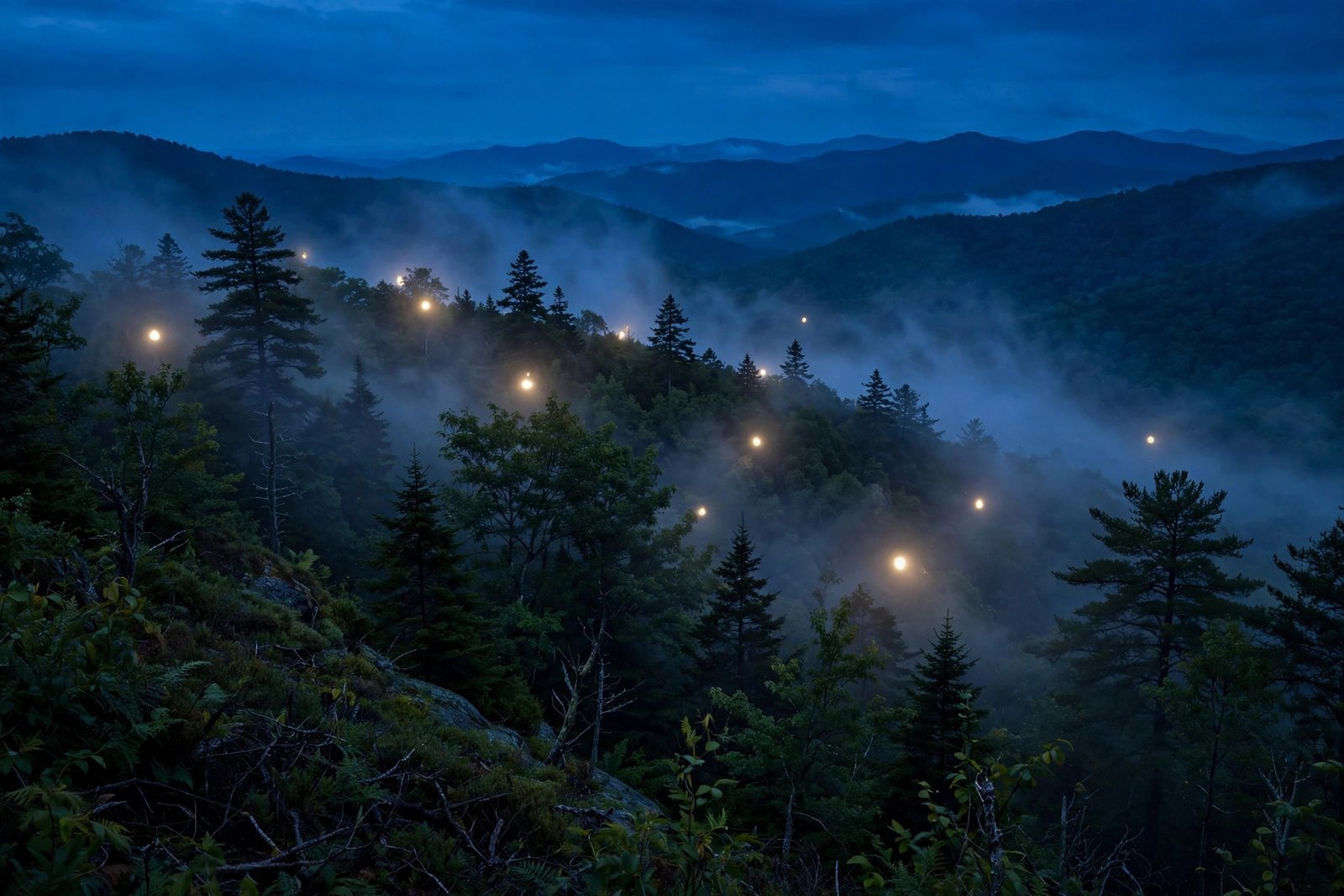
On a clear night in the Blue Ridge Mountains of western North Carolina, people gather at dark overlooks, settle into folding chairs, and stare at a low ridge in the distance. They are waiting for something that may or may not appear. Sometimes nothing happens for hours. Sometimes, if the stories are true, a small glow rises above the trees, drifts slowly across the ridgeline, grows brighter, and then fades away as quietly as it came. These are the Brown Mountain Lights, and for more than a century they have resisted every attempt to explain them away.
What People Say They See
The descriptions vary, which is part of the puzzle. Most witnesses describe small, glowing orbs, often reddish, orange, or pale yellow, that appear low in the air above the ridge. Some say the lights hover in one spot. Others say they move slowly along the treeline, rise and fall, or drift across the gorge. A few describe lights that split into two, flare suddenly brighter, or vanish in an instant. The NCpedia entry on the Brown Mountain Lights, drawn from the Encyclopedia of North Carolina, describes them as unexplained phenomena that appear low in the air under favorable atmospheric conditions, grow in size, and then linger for a few minutes before fading away.
It is also worth being honest about what most sightings turn out to be. Researchers who have spent years watching the ridge say that the large majority of reported lights can be matched to something ordinary: a car headlight on a distant road, a train moving through the valley, a porch light, a hiker’s flashlight, or a brush fire. The mystery is not that every light is unexplainable. The mystery is the small remainder, the handful of reports and recordings that do not fit neatly into any of those boxes.
Where Is Brown Mountain?
Brown Mountain sits in the Blue Ridge Mountains of western North Carolina, near the town of Morganton and the Linville Gorge, a steep, rugged canyon carved by the Linville River. The gorge is often called the Grand Canyon of the East, and it is part of Pisgah National Forest. The mountain itself is best viewed from a distance, from overlooks on the surrounding ridges, because the lights are reported above the mountain rather than on it.
The three main viewing locations are all around the Linville Gorge area. The best known is Wiseman’s View, an overlook in Pisgah National Forest that looks east across the gorge toward Table Rock and Hawksbill Mountain, with Brown Mountain beyond that ridge. The overlook is reached by a gravel road, the Kistler Memorial Highway, off Highway 183 near Linville, and the short paved path from the parking area to the stone overlooks is about two-tenths of a mile. The gorge drops nearly fifteen hundred feet below the viewpoints, and the view in daylight is spectacular on its own.
The second spot is the Brown Mountain Overlook on North Carolina Highway 181, between mile markers 20 and 21, about twelve miles north of Morganton. This roadside overlook is the most accessible of the three, with a paved parking lot and informational displays about the lights. The third is the Lost Cove overlook on the Blue Ridge Parkway near milepost 310, northeast of the parkway’s junction with NC 181. Researchers at Appalachian State have noted, however, that in spite of the sign at Lost Cove, Brown Mountain itself cannot actually be seen from that overlook, so it is the least reliable of the three for serious watching. The Appalachian State guide to seeing the lights lists all three locations and gives GPS coordinates for each.
The Earliest Reports
How far back do the lights go? That question is more contested than most retellings suggest. Visit North Carolina says that people have reported strange lights in the Brown Mountains since the time Cherokee and Catawba people lived in the region, and that Civil War soldiers also described them. The Visit North Carolina page on the Brown Mountain Lights repeats that long history, and it is the version most visitors hear first.
The documented record, however, is shorter and more careful. The earliest published account that the U.S. Geological Survey investigator George Rogers Mansfield could find was a dispatch from Linville Falls to the Charlotte Daily Observer, dated September 23, 1913. That article credited the discovery of the lights to members of the Morganton Fishing Club. Before that, the paper trail is thin. The earliest published mentions of strange lights near Brown Mountain date from around 1910, at about the same time electric lighting was becoming widespread in the area, according to the historical summary on Wikipedia’s Brown Mountain lights page.
The 1913 Investigation
The first scientific investigation came quickly. In October 1913, at the urgent request of local residents, the U.S. Geological Survey sent D. B. Sterrett to Brown Mountain to observe the lights and determine their origin. Sterrett spent only a few days on the ridge, but he reached a firm conclusion: the lights were locomotive headlights, seen over the mountain from the neighboring heights. He checked the train schedules for the Southern Railway line through the Catawba Valley and found that the times matched the reported sightings.
The 1922 Investigation: Mansfield and the Alidade
In 1922, the Geological Survey tried again, this time with a more thorough investigator. George Rogers Mansfield, a USGS geologist, spent two weeks near Brown Mountain in March and April 1922, watching for the lights on seven evenings, four of them until after midnight. He worked from viewing points on the surrounding hillsides, including a station near Loven’s Hotel, at the former home of C. E. Gregory, accompanied by members of the Loven family.
Mansfield’s method was careful and old-fashioned in the best sense. He trained a surveying instrument called an alidade telescope on each light as it appeared, noted the time, and measured its direction and vertical angle. Then he compared those lines of sight with maps of the roads, railroads, and settlements beyond the ridge, and with railroad timetables. His report, later reprinted by the Survey in 1971 as Geological Survey Circular 646, was blunt. He wrote that the lights were clearly not of unusual nature or origin.
Of the lights he was able to study with his instruments, Mansfield attributed about 47 percent to automobile headlights, 33 percent to locomotive headlights, 10 percent to stationary lights, and 10 percent to brush fires. One light that Joseph Loven called a true Brown Mountain light, because it appeared to move and flare in brightness, proved through repeated azimuth readings to have been stationary throughout the entire evening. Another series of lights plotted exactly onto a curve in a Southern Railway track, and the time of their appearance corresponded exactly to a scheduled train.
Mansfield’s report ended widespread public concern at the time, but it did not end the legend. It could not, because it had a gap that believers have pointed to ever since. In July 1916, a flood tore through the Catawba Valley and destroyed every rail line in it. Trains stopped for months. Roads were washed out. And people said the lights kept appearing. If the lights were only train headlights, what was shining during the months when there were no trains? Mansfield’s investigation, careful as it was, could not answer a question about a night six years earlier.
The Later Science
The lights kept being studied. In 1977, a team from Oak Ridge National Laboratory aimed a distant arc lamp toward observers at the viewing sites, and the white beam arrived as an orange-red orb that appeared to hover above the crest, a clean demonstration that atmospheric refraction can manufacture the classic Brown Mountain effect. A steady light far away, bent by layers of air at different temperatures, can appear to rise, move, flare, and fade, even though nothing is moving at all.
The most sustained modern study has come from Daniel Caton, a professor of physics and astronomy and director of observatories at Appalachian State University, who has been chasing the Brown Mountain Lights since the mid-1980s. Caton and his colleague R. Lee Hawkins set up cameras aimed at the ridge, running on clear nights, and collected thousands of hours of footage. Their Brown Mountain Lights research page at Appalachian State describes the work plainly: they investigate flashlight tests, natural lights like blue ghost fireflies, and swamp methane flames, and they admit they remain frustrated by how random the phenomenon is.
Caton has said he reckons about 95 percent of claimed sightings are bogus, meaning they are misidentified ordinary lights. But he has also said that a small remainder does not fit. The most famous piece of evidence came on the night of July 16 to 17, 2016, when both of Caton’s cameras recorded the same unexplained light. The footage, running from about 9:40 p.m. to 5:37 a.m., showed a stationary light appearing in the same spot four separate times across about twenty minutes, with no lateral motion between exposures. Because it appeared on both cameras at the same location, it could not be dismissed as a flaw in one camera. Caton has suggested ball lightning, a rare and poorly understood glowing sphere of energy, as a possibility worth testing, but no study has yet shown what produced that light.
The Main Theories, Weighed Honestly
Headlights and refraction remain the strongest explanation for most sightings. The valleys beyond Brown Mountain are full of roads and rail lines, and the lines of sight from the overlooks pass hundreds of feet over the top of the ridge. A distant headlight can look as if it is floating above the mountain. Layers of warm and cool air bend the light, making a steady lamp appear to move, flare, and change color. Mansfield proved this with measurements in 1922, and the Oak Ridge experiment showed it visually in 1977.
Ball lightning is the most intriguing natural theory, and the one Caton favors for the unexplained remainder. Ball lightning is a rare, glowing sphere of energy associated with thunderstorms, but it is so poorly understood that scientists cannot reliably produce it in a laboratory. If it exists in the form witnesses describe, it could explain a light that drifts, hovers, and vanishes without a source. The problem is that the theory is itself unproven, so it explains one mystery with another.
How to Try to See the Lights Yourself
If you want to try, go on a clear, dark night, ideally in the fall, especially after a rain, when the air is clear and the skies are dark. The lights are most often reported shortly after dark on warm evenings, though reports come from all seasons. A new moon helps, because the darker the sky, the easier it is to spot a faint glow. Bring patience above all else. There is no guarantee the lights will appear on any given night, and many visitors never see anything unusual.
Wiseman’s View is the classic choice, but be prepared for the drive. The last stretch is a gravel road with potholes, and it takes about twenty minutes from the paved highway. The overlook itself is free, with no fee or permit needed for day use, and the paved path to the viewpoints is short and accessible. Note that day use runs until 10 p.m., so plan your visit within that window. Bring a flashlight for the walk back to your car, dress warmly, and bring water and snacks, because there are no facilities at the overlook.
The Brown Mountain Overlook on NC 181 is easier to reach and has a paved parking lot and informational displays. It sits at about 2,760 feet in elevation, slightly above Brown Mountain itself. The Lost Cove overlook on the Blue Ridge Parkway near milepost 310 is also marked for the lights, but remember the researchers’ warning that Brown Mountain cannot actually be seen from there. If you go, go for the parkway drive and the view, not for a guaranteed sighting.
Why the Mystery Endures
A century after the first newspaper report, the Brown Mountain Lights remain unexplained in the only sense that matters: no single explanation covers every credible report. The government investigated and explained most of what it could measure. A university astronomer spent decades filming the ridge and found mostly ordinary lights, plus one recording he still cannot explain. The atmosphere can bend a headlight into a ghost. Ball lightning might exist. Fireflies glow. And still, on some nights, something appears above that ridge that nobody can name with confidence.
FAQ
Where is the best place to see the Brown Mountain Lights?
Wiseman’s View in Pisgah National Forest and the Brown Mountain Overlook on NC Highway 181 are the two best-known viewing spots. The Lost Cove overlook on the Blue Ridge Parkway near milepost 310 is also marked for the lights, but researchers note that Brown Mountain itself cannot be seen from there.
When is the best time to look for the lights?
Reports say the lights appear most often on clear, warm evenings shortly after dark, with fall often cited as a good season, especially after rain. Sightings have been reported in every season, though, and there is no night when they are guaranteed to appear.
What did the 1922 USGS investigation conclude?
Geologist George Rogers Mansfield spent two weeks near Brown Mountain in March and April 1922, measuring lights with an alidade telescope. He concluded the lights he could study were not of unusual origin, attributing about 47 percent to automobile headlights, 33 percent to locomotive headlights, 10 percent to stationary lights, and 10 percent to brush fires.
Have scientists ever captured an unexplained light on camera?
Yes, at least one recording remains unexplained. On the night of July 16 to 17, 2016, two cameras operated by Appalachian State University researchers recorded the same stationary light appearing four times in about twenty minutes. The cause of that light has not been established.
Are the Brown Mountain Lights dangerous?
The lights themselves have never been shown to be dangerous. The real risks are the same as any nighttime mountain visit: dark gravel roads, steep drops at overlooks, and cold weather. Stay on marked paths, keep to the overlooks, and do not trespass on private land.