
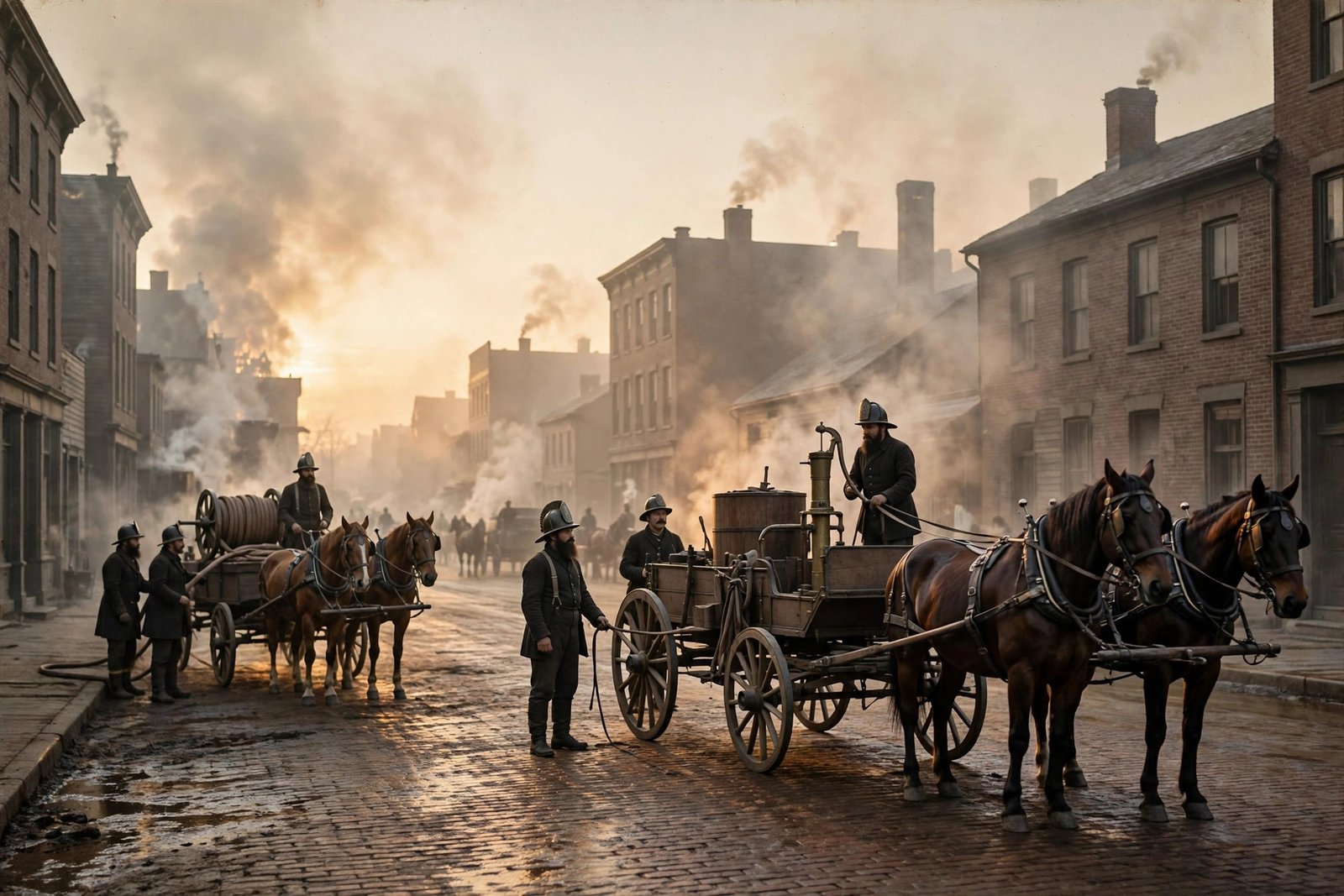
On the night of Sunday, October 8, 1871, a small fire started in a barn on the southwest side of Chicago. Within hours it became one of the most famous disasters in American history. The Great Chicago Fire burned for two days, destroyed roughly 3.3 square miles of the city, and left about 100,000 people, nearly a third of Chicago’s population, homeless. It killed an estimated 300 people, leveled more than 17,000 buildings, and caused damage estimated at about $200 million, an enormous sum in 1871.
Yet the fire is remembered for more than destruction. Chicago rebuilt with astonishing speed, and the rebuilding changed the city forever: new building codes, fireproof construction, and, within fourteen years, the world’s first skyscraper. This is the story of how a wooden city burned, how a famous cow legend took hold, and how Chicago rose again.
Chicago in 1871: A Wooden City Built to Burn
To understand why the fire was so devastating, you have to understand what Chicago was made of in 1871. The city had grown at a breathtaking pace: incorporated in 1837 with about 4,000 residents, it held roughly 324,000 people by 1871. It was a railroad hub, a lumber port, and a center of trade for the entire Midwest, and it had been built in a hurry.
Almost everything in that fast-growing city was wood: houses, shops, warehouses, and even the streets and sidewalks in many neighborhoods. Wood was cheap, plentiful, and fast to build with, and in a boomtown where new arrivals needed homes immediately, nobody stopped to ask what would happen if it all caught fire at once.
The city’s fire department was small for a city of its size, and it had already been worn down by a season of constant alarms. The summer and fall of 1871 had been extraordinarily warm, dry, and windy, and fires had become a near-daily event. According to History.com, Chicago averaged two fires a day in 1870, and there were twenty fires in the city in the week before the Great Fire. Firefighters were already exhausted from a major blaze the day before, on October 7, that had consumed four blocks.
A Summer of Drought
The summer of 1871 was one of the driest on record across the upper Midwest. Rain had been scarce for months, and by early October the ground was parched and the wooden buildings were dried out. On the very same day the Chicago fire began, the Peshtigo Fire erupted in Wisconsin, a blaze that would become the deadliest wildfire in American history, though it is far less remembered than Chicago’s.
The wind made everything worse. A strong southwest wind blew straight across the city, carrying embers for miles, and it only grew stronger as the night went on. Dry fuel, high wind, and a city made of wood: it was the worst possible combination.
The Night of October 8, 1871
The fire began on the evening of Sunday, October 8, 1871, in or around a small barn belonging to Patrick and Catherine O’Leary, Irish immigrants who lived at 137 DeKoven Street on the city’s southwest side. The first flames were spotted at about 8:30 in the evening, and from there the fire moved fast.
Within an hour, the blaze had spread beyond the O’Leary neighborhood. The fire department responded, but its equipment was limited and its crews were already tired from the previous day’s fire. Alarm boxes malfunctioned, hoses leaked, and the water pumping system soon failed, while the fire jumped from rooftop to rooftop, moving faster than people could run.
By midnight, the fire crossed the Chicago River, carried by burning debris that ignited coal yards and warehouses on the far bank. Once across, there was little left to stop it, and the business district, with its hotels, theaters, offices, and newspaper buildings, burned through the night.
The Fire Spreads: River, Wind, and Panic
Monday, October 9, was the worst day. The fire kept moving northeast, block after block, driven by the southwest wind. People fled ahead of it carrying what they could, while others took refuge in the lake, standing in the cold water as the fire roared behind them. City Hall, the opera house, the Tribune Building, hotels, churches, and miles of shops and homes were all consumed.
Firefighters tried to create firebreaks by dynamiting buildings in the fire’s path, but the explosions came too late and too slowly to hold the line, and the wind kept throwing burning embers far ahead of the main blaze. The city had been built so densely, with wooden buildings standing shoulder to shoulder, that once a block caught fire, the next one was almost certain to follow.
The fire finally died down on Tuesday, October 10, when rain fell and the flames reached the less developed North Side. By then it had destroyed an area about four miles long and three-quarters of a mile wide, more than 2,000 acres of the city.
The Cow That Didn’t Do It
No story about the Great Chicago Fire is told without the cow, and that is exactly the problem. The most famous version says the fire began when Catherine O’Leary was milking her cow in the barn, the cow kicked over a lantern, and the barn caught fire. It is one of the best-known tales in American history. It is also, by every serious account, untrue.
Here is what is actually known. The fire did start in or around the O’Learys’ barn on DeKoven Street, but the cause was never determined. The official inquiry, conducted by the Chicago Board of Police and Fire Commissioners, heard testimony from Catherine O’Leary and more than fifty other witnesses across more than 1,100 handwritten pages, and its report, issued on December 11, 1871, concluded that the exact cause was unknown and cleared Mrs. O’Leary of responsibility.
Catherine O’Leary herself testified that she had not been in the barn at all that night. She said she had gone to bed between 8 and 8:30 in the evening and was woken by her husband shouting that the barn was on fire. The cow story was largely invented: decades later, Chicago Tribune reporter Michael Ahern admitted that he and two other reporters had made the tale up. As the National Archives Foundation explains, the combination of distrust of Catholics and rising anti-Irish sentiment made the poor immigrant family the perfect scapegoat for the disaster.
The legend outlived everyone involved. Catherine O’Leary died in 1895, still blamed as the woman whose cow had burned Chicago, and it was not until 1997 that the Chicago City Council formally exonerated her and the cow. The history is clear: the cow did not start the Great Chicago Fire, and the real cause remains unknown to this day.
The Toll: What the Fire Destroyed
The numbers explain why the disaster changed the city so completely. The fire killed an estimated 300 people. Only 120 bodies were recovered and identified, but historians believe the true toll was closer to 300, because some victims drowned while fleeing or were burned beyond recognition. More than 17,000 buildings were destroyed, including over 120 factories, and more than 73 miles of roads and 120 miles of sidewalks were ruined.
The human cost was even greater than the physical one. About 100,000 people were left homeless, roughly one in three of the city’s residents. Property damage was estimated at about $200 million in 1871, roughly a third of the city’s total valuation at the time. As History.com reports, the fire left an estimated 300 people dead, 100,000 homeless, more than 17,000 structures destroyed, and damages estimated at $200 million.
And yet the death toll was lower than it might have been. The fire moved fast, but in a clear direction, and most residents had time to flee ahead of it. The tragedy was that the city was flammable, and everyone knew it, and nobody had done enough about it in time.
Rain, Relief, and the First Days After
When the rain finally came on October 10 and the fire burned itself out, Chicago was a smoking ruin over more than three square miles of its heart. But the response was immediate: aid poured in from across the United States and Europe, and food, clothing, money, and building materials arrived by train within days. General Philip H. Sheridan arrived on October 11 and was placed in charge of maintaining order by Mayor Roswell B. Mason.
Chicagoans did not wait for permission to rebuild. Within days, businesses were operating out of hastily erected sheds on the burned streets. In November, just a month after the fire, the city elected Joseph Medill, co-owner of the Chicago Tribune, who had campaigned on promises of strict building and fire codes. The railroads, the lake, and the markets that had made Chicago rich were still there, waiting under the ash.
The Chicago History Museum notes that Chicago rebuilt so quickly that within four years, there were no visible traces of the fire left to be seen. A city that had lost a third of its homes and its entire business district was standing again, taller and stronger than before.
Rebuilding: A City Rises in Stone and Steel
The rebuilding of Chicago was not just fast. It was different. The city had learned its lesson about wood, and it was determined not to burn again. In 1872, the Chicago City Council directed that all new construction in the burned district must use fire-resistant materials. The new buildings were made largely of stone, iron, and steel, and fireproofing became a selling point rather than an afterthought.
The new codes were not popular with everyone. Many poorer residents had already rebuilt wooden homes in the rush after the fire, and the city eventually grandfathered in some of those structures. A second fire in 1874 destroyed 60 acres and another 800 buildings, a reminder that the danger had not vanished. But the direction was set: Chicago would be rebuilt as a city of masonry, iron, and steel.
The rebuilding also drew the best architectural talent in America to Chicago. With land in the Loop expensive, the only way to make a new building pay was to build more floors on the same small lot. That economic pressure, born directly from the fire’s destruction, became the engine of the skyscraper.
The Home Insurance Building and the Birth of the Skyscraper
The most famous result of Chicago’s rebuilding was the Home Insurance Building, completed in 1885 at the corner of Adams and LaSalle Streets in the Loop. Designed by William LeBaron Jenney, a French-educated engineer and Civil War veteran, it used a revolutionary design: an inner skeleton of vertical columns and horizontal beams made of iron and steel, which carried the weight of the structure instead of thick masonry walls.
Traditional tall buildings needed enormously thick walls at the base to support their weight, which limited their height and left little room for windows. Jenney’s steel skeleton freed the walls from their load-bearing job, allowing taller buildings with far more glass. The Home Insurance Building originally had ten stories and stretched 138 feet into the air, and two more floors were added in 1890, bringing it to 180 feet. According to History.com, it became the leading example of a new generation of fireproof, steel-framed construction, and by the time New York got its first steel-frame skyscraper in 1889, Chicago already had five.
The Home Insurance Building is widely regarded as the world’s first skyscraper, and it was demolished in 1931 to make way for an even larger structure. But its influence never faded. Jenney’s achievement paved the way for the architects and engineers known as the Chicago School, and the steel-frame skyscraper became the defining building type of the modern city.
The Fire’s Lasting Legacy
The Great Chicago Fire left a legacy that goes far beyond architecture. It changed how American cities thought about fire safety, building codes, and urban planning. Cities across the country studied Chicago’s new codes and fireproof construction methods, and professional fire departments became better equipped and better organized. The disaster also produced one of the first great American relief efforts, with aid coordinated across the country.
The fire also left a cultural mark. The Chicago flag, adopted in the years after the fire, carries two stars, one for the Great Chicago Fire and one for the 1893 World’s Columbian Exposition.
There is a final irony worth noting. The Peshtigo Fire in Wisconsin, which burned on the same night, killed far more people, perhaps more than a thousand, yet it is barely remembered outside Wisconsin. Chicago’s fire is known around the world. The difference is not the size of the tragedy. It is what happened next: Chicago rebuilt, and the rebuilding became the story.
Frequently Asked Questions
When did the Great Chicago Fire happen?
The Great Chicago Fire burned from October 8 to October 10, 1871. It began on the evening of Sunday, October 8, in or around a barn on DeKoven Street, and it was finally stopped on October 10 when rain fell and the fire reached less developed areas with less fuel.
Did Mrs. O’Leary’s cow really start the fire?
No. The story that Catherine O’Leary’s cow kicked over a lantern is a legend, never proven, and the reporter who first published it later admitted he and two colleagues made it up. The official 1871 inquiry concluded the exact cause was unknown, and in 1997 the Chicago City Council formally exonerated her and the cow.
How many people died in the Great Chicago Fire?
The death toll is estimated at about 300 people. Only 120 bodies were recovered and identified, but historians believe the true number was closer to 300, since some victims drowned while fleeing or were burned beyond recognition.
How did the fire change Chicago?
The fire destroyed about 3.3 square miles and more than 17,000 buildings, but Chicago rebuilt within a few years using stone, iron, and steel instead of wood, with strict new fire codes. The rebuilding led directly to the world’s first skyscraper, the Home Insurance Building of 1885.
Related Reading
- Hoover Dam: The Concrete Giant That Built the West
- The Erie Canal: How It Changed America
- The Louisiana Purchase of 1803: How America Doubled
One hundred and fifty-five years later, the Great Chicago Fire is still the disaster Americans remember best from the nineteenth century, not because of what it destroyed, but because of what it built. A wooden city burned in two days, and a modern city rose in its place.