
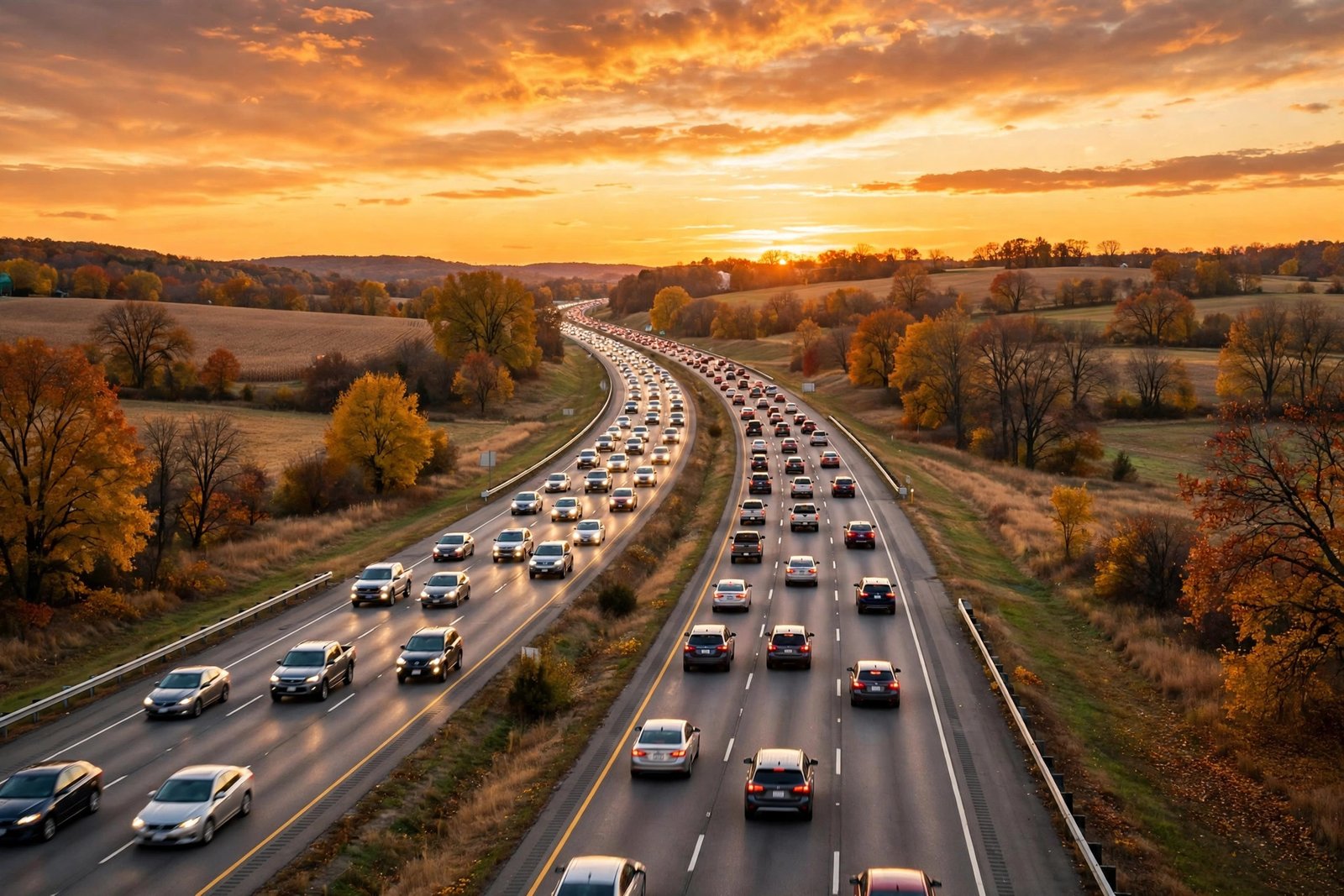
Thanksgiving week is almost here, and tens of millions of Americans are about to pack a bag, fill the tank, and head for home. AAA says 81.5 million people will travel at least 50 miles from home between Tuesday, November 24, and Monday, November 30, 2026. It is a staggering number, nearly one in four Americans on the move in a single week, and it comes with a twist: for the first time in three years, the total is slightly down instead of setting a new record. The dip is tiny, about 121,000 fewer travelers than last year, but it tells a story about what travel costs in America right now.
AAA released its forecast on Monday, November 16, and the message behind the numbers is simple. People still want to gather for Thanksgiving, and almost all of them still will. Higher gas prices and pricier plane tickets are trimming the edges of the holiday rush, not stopping it. As AAA Travel Vice President Stacey Barber put it, after three years of record highs, the number of travelers is slightly lower partly because of higher travel costs this year, but travelers will not notice much of a difference. If you are on the road or in an airport next week, that prediction will feel very true. The highways will still be full, the security lines will still be long, and the turkey will still be waiting at the other end.
The Headline Number: 81.5 Million Travelers
AAA projects 81.5 million Americans will travel at least 50 miles from home for Thanksgiving 2026. The holiday travel period runs seven days, from Tuesday, November 24, through Monday, November 30, with Thanksgiving Day itself falling on Thursday, November 26. Last year, 81.6 million people made the trip, so this year is down just 0.1 percent, roughly 121,000 fewer travelers.
That small decline ends a three-year streak of record Thanksgiving travel that began in 2023. Since the pandemic travel rebound, each Thanksgiving had topped the one before it. This year breaks the pattern, and AAA points squarely at cost. Gasoline and airfares are both running well above last year, and while most families absorb the extra expense for a holiday that matters this much, some at the margins are staying home, shortening trips, or driving instead of flying.
Why the Record Streak Is Ending: It Comes Down to Cost
Two prices explain almost the whole story. Regular gasoline averaged $3.82 a gallon on November 15, 2026, compared with $3.08 a year earlier, according to AAA. That is about 74 cents more per gallon, and if prices hold near current levels through Thanksgiving Day, gas would be more expensive on the holiday than ever before. The previous Thanksgiving Day record was $3.58 a gallon, set in 2022. Gas prices have eased a little in recent days, but they remain well above where they were last fall, and for a family driving several hundred miles each way, the difference adds up fast.
Airfare tells the same story from the sky. Round-trip domestic flights booked through AAA for the Thanksgiving period averaged $800, up about 17 percent from last year. Government data cited in coverage of the forecast showed airfares running more than 22 percent higher in September than the same month a year earlier, with baggage fees climbing too. Aviation analytics firm Cirium reported that Thanksgiving flight bookings were running about 1.6 percent behind last year as of late October, which lines up with AAA expecting slightly fewer flyers.
By Car: 72.9 Million Drivers Hit the Road
Driving remains the overwhelming way Americans get to Thanksgiving. AAA projects 72.9 million people will travel by car, down slightly from 73.1 million last year, a drop of about 200,000 drivers. That is still nearly 90 percent of all Thanksgiving travelers, and it means the interstates will be the busiest place in America next week.
The good news for drivers is that gas prices, while high compared with last year, have been drifting down in the days before the holiday. The bad news is that even at lower prices, filling up costs noticeably more than it did a year ago. A driver covering 500 miles round trip in a car that gets about 30 miles per gallon will use roughly 17 gallons, and at $3.82 a gallon that is about $65 in fuel, versus about $52 at last year’s $3.08. It is not a trip-canceling difference, but it is the kind of thing families notice when the whole holiday budget is already stretched.
Best and Worst Times to Drive, According to INRIX
Timing is the single biggest lever drivers have. INRIX, the transportation data company that builds the traffic forecast with AAA, expects the busiest days on the road to be Tuesday and Wednesday as travelers head out, and Sunday and Monday as they come home. The worst congestion hits in the afternoon and early evening, so the advice is simple and consistent: leave in the morning.
Here is the day-by-day picture from INRIX, with times in local time for each metro area:
- Tuesday, November 24: worst from 2 p.m. to 8 p.m.; best before 1 p.m.
- Wednesday, November 25: worst from noon to 7 p.m.; best before noon.
- Thursday, November 26 (Thanksgiving Day): minimal traffic expected.
- Friday, November 27: worst from 1 p.m. to 7 p.m.; best before noon.
- Saturday, November 28: worst from noon to 9 p.m.; best before 11 a.m.
- Sunday, November 29: worst from noon to 8 p.m.; best before 11 a.m.
- Monday, November 30: worst from 2 p.m. to 7 p.m.; best before 1 p.m.
INRIX also flags the specific routes where traffic will run furthest above normal at peak times. In the New York area, for example, the drive from New York City to the Hamptons on the Long Island Expressway eastbound on Tuesday afternoon is projected to take more than four hours, running far above its normal time. Big metro areas including New York, Washington, Los Angeles, and Boston are expected to see congestion more than double its normal levels at the worst moments of the week.
Flying: 5.96 Million Passengers and $800 Average Fares
AAA projects 5.96 million travelers will take domestic flights for Thanksgiving, down 0.2 percent from last year, or about 12,000 fewer flyers. Airlines for America, the industry trade group, separately expects U.S. airlines to carry nearly 29 million passengers between November 20 and November 30, a wider window that includes the weekend before the AAA travel period begins. The two counts measure different things, but they agree on the same picture: planes will be full.
With average round-trip fares around $800 through AAA bookings, flying is where the cost squeeze bites hardest. Families of four can easily spend more on tickets than on everything else about the trip combined. If you have already booked, your fare is locked in, and the best move now is to protect the trip itself. Arrive at the airport earlier than you think you need to, carry essentials like medication and phone chargers in your carry-on, and download your airline app so you get rebooking options pushed to your phone before you ever reach a customer service line.
The FAA Ground Stop: What Happened on November 13
There is one big caveat hanging over this year’s forecast, and AAA is upfront about it. The forecast was prepared in mid-October, before a nationwide air traffic ground stop on Friday, November 13, temporarily halted most U.S. flights. The FAA issued the ground stop at 3:54 p.m. Eastern after a telecommunications outage hit air route traffic control centers, and lifted it around 8:15 p.m., a little more than four hours later. It was the longest nationwide ground stop since September 11, 2001, and only the second one since then.
The disruption was enormous on the day itself. More than 1,000 flights were canceled and nearly 10,000 delayed on Friday, with thousands more cancellations the following day as planes and crews sat in the wrong cities. Transportation Secretary Sean Duffy blamed aging equipment in the air traffic control network, and officials said the cause was a telecommunications failure, not a cyberattack. The FAA has since said flights are back up and operational and that it expects the system to be running normally by Thanksgiving, but it has also cautioned that some lingering schedule adjustments are possible as airlines finish repositioning aircraft and crews.
Where Everyone Is Going: Florida on Top Again
Florida dominates AAA’s list of the most popular domestic Thanksgiving destinations, based on trips booked through AAA Travel. Orlando ranks first, followed by Fort Lauderdale at No. 2 and Miami at No. 3, with Tampa at No. 6, giving Florida four cities in the top 10 and a clean sweep of the top three. Anaheim and Los Angeles, California, come in fourth, New York City fifth, and Las Vegas seventh. Warm weather, theme parks, and family gatherings in the Sunshine State are a powerful combination, and Florida has topped this list before.
Rental car demand tells a similar story. Hertz says Orlando, Phoenix, Las Vegas, Atlanta, and Denver are the cities with the highest rental demand based on advance bookings, which suggests plenty of travelers are flying into a hub and then driving the last leg. If your destination is one of those cities, book your rental car now if you have not already, and confirm the reservation the day before you travel. Rental fleets at popular holiday airports can sell out, and walk-up prices are rarely kind.
Internationally, AAA’s top destinations for its members are led by Budapest, Hungary, followed by Cancun, Mexico, and Paris, France. Those trips are a small slice of Thanksgiving travel overall, but they show that for some Americans, the holiday is a chance to get far away rather than come home.
Buses, Trains, and Cruises: The 2.6 Million
Not everyone drives or flies. AAA projects 2.6 million Americans will travel by bus, train, or cruise for Thanksgiving, up 4.1 percent from last year, making it the only travel mode that is growing. Part of that growth reflects travelers looking for cheaper alternatives to $800 flights, and part reflects the simple appeal of letting someone else do the driving.
Trains are an especially good fit for the Northeast corridor and other city-to-city routes, where Amtrak can beat both driving and flying on total trip time once airport and traffic delays are counted. Buses are the budget option on many routes, though they share the highways with all those cars, so the same INRIX timing advice applies. Cruises over the holiday week appeal to families that want the gathering and the getaway in one package. Whatever the mode, the same rule holds: book early, arrive early, and keep your confirmation and ID where you can reach them.
How to Make the Trip Cheaper and Calmer
A few practical moves can still take the edge off a pricey travel week. For drivers, gas prices vary widely by state and even by neighborhood, so use AAA’s gas price tracker to find the cheapest fuel along your route rather than filling up at the first station off the interstate. Keeping your speed steady and your tires properly inflated also stretches each gallon a little further.
For flyers, packing light is real money now that baggage fees have climbed. If you can fit everything in a carry-on, you skip both the fee and the wait at baggage claim, and you keep your belongings with you if a flight is delayed or changed. Bring snacks and an empty water bottle to fill after security, since airport food prices are not getting any friendlier.
Related reading
- Thanksgiving Travel 2026: Best and Worst Days to Hit the Road
- Thanksgiving Turkey Prices in 2026: What Dinner Will Cost This Year
- USPS Holiday Shipping Deadlines 2026: When to Mail Your Gifts
Frequently Asked Questions
How many Americans are traveling for Thanksgiving 2026?
AAA projects 81.5 million Americans will travel at least 50 miles from home between Tuesday, November 24, and Monday, November 30, 2026. That is down 0.1 percent, or about 121,000 fewer travelers, from 81.6 million in 2025.
What are the best and worst times to drive for Thanksgiving?
According to INRIX, the worst times are Tuesday, November 24, from 2 p.m. to 8 p.m. and Wednesday, November 25, from noon to 7 p.m. On the way home, Sunday from noon to 8 p.m. and Monday from 2 p.m. to 7 p.m. are the busiest. The best times are mornings: before 1 p.m. Tuesday, before noon Wednesday, and before 11 a.m. on Saturday and Sunday. Thanksgiving Day has minimal traffic.
How much is gas for Thanksgiving 2026?
Regular gasoline averaged $3.82 a gallon on November 15, 2026, compared with $3.08 a year earlier, according to AAA. If prices hold, that would be the most expensive Thanksgiving Day gas on record, above the previous record of $3.58 set in 2022.
How much are Thanksgiving flights in 2026?
Round-trip domestic flights booked through AAA averaged about $800 for the Thanksgiving period, up about 17 percent from last year. AAA expects 5.96 million people to fly domestically during the holiday week.
Will the FAA ground stop affect Thanksgiving travel?
AAA’s forecast was prepared before the nationwide ground stop on November 13, so it does not account for any lingering effects. The FAA says flights are back up and operational and expects normal operations by Thanksgiving, but travelers should still check flight status, allow extra time, and know that a canceled flight entitles them to a full refund if they choose not to travel.
AAA’s full forecast is available through AAA’s Thanksgiving travel release, and the Associated Press coverage of the forecast, including the gas price record, is reported here. For destination trends, see the Florida destination breakdown. Drivers can check current fuel prices at AAA’s gas price tracker, check airspace status at the FAA, review airport screening guidance from the TSA, and explore the traffic data behind the drive-time forecasts at INRIX.