
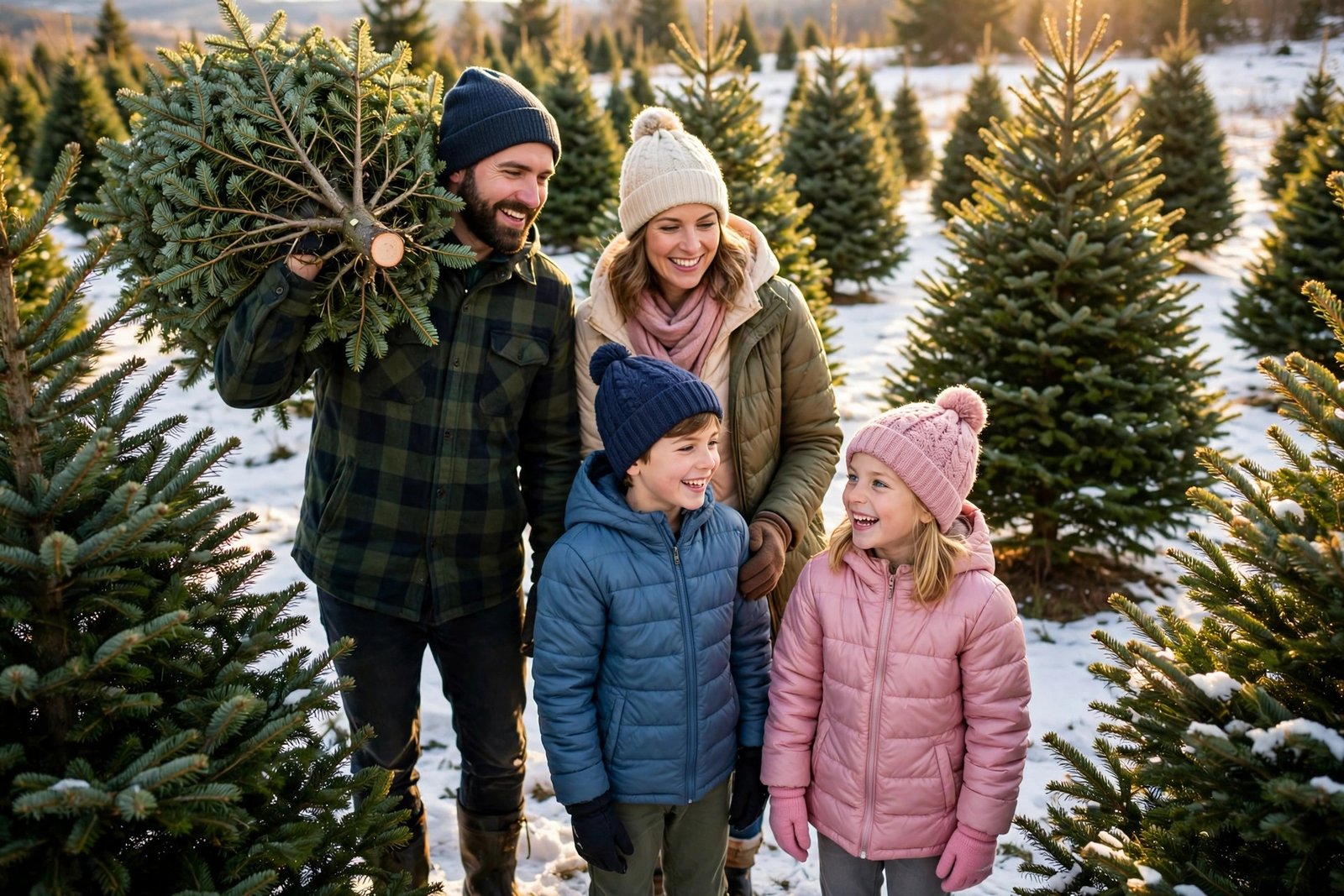
There is a particular kind of quiet you only find in a Christmas tree field in late November. The air smells of pine resin and wood smoke, your breath fogs, and somewhere between the rows a family is happily arguing about whether the tall skinny one or the short fat one is the tree. Cutting your own Christmas tree is one of the oldest American holiday traditions, and in 2026 it is more popular than ever, as families trade crowded tree lots for a morning in the fields, a saw in hand, and a tree they picked themselves.
Why Cut Your Own Tree Instead of Buying One at a Lot?
A tree lot is convenient, but a farm is an experience — and, in most cases, a fresher tree. A tree cut at a lot may have been harvested weeks earlier and shipped hundreds of miles. A tree you cut yourself was standing in the field minutes before it went on your roof. That freshness shows up in the needles: a just-cut tree holds its needles longer, smells stronger, and drinks water eagerly once it is in the stand.
When Do Christmas Tree Farms Open for the 2026 Season?
Most cut-your-own farms open the weekend before Thanksgiving or on the Friday after Thanksgiving, and many are only open on weekends or for a short run of dates. Thanksgiving falls on November 26 in 2026, so the big opening weekend for most farms is Friday, November 27.
The practical lesson is simple: go early in the season if you want the widest choice, and go early in the day if you want the best trees. Opening weekends draw the biggest crowds, and the straightest, fullest trees in the most popular sizes go first.
The Best Cut-Your-Own Farms by Region
The Northeast: The Rocks, Bethlehem, New Hampshire
The Rocks is a 19th-century estate in the White Mountains run by the Society for the Protection of New Hampshire Forests, and it is one of the most scenic places in America to cut a Christmas tree. Every tree this season is cut-your-own, with the Presidential Range on the horizon and horse-drawn wagon rides on selected days. The farm opens Saturday, November 21, from 10 a.m. to 3 p.m., then runs daily from November 27 through December 13. No reservations are needed, but the farm advises visitors to use its own directions rather than a map app. Details are on the farm’s listing in a 2026 Christmas tree farm road-trip guide that checks each farm’s own website.
The Mid-Atlantic: Linvilla Orchards, Media, Pennsylvania
Just outside Philadelphia, Linvilla Orchards is the easy pick for families who want a real field without a long drive. The farm offers choose-and-cut trees along with its Christmasland displays, and staff will tie the tree to your car for the trip home. Linvilla is also featured in the same 2026 farm road-trip guide, which pairs six choose-and-cut farms with nearby downtowns.
The Southeast: Frosty’s Choose and Cut, West Jefferson, North Carolina
Ashe County, in North Carolina’s High Country, is the heart of Fraser fir country, and Frosty’s Choose and Cut sits on the hillsides just outside West Jefferson. Its weekends feel like a small fair, with a gift barn, treats by the fire, a trolley ride, and visits with Santa. The 2026 season opens Friday, November 20, at 3 p.m., then runs November 20–22, November 27–29, and December 4–6, closing on Thanksgiving Day. Farm details appear in the 2026 road-trip guide.
The Midwest: Wisconsin’s Tree Farm Country
Wisconsin grows a lot of Christmas trees, and the Green Bay area alone has a long list of family farms opening for 2026. Aissen Tree Farm opens November 21 for cut-your-own, daily from 9 a.m. to 4:30 p.m. until sold out, with a gift shop, free tree shaking, and dogs welcome. Balsam Creek Lane Tree Farm in Bear Creek opens November 27, 28, and 29 and December 5 and 6, from 9 a.m. to 4 p.m., with cut-your-own trees 12 feet and under priced at $70. Trudell’s Christmas Tree Farm opens November 27, 2026, and runs weekends from 9 a.m. to 4 p.m. with cut-your-own and pre-cut trees and wreaths. The full local list is kept in the Green Bay Christmas tree farms guide.
The Pacific Northwest: Oregon and Washington
Oregon is Christmas tree country, and the Portland area has one of the deepest benches of u-cut farms in the nation. Christmas Mountain Choose and Cut in Scappoose offers early access November 21–22, with the regular season running November 27 through December 20, 2026; a reservation is required per vehicle on November 27–29 and December 5–6. Thorntons’ Treeland in Vancouver, Washington, a 50-acre farm, runs a pre-season farm festival on November 7–8, 14–15, and 21–22, with a tree maze, hayrides, a petting zoo, and food trucks. Furrow Farm in Hillsboro opens November 27, with saws, twine, and tree baling provided and a free weekend tractor ride. Helvetia Christmas Tree Farm, also in Hillsboro, runs November 27–29 and December 5–6 from 9 a.m. to 4 p.m., with u-cut or pre-cut trees from 5 to 9 feet priced at $75, shaking included and baling $5 extra. All of these farms are listed in the Portland-area u-cut tree farms guide.
California: The Sierra Foothills and the National Forests
In California’s Gold Country, Anderson Christmas Tree Farm in Murphys opens for choose-and-cut on Friday, November 27, and is then open every day from 10 a.m. to 4 p.m. until it sells out. The farm was planted by Charlie Anderson starting in 1990 and now runs across three generations of the family; its fields grow Douglas fir, Scotch pine, cedar, and sequoia, with fresh-cut silvertip, noble, Douglas, and Nordmann firs brought in from Oregon. Tabletop Christmas Tree Farm in Groveland opens the same day, November 27, daily from 9 a.m. to 3 p.m. through December 6, growing Douglas fir, white fir, and blue spruce. Both farms are covered in a 2026 cut-your-own guide for the 209 region.
For the truly adventurous, a national forest permit is the cheapest way to cut a tree in California. The Stanislaus National Forest permit for 2026 runs November 27 through December 31, costs $20 per tree plus a $2.50 processing fee, and covers up to two trees. The Eldorado National Forest permit costs $10 per tree. Forest permits come with rules — you must cut in designated areas, away from roads and campgrounds, and you need to check the forest’s cutting map before you go.
Fraser Fir vs. Douglas Fir vs. Noble Fir: Which Tree Should You Pick?
Three species dominate American Christmas tree farms, and each has a distinct personality.
The Fraser fir is America’s bestseller and the classic eastern tree. It has short, dense, dark-green needles with a silvery underside, strong branches that hold heavy ornaments, and outstanding needle retention — a fresh-cut Fraser kept watered routinely lasts four to five weeks indoors. The trade-off is price: a 6- to 7-foot Fraser typically runs $90 to $150, at the top of the range at most lots.
The Noble fir is the West Coast standard, grown mainly in Oregon and Washington. It has stiff, blue-green needles arranged so the branches form distinct horizontal tiers, and each branch can hold significant weight, making it the go-to species for collectors with heavy glass or metal ornaments. Needle retention rivals Fraser at four to five weeks, and the scent is light and fresh. Nobles are often the most expensive species, typically $100 to $160 for a 6- to 7-foot tree.
The Douglas fir is the softest and fullest of the three, with needles that point in every direction to give the tree a dense, bushy look and a sweet, mild scent. It is also the budget pick, typically $60 to $110 for a 6- to 7-foot tree. The catch is that Douglas branches are soft, so heavy ornaments will pull them down, and needle retention is shorter, at about three weeks. These comparisons come from a 2026 Christmas tree types comparison and a species guide based on university extension services.
How Much Does a Cut-Your-Own Tree Cost in 2026?
Prices vary by region, species, and height, but the pattern is consistent: you pay more for a taller tree and for a Fraser or Noble fir than for a Douglas fir or pine. At the farm level, the verified 2026 prices we found are refreshingly modest. Helvetia Christmas Tree Farm in Oregon charges $75 for a u-cut or pre-cut tree between 5 and 9 feet. Balsam Creek Lane in Wisconsin charges $70 for a cut-your-own tree 12 feet and under. National forest permits are cheaper still — $20 per tree in the Stanislaus and $10 in the Eldorado, plus small processing fees.
At retail lots, a 6- to 7-foot tree generally runs $60 to $160 depending on species, with Douglas fir at the low end and Noble fir at the high end, according to the 2026 species comparison cited above. Farm prices are often lower than lot prices for the same tree, and the price at a farm usually includes the sawing, shaking, and baling. Bring cash as well as a card — a few smaller farms are still cash or check only.
How to Choose the Perfect Tree in the Field
Start by measuring your space before you leave home — ceiling height, the width of the spot, and the size of your stand. A tree always looks smaller standing in a field than it will in your living room, so bring a tape measure and measure the tree before you cut it. Leave at least six inches of clearance below the ceiling for the topper.
Test freshness the way the extension services recommend. Grab a branch and pull your hand toward you: if the needles come off easily, the tree is already dry. Bend a twig — it should flex, not snap. If the tree drops a shower of brown needles when you shake it gently, keep walking.
Cutting, Baling, and Getting Your Tree Home
Most farms provide saws, so you usually do not need to bring your own — but a pair of work gloves and sturdy boots are worth packing. Cut low and level, as close to the ground as you can, with a straight cut across the trunk. A straight cut matters: it lets the trunk sit flat in the stand and drink water properly, while an angled or V-shaped cut can actually reduce water uptake.
For the drive home, lay the tree with the trunk facing forward if it goes on the roof, so the wind presses the branches backward rather than peeling them forward. Tie it at the trunk, the middle, and the tip, and use a blanket or tarp under it to protect your paint. If the tree goes inside an SUV or truck bed, that is even better — a tree tied to a roof rack on a long highway drive dries out fast.
Keeping Your Tree Fresh and Safe at Home
The moment you get home, get the tree into water. If more than twelve hours have passed since it was cut, saw a fresh disk — about a half inch thick — straight across the bottom of the trunk before it goes in the stand. That fresh cut reopens the wood so the tree can drink; once the cut end dries out and seals with resin, the tree cannot take up water at all. Use a stand that holds about one quart of water per inch of trunk diameter, at least a gallon for most trees, and check the water every day, especially in the first week, when a fresh tree can drink a gallon or more a day. Plain tap water is all it needs — extension services agree that sugar, aspirin, bleach, and commercial preservatives do not help. This advice comes from Mississippi State University Extension and Purdue University Extension.
Placement matters as much as watering. Keep the tree at least three feet from fireplaces, heaters, radiators, and sunny windows, and use LED or mini lights, which run cooler than older incandescent strings. Inspect light wires for cracks or frays before you hang them, do not overload outlets, and turn the lights off when you leave the house or go to bed. A well-watered tree is a much safer tree: a fresh tree does not just burst into flames, but a dried-out one can, and keeping the stand full is the single best fire-safety step you can take.
Finally, know when to say goodbye. When the needles turn brittle, break easily, or rain off in your hand, it is time to take the tree down.
Related reading
Keep the holiday season going with more from Famus News: The American Christmas Tree Tradition, The National Christmas Tree Lighting 2026 Guide, and USA Christmas Light Displays 2026 Guide.
Frequently Asked Questions
When is the best time to cut your own Christmas tree? The weekend after Thanksgiving is the traditional start of the season, and most farms open then. If you want the widest choice, go on opening weekend or the first weekday after it.
How much does a cut-your-own Christmas tree cost? It varies by region and species. Verified 2026 farm prices include $75 for a 5- to 9-foot tree at Helvetia in Oregon and $70 for a tree up to 12 feet at Balsam Creek Lane in Wisconsin. Retail lots generally charge $60 to $160 for a 6- to 7-foot tree depending on species.
What is the best type of Christmas tree for heavy ornaments? Fraser fir and Noble fir, both of which have stiff branches and excellent needle retention of four to five weeks. Douglas fir is softer and better suited to light ornaments.
How long will a real Christmas tree last indoors? A fresh-cut fir kept in water typically lasts four to five weeks, while a Douglas fir lasts about three weeks. Keep the stand full every day, keep the tree away from heat sources, and take it down when the needles turn brittle.
Can I cut a Christmas tree in a national forest? Yes, with a permit. The Stanislaus National Forest permit for 2026 costs $20 per tree plus a $2.50 fee, and the Eldorado permit costs $10 per tree.