
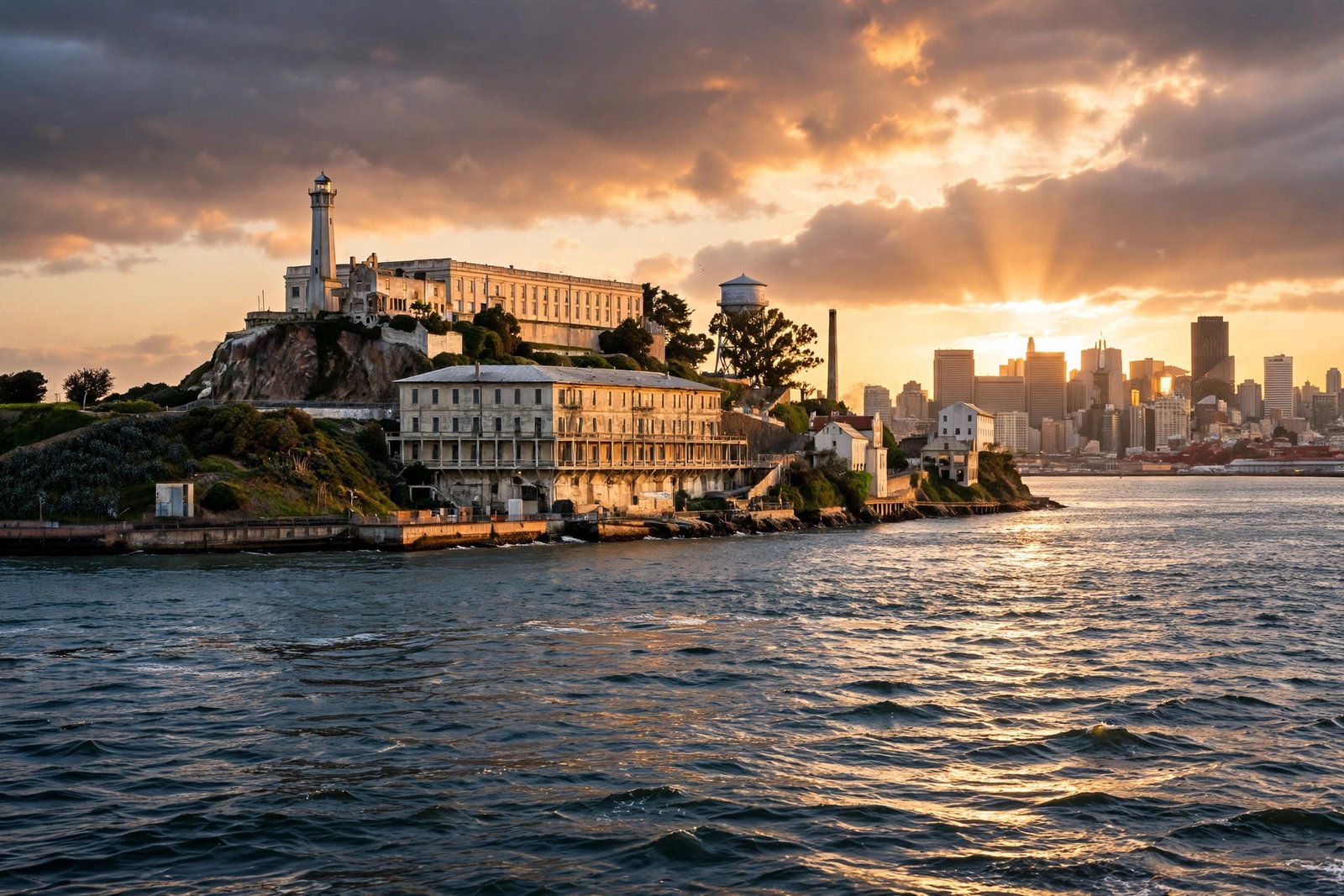
On the morning of June 12, 1962, a guard making a routine head count in Alcatraz’s B Block found three prisoners apparently still asleep in their cells. He went to wake them — and discovered that the “sleeping men” were dummy heads made of papier-mâché, painted to look like faces, with real human hair glued on. The real men were gone. Frank Morris and the brothers John and Clarence Anglin had slipped out of the most escape-proof prison in America, crossed the roof, climbed down a smokestack, and vanished into the dark water of San Francisco Bay on a raft made from raincoats. More than sixty years later, no one knows for certain whether they lived or died.
The Alcatraz escape of 1962 is the most famous prison break in American history, and it remains unsolved. The FBI spent seventeen years investigating and concluded the three men most likely drowned. The U.S. Marshals Service kept the case open for decades. Family members insist the men survived and built new lives in South America.
The Rock: America’s Escape-Proof Prison
Alcatraz Island sits about a mile and a quarter off the San Francisco shore, in the middle of cold, fast-moving bay water. The island had been a military fort and a military prison since the 19th century, but it became a federal penitentiary in 1934, when the Department of Justice took it over to hold the prisoners other federal prisons could not handle — the troublemakers, the escape artists, the men considered too dangerous for anywhere else. The first batch of 137 prisoners arrived on August 11, 1934, and the roster over the years included Al Capone.
Life inside was deliberately harsh: strict routine, silence in the cellhouse, minimal privileges, and cells just nine feet by five. The island itself was part of the security system. The water around Alcatraz is cold — cold enough to sap a swimmer’s strength in minutes — and the currents run fast toward the Golden Gate and the open Pacific. No fresh water existed on the island; nearly a million gallons a week had to be shipped in from the mainland, and the same boats carried the waste away. That expense, more than any escape, is what finally closed the prison. On March 21, 1963, less than a year after the great escape, Alcatraz shut its doors for good. The closure had been decided before the escape, and the escape is thought by some to have helped push the decision along, but the official reason was cost. Today the island is part of the Golden Gate National Recreation Area, run by the National Park Service, and it is one of San Francisco’s most popular attractions. The island was closed from October 26 to November 18, 2026, for dock repairs, according to San Francisco Travel, and has since reopened to visitors arriving by ferry from Pier 33. The full history is set out by Britannica and History.com, with visitor details from San Francisco Travel.
The Men Behind the Plan
Frank Lee Morris was born on September 1, 1926, in Washington, D.C., and grew up in foster homes. By the time he reached Alcatraz he had already built a reputation as an escape artist, having broken out of a Louisiana facility, and his prison file flagged him as such. He was also known for a high IQ, often reported as 133, and for a cool, methodical temperament. The Anglin brothers, John William Anglin, born May 2, 1930, and Clarence Anglin, born May 11, 1931, grew up in a family of thirteen children in Donalsonville, Georgia. They were bank robbers: in January 1958, with an older brother, they robbed a bank in Alabama using a toy gun, were caught five days later in Ohio, and received long sentences. They served time in Florida, at Leavenworth, and at Atlanta, where they met Morris, before prison officials — wary of their determination — sent them to Alcatraz.
A fourth man, Allen West, was part of the plan from the start. On the night itself, West could not get his ventilator grill off in time, and he was left behind. He later told investigators everything he knew, and his account became one of the main sources for how the escape was carried out. The basic facts of the escape — the date, the men, the dummy heads, the raft — are documented in the June 1962 Alcatraz escape account, which draws on the FBI investigation.
Six Months of Quiet Preparation
The plan began in December 1961, about six months before the escape, and it was a masterpiece of patience. The men worked at night, in short stretches, using tools they had stolen or improvised. They used spoons taken from the mess hall to chip away at the concrete around the air vents at the back of their cells, and a drill powered by a vacuum cleaner motor to speed the work. The vents were only about six by ten inches, but over months the men widened the holes enough to crawl through. During the day they covered the openings with suitcases or cardboard so nothing looked out of place.
Behind the cell walls was an unguarded utility corridor, a narrow space between the cell block and the outer wall. That corridor became their workshop. There, hidden from the guards, they built the two most important pieces of the escape: the dummy heads and the raft. The heads were made from plaster, papier-mâché, soap, and paint, with human hair swept up from the prison barbershop glued on top and pillows tucked under the blankets to suggest bodies. They were crude up close but convincing in a dark cell at a glance — convincing enough to fool the evening checks on June 11.
The raft was even more ambitious. The men stole more than fifty prison-issue raincoats and stitched and glued them together with contact cement, sealing the seams with heat from the prison’s steam pipes. They also made life vests from the same material, and rigged a pump from a musical instrument — an accordion or concertina, by most accounts — to inflate the raft. The finished raft was about six feet by fourteen, big enough to carry three men and their gear.
The Night of June 11, 1962
On the night of June 11, 1962, the men put the dummy heads in their beds, slipped through the holes behind their cells into the utility corridor, and climbed up through the ventilation shaft to the cellhouse roof. From there they shimmied down the bakery smokestack, climbed over the fence, and made their way to the northeast shore of the island, where they inflated the raft and launched it into the bay. Allen West, still stuck behind his vent grill, stayed in his cell and said nothing. The escape was discovered only at the morning head count on June 12, when guards found the dummy heads and empty cells. The date is confirmed across the historical record: the escape happened on the night of June 11, 1962, and was discovered on the morning of June 12.
What happened after the launch is where fact ends and the mystery begins. Nobody saw the raft leave the island. A search by the FBI, the Coast Guard, and local police swept the bay by air, sea, and land. The search found fragments: a paddle and other debris washed up, and a sealed packet containing names, addresses, and photographs belonging to the Anglin family, carefully wrapped in rubber to keep it dry, was recovered near Angel Island.
The FBI’s Verdict: They Most Likely Drowned
The FBI investigated the escape for seventeen years, pursuing hundreds of leads. In 1979 the bureau officially concluded, on the basis of circumstantial evidence and the preponderance of expert opinion, that the three men likely drowned in the frigid waters of San Francisco Bay while trying to reach the mainland. The FBI closed its file on December 31, 1979. The reasoning was straightforward: the bay water is cold enough to cause hypothermia quickly, the currents are strong and unpredictable, and the raft — however cleverly built — was a homemade inflatable made of raincoats, not a seaworthy boat. The debris found afterward was consistent with a raft that had broken up in the water.
But the FBI’s conclusion was never proof. No bodies were ever recovered, and the bureau itself acknowledged that the evidence was circumstantial. The U.S. Marshals Service, which took over the fugitive case, kept its file open and active for decades, and the three men remained on its wanted list until September 2026, according to the historical record.
The Case for Survival: MythBusters and the Tide Models
The most famous test of the escape came from television. In a 2003 episode of MythBusters, first aired on December 12, 2003, Adam Savage and Jamie Hyneman rebuilt a raincoat raft using period materials and paddled it across San Francisco Bay at night. They reached the Marin Headlands. The show’s conclusion was that the escape was possible — that three men on a raincoat raft could have made it to shore.
A more scientific test came a decade later. Researchers at Delft University of Technology in the Netherlands, working on flood models for San Francisco Bay, simulated the escape using the tide data from the night of June 11, 1962. They released virtual “boats” every thirty minutes between 8 p.m. and 4 a.m. from a range of starting points around the island. Their finding was that the outcome depended almost entirely on what time the men launched. If they left around 10 p.m., the outgoing tide would have carried them west toward the Golden Gate Bridge and out to sea. But if they launched around 11:30 p.m., the currents could have carried them to land north of the Golden Gate — and the debris found later at Angel Island would be consistent with that route. The research was covered by Live Science and explained in detail by the American Institute of Physics.
The 2013 Letter and the Brazil Photograph
In 2018, the FBI disclosed the existence of a letter received by the San Francisco Police Department in 2013. The writer claimed to be John Anglin, said that he, his brother, and Morris had all made it off the island that night, and offered to surrender in exchange for medical treatment and a short sentence. The letter said Morris and Clarence were both dead by then. Reports of the letter’s exact contents differ — one account says it claimed Morris died in 2008 and Clarence in 2011, while another account, quoting the letter directly, says Morris died in October 2005 and Clarence in 2011 — and the letter itself said the writer was 83 years old and suffering from cancer. The FBI’s laboratory examined the letter, and the results were inconclusive: the testing neither confirmed nor ruled out that John Anglin wrote it. The letter is real — the FBI confirmed receiving it — but whether its claims are true is unproven, and it could equally be a hoax.
The other famous piece of evidence is a photograph. In 2015, the Anglin family publicized a photo said to show John and Clarence in Brazil in 1975, taken by Fred Brizzi, a childhood friend of the brothers, on a farm near Rio de Janeiro. A later facial-recognition analysis was said to support the identification, but the claim is disputed: an expert working for the U.S. Marshals Service did not believe the photograph was legitimate, and measurements of the men’s physical characteristics were said to indicate they are not the men in the photo. The photograph remains unverified, and no official investigative body has authenticated it.
Why the Mystery Endures
Part of the answer is the escape itself. The dummy heads, the spoons, the raincoat raft — it reads like a movie, and Hollywood noticed: the 1979 film Escape from Alcatraz, starring Clint Eastwood as Frank Morris, fixed the story in the popular imagination the same year the FBI closed its case.
Today, visitors can stand in the cells where it happened. The National Park Service runs the island as a historic site, and the cellhouse audio tour tells the story of the escape in the place where it was planned. The dummy heads are part of the exhibit. If you go, book the ferry in advance — tours sell out, especially in summer and around the holidays — and allow two to three hours on the island.
Related reading
More American mysteries from Famus News: The D.B. Cooper Hijacking Mystery Explained, The Bermuda Triangle Mystery Explained, and Area 51 Mystery Explained.
Frequently Asked Questions
When did the Alcatraz escape happen? The escape took place on the night of June 11, 1962. Frank Morris and John and Clarence Anglin left their cells that night, and the escape was discovered at the morning head count on June 12, 1962.
Who escaped from Alcatraz in 1962? Three men: Frank Morris, a bank robber known as an escape artist, and the brothers John and Clarence Anglin, also bank robbers.
How did they escape from Alcatraz? Over about six months, they chipped holes through the walls behind their cells using spoons and an improvised drill, then crawled into an unguarded utility corridor. They left papier-mâché dummy heads in their beds to fool the guards, climbed to the cellhouse roof, shimmied down a smokestack, and launched a raft made from more than fifty raincoats into San Francisco Bay.
Did Frank Morris and the Anglin brothers survive? It is not known. The FBI concluded in 1979 that they most likely drowned, but no bodies were ever found and no conclusive evidence of their fate has ever surfaced. The U.S. Marshals Service kept the case open and active for decades.
What is the 2013 Alcatraz letter? A letter sent to the San Francisco Police Department in 2013, disclosed by the FBI in 2018, claimed to be from John Anglin and said all three men survived the escape. FBI laboratory testing of the letter was inconclusive, and its claims remain unverified.
Can you visit Alcatraz today? Yes. Alcatraz Island is a National Park Service site in the Golden Gate National Recreation Area, reached by ferry from Pier 33 in San Francisco. Book tickets in advance, allow two to three hours, and note that the island was closed for dock repairs from October 26 to November 18, 2026.