
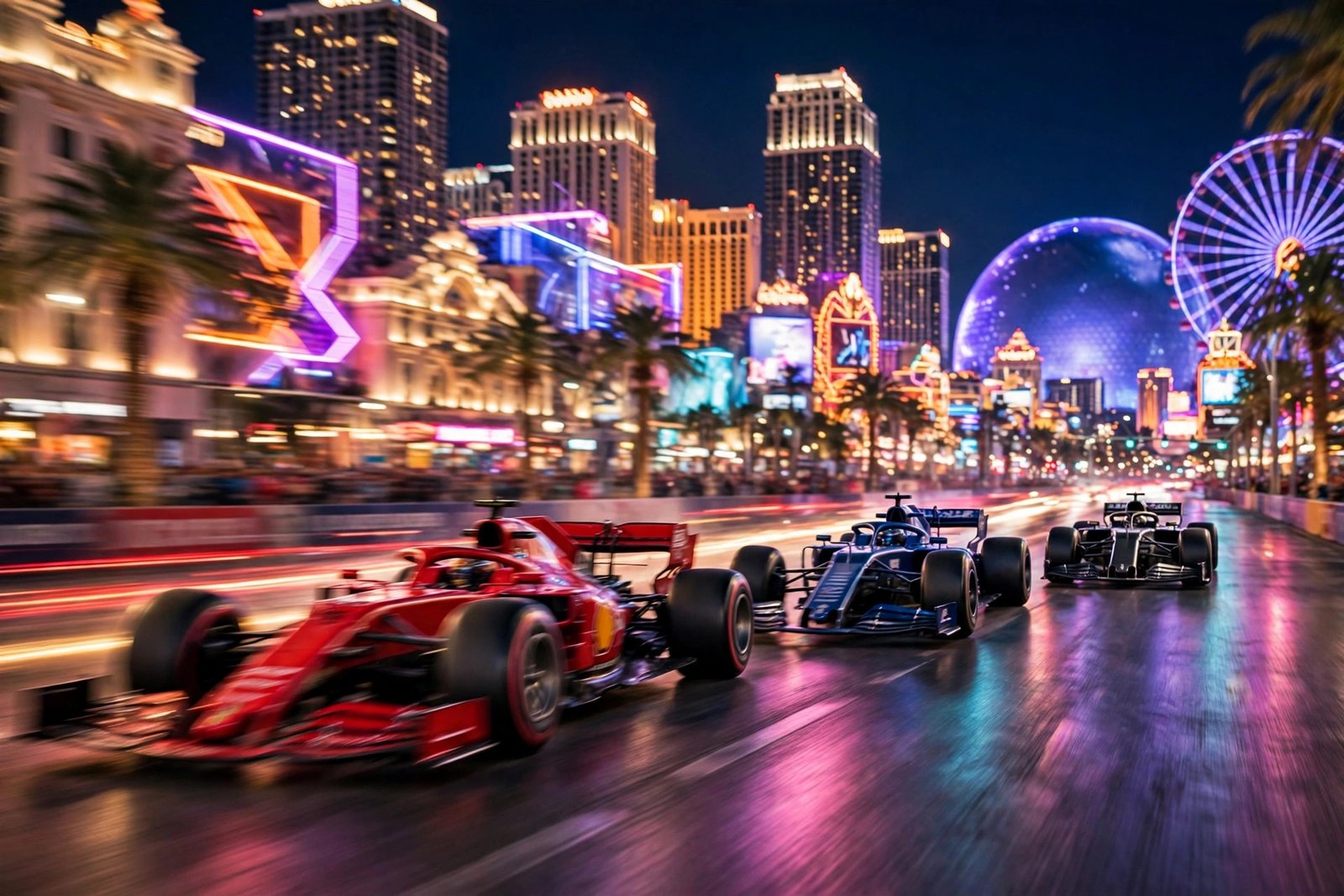
Formula 1 came to Las Vegas promising a show, and on Saturday night, November 21, 2026, the sport delivered one of the wildest races in its modern history. Max Verstappen won the Las Vegas Grand Prix for the third time in four years, but the result barely tells the story. Over 50 laps around the Strip circuit, the lead changed hands 35 times and cars swapped positions 352 times, and no driver could hold the front for long before somebody came straight back at him. When the checkered flag finally fell, Verstappen beat Lando Norris by just 0.639 seconds, with Oscar Piastri third, and the paddock was left searching for words to describe what it had just seen.
“That was crazy. Really, really surreal and something I’ve never seen before in Formula One myself,” Verstappen said afterwards, and his rivals agreed. Norris called it the most chaotic race ever in the history of Formula 1, admitting he barely knew what was happening half the time. The win was the 75th of Verstappen’s career and his fourth of the 2026 season, all of them coming in the last six races. Yet the championship had already been decided before the cars arrived in Nevada: Mercedes had wrapped up both titles, and 20-year-old Kimi Antonelli had become the youngest world champion in Formula 1 history earlier in November. What remained was a scrap for second place in the standings, pride, and pure entertainment. The drivers delivered all three.
A race that never sat still
From the moment the lights went out, the race refused to settle. Verstappen started from pole only because Antonelli, fastest in qualifying, carried a grid penalty for exceeding his allocation of engine components. George Russell lined up alongside him on the front row, and within a handful of laps the pattern of the evening was set: somebody would pass Verstappen, and seconds later the four-time world champion would take the place straight back. There were eight changes of the lead in the first 16 laps alone, and the swapping never really stopped.
The long straights of the Strip circuit, combined with the slipstream effect and the energy deployment of the new 2026 power units, meant a car following closely could surge past on one straight and find itself overtaken again on the next. Drivers ran nose-to-tail for lap after lap, track position swinging back and forth like a yo-yo. Formula 1’s own race report described a breathless Grand Prix from start to finish, and the numbers backed that up: 35 lead changes and 352 overtakes, a new record that nearly doubled the previous mark of 186 set at the 2023 Dutch Grand Prix in wet conditions. Some early reports put the lead-change figure at 37, but Formula 1’s official count is 35, and that is the number the sport has stood behind.
The chaos was not confined to the front. All through the field, drivers fought for inches, and midfield cars that would normally be spread out were bunched into long trains, each one looking for a tow down the straight. The result was a race in which almost nobody had a quiet evening, and the television cameras barely had time to settle on one battle before another broke out somewhere else on the track.
Verstappen versus Russell: a duel for the ages
The defining duel of the night was between Verstappen and Russell. The Mercedes driver made it his mission to take the lead from the polesitter, and for long stretches he succeeded, again and again. The two exchanged positions 12 times as they fought for first place, Russell repeatedly finding a way past only for Verstappen to answer immediately, often retaking the lead at the final corner with better energy deployment. It was a contest of patience as much as speed, and the crowd in the grandstands along the Strip roared with every swap.
Russell was still in the fight deep into the race. After losing the lead battle he worked his way back to third and was chasing second place when his night unravelled. With three laps remaining, on lap 48, he locked up while trying to retake second from Antonelli and hit the barriers, dropping to ninth at the finish. It was a brutal end to a superb drive. Verstappen’s fourth win in six races moved him 37 points clear of Ferrari’s Lewis Hamilton in the standings, while Russell fell to fourth overall, level on points with Norris.
The McLarens strike late
If the first two-thirds of the race belonged to Verstappen and Russell, the closing laps belonged to McLaren. Norris and Piastri had been in the mix all evening without ever quite breaking clear, but as the race entered its final phase the picture changed in their favour. Antonelli, running near the front, suffered an issue at the start of the final lap that allowed both McLarens to sweep past him. Norris crossed the line 0.639 seconds behind Verstappen, with Piastri a further 0.890 seconds back in third, 1.529 seconds behind the winner.
For Piastri, it was his first podium since the Miami Grand Prix, a welcome return to the top three after a difficult run. For Norris, it was a reminder of his quality on a night when he admitted he did not know whether he was going to win or end up last. Both drivers kept their cars clean through 50 laps of chaos, stayed within striking distance, and were ready when the opportunity came. In a race where so many drivers hit trouble, simply staying out of it was an achievement. Norris and Piastri did more than that.
Antonelli’s bittersweet night
For Kimi Antonelli, Las Vegas was a strange sort of homecoming. The 20-year-old had already made history earlier in November by becoming the youngest world champion Formula 1 has ever seen, and he underlined his speed by going fastest in qualifying, only to lose pole because of his grid penalty for using too many engine components. That left him starting behind Verstappen, but it did not stop him fighting his way into the lead battle, and at times he looked the man most likely to spoil the Dutchman’s evening.
He also survived the late scramble with Russell, the incident that ended the Mercedes veteran’s race, and was running second before his problem on the final lap dropped him behind both McLarens. Fourth place was still a strong result, but it will have felt like a missed opportunity for a driver with the pace to win. The bigger picture, though, is unchanged: his title and Mercedes’ constructors’ crown are secure, and his performance in Las Vegas showed why he won the championship in the first place.
Ferrari’s familiar frustration
While the front of the field produced a classic, Ferrari produced a familiar headache. Lewis Hamilton and Charles Leclerc collided with each other again, the latest in a series of on-track incidents between the two teammates this season. Both drivers collected 10-second penalties for separate incidents during the race, and they finished seventh and 10th respectively, a poor return for a team that had hoped to fight for the podium.
Hamilton, who started the weekend second in the championship behind Verstappen in the battle for the runner-up spot, lost ground with his seventh-place finish, while Leclerc could only manage a single point. In a race where overtaking was possible almost everywhere, both drivers spent their time fighting each other and the stewards rather than the cars ahead of them. With two races remaining, Ferrari needs a clean weekend, and it needs it soon.
Why the racing was so wild: the 2026 rules
One question dominated the paddock after the race: why was this Grand Prix so different from almost every other race of the season? Part of the answer lies in the circuit itself, with its long straights and heavy braking zones. But the bigger factor was the new generation of Formula 1 cars introduced for 2026, and in particular the new power units, which feature a near 50-50 split between electrical power and the internal combustion engine.
That change altered how drivers deploy energy around a lap. On a circuit like Las Vegas, with long flat-out sections, the electrical deployment created a yo-yo effect: a driver could use a burst of energy to surge past on one straight, only for the car ahead to have its own energy available a few corners later and come straight back. The result was the constant swapping that defined the race. It does not mean every race under the new rules will look like Las Vegas, but it offered the most encouraging evidence yet that the 2026 cars can produce genuine, wheel-to-wheel entertainment.
What the result means for the championship
With the titles decided, the main championship interest in Las Vegas was the fight for second place. Verstappen’s victory strengthened his hold on that position considerably, moving him 37 points clear of Hamilton with two races remaining. Russell, who had started the weekend as his closest challenger for the runner-up spot, dropped to fourth overall and is now level on points with Norris.
The result also confirmed Verstappen’s remarkable late-season form. The four-time champion went winless through the first 15 races of the season and is guaranteed to finish a second straight year without a fifth title, but four wins in six races is championship-winning form in any other year, and it suggests Red Bull has found something in the second half of the season that its rivals will need to match next year. The season now moves on to Qatar, the penultimate round, with the final race to follow. The titles may be decided, but if Las Vegas proved anything, it is that there is still plenty to race for.
The numbers behind the madness
Some races are remembered for a single moment. Las Vegas 2026 will be remembered for its numbers:
- 35 lead changes over 50 laps, the official count from Formula 1, in a race that never settled down.
- 352 overtakes, a new all-time record for a Grand Prix, nearly doubling the previous mark of 186.
- 75 career wins for Max Verstappen, his fourth victory of the 2026 season and his fourth in six races.
- 0.639 seconds, the margin of victory over Lando Norris, with Oscar Piastri 1.529 seconds behind the winner.
- 1:27:39.624, Verstappen’s total race time for the 50 laps around the Las Vegas Strip Circuit.
- 12 position swaps between Verstappen and George Russell alone as they dueled for the lead.
- Lap 48, when Russell hit the barriers while fighting for second place and dropped to ninth.
Those figures will be quoted for years. But the real memory of Las Vegas 2026 will be the noise, the lights, and the sight of Formula 1 cars racing wheel to wheel down the most famous street in America, lap after lap, with nobody able to say who would be in front at the next corner. That is what the sport is supposed to look like.
Related reading
Want more from Famus News? Check out our guides to the biggest stories in American sports and entertainment this season:
- NFL Thanksgiving Games 2026 Guide
- Macy’s Thanksgiving Day Parade 2026 Guide
- Thanksgiving Travel Forecast 2026: AAA Expects 81 Million Travelers
FAQ
Who won the 2026 Las Vegas Grand Prix?
Max Verstappen won the race on Saturday, November 21, 2026, driving for Red Bull. It was his 75th career Formula 1 victory, his fourth win of the 2026 season, and his third Las Vegas Grand Prix win in four years. Lando Norris finished second, 0.639 seconds behind, and Oscar Piastri was third.
How many lead changes were there in the Las Vegas Grand Prix?
There were 35 lead changes over the 50 laps, according to Formula 1’s official race report. The race also set a new record with 352 overtakes, nearly double the previous record of 186 set at the 2023 Dutch Grand Prix. Some early reports put the lead-change figure at 37, but 35 is the official count.
What happened to George Russell in Las Vegas?
Russell was fighting for second place late in the race when he locked up on lap 48 while trying to retake the position from Kimi Antonelli. He hit the barriers and dropped down the order, eventually finishing ninth. It was a costly end to a race in which he had dueled with Verstappen for the lead and swapped positions with the Dutchman 12 times.
Why did Kimi Antonelli not start from pole position?
Antonelli was fastest in qualifying, but he carried a grid penalty for exceeding his allocation of engine components, so he could not take pole. Verstappen, who had qualified second, was promoted to pole position as a result. Antonelli fought back through the race and finished fourth after a problem on the final lap cost him second place.
What race is next after Las Vegas?
The next race is the Qatar Grand Prix, the penultimate round of the 2026 Formula 1 season. Las Vegas was race 21 of 23, so two rounds remain after the Strip delivered one of the most chaotic races in the sport’s history.