
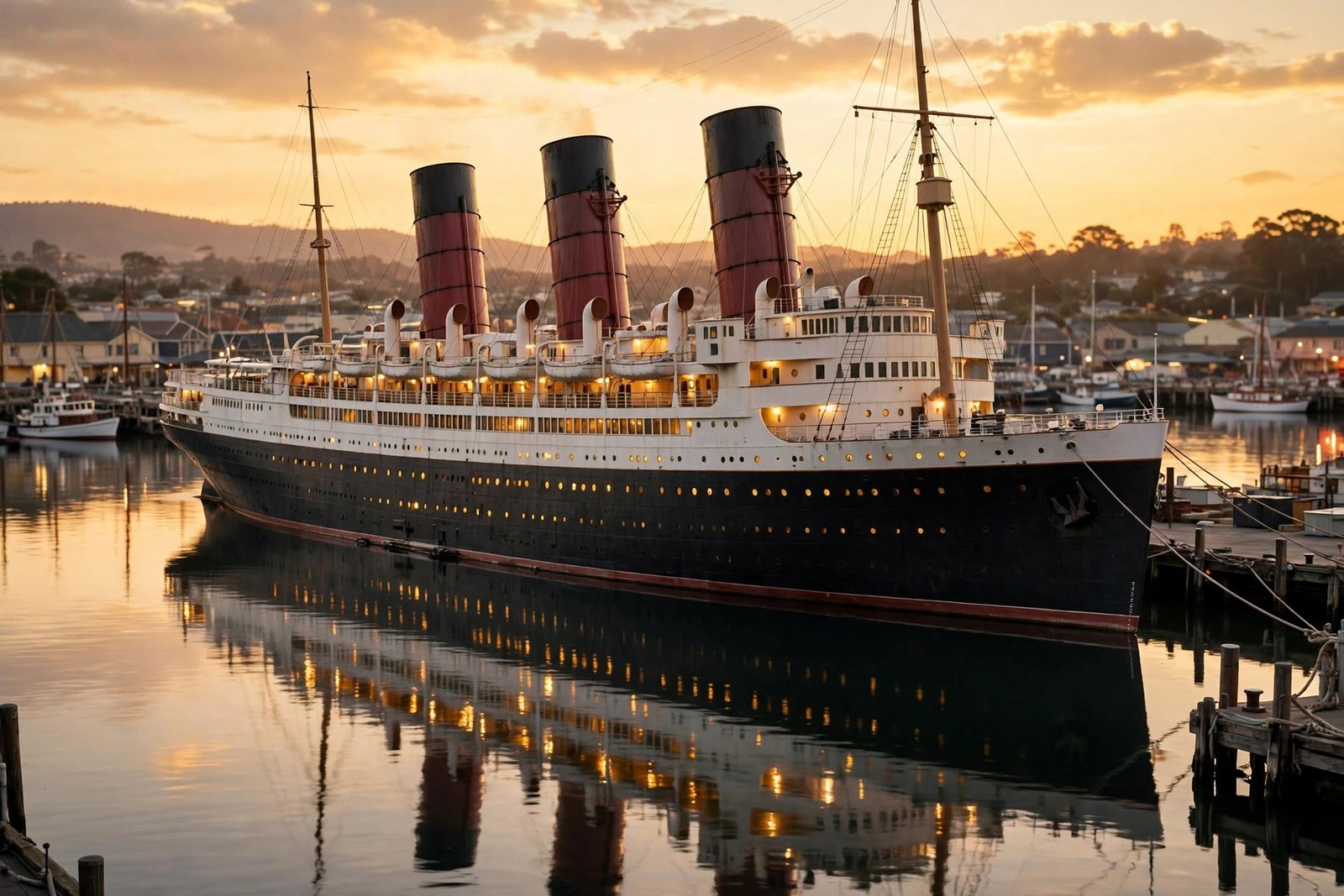
She is more than a thousand feet of steel and rivets, moored in the harbor at Long Beach, California, and she has not moved under her own power since 1967. By day, the RMS Queen Mary is a floating hotel and museum, all polished wood, Art Deco staircases, and ocean-liner glamour. By night, she becomes something else: the most famous haunted ship in America. Guests report knocking in empty cabins, lights switching themselves on, and a woman in a white evening gown dancing alone in the old first-class lounge.
Is the Queen Mary really haunted? Nobody can prove it either way, and that is why the stories endure. What is certain is the history underneath them: three decades crossing the Atlantic, hundreds of thousands of soldiers carried through a world war, and survival as a hotel. This guide covers both, the documented history first, then the famous hauntings, with a clear line between fact and legend.
From Ocean Liner to Floating Hotel
The Queen Mary was built by John Brown and Company in Clydebank, Scotland, for the Cunard Line, as part of a planned two-ship express service between Southampton, Cherbourg, and New York. Work was halted during the Great Depression, then resumed. She was launched on September 26, 1934, christened by her namesake, Queen Mary, the wife of King George V. At 1,019.5 feet long, she was Britain’s first entry in the 1,000-foot category of ships.
Her maiden voyage began on May 27, 1936, sailing from Southampton to New York with a stop in Cherbourg, France. She was fast as well as grand: she won the Blue Riband for the fastest average Atlantic crossing in August 1936, lost it to the French liner Normandie in 1937, recaptured it in 1938, and held it until 1952, when the new American liner SS United States claimed it. Britannica’s history of the ship covers her service from 1936 to 1967, and the full record is laid out in the RMS Queen Mary article on Wikipedia.
The Grey Ghost Goes to War
When World War II began in September 1939, the Queen Mary was en route to New York. After completing the voyage, she suspended commercial service and was refitted as a troopship. Her elegant paintwork was replaced with battleship grey, and her speed and grey color earned her the wartime nickname the Grey Ghost. She was reportedly the fastest and largest troopship of the war, able to reach a top speed of 32.5 knots, faster than many German U-boat torpedoes, and to carry more than 15,000 soldiers at a time.
On one voyage in 1943, she carried more than 16,600 people, a record that still stands. Over the war, she ferried hundreds of thousands of Allied soldiers. That service is not just background for the ghost stories. It is why so many hauntings are tied to soldiers, crewmen, and the lower decks, where troops slept in crowded quarters far below the grand lounges above.
After the war, the Queen Mary was refitted for passenger service and returned to the Atlantic run alongside her sister ship, the Queen Elizabeth. But the age of the ocean liner was ending. Air travel was faster and cheaper, and by the 1960s the great liners were losing money. Cunard officially retired the Queen Mary from service in 1967.
The Long Voyage to Long Beach
Retirement did not mean the scrapyard. The City of Long Beach, California, bought the Queen Mary for 3.45 million dollars, planning to turn her into a hotel and tourist attraction. On October 31, 1967, she departed Southampton for the last time. Too big to pass through the Panama Canal, she sailed around Cape Horn at the southern tip of South America. After a 39-day trip, she arrived in Long Beach on December 9, 1967, and has been permanently moored there ever since.
The conversion took years and cost about 31 million dollars. Much of the machinery was removed, including one engine room, three of the four propellers, and all of the boilers. The ship opened to the public in 1971 and moved to her permanent berth at Pier J on February 27, 1971. Today she operates as a hotel, museum, and convention space at 1126 Queens Highway in Long Beach, and she has been in her California home longer than she ever spent at sea.
Why People Call the Queen Mary Haunted
Reports of strange activity began surfacing soon after she arrived in Long Beach, and they have never really stopped. In 2008, Time magazine put her on its list of the top 10 haunted places in America, and in 2026, Historic Hotels of America named her to its list of the most haunted historic hotels. Paranormal television shows, including Ghost Hunters, Ghost Adventures, and Unsolved Mysteries, have all investigated the ship.
The ship herself leans into the reputation, selling a themed haunted stateroom, running ghost tours every day, and hosting a seasonal Halloween event called Dark Harbor. But the stories come from guests, staff, and investigators. The same places come up again and again: Stateroom B340, the first-class pool, the engine room around door 13, the Queen’s Salon, and the children’s playroom. The reports share a pattern: knocking, lights switching on by themselves, cold spots, and figures that vanish when approached.
Stateroom B340: The Most Haunted Room on the Ship
No room on the Queen Mary is more famous than Stateroom B340, a first-class cabin on B deck. Guests have reported loud knocking in the middle of the night, bathroom taps and lights switching themselves on, doors slamming, and the sound of someone moving around the room. The best-known story says a woman woke to find her covers being pulled off and a man standing at the foot of her bed, who vanished before the steward arrived.
The room was kept off-limits for years and is now sold as the ship’s Paranormal Suite, complete with a Ouija board, tarot cards, a crystal ball, and ghost-hunting equipment. The legend usually starts with a passenger who died in the cabin in 1948. Online retellings give him different names, including Walter J. Static and Walter J. Adamson, and researchers say they could not find a record to back up any version. Darker stories of a murder in B340 also circulate, but historians of the ship say there was no murder aboard. In 2026, the ship added three more themed rooms, the Paranormal Passage staterooms B326, B328, and B334. A detailed guide to the haunted Queen Mary hotel covers B340, the pool, and door 13.
The Lady in White and the First-Class Pool
The Lady in White is the Queen Mary’s most elegant ghost. Witnesses describe a woman in a white evening gown, sometimes dancing alone in the Queen’s Salon, the former first-class lounge, and sometimes gliding through the corridors. Some say she seems sad, others peaceful, even protective. Some retellings link her to a first-class passenger, others to a woman who died in a car accident near the ship. No identity has ever been confirmed.
The first-class swimming pool has its own cast of spirits. Guests and staff report seeing women in 1930s swimsuits near the water, hearing splashing when the pool is empty, and catching the sound of children laughing and playing. The most famous of the pool’s ghosts is a little girl nicknamed Little Jackie, said to be heard giggling in the pool area and the nearby third-class children’s playroom. The pool is one of the ship’s grandest spaces, with a lighted fountain, a mother-of-pearl ceiling, and detailed mosaics. A roundup of the ship’s ghost stories collects the Lady in White, the pool reports, and the engine room accounts in one place.
Door 13 and the Ghost of John Pedder
Deep in the engine room, about 50 feet below the waterline, sits watertight door 13. On July 10, 1966, during a routine watertight door drill, an 18-year-old crewman was crushed as the heavy door closed. Retellings name him John Pedder. The accident is the one ghost story on the ship with a documented death behind it, and it is also the most specific.
Staff and tour guests have described a young man with a beard, wearing blue overalls, walking along Shaft Alley, the long passage that carries the propeller shafts, before disappearing at door 13. Others report unexplained knocking from the door, and greasy handprints found in the area. The story matters because it shows how the Queen Mary’s hauntings work: a real tragedy happened in that spot, and the stories that followed are tied to a real person and a real date. Whether the figure in the overalls is a ghost or a trick of a dark, noisy engine room is a question no tour can settle.
Tour guides often say 49 people died aboard the Queen Mary, but that number is not backed by a published list of names and dates and should be treated as ship lore, not a verified count. Documented deaths, like John Pedder’s, are specific and checkable.
What the Ship’s Own Tours Say
The Queen Mary does not hide her haunted side. Her official guided tours page lists these paranormal experiences:
- Haunted Encounters: about an hour, offered daily, an introduction to the ship’s most famous paranormal residents.
- Paranormal Ship Walk: about two hours after hours, into hidden rooms rarely open to the public.
- Graveyard Tour: Friday and Saturday after midnight, about two hours, ages 16 and up.
The ship also offers paranormal investigations and a theatrical seance show.
What is interesting about the ship’s own framing is how careful it is. The Haunted Tour is described as the place where documented history, wartime tragedy, and enduring legends meet, grounded in real events, including wartime service and recorded deaths aboard the ship. That is an honest description of what a good ghost tour should be: real history first, then the stories that grew from it, with the gap between them left open for the visitor to judge. The seasonal Halloween event, Dark Harbor, runs on select nights in the fall, and Visit Long Beach publishes a guide to the ship’s spooky season tours each year.
Fact Versus Legend on the Queen Mary
So what is true, and what is story? The history is solid. The launch date, the maiden voyage, the Blue Riband years, the wartime service as the Grey Ghost, the retirement in 1967, and the arrival in Long Beach are all documented in the ship’s own records and in reference works. The death of John Pedder at door 13 in 1966 is documented. The Time magazine list in 2008 is real, and the ship’s ghost tours are real and bookable today.
The legends are a different category. The Lady in White has no confirmed identity. The death in B340 in 1948 has no record to support it, and the murder stories about the room are contradicted by the ship’s historians. Little Jackie has no documented identity. The figure of 49 deaths is repeated but not verified. None of that means the stories are false in the way a made-up fact is false. Ghost stories are what people say they experienced, passed along and polished by retelling. The honest way to enjoy them is to hold both things at once: the history is real, the experiences are reported by real people, and the explanations are still open.
The Queen Mary is worth visiting even if you do not believe in ghosts. The ship is a museum of the 1930s, and the ghost tours are one of the best ways to see parts daytime visitors never reach: the engine room, the shaft alley, the pool deck at night. Go for the history, stay for the stories.
Visiting the Queen Mary
The Queen Mary sits at 1126 Queens Highway in Long Beach, California, about 45 minutes from downtown Los Angeles depending on traffic. General admission covers a self-guided experience, and guided tours, including the history tours and the haunted tours, are available for an additional fee. Advance reservations are encouraged, especially for the evening ghost tours and around Halloween, when weekend slots fill quickly.
Take a daytime history tour first. Knowing the real story, the construction, the wartime service, the famous passengers, makes the ghost stories richer. Then take an evening tour, when the ship is quieter and the corridors are dark. Staying overnight is also possible: the ship operates as a hotel, and the themed staterooms, including B340, can be booked through the ship’s own website. Bring a camera and keep an open mind.
Related reading
If you enjoyed this guide, you may also like the Marfa Lights mystery in Texas, Skinwalker Ranch in Utah, and the Winchester Mystery House legend.
FAQ
When was the Queen Mary built, and when did it retire?
The RMS Queen Mary was launched on September 26, 1934, in Clydebank, Scotland, and her maiden voyage began on May 27, 1936, from Southampton to New York. Cunard retired her in 1967. She arrived in Long Beach, California, on December 9, 1967, and has been permanently moored there ever since.
Why is the Queen Mary called the Grey Ghost?
During World War II, the Queen Mary was refitted as a troopship and painted battleship grey. Her speed, with a top speed of 32.5 knots, and her grey color earned her the nickname the Grey Ghost. She carried more than 15,000 soldiers at a time, and on one 1943 voyage she carried more than 16,600 people, a record.
What is Stateroom B340?
Stateroom B340 is a first-class cabin on B deck, widely described as the most haunted room on the Queen Mary. Guests have reported knocking, lights and taps switching on by themselves, doors slamming, and a figure at the foot of the bed. The room was kept off-limits for years and is now sold as the ship’s Paranormal Suite. The popular story of a passenger dying in the room in 1948 has no record to support it.
Who is the Lady in White?
The Lady in White is the Queen Mary’s best-known ghost, described as a woman in a white evening gown seen dancing alone in the Queen’s Salon or gliding through the corridors. Her identity has never been confirmed, and different retellings link her to different people. She is a reported sighting, not a documented historical figure.
Can you take a ghost tour of the Queen Mary?
Yes. The ship runs the Haunted Encounters tour, about an hour long and offered daily, the Paranormal Ship Walk, about two hours after hours, and the Graveyard Tour on Friday and Saturday after midnight for guests aged 16 and up. The ship also offers paranormal investigations and a seasonal Halloween event called Dark Harbor. Tours are listed on the Queen Mary’s official website, and advance reservations are encouraged.