
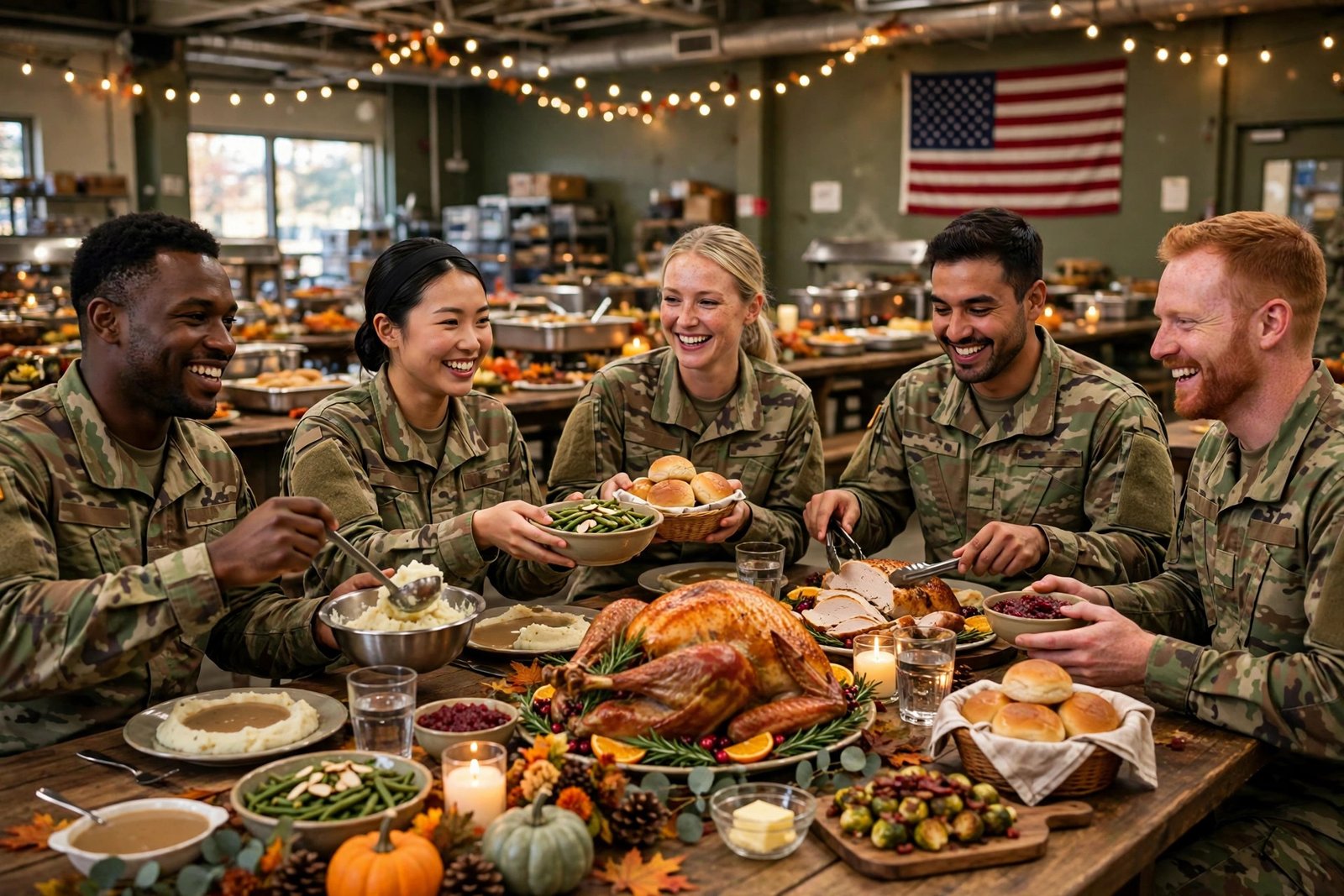
Thanksgiving is a home holiday, usually eaten in a dining room full of family. For soldiers in the United States Army, the holiday often looks very different. It may be served in a dining facility on a base in Texas, on a folding table in a tent in the desert, or from the back of a helicopter flying over a jungle. Yet wherever Army soldiers eat their Thanksgiving dinner, the tradition is taken seriously, and it has been taken seriously for more than a century and a half.
The Army has fed its troops on Thanksgiving since the days of the Civil War. The food has changed, the kitchens have changed, and the wars have changed, but the idea has stayed the same: on a day when Americans give thanks at home, the Army does its best to bring a taste of home to the men and women who cannot be there. Cooks work through the night, commanders put on their dress uniforms and serve the meal themselves, and the dining facility is decorated until it looks like a small piece of America transplanted to wherever the unit happens to be.
How Thanksgiving Became an American Holiday
Thanksgiving did not start out as the national holiday Americans know today. The early celebrations were local and irregular, declared by governors and presidents one year at a time. President George Washington issued a proclamation in 1789 naming Thursday, November 26 of that year a day of thanks, but there was no fixed annual holiday for decades afterward. That changed during the Civil War, and the change came largely because of one determined woman.
Sarah Josepha Hale, the editor of Godey’s Lady’s Book and the author of the nursery rhyme “Mary Had a Little Lamb,” campaigned for a national Thanksgiving holiday for 36 years. She wrote essays and letters to governors and presidents, arguing that a shared day of thanks could help hold a divided country together. On September 28, 1863, she wrote directly to President Abraham Lincoln, asking him to use his power to create the holiday. Five days later, on October 3, 1863, Lincoln issued the proclamation that made Thanksgiving a national holiday.
Lincoln’s proclamation invited Americans “to set apart and observe the last Thursday of November next, as a day of Thanksgiving and Praise.” It was written by Secretary of State William H. Seward, and it was issued just months after the Battle of Gettysburg, one of the bloodiest battles of the war. The proclamation also asked Americans to remember “all those who have become widows, orphans, mourners or sufferers in the lamentable civil strife,” a reminder that the holiday was born in wartime. Every year since Lincoln’s proclamation of 1863, the United States has celebrated Thanksgiving Day, and in 1941 Congress fixed the date as the fourth Thursday in November.
Thanksgiving in the Civil War
The first great Army Thanksgiving came in 1864, one year after Lincoln’s proclamation. The Union Commissary was stretched too thin to provide a special meal for the entire wartime army, so the Union League Club of New York launched a campaign to provide Thanksgiving dinner for Union soldiers, sailors, and Marines. The effort raised 146,586 pounds of poultry, and received an additional 225,000 pounds through donations. The food was shipped to troops on military bases, and the meals included turkey and other meats, cakes, gingerbread, pickles, apples, and vegetables. A newspaper account that appeared on December 1, 1864, praised the hearty servings of turkey, goose, and duck, calling it a “real old-fashioned Thanksgiving dinner.” For soldiers who had spent months eating salt pork and hardtack, the meal was a reminder of the homes they were fighting for.
Thanksgiving on the Frontier
After the Civil War, the Army’s Thanksgiving dinners depended heavily on where a soldier happened to be stationed. Forts on the East Coast could receive a wide variety of foods by railroad, but soldiers posted on the western frontier had to rely on their own devices. Boiled beef and salt pork were the standard Army fare, and nobody wanted to eat them on Thanksgiving, so hunting became the way to put a feast on the table. In 1874, a correspondent from Fort Sill, Oklahoma, reported that a hunting party of 12 men provided the canteen with 156 turkeys, while another group of officers provided 60 more turkeys, five deer, two wildcats, and a bear. At Fort Lyon, Colorado, a few years earlier, the 1871 Thanksgiving feast centered around buffalo.
Thanksgiving in World War I
During World War I, Thanksgiving took on an additional role. The United States was absorbing a great wave of immigrants, and celebrating a shared American holiday was one way to help new Americans adopt a collective identity. On the home front, Americans were asked to eat less wheat, meat, fats, and sugar so that those foods could be saved for the troops overseas.
The menu at Camp Wadsworth in South Carolina in 1918 showed how far the tradition had come. Soldiers there sat down to celery, pickles, olives, roast turkey with dressing, cranberry sauce, mashed potatoes, salted wafers with cheese, bread and butter, pumpkin pie, fruit cake, ice cream, and coffee. Printed menus with holiday artwork became part of the celebration, and the Smithsonian’s National Museum of American History still holds several of them in its collection.
Thanksgiving in World War II
World War II demanded the greatest effort the Army had ever made to feed its troops on Thanksgiving. Near-heroic efforts were made to transport hot holiday dinners to troops on the front lines and in the most remote areas. Meal convoys often traveled under fire on dangerous roads in terrible weather, and soldiers who could be rotated off the front lines were ordered to the rear for Thanksgiving dinner and much-needed rest.
The menus from that war show how much the meal meant. In Italy in 1944, American troops ate roast turkey, fresh vegetables, and fresh white bread, unlike any meal they had eaten since the war began. Aboard the aircraft carrier USS Intrepid, also in 1944, the Thanksgiving menu included turkey, baked Virginia ham, cranberry sauce, giblet gravy, candied yams, and snowflake potatoes, followed by plum pudding and apple pie a la mode. At Camp Elliot in California in 1944, dinner was presented as a play, with each course as an act: celery soup and crackers for Act I, and turkey, oyster dressing, giblet gravy, cranberry sauce, and French peas for Act II.
Thanksgiving in Korea
On Thanksgiving Day in Korea in 1950, American troops were days away from being attacked in force along the bitter-cold Chosin Reservoir. Cooks drove out to the forward-most positions, opened huge insulated containers, and served turkey with all the trimmings on tin trays. Soldiers remembered that they had to eat fast, because the food went cold quickly in the freezing air.
Thanksgiving in Vietnam
During the Vietnam War, the military tried to provide as many troops as possible with a hot, traditional Thanksgiving dinner. Most of the meals were prepared at a base away from the fighting and flown by helicopter to troops serving in remote locations. A Department of Defense film release from November 22, 1966, described a Thanksgiving dinner enjoyed by members of A Detachment, 5th Special Forces, at Xom Cat in War Zone D. The meal was prepared by Sergeant First Class Lonnie Mitchell at Bien Hoa and delivered in hot, steaming containers by helicopter to the 12 men of the detachment.
The scale of the effort was enormous. A Department of Defense release from November 25, 1969, reported that hundreds of thousands of American service members around the world would receive their Thanksgiving turkey, even men in remote posts in Vietnam. The total that year was approximately 2,800,000 pounds of turkey, 192,000 pounds of shrimp, 787,500 pounds of potatoes, 383,933 pounds of cranberry sauce, and 350,000 pounds of fruitcake. Helicopters carried the trimmings to soldiers in the field, dropping off insulated containers holding hot turkey, mashed potatoes, gravy, cold cranberry sauce, cornbread stuffing, and peas.
The Modern Dining Facility Tradition
Today, the center of the Army’s Thanksgiving celebration is the dining facility, known to soldiers as the DFAC. For the cooks, officially called food service specialists, Thanksgiving is the premier event of the year. Dining facilities are transformed with decorations, ice carvings, and elaborate displays of turkeys, cakes, and pies. About 40 percent of soldiers are single, and many of them stay on post for the four-day holiday weekend rather than traveling home, so the dining facility meal becomes their Thanksgiving.
At U.S. Army Garrison Italy in 2026, for example, the dining facility at Caserma Ederle served a traditional Thanksgiving meal on November 18, with the dining facility at Del Din offering the same meal on November 25.
Commanders Serve the Troops
One of the most loved Army Thanksgiving traditions is the sight of the unit’s leaders serving the meal. On Thanksgiving Day, commanders and senior noncommissioned officers put on their dress blue uniforms and stand behind the serving line with ladles and spoons, dishing out turkey, mashed potatoes, and gravy to their soldiers and their families. Captains, majors, and generals all take a turn, and the gesture is understood by everyone in the room: on this day, the leaders serve the led.
The tradition is not limited to Thanksgiving at home stations. In Iraq in 2016, Army leaders assigned to the 2nd Brigade Combat Team of the 101st Airborne Division served their soldiers a Thanksgiving meal at a tactical assembly area in support of Operation Inherent Resolve. In the Netherlands, when soldiers working at the port of Vlissingen spent Thanksgiving on duty, their senior leadership personally served them the holiday meal the USO had prepared.
Thanksgiving for Deployed Soldiers
For deployed soldiers, the USO plays a central role in making Thanksgiving feel like home. The USO’s Operation Celebration program provides a home away from home for troops stationed around the world, making sure every holiday is celebrated with seasonal meals, company, and entertainment. The organization holds hundreds of celebrations each year, including Thanksgiving dinners, reaching tens of thousands of troops and their families.
At USO Kaiserslautern in Germany, more than 600 troops receive a free takeout Thanksgiving meal each year, with each meal including a full dinner of turkey, pie, dinner rolls, stuffing, gravy, mashed potatoes, peas, sweet potatoes, and cranberries, along with a gift card and a calling card. When soldiers from the 1st Air Cavalry Brigade and other units were working long hours at the port of Vlissingen in the Netherlands through Thanksgiving, the USO Kaiserslautern team prepared and transported a full Thanksgiving spread to feed more than 400 soldiers.
USO centers mark the holiday in their own ways each year. In 2026, USO Walker at Camp Walker in South Korea hosted a free Thanksgiving lunch for service members and military families on November 12, and in Italy, the USO served a free Thanksgiving meal for service members and families on November 26. For soldiers far from home, these meals are often the closest thing to a family dinner they will get.
Families Back Home
Thanksgiving is hard on the families of deployed troops, and communities across America step in to help. Programs like the Armed Services YMCA’s Home Hospitality place Marines from the School of Infantry at Camp Pendleton into local homes for Thanksgiving dinner with a surrogate family. Operation Home Cooking in San Antonio looks for about 400 host families each year to share Thanksgiving with trainees at Lackland Air Force Base who are away from home during the holidays. In 2026, Winn-Dixie partnered with USO Jacksonville to distribute Thanksgiving meals to 300 military families at a drive-through mobile food pantry, part of 6,000 meals distributed across the region.
What Is on the Menu Today
The modern Army Thanksgiving menu would be familiar to a soldier from any era. The centerpiece is roast turkey with dressing and giblet gravy, served with cranberry sauce, mashed potatoes, sweet potatoes, green beans, and rolls. Pumpkin pie and fruitcake close the meal. That continuity is the point. The Army’s Thanksgiving is not about the food alone, and it never has been. It is about a promise that has been kept through the Civil War, two world wars, Korea, Vietnam, and every deployment since: that on the fourth Thursday of November, wherever American soldiers are, someone will do the hard work of bringing Thanksgiving to them.
Frequently Asked Questions
When did the Army start serving Thanksgiving dinner to soldiers?
The tradition dates to the Civil War. After President Lincoln’s 1863 proclamation made Thanksgiving a national holiday, the Union League Club of New York organized a campaign in 1864 that delivered Thanksgiving dinners, including more than 146,000 pounds of poultry, to Union troops.
Do Army commanders really serve Thanksgiving dinner?
Yes. It is a long-standing tradition for unit leaders to put on their dress blue uniforms and serve the Thanksgiving meal to soldiers and their families from behind the serving line in the dining facility, including at deployed locations.
What do soldiers eat for Thanksgiving when they are deployed?
Deployed soldiers eat the same traditional meal when possible: roast turkey with dressing and gravy, cranberry sauce, mashed potatoes, sweet potatoes, and pumpkin pie. Meals are prepared at base dining facilities or field kitchens and delivered by truck, convoy, or helicopter to remote positions, and the USO provides holiday meals at many locations overseas.
Does the USO serve Thanksgiving dinner to troops?
Yes. The USO’s Operation Celebration program provides Thanksgiving dinners and other holiday celebrations at USO centers around the world, including free takeout meals for hundreds of troops at locations such as Kaiserslautern, Germany.
Can civilians invite a service member for Thanksgiving?
Yes. Programs such as the Armed Services YMCA Home Hospitality, Operation Home Cooking, and Adopt-a-Sailor match single service members with local host families for Thanksgiving dinner. Contact the local installation or the program directly for details and deadlines.
Related reading
- The 442nd Regimental Combat Team: The Most Decorated Unit in US Army History
- The Old Guard: Sentinels of the Tomb of the Unknown Soldier
- Thanksgiving Dinner Cost in 2026: What Americans Are Paying This Year
Sources: U.S. Army, “Thanksgiving in the Army”; National Archives, “The National Archives Celebrates Thanksgiving”; National Park Service, “Lincoln and Thanksgiving”; The Daily Meal, “Military Thanksgiving From The Home Front To The Front Lines”; National Archives, “Mission: Turkey! Thanksgiving Dinner and the U.S. Military”; Smithsonian, “Home Away From Home: Thanksgiving on Base and at Sea”; USO, “Operation Celebration”; USO Kaiserslautern, “Service Members Deployed to the Netherlands Get a Taste of the Holidays”; Who’s On The Move, “Evolution of a Tradition”; Bulwark Takes, “What It Takes to Bring Thanksgiving to Soldiers in Danger”