
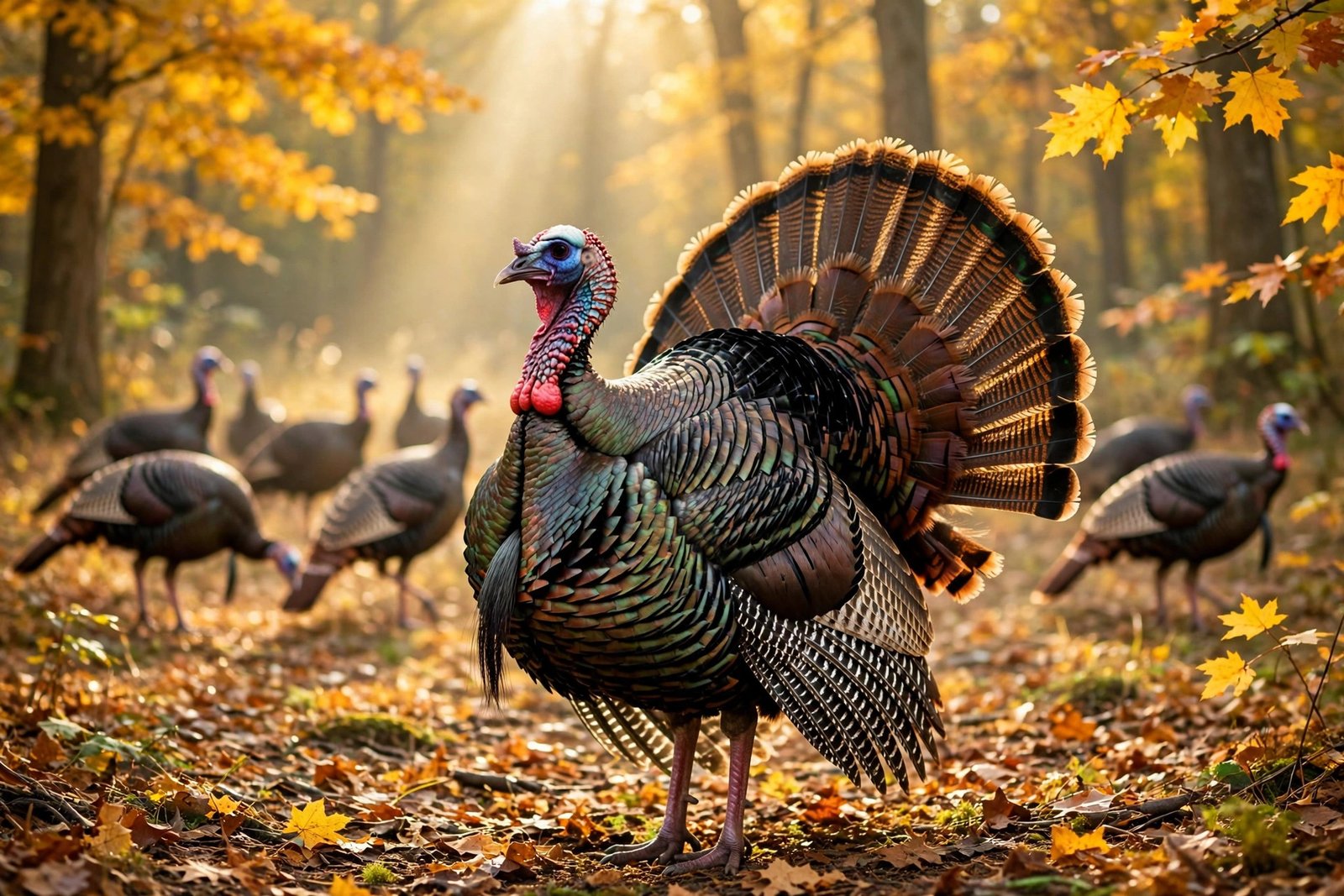
Every November, the wild turkey becomes the most talked-about bird in America. It appears on dinner tables, greeting cards, and in family stories about the first Thanksgiving. But the bird itself is far more interesting than its holiday reputation suggests. The wild turkey is a tough, wary, surprisingly athletic native of North American forests, and its history is one of the great comeback stories in American conservation. A little more than a century ago, it was nearly gone. Today, millions of wild turkeys roam the woods and fields of nearly every state, and the story of how they came back is worth knowing.
The Bird Behind the Holiday
The wild turkey, known to scientists as Meleagris gallopavo, is the largest game bird native to North America, a true original native of the continent. Adult males, called gobblers or toms, are big, dark, iridescent birds with a fan-shaped tail, a bare blue and red head, and a wattle hanging from the beak. Females, called hens, are smaller and drabber, which helps them blend into the forest floor while they sit on their nests. Young males are called jakes, and the young birds are called poults.
There are five subspecies, each adapted to a different part of the country. The Eastern is the most widespread and numerous, ranging across the forests east of the Mississippi River. The Rio Grande lives in the central plains and the drier West. The Merriam’s haunts the ponderosa pine forests and foothills of the Rockies. The Florida wild turkey, or Osceola, lives only on the Florida peninsula. The Gould’s, the largest of the five, lives in the mountains of southeastern Arizona and southwestern New Mexico. Wild turkeys are social birds that live in flocks: hens and poults travel together, while gobblers often form separate bachelor flocks outside the breeding season.
How America Almost Lost the Wild Turkey
When European settlers first arrived in North America, wild turkeys were abundant, and early chroniclers described flocks that seemed beyond counting. But abundance did not protect the bird. As settlers cleared forests for farms and towns, the turkey lost the mature woodlands it depended on for food and shelter. At the same time, hunting was unregulated. Turkeys were shot for food and for market year-round, with no seasons and no limits, and the birds had nowhere safe left to raise their young.
The decline was swift and steep. By the early 1900s, the wild turkey population across the continent had been reduced to an estimated 30,000 birds, fewer than the number of polar bears alive in the world today. The birds had been wiped out entirely in 18 of the 39 states where they had once lived. In Ohio, the last native wild turkey was seen in 1880. Michigan lost its last in 1897, Illinois in 1903, and Indiana in 1906. What saved it was timing: the conservation movement was just finding its feet under leaders such as President Theodore Roosevelt, and game laws were passed and enforced for the first time.
The Greatest Comeback in American Conservation
The wild turkey’s recovery is often called the greatest wildlife conservation success story in American history, and the numbers back up the claim. The turning point came in 1937, when Congress passed the Federal Aid in Wildlife Restoration Act, known as the Pittman-Robertson Act. The law placed an excise tax on firearms, ammunition, and other hunting gear, and the money raised was dedicated to state wildlife restoration work. Hunters, in other words, paid for the recovery of the birds they hunted, and the funding made large-scale habitat work possible for the first time.
Meanwhile, abandoned farmland across the East was growing back into woodland habitat. By 1952, the population had crept up to about 320,000 birds, but early restocking with pen-raised birds failed, because farm-raised turkeys could not survive in the wild. The breakthrough was trap and transfer: biologists captured truly wild turkeys where they thrived and released them where habitat was good but birds were few. Since the 1950s, more than 200,000 wild turkeys have been relocated this way.
In 1973, the National Wild Turkey Federation was founded by hunters to support the recovery. A census that same year counted about 1.3 million birds. Today there are about 7 million wild turkeys in North America, living in every state except Alaska, plus Hawaii. From roughly 30,000 birds to about 7 million, the comeback is one of the most remarkable turnarounds in the history of wildlife management. You can read the full story in the Nature Conservancy’s account of the wild turkey restoration and in the Environmental Defense Fund’s history of the recovery.
Where Wild Turkeys Live Now
Wild turkeys are found today in suitable habitat in each of the lower 48 states and Hawaii, according to the U.S. Department of Agriculture’s Natural Resources Conservation Service. They are non-migratory, year-round residents. The key to their habitat is variety: a mosaic of mature forest and open ground close together. Forests provide roosting trees and food, especially acorns and other nuts that fall in autumn. Open fields are where they find the insects young poults need, and where gobblers display in spring. Nesting hens look for thick, overgrown cover along forest edges, where bushes, vines, and small trees hide the nest.
Each subspecies has its own preferred landscape within that pattern. Eastern turkeys favor mature hardwood forests with nearby fields. Rio Grande turkeys use brushy areas near streams and rivers. Merriam’s turkeys live in ponderosa pine forests and mountain foothills. Florida turkeys use pine flatwoods, oak and palmetto hammocks, and wooded swamps. Gould’s turkeys live in steep, rocky mountain canyons. The details differ, but the recipe is the same everywhere: trees to roost in, open ground to feed in, and thick cover to nest in. The USDA’s wild turkey habitat leaflet describes these needs in detail.
What Wild Turkeys Eat
Wild turkeys are true omnivores and will eat just about anything they can find. Adults eat acorns, leaves, buds, seeds, fruits, waste grain left in farm fields, and insects. In autumn and winter, hard mast such as acorns and beechnuts is the backbone of the diet, and a good acorn year can carry a flock through the cold months. In spring and summer, the menu shifts toward green plants, seeds, berries, and insects.
For young turkeys, insects are survival. For their first few weeks, poults feed mostly on protein-rich insects such as grasshoppers, beetles, and caterpillars, and that protein lets them grow fast enough to fly into the roost trees within a couple of weeks of hatching. Turkeys find food by scratching, raking aside leaves and soil to uncover seeds, nuts, and insects, and the food is stored in the crop, an enlarged chamber in the esophagus, before it is digested.
A Day in the Life of a Wild Turkey
A wild turkey’s day begins before dawn, when the birds fly down from their roost trees at first light. In spring, gobblers announce themselves with the gobble, a loud, rolling call that tells hens where to find a mate and warns rival males away. It is also when gobblers put on their famous display, spreading the tail into a wide fan, dropping the wings, and strutting in slow circles so the sun catches the iridescent bronze and green of the feathers.
After breeding, hens nest on the ground in thick cover, sitting on their eggs for about a month. Once the poults hatch, the hen leads them to insect-rich fields, and by autumn the young have joined the flocks. In winter, turkeys feed hard on acorns and waste grain by day and gather each evening in the same roost trees. Wild turkeys are far better athletes than most people expect: they can fly up to 50 miles per hour for short distances, usually to reach a roost tree or escape a predator. The Maryland Department of Natural Resources’ wild turkey fact sheet describes the bird’s daily habits.
Wild Turkeys and Domestic Turkeys: Not the Same Bird
It is easy to assume that the turkey on the Thanksgiving table is just a farm version of the wild bird, but the two have grown far apart. Domestic turkeys descend from wild turkeys, but centuries of selective breeding have shaped them into something very different. Domestic birds have been bred for size and for breast meat, and a modern farm turkey is far heavier than its wild cousin. That weight comes at a cost: domestic turkeys are poor flyers and slow movers compared with wild birds.
The wild turkey, by contrast, is built for survival: lean, wary, and alert, with eyesight so sharp that hunters consider it one of the hardest game birds in America to approach. Where a domestic turkey waits for feed, a wild turkey spends its whole day working for food and watching for predators. And while wild turkeys fly up into trees every night of their lives, a domestic turkey rarely leaves the ground.
Benjamin Franklin and the Turkey: The Real Story
The most famous story about the wild turkey is also the most misunderstood: the tale that Benjamin Franklin wanted the turkey, not the bald eagle, to be the national bird. It is a wonderful story, and it is not true. Franklin never formally proposed the turkey as the national bird. What he did was write a funny, private letter to his daughter, and that letter has been misunderstood ever since.
The letter was written on January 26, 1784, from France, to Franklin’s daughter Sarah Bache. In it, Franklin complained about the Society of the Cincinnati, a hereditary society of former officers of the Revolutionary War that had adopted the bald eagle as its emblem. Franklin thought the eagle on the society’s badge looked more like a turkey than an eagle, and he used the comparison to make a joke at the eagle’s expense. “For my own part I wish the Bald Eagle had not been chosen as the Representative of our Country,” he wrote. “He is a Bird of bad moral Character. He does not get his Living honestly.” The eagle, Franklin went on, was too lazy to fish for itself and stole fish from the fishing hawk, and it was “a rank coward,” chased off by the little kingbird, “not bigger than a Sparrow.”
Then came the turkey’s turn. “I am on this account not displeased that the Figure is not known as a Bald Eagle, but looks more like a Turkey,” Franklin wrote. “For the Truth the Turkey is in Comparison a much more respectable Bird, and withal a true original Native of America… He is besides, though a little vain and silly, a Bird of Courage, and would not hesitate to attack a Grenadier of the British Guards who should presume to invade his Farm Yard with a red Coat on.” This was a joke about a society badge, not a policy proposal. Franklin had served on the first committee to design the Great Seal, and his own proposal contained no birds at all. The myth was popularized much later, in part by a 1962 cover of the New Yorker that imagined the Great Seal with a turkey in place of the eagle. The Harvard Declaration Resources Project has a clear account of how the myth grew, and the Smithsonian Magazine untangles the story as well.
Hunting: How the Comeback Is Managed
One of the most surprising parts of the wild turkey story is the role hunters played in saving it. Hunting, unregulated, helped drive the bird to the edge. Hunting, regulated and taxed, helped bring it back. The Pittman-Robertson Act turned the money hunters spent on guns and ammunition into habitat funding, and the National Wild Turkey Federation, founded by hunters in 1973, became one of the most effective conservation organizations in the country.
Today, each state manages wild turkey hunting carefully, setting spring and fall seasons, limiting the number of birds a hunter can take, and adjusting the rules each year based on population surveys. License fees and excise taxes continue to fund habitat work and the trap-and-transfer programs that keep populations healthy. It is a system in which the people who use the resource pay to sustain it. In some places, there are now so many turkeys that they cause problems in suburbs and farms, and hunting remains one of the main tools for keeping numbers in balance.
Frequently Asked Questions
How many wild turkeys are there in the United States?
About 7 million, a dramatic recovery from an estimated 30,000 birds in the early 1900s. Wild turkeys now live in every state except Alaska, plus Hawaii.
Did Benjamin Franklin really want the turkey to be the national bird?
No. In a private letter to his daughter Sarah Bache on January 26, 1784, Franklin joked that the bald eagle was a bird of bad moral character and praised the turkey as a more respectable bird. The letter was a joke about the Society of the Cincinnati’s badge, not a proposal to change the national symbol.
What do wild turkeys eat?
Wild turkeys are omnivores. Adults eat acorns, seeds, nuts, fruits, waste grain, and insects. Young poults feed mostly on protein-rich insects for their first few weeks, then shift to the adult diet.
Can wild turkeys fly?
Yes. Wild turkeys are strong short-distance flyers, reaching up to 50 miles per hour in a burst. They fly into trees every night to roost and spend most of the day feeding on the ground.
Where can I see wild turkeys?
Look along the edges of fields and forests at dawn or dusk, especially in spring when gobblers are calling. State parks, national wildlife refuges, and rural back roads are good places to start. Keep your distance, use binoculars, and never feed wild turkeys.