
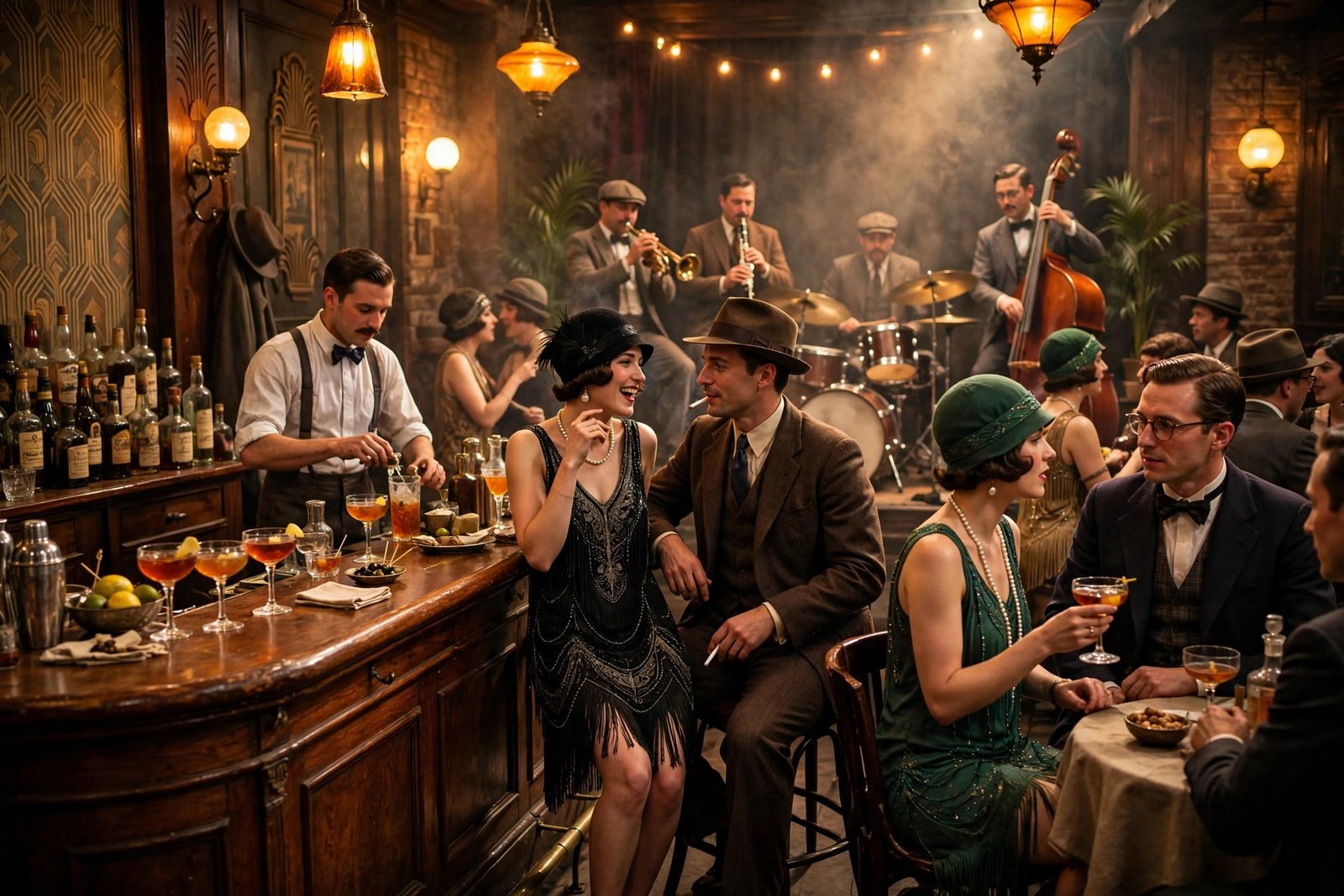
On the night of January 16, 1920, Americans raised their glasses for a last legal drink. At midnight, the United States went dry. The manufacture, sale, and transportation of alcohol became illegal across the entire country, and a great social experiment began. Supporters called it the “noble experiment” — a plan to end drunkenness, poverty, and crime by simply removing alcohol from American life. Thirteen years later, the experiment was over. It had not ended drunkenness or crime. Instead, it had created an illegal liquor industry worth a fortune, handed America’s cities to organized crime, and produced some of the most famous gangsters in history. On December 5, 1933, the nation did something it has never done before or since: it repealed a constitutional amendment.
The Temperance Movement: A Century in the Making
The campaign against alcohol in America began in the early 1800s, when Protestant clergy and reformers started warning that drinking was destroying families and communities. In those days, alcohol was everywhere. It was served at breakfast, offered to workers in the fields, and sold in saloons that anchored nearly every American town. Reformers argued that drunkenness caused poverty, domestic violence, and crime, and they urged Americans to drink less — or not at all.
After the Civil War, the movement surged again. Women took a leading role, believing that closing the saloons would strengthen families and reduce domestic violence. In the winter of 1873-74, groups of women in Ohio and New York marched to saloons, knelt to pray, and sang hymns until many owners agreed to close. This “Woman’s Crusade” inspired the founding of the Woman’s Christian Temperance Union, officially declared at a national convention in Cleveland, Ohio, on November 18-20, 1874. Under its second president, Frances Willard, who led the organization from 1879 until her death in 1898, the WCTU became the largest women’s organization in the country. It pushed for temperance education in schools, lobbied state legislatures, and helped secure restrictions on the liquor trade in states and territories across the nation.
But the organization most responsible for national Prohibition was the Anti-Saloon League, founded in 1893 in Oberlin, Ohio, by clergyman Howard Hyde Russell. The League took a different approach from the moral campaigners before it. It focused narrowly on a single goal, built alliances with Protestant churches and both major political parties, and ran a disciplined lobbying and fundraising operation under its counsel, Wayne B. Wheeler. The League published pamphlets, gave speeches, and targeted politicians at every level of government. By the 1910s, its influence was at its peak.
The movement also drew strength from the politics of World War I. Many of America’s largest brewers were German-American, and wartime suspicion of German immigrants gave the “drys” a powerful new argument: drinking beer was unpatriotic. Grain needed for the war effort, they said, should not be wasted on alcohol. In 1916, a wave of “dry” candidates swept into Congress. The moment for a constitutional amendment had arrived.
The 18th Amendment and the Volstead Act
On December 18, 1917, Congress proposed the Eighteenth Amendment to the Constitution. The amendment was short and sweeping: it prohibited the manufacture, sale, or transportation of intoxicating liquors within the United States. Ratification required approval by three-fourths of the states — 36 of the 48 states at the time. The states moved fast. On January 16, 1919, Nebraska became the 36th state to ratify, and the amendment became part of the Constitution. Only two states, Connecticut and Rhode Island, ultimately refused to ratify it.
By the terms of the amendment, the ban would take effect one year after ratification — on January 17, 1920. Congress needed a law to enforce it, and in October 1919 it passed the National Prohibition Act, better known as the Volstead Act after its sponsor, Representative Andrew Volstead of Minnesota, chairman of the House Judiciary Committee. The act defined “intoxicating liquors” as any beverage containing more than 0.5 percent alcohol, and it set out the rules and penalties for enforcement.
President Woodrow Wilson vetoed the Volstead Act, but Congress overrode his veto the next day, on October 28, 1919. The stage was set. When the clock struck midnight on January 17, 1920, the United States became, on paper at least, a dry nation. The amendment did not outlaw the possession or consumption of alcohol — only its manufacture, sale, and transportation — but for most Americans, the practical effect was the same. The corner saloon was closed, the brewery was shuttered, and the legal drink was gone.
Speakeasies, Bootleggers, and Bathtub Gin
The law’s supporters had assumed that once alcohol was illegal, Americans would simply stop drinking. They were wrong. Millions of Americans kept drinking, and wherever there was demand, supply followed. Almost overnight, a vast illegal industry sprang up to serve them.
Speakeasies — secret, unlicensed bars — opened in basements, back rooms, and behind false storefronts in every American city. To get in, you needed a password or a member’s introduction, and the door was watched from the inside through a peephole. Some were rough dives; others were elegant jazz clubs where the rich and famous drank cocktails and listened to live music.
Bootleggers smuggled liquor in from Canada and Mexico, ran it ashore from ships anchored just beyond American waters — the famous “Rum Row” off the Atlantic coast — and distilled it in hidden stills across the country. Others made their own at home: “bathtub gin” mixed in kitchens and bathrooms, and “moonshine” cooked up in rural stills. Some of it was harmless. Some of it was poison. Industrial alcohol, which the government ordered denatured with toxic chemicals to keep it out of the liquor supply, killed and blinded drinkers by the thousands. The dangers of illegal liquor became one of Prohibition’s darkest consequences.
Enforcement, meanwhile, was underfunded and overwhelmed. The federal government had only a small force of Prohibition agents, and they were poorly paid, which made bribery easy. Local police often looked the other way, and in many cities the public simply refused to cooperate with a law they considered an intrusion into private life. The ban was widely disobeyed from the start, and it grew more unpopular with every passing year.
Al Capone and the Rise of Organized Crime
Prohibition’s most lasting legacy was the fortune it handed to organized crime. Before 1920, gangs made their money from gambling, prostitution, and labor racketeering. Prohibition gave them something far bigger: a product that millions of law-abiding Americans wanted and were willing to pay for. The illegal liquor trade turned street gangs into business empires.
No one embodied that transformation more than Al Capone. Born in Brooklyn in 1899, Capone moved to Chicago and took over the city’s most powerful crime syndicate, the Chicago Outfit, after his mentor Johnny Torrio retired in 1925. Capone built a bootlegging empire that stretched across the Midwest, smuggling Canadian whiskey, running breweries and speakeasies, and bribing police, judges, and politicians on a massive scale.
Capone was, for a time, a folk hero in Chicago. But the violence that came with his business was impossible to ignore. Rival gangs fought over territory, hijacked each other’s shipments, and killed each other in the streets. In 1924, a gang war broke out between Capone’s South Side organization and the Irish-Jewish North Side Gang led by Dion O’Banion. O’Banion was murdered in his flower shop in November 1924, and the war escalated through his successors, Hymie Weiss and Vincent Drucci, until George “Bugs” Moran took over the North Side.
The St. Valentine’s Day Massacre
The gang war reached its most infamous moment on February 14, 1929. That morning, at about 10:30 a.m., a black Cadillac pulled up outside a garage at 2122 North Clark Street in Chicago, where Moran’s men stored the trucks used in their bootlegging operations. Four men got out, two of them in police uniforms. Inside, they found seven members and associates of the North Side Gang, lined them up against the wall, and executed them with Thompson submachine guns. The massacre marked one of the deadliest escalations of violence in Chicago’s gang wars.
The dead included the Gusenberg brothers, Peter and Frank, along with Albert Kachellek, Adam Heyer, Albert Weinshank, Reinhardt Schwimmer, and John May. Moran himself was supposed to be there, but he was late — when he arrived and saw the Cadillac outside, he kept walking and survived. Capone was in Florida at the time, and no one was ever convicted of the murders, but the killings were widely believed to be the work of his men, and the massacre became the defining image of Prohibition-era violence.
The public reaction was intense. Until then, Capone had enjoyed a reputation as a rough-edged neighborhood figure who gave to the poor. The cold-blooded killing of seven unarmed men ended that. The outrage reached the White House, where the newly elected President Herbert Hoover authorized federal help to bring Capone down. It took two years, and the charge that finally toppled him had nothing to do with liquor or murder: it was tax evasion. In 1931, Capone was convicted of failing to pay taxes on his illegal income and sentenced to 11 years in federal prison. He was never a major force in Chicago again.
What Prohibition Actually Did to America
For all its failures, Prohibition did some of the things its supporters had promised. Alcohol consumption fell sharply, and so did the harms that came with it. Cirrhosis death rates for men dropped from 29.5 per 100,000 in 1911 to 10.7 in 1929. Admissions to state mental hospitals for alcoholic psychosis fell from 10.1 per 100,000 in 1919 to 4.7 in 1928. Arrests for public drunkenness declined, and workplace absenteeism dropped. Some historians argue that the popular claim that Prohibition was a total failure is simply false.
But the costs were enormous, and they grew harder to ignore as the years passed. The federal government lost a major source of revenue: before Prohibition, taxes on alcohol had supplied about 14 percent of federal, state, and local tax revenues. The Association Against the Prohibition Amendment estimated that the government lost $11 billion in liquor-tax revenue during the Prohibition years while spending hundreds of millions trying to enforce the ban. The illegal liquor industry, meanwhile, corrupted police forces, courts, and city governments across the country. Enforcement also fell unevenly: it was harshest in poor, immigrant, and Black communities, while the wealthy drank in private clubs with little fear of arrest.
The Road to Repeal
By the late 1920s, opposition to Prohibition was growing nationwide. The “wets” argued for personal liberty, for the tax revenue that legal alcohol would bring, and for an end to the crime and corruption the ban had created.
The presidential election of 1932 made repeal a national issue. Franklin D. Roosevelt ran on a platform that promised to end Prohibition, and his victory gave the repeal movement its opening. Within weeks of taking office in March 1933, Roosevelt signed the Cullen-Harrison Act, which legalized beer and light wine with an alcohol content of 3.2 percent by weight. The law took effect on April 7, 1933 — a day celebrated across the country as “Beer Day,” with crowds lining up outside breweries and bars.
The formal repeal required a constitutional amendment of its own. In February 1933, Congress proposed the Twenty-first Amendment, which repealed the Eighteenth Amendment and returned control of alcohol to the states. This time, ratification went through state conventions rather than state legislatures, and the process moved quickly. On December 5, 1933, Utah became the 36th state to ratify, and Prohibition was over. Federal enforcement laws were repealed, and the Volstead Act became a dead letter. The date is still celebrated as Repeal Day.
The Twenty-first Amendment remains unique in American history: it is the only constitutional amendment ever passed for the purpose of repealing another. No amendment before or since has been overturned in this way.
The Legacy of the Noble Experiment
Prohibition ended nationally in 1933, but it did not disappear everywhere. Many states kept their own bans, and after repeal nearly two-fifths of the American population still lived in dry areas. Some counties in the United States remain dry to this day. The Twenty-first Amendment gave states the power to regulate alcohol as they saw fit, and that patchwork of state laws still shapes how alcohol is sold in America — from state-run liquor stores to dry counties to the varying rules on Sunday sales.
The deeper legacy of Prohibition is the lesson it taught about law and human behavior. The “noble experiment” was born of genuine reformist hopes: its supporters sincerely believed that banning alcohol would reduce poverty, violence, and suffering, and in some ways they were right. But they underestimated how deeply drinking was woven into American social life, and they overestimated what a law could do when millions of people disagreed with it. The result was a lesson America has never forgotten: a law that criminalizes behavior most citizens consider normal does not eliminate the behavior — it hands control of it to criminals.
Frequently Asked Questions
When did Prohibition start and end in the United States?
Prohibition began on January 17, 1920, when the Eighteenth Amendment and the Volstead Act took effect. It ended on December 5, 1933, when the Twenty-first Amendment was ratified, repealing the Eighteenth Amendment.
What was the 18th Amendment?
The Eighteenth Amendment to the U.S. Constitution, proposed by Congress on December 18, 1917, and ratified on January 16, 1919, prohibited the manufacture, sale, and transportation of intoxicating liquors in the United States. It did not ban the possession or consumption of alcohol.
What was the Volstead Act?
The Volstead Act, formally the National Prohibition Act, was the enforcement law for the Eighteenth Amendment. Passed by Congress on October 28, 1919, over President Woodrow Wilson’s veto, it defined intoxicating liquor as any beverage with more than 0.5 percent alcohol and set out the rules and penalties for enforcement.
What was the St. Valentine’s Day Massacre?
On February 14, 1929, seven members and associates of Chicago’s North Side Gang were lined up against a wall and shot dead in a garage at 2122 North Clark Street. The killings, widely blamed on Al Capone’s organization, became the most infamous act of violence of the Prohibition era and turned public opinion sharply against the gangsters.
Why was Prohibition repealed?
Prohibition was repealed because it had failed to stop drinking, had created a vast criminal liquor industry, corrupted law enforcement, and cost the government billions in lost tax revenue — losses that became intolerable during the Great Depression. The Twenty-first Amendment, ratified on December 5, 1933, remains the only constitutional amendment ever repealed.