
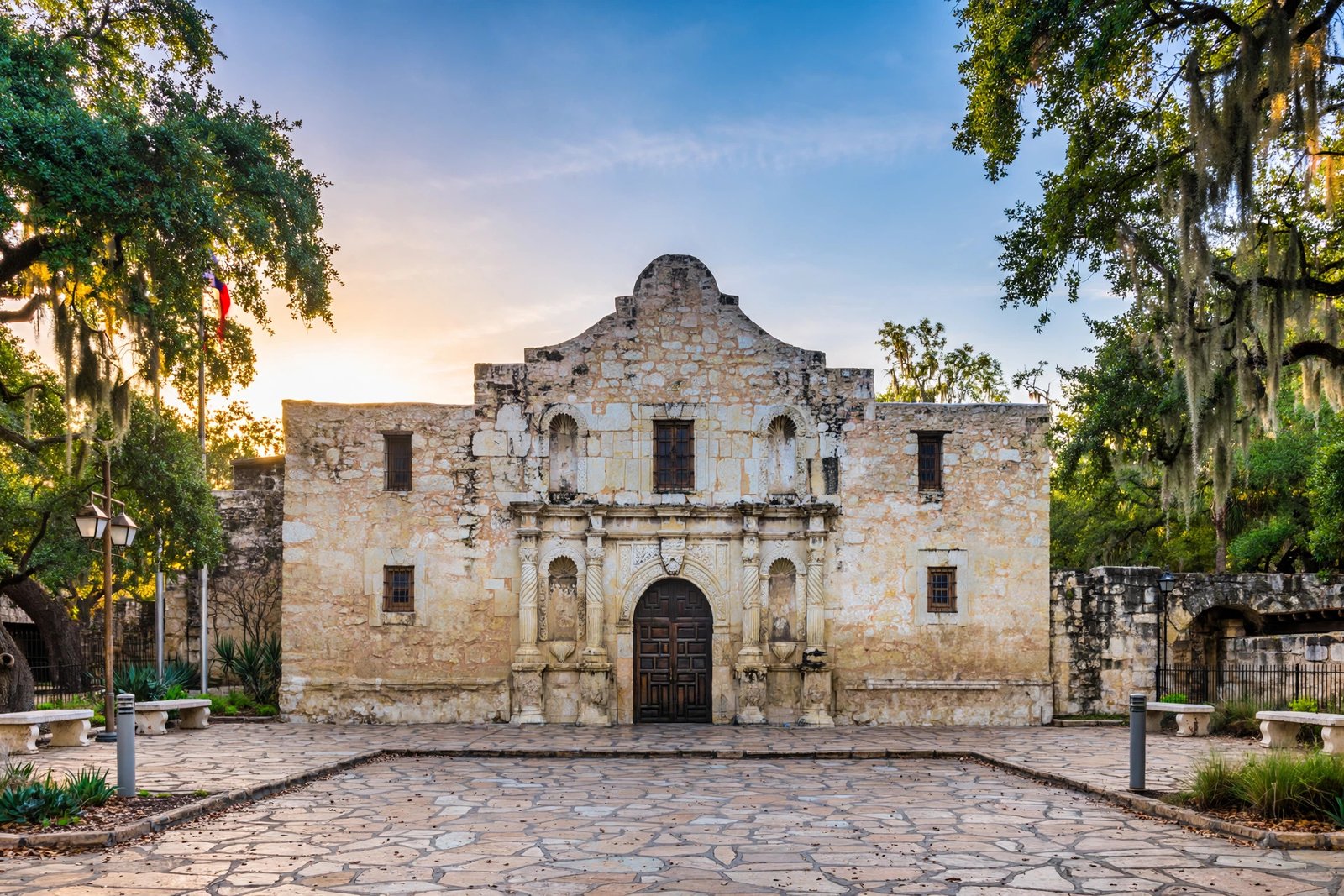
Before dawn on March 6, 1836, Mexican soldiers moved silently through the dark streets of San Antonio de Béxar toward a crumbling Spanish mission. Inside its walls, fewer than 200 Texian defenders waited behind cannons and barricades, knowing no help was coming. Within about ninety minutes, every defender was dead. It was a total military defeat — and yet the Alamo became the most famous battle in Texas history, a rallying cry that carried an outnumbered rebel army to victory six weeks later. “Remember the Alamo” is still one of the best-known phrases in American history, and the old mission church in downtown San Antonio remains one of the most visited historic sites in the United States.
This is the story of the 13-day siege that shaped Texas: the mission that became a fortress, the men who chose to stay, the assault that destroyed them, and the legacy that outlived them all.
From Spanish Mission to Fortress
The Alamo began not as a fort but as a church. It was founded on May 1, 1718, as Mission San Antonio de Valero, the first Spanish mission in the San Antonio area, established by Franciscan missionaries to convert the local Indigenous peoples — mostly Coahuiltecan — to Christianity. The mission moved to its present site in 1724 after a hurricane destroyed its first church, and construction of the stone mission complex, including the church visitors see today, began around 1744.
At its peak, the mission was a self-sufficient community of more than 300 converted Native Americans, with farmland, workshops, and a herd of over 2,000 cattle. But the mission era ended in 1793, when San Antonio de Valero was secularized and soon abandoned. The empty buildings were occupied by a Spanish military company in 1803, and around that time the old mission picked up a new name: the Alamo, probably from a Spanish cavalry company from Álamo de Parras in Coahuila that was stationed there. By the 1830s, the former mission was a walled military compound of about three acres, with a chapel, a long barrack building called the convento, and walls nine to twelve feet high — a ready-made fortress in the middle of a frontier town.
In July 2015, the Alamo Mission and the San Antonio Missions National Historical Park were designated a UNESCO World Heritage Site, recognizing more than three centuries of history at the site. The National Park Service notes that the mission was the first of the San Antonio missions and that its meaning changed drastically over time, from mission to garrison to shrine.
The Texas Revolution Reaches San Antonio
The Alamo’s moment came during the Texas Revolution, the 1835–1836 uprising in which Anglo and Tejano settlers in Mexican Texas rebelled against the central government of President General Antonio López de Santa Anna. In late 1835, Texian volunteers had captured San Antonio de Béxar from Mexican forces, and the town became the front line of the rebellion. The Alamo, with its thick walls and stock of captured cannons, was the key to holding the town — and the road north into the rest of Texas.
Sam Houston, commander of the Texian army, at first thought the Alamo was indefensible and ordered Colonel James Bowie to go to San Antonio, remove the munitions, and abandon the town. But Bowie and the garrison’s other officers disagreed. They believed the Alamo should be held as a first line of defense if Santa Anna decided to retake Texas, and the newly elected governor, Henry Smith, approved the plan. Reinforcements began to arrive, and the men set about strengthening the walls and mounting the cannons.
Meanwhile, Santa Anna was marching north with an army to crush the rebellion. His advance detachment reached the outskirts of San Antonio on February 23, 1836, surprising the garrison, which had done little to lay in food, supplies, or ammunition. His demand for unconditional surrender was answered with a cannon shot, and the siege began.
The Men Inside the Walls: Travis, Bowie, and Crockett
The Alamo’s defenders were a small, mixed force of Texian volunteers and Tejanos, and three of their leaders became legends. Lieutenant Colonel William Barret Travis, a 26-year-old lawyer and cavalry officer, arrived on February 3 with about 30 men and took command after Bowie fell ill. Colonel James Bowie, already famous across the frontier for his fighting knife and his exploits, had arrived earlier with orders to abandon the post — and had chosen to stay and defend it instead.
The most famous arrival came on February 8, when Davy Crockett rode in with a small group of volunteers. Crockett was a former Tennessee congressman and one of the most celebrated frontiersmen in America, a folk hero whose name alone drew attention to the little garrison. Also among the defenders were Tejanos led by Juan Seguín, whose men fought alongside the Anglo volunteers — a reminder that the Texas Revolution was not a simple contest of one people against another, but a coalition of settlers of many backgrounds against a central government they believed had betrayed them.
Historians still argue about exactly how many defenders there were. Estimates generally range from about 180 to 250 men, and the uncertainty is a good reminder of how thin the records are. What is not in doubt is that they were heavily outnumbered: Santa Anna’s army is usually estimated at somewhere between 1,800 and 6,000 men, with the American Battlefield Trust putting the force that reached San Antonio at around 6,000 at its height, though not all of them took part in the final assault.
Thirteen Days Under Siege
For thirteen days, from February 23 to March 6, 1836, the Mexican army bombarded the Alamo and tightened its grip. Santa Anna raised a red flag of “no quarter” — no mercy, no prisoners — from the church tower of San Fernando, and the defenders answered with cannon fire. Mexican artillery was set up opposite the south and east walls, and the bombardment went on day and night. The defenders fired back with their own cannons, at first even shooting back the enemy’s cannonballs, until Travis ordered them to conserve powder.
On February 24, Travis wrote the letter that became the most famous document of the Texas Revolution. Addressed “To the People of Texas and all Americans in the World,” it declared that he would never surrender or retreat and closed with the words “Victory or Death.” The letter was carried out by courier and reprinted in newspapers across Texas and the United States. No relief force came in time. A small party of reinforcements from Gonzales slipped through the lines on March 1, but the hoped-for larger relief columns never arrived.
Inside the walls, conditions grew desperate. Food and water ran short, sleep was broken by bombardment, and Bowie lay bedridden with illness. Travis divided his men along the walls and kept them working on the defenses, but everyone inside understood the arithmetic. Santa Anna, after a council of war in which he overruled subordinates who favored waiting for heavier artillery, ordered the assault for the morning of March 6.
The Final Assault: March 6, 1836
The attack came before dawn, at around 5 a.m. About 1,400 Mexican soldiers advanced in four columns against different sides of the compound, while the defenders fired their cannons and rifles from the walls. Crockett’s men held the palisade and the lunette protecting the main gate on the south side, and the first two assaults were beaten back. But the massed infantry eventually overwhelmed the defenders on the weak north wall, and the fighting moved inside the compound.
What followed was bitter hand-to-hand combat, room by room through the Long Barracks, where most of the Texian casualties occurred. Travis fell early in the assault at the north wall’s battery. Bowie was killed in his room, too ill to stand. The last resistance was in the church itself, where a small detachment held their final cannon. By about 6:30 a.m., it was over. As Britannica records, nearly all of the Texan defenders were killed during the battle, and Mexican casualties are disputed, with estimates ranging from about 600 to 1,600 killed and wounded.
The exact manner of Davy Crockett’s death has been debated ever since. Some accounts say he fell fighting on the walls; others, including the later-published account of Mexican officer José Enrique de la Peña, say he was among a handful of men captured alive and executed on Santa Anna’s orders. A few noncombatants survived, including Susanna Dickinson and her infant daughter, who were allowed to leave and carry news of the defeat to the Texian settlements. Their reports set off the Runaway Scrape, a mass flight of settlers eastward ahead of the Mexican army.
“Remember the Alamo”: San Jacinto and Texas Independence
Santa Anna had won the battle and lost the war’s momentum. The Alamo’s fall horrified Texans and Americans alike, and “Remember the Alamo” became the rallying cry of the revolution. Volunteers poured into Sam Houston’s army, and on April 21, 1836 — just six weeks after the Alamo fell — Houston’s forces surprised and defeated Santa Anna’s army at the Battle of San Jacinto, shouting “Remember the Alamo!” as they charged. Santa Anna was captured the next day, and Texas independence was effectively won.
The Republic of Texas was born from that victory, and it remained an independent nation until it joined the United States in 1845. The Alamo’s defenders had bought Houston the time he needed: thirteen days in which the Texian government organized, the army gathered, and the cause found its symbol. A defeat that should have ended the rebellion instead gave it a martyr’s story powerful enough to carry it to victory.
The phrase has echoed through American history ever since — invoked in later wars, in politics, and in popular culture — and the battle has been retold in countless books and films. The World History Encyclopedia calls it one of history’s greatest last stands, and the story’s power lies in that tension: a hopeless defense that changed the outcome of a war.
Myths, Debates, and What Historians Still Argue About
For nearly two centuries, the Alamo has been wrapped in legend, and separating fact from folklore is part of what makes it so fascinating. The famous “line in the sand,” in which Travis supposedly drew a line and invited anyone unwilling to stay to step across it, comes from a much later account and is almost certainly a legend rather than a documented event. Travis’s “Victory or Death” letter is real, and it is preserved in the Texas State Library — but many of the most dramatic details of the siege come from sources written years afterward.
Historians also continue to debate the numbers. The size of Santa Anna’s army, the number of defenders, and the Mexican casualties all vary widely between sources, because the records are incomplete and both sides had reasons to shape the story. Modern scholarship has also widened the lens: the Tejano defenders, the Indigenous peoples of the mission era, and the enslaved people present at the Alamo are now part of the story in a way they were not in older accounts. The Alamo’s own interpretation today presents the battle as one part of a much longer story that includes the mission era, military occupation, commerce, and preservation — not the whole of it.
That fuller picture makes the site more interesting, not less. The Alamo is not only a battlefield; it is a place where three centuries of Texas history overlap in a few acres of downtown San Antonio.
Visiting the Alamo Today
Today the Alamo stands in the heart of downtown San Antonio at 300 Alamo Plaza, a limestone mission church surrounded by gardens and the Long Barrack, in the middle of a busy modern city. The site is open daily from 9 a.m. to 5:30 p.m., except Christmas Day, and entry to the church, the Long Barrack, and the grounds is free — though a free timed ticket is required for the church, so reserve one in advance on the Alamo’s official website. Most visitors spend thirty minutes to an hour seeing the church and grounds; adding the Alamo Exhibit or a guided tour brings the visit closer to two hours.
Inside the church, you can see the building’s worn stone walls and exhibits on the battle and the mission era. The Long Barrack houses a museum with paintings, weapons, and artifacts from the Texas Revolution, and the Ralston Family Collections Center holds the Alamo Exhibit, including portions of the Phil Collins Collection of Alamo artifacts. The grounds include shaded gardens, the Alamo Cenotaph — a monument to the defenders — and the Wall of History, a mural tracing the site from its mission days to the present.
Be aware that the area around Alamo Plaza has been under construction as part of a long-term redevelopment plan, with a new visitor center and museum due in 2028, so check the official website for the latest visitor information before you go. And take a moment in the church to remember what happened there: the quiet inside those old walls, after the crowds and the traffic outside, is the most moving part of the visit.
Frequently Asked Questions
How long did the siege of the Alamo last? Thirteen days, from February 23 to March 6, 1836. The Mexican army under General Antonio López de Santa Anna surrounded the mission on February 23, bombarded it for nearly two weeks, and stormed it before dawn on March 6.
Who were the defenders of the Alamo? A small force of Texian volunteers and Tejanos, generally estimated at 180 to 250 men. Their best-known leaders were Lieutenant Colonel William Barret Travis, Colonel James Bowie, and the frontiersman and former congressman Davy Crockett. Nearly all of them were killed in the final assault.
What does “Remember the Alamo” mean? It was the battle cry of the Texian army at the Battle of San Jacinto on April 21, 1836, six weeks after the Alamo fell. Sam Houston’s men shouted it as they defeated Santa Anna’s army and won Texas independence. The phrase has since become a symbol of courage and sacrifice in American culture.
Is the Alamo free to visit? Yes, entry to the Alamo Church, the Long Barrack, and the grounds is free, but a free timed ticket is required for the church. The site is open daily from 9 a.m. to 5:30 p.m., except Christmas Day. Paid guided tours and the Alamo Exhibit are available for visitors who want a deeper experience.
Related Reading
Keep exploring American history: The Gettysburg Address, 1863, The Boston Tea Party, 1773, and The Louisiana Purchase, 1803: How America Doubled.