
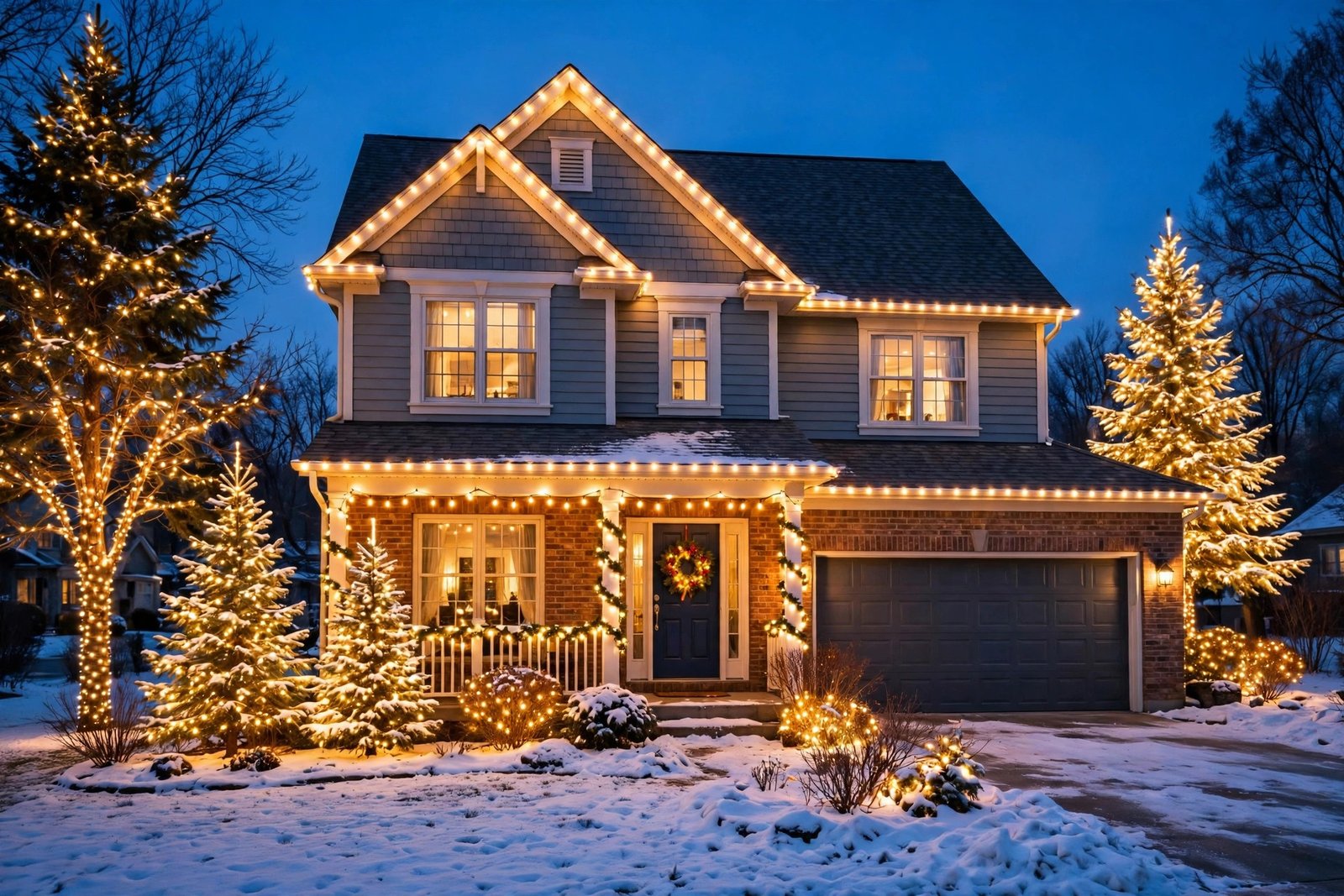
Every December, America lights up. Rooflines glow, trees sparkle in living-room windows, and whole neighborhoods turn into drive-through light shows. It is one of the most beloved parts of the American holiday season — and it runs on a staggering amount of electricity. The most widely cited estimate, from the U.S. Department of Energy, puts the nation’s decorative holiday lighting at about 6.6 billion kilowatt-hours of electricity a year. That is enough to power about 14 million refrigerators.
But here is the good news: the type of bulb you choose changes the bill dramatically. A single string of old incandescent lights can use eight to ten times more electricity than the LED equivalent, and the Department of Energy’s own cost comparison shows that lighting a Christmas tree with LEDs costs 27 cents a season, against about 10 dollars with old-fashioned incandescent bulbs. This guide breaks down the real numbers behind America’s holiday glow — what it uses, what it costs, and how to keep the magic without the shocking bill.
The Big Number: 6.6 Billion Kilowatt-Hours
The headline figure comes from a 2008 study by the U.S. Department of Energy, and it is still the standard reference point cited by energy experts today. According to the DOE, Americans use about 6.6 billion kilowatt-hours of electricity each year on decorative holiday lighting — the strings on trees, rooflines, bushes, and yard displays that go up between Thanksgiving and New Year’s Day.
To put that in perspective, researchers at the Center for Global Development noted that 6.6 billion kilowatt-hours is more electricity than some entire countries use in a full year. A separate DOE-based estimate put holiday lighting at 2.22 terawatt-hours — roughly the amount of electricity 200,000 American homes use over 12 months. The exact total depends on how you count commercial displays and how many households have switched to LED, and the real number today is probably lower per household than it was in 2008, because LED adoption has transformed the market. But even with that caveat, the scale is enormous: millions of homes, each running hundreds of bulbs for hours every night, for weeks on end.
The DOE’s 2008 estimate assumed lights run about nine hours a day for 45 days, or roughly 410 hours a year — a figure that includes commercial displays. Most households run their lights for fewer hours, typically from dusk until around midnight, and for a shorter season. Even so, multiplied by tens of millions of homes, the kilowatt-hours pile up fast.
What That Means in Plain English
A kilowatt-hour is simply the unit on your electric bill: one kilowatt of power used for one hour. Holiday lights are small loads individually, but they run for a long time and there are a lot of them.
Here is the comparison that makes it click. A standard string of 100 incandescent mini lights draws about 40 watts. The LED equivalent draws about 5 to 7 watts — roughly a tenth of the power for the same length of light. A 25-bulb string of big C9 incandescent bulbs draws about 159 watts; the LED version draws about 2.5 watts. That gap is the whole story of holiday lighting in America: the same glow, for a fraction of the power.
Scale it up to a whole house and the difference becomes real money. A display of ten 100-bulb incandescent strings draws around 400 watts; in LED, the same display draws 50 to 70 watts. Run six hours a night for 40 nights, the incandescent version uses about 96 kilowatt-hours against about 12 to 17 for LED — the difference between a season costing a few dollars and one costing closer to twenty.
LED vs. Incandescent: The 70 to 90 Percent Gap
The U.S. Department of Energy says LED light strings use about 70 percent less energy than conventional incandescent strands, and ENERGY STAR certified decorative light strings use about 70 percent less energy than incandescent strings while lasting up to ten times longer. The Department of Energy also notes that LEDs can use up to 90 percent less energy than incandescent bulbs and last up to 25 times longer.
The reason is physics. An incandescent bulb makes light by heating a filament until it glows, and about 90 percent of the energy it consumes becomes heat rather than light. An LED converts most of its energy directly into light, which is why LED strings stay cool to the touch even after hours of use. That cool running is also a safety win around dry trees and fabric decorations.
Lifespan is the other half of the advantage. A typical incandescent holiday bulb is rated for about 1,000 to 3,000 hours, while LED holiday lights are typically rated for 25,000 to 50,000 hours. At six hours a night for a 40-night season, an LED string could last for decades of holiday seasons before burning out, while an incandescent string may need replacing every few years. ENERGY STAR certified strings also carry a warranty of at least three years and are capped at 0.2 watts per bulb.
The savings add up nationally, too. The Department of Energy has estimated that switching America’s holiday lights from incandescent to LED could save about 850 million dollars a year in electricity costs and prevent about 9.9 billion pounds of greenhouse gas emissions from entering the atmosphere. That is the power of a simple swap, repeated in tens of millions of homes.
What It Costs You: The Tree Test
The Department of Energy published a cost comparison that has become the classic illustration of the LED advantage. Lighting a six-foot Christmas tree for 12 hours a day over 40 days costs about 27 cents with LED mini-lights, compared with about 10 dollars with incandescent lights. That is a difference of nearly 40 times, for the same tree, lit the same number of hours.
Stretch the comparison over ten holiday seasons and the gap grows. The Department of Energy estimates it costs about 17.99 dollars to buy and run LED C-9 lights for a six-foot tree over ten years, compared with about 122.19 dollars for incandescent C-9 lights. The ten-year figure accounts for the fact that incandescent bulbs burn out and need replacing, typically every three years, while the LEDs keep going.
Utility estimates tell the same story at the level of a single string. National Grid, a major utility in the northeastern United States, estimates that running a C-9 incandescent strand costs about 95 cents a day, or 35.15 dollars over the holiday season, while the LED equivalent costs about 14 cents a day, or 5.18 dollars for the season. A mini-light strand drops from about 1.85 dollars a season in incandescent to about 37 cents in LED. The pattern holds at every scale: the bigger the display, the bigger the savings.
For the truly elaborate displays, the difference is hundreds of dollars: a heavy incandescent display can cost around 115 dollars or more for the season, while the LED equivalent runs about 15 to 20 dollars.
What a Kilowatt-Hour Costs in 2026
To work out your own holiday light bill, you need one number from your electric bill: your price per kilowatt-hour. The formula is simple — watts divided by 1,000, multiplied by hours, multiplied by your price per kilowatt-hour, equals your cost. A 100-bulb incandescent string at 40 watts, lit six hours a night for 40 nights, uses 9.6 kilowatt-hours. The LED version at 7 watts uses 1.68 kilowatt-hours over the same period.
According to the U.S. Energy Information Administration, the average residential electricity price in the United States was 18.17 cents per kilowatt-hour in September 2026, and the agency projected an average of about 18.2 cents for 2026 as a whole. At that rate, the incandescent string above costs about 1.74 dollars for the season, while the LED string costs about 31 cents.
Rates vary widely by state: in September 2026, prices ran from about 13.25 cents per kilowatt-hour in Nevada to about 48.31 cents in Hawaii. The same display can cost two or three times more in one state than another — check your own bill rather than trusting a national average.
How the Grid Handles the December Surge
America’s power grid is built to handle peaks, and the December lighting surge is one of the most predictable peaks of the year. Utilities plan for it the same way they plan for summer air-conditioning peaks: by forecasting demand, keeping spare generation ready, and managing the load across the network. The evening hours, when millions of households switch their displays on at dusk, are the busiest time for holiday lighting demand.
That is where the LED shift has quietly helped the grid: as households have replaced incandescent strings with LED, the December evening peak from holiday lighting has shrunk even as displays have grown bigger.
Community displays add another dimension: city light shows, zoo festivals, and drive-through displays use commercial-scale lighting, and many have switched to LED as well, some with timers or smart controls that dim sections when crowds thin out.
Seven Ways to Cut Your Holiday Light Bill
You do not need to give up the glow to save money. These seven moves cut the cost of holiday lighting without dimming the display.
1. Switch to LED. This is the single biggest step. LED strings use 70 to 90 percent less energy than incandescent and last far longer. If your old strings are starting to fail, replace the whole string with LED rather than hunting for bad bulbs.
2. Use a timer. Put your lights on a timer so they switch off when nobody is watching. Eight hours a day, from dusk to around midnight, is plenty — the Department of Energy’s own guidance points to that window. Lights left on all night cost roughly twice as much for no extra joy.
3. Buy ENERGY STAR certified strings. Certified decorative light strings use about 70 percent less energy than incandescent, are capped at 0.2 watts per bulb, last up to ten times longer, and carry a three-year warranty. The label is the easiest way to be sure you are getting the efficient version.
4. Count your watts before you plug in. Every string has its wattage printed on the tag or the box. Add up the watts, divide by 1,000, multiply by the hours you will run them, and multiply by your price per kilowatt-hour. Knowing the number before you decorate beats being surprised by the bill in January.
5. Light the tree, not the whole block. Concentrate lights where people actually look — the tree, the front windows, the roofline — rather than blanketing every bush and fence.
6. Consider solar for small accents. Solar-powered stake lights and small accent strings work well for pathways and garden features, and they cost nothing to run once bought. They are not a replacement for a main display in December’s short days, but they are a free way to extend the glow.
7. Unplug when the season ends. Holiday lights left plugged in after the season draw standby power through their controllers and transformers, and they degrade faster in the weather. Take them down, coil them loosely, and store them somewhere dry. Your January self — and your January bill — will thank you.
Safety: Cool Bulbs, Fewer Fires
The efficiency story has a safety chapter too. LED holiday lights stay cool to the touch, which lowers the risk of fire — a real concern when lights sit against a dry tree, fabric, or wrapping paper. The U.S. Fire Administration, citing the National Fire Protection Association, notes that almost one-third of home Christmas tree fires are caused by electrical problems. Keeping bulbs cool, checking strings for frayed wires and cracked sockets, and never overloading an outlet all help.
Outdoor strings deserve the same care: use lights rated for outdoor use, keep connections off the ground, and use a ground-fault protected outlet. Replace any string with damaged insulation rather than patching it.
America’s holiday glow is not going anywhere, and the displays will keep getting more ambitious. The good news is that the power behind the glow keeps getting cheaper — one LED string at a time. A few dollars of electricity, a timer, and a little planning are all it takes to keep the magic bright without letting the bill steal the season.
Related Reading
Want more on how American power works? Read How the US Power Grid Delivers Electricity to America, America’s Best Christmas Light Displays 2026, and National Christmas Tree Lighting 2026 Guide.
Frequently Asked Questions
How much electricity do American Christmas lights use?
According to the U.S. Department of Energy, decorative holiday lighting in the United States uses about 6.6 billion kilowatt-hours of electricity per year — enough to power about 14 million refrigerators. The figure comes from a 2008 DOE study and remains the standard reference, though the real number today is probably lower per household because so many homes have switched to LED.
How much do LED Christmas lights save compared to incandescent?
LED light strings use about 70 percent less energy than incandescent strands, according to the Department of Energy, and up to 90 percent less by some measures. ENERGY STAR certified strings use about 70 percent less energy and last up to ten times longer. The DOE estimates that lighting a six-foot tree for 12 hours a day over 40 days costs about 27 cents with LEDs versus about 10 dollars with incandescent lights.
How much does it cost to run Christmas lights for a season?
It depends on the size of the display and your electricity rate. A single 100-bulb LED string run six hours a night for 40 nights uses about 1.68 kilowatt-hours, costing about 31 cents at the national average residential price of about 18.17 cents per kilowatt-hour. A modest LED home display typically costs a few dollars for the whole season, while a large incandescent display can cost tens or even hundreds of dollars.
How long do LED Christmas lights last?
LED holiday lights are typically rated for 25,000 to 50,000 hours, compared with about 1,000 to 3,000 hours for incandescent bulbs. At six hours a night for a 40-night season, an LED string could last for decades of holiday seasons. ENERGY STAR certified strings carry a warranty of at least three years.
What is the cheapest way to run holiday lights?
Use LED strings, put them on a timer for about eight hours a day from dusk to midnight, and buy ENERGY STAR certified lights. The timer alone can cut your lighting cost nearly in half compared with leaving lights on all night, and the switch from incandescent to LED cuts the energy use of each string by 70 percent or more.