
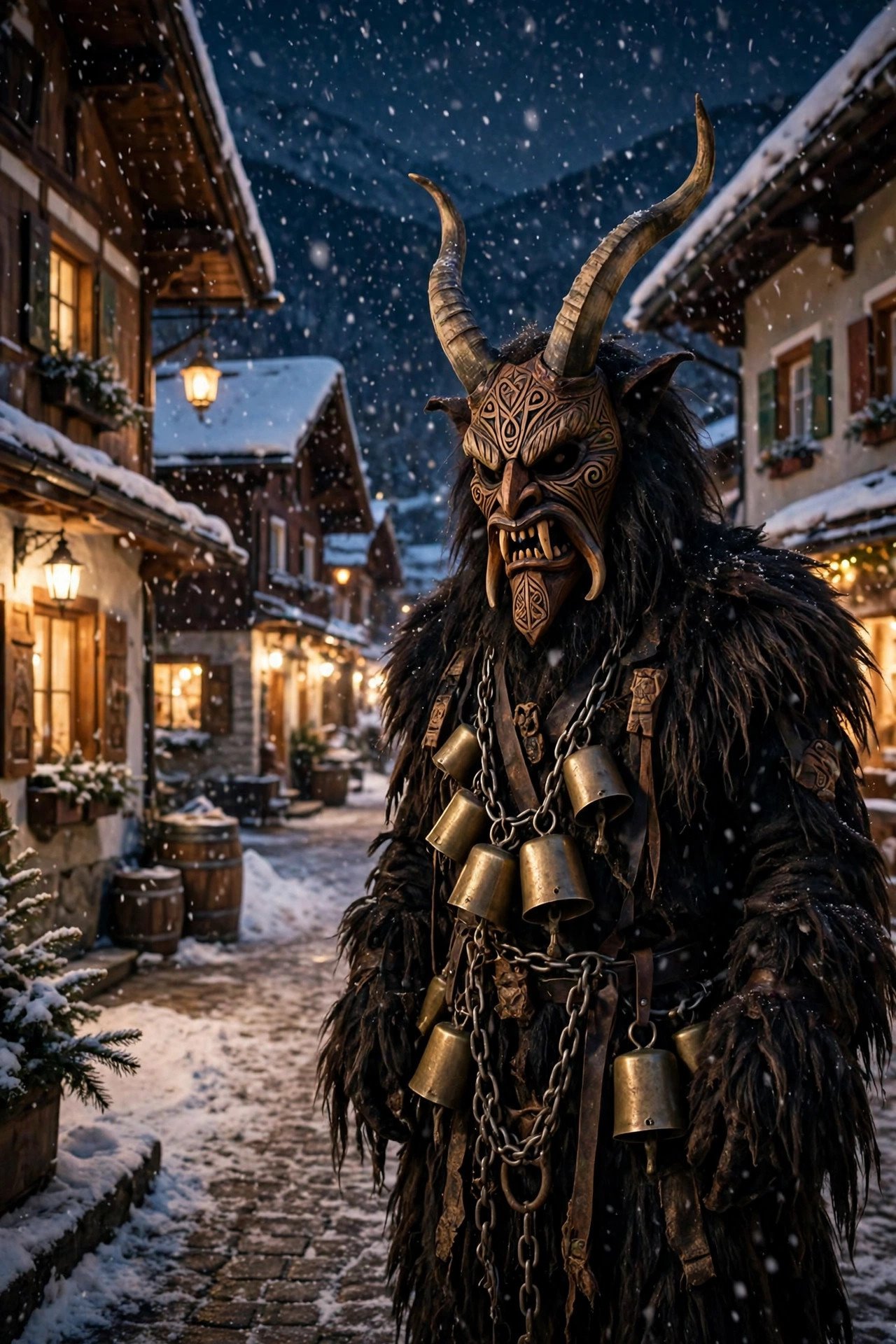
Every December, while most of America is hanging stockings and waiting for Santa Claus, a very different figure is making his rounds in the Alpine villages of Austria, Bavaria, and Slovenia. He has curved horns, a long red tongue, a bundle of birch sticks, and a chain that rattles as he walks. His name is Krampus, and for centuries, children in Central Europe have feared the night he comes to town almost as much as they have loved the morning after.
Krampus is the dark half of Christmas — the shadow that makes the light of St. Nicholas shine brighter. He is spooky, strange, and surprisingly fun, and in recent years he has crossed the Atlantic to crash American holiday parties, movie screens, and Christmas parades. Here is the full story of the horned Christmas demon, from Alpine folklore to Hollywood.
Who Is Krampus?
Krampus is a horned, half-goat, half-demon figure from the folklore of the Alpine region — the mountain country of Austria, southern Germany, Slovenia, the Czech lands, and northern Italy. He is the companion of St. Nicholas, and the two of them form a matched pair: Nicholas rewards the good children, and Krampus deals with the naughty ones.
His appearance is deliberately terrifying. He is usually pictured covered in dark fur, with curved goat horns, glowing eyes, fangs, and a long tongue that lolls down his chest. He often has one human foot and one cloven hoof, though nobody quite knows why. He carries chains, which are said to symbolize the binding of the Devil by the Christian Church, and he rattles them as he approaches. In one hand he carries a bundle of birch branches, the ruten, for swatting misbehaving children. On his back he carries a sack or a basket — and according to legend, the very worst children get stuffed inside it and carried away.
That is the scary part, and it is worth remembering that Krampus is a story, not a real threat. Like the witch in “Hansel and Gretel” or the monsters under the bed, he was a tale told to encourage good behavior — a little fear, delivered with a wink, to make children think twice before misbehaving in the weeks before Christmas. Britannica describes Krampus as a half-goat, half-demon figure who carries chains, bells, a bundle of birch twigs, and a basket for carrying off bad children, while St. Nicholas rewards the good ones with gifts.
Krampusnacht: The Night of December 5
The most important date in the Krampus calendar is December 5, known as Krampusnacht — Krampus Night. It is the eve of St. Nicholas Day, which falls on December 6. On Krampusnacht, the legend says, Krampus travels from house to house with St. Nicholas, visiting children while they sleep.
Children in Alpine tradition leave a shoe or a boot outside their door on the night of December 5. When they wake on the morning of December 6, the good ones find the shoe filled with small gifts and sweets from St. Nicholas. The naughty ones find something else: a bundle of birch twigs, a lump of coal, or nothing at all. It is a simple system, and it works — or at least, it has worked for centuries as a way of keeping children on their best behavior in the final weeks of the year.
Smithsonian Magazine explains that Krampus comes around on the night of December 5, tagging along with St. Nicholas and visiting houses all night. While St. Nick puts candy in the shoes of good children and birch twigs in the shoes of the bad ones, Krampus specializes in the punishment side of the visit. The two are a team — the yin to St. Nick’s yang, as one folklorist put it.
What Does His Name Mean?
Krampus gets his name from the German word krampen, meaning “claw” — a fitting name for a creature with curved horns and a reputation for grabbing naughty children. Some scholars trace the name to the Old High German word for cramp or claw, though the exact etymology is disputed. Either way, the name suits him: he is the clawed one, the grabber, the creature who reaches out of the dark.
Where did he come from? Nobody knows for certain, and that mystery is part of the appeal. Some folklorists believe Krampus grew out of pre-Christian winter rituals in the Alpine region, when masked figures roamed the villages during the darkest nights of the year to drive away the spirits of winter. According to some legends, he is the son of Hel, the Norse goddess of the underworld. Other scholars are more cautious, pointing out that Krampus is not clearly attested in writing until the 16th century, and that his origins may be a blend of pagan custom, Christian morality tales, and village theater rather than a single ancient god.
What is certain is that by the 17th century, Krampus had been firmly paired with St. Nicholas. The logic was simple: a saint could not be seen handing out punishments, so he needed a helper to do the frightening work. Across Europe, St. Nicholas collected a whole crew of dark companions — Knecht Ruprecht in Germany, Père Fouettard in France, and others — but Krampus, with his horns and his sack, became the most famous of them all.
Krampuslauf: The Wild Runs Through Town
If Krampusnacht is the quiet, household version of the legend, the Krampuslauf — the Krampus Run — is the loud, public one. In early December, groups of young men in hand-carved wooden masks, shaggy fur costumes, cowbells, and chains run through the streets of Alpine towns, chasing spectators, rattling their chains, and playfully swatting at the crowd with birch branches.
The runs are part parade, part folk theater, and part winter carnival. The masks alone are works of art: carved from wood, painted in fierce colors, fitted with real goat horns, and passed down or sold as valuable pieces of folk craft.
The tradition is strongest in the Austrian state of Tyrol and in Bavaria, where the best Krampus runs draw crowds on the night of December 5. National Geographic describes how the modern Krampuslauf works: costumed figures take over the streets for a Krampus Run, a noisy parade of devils that has become one of the most popular winter events in the region. The runs are not just for tourists, either — they are organized by local Krampus groups who spend all year preparing costumes, masks, and routes.
Krampuskarten: Greetings From the Demon
Long before Krampus became a movie star, he was a postcard star. In the late 19th century, new printing technology made it possible to mass-produce colorful holiday greeting cards, and Krampus was one of the most popular subjects. These cards, called Krampuskarten, were exchanged across German-speaking Europe from the 1880s until the First World War, and they are now collectors’ items.
The cards are wonderfully strange. They show Krampus chasing children through the snow, stuffing them into his sack, and — in the more playful ones — flirting with young women or peeking out from behind a Christmas tree. Most of them carry the greeting “Gruss vom Krampus” — “Greetings from Krampus” — which is a joke in itself: who sends a holiday card from a demon?
The cards tell us something important about how people actually felt about Krampus. He was scary, yes, but he was also funny, theatrical, and a little bit naughty — a folk character people enjoyed, not one they purely feared. The cards were the memes of their day: mass-produced, widely shared, and designed to make the recipient laugh. When the cards faded away after the First World War, Krampus went quiet for a while. But he was not gone. He was waiting for a comeback.
Banned, Suppressed, and Still Standing
Krampus has spent much of his life being banned — and surviving every ban. The Catholic Church tried to suppress Krampus celebrations as early as the 12th century, because a horned, devilish figure did not fit comfortably into a Christian holiday. Anyone caught dressing up as Krampus could face severe punishment, and in some accounts, even the death penalty, because the figure was perceived as the devil himself.
The bans kept coming. In the 1930s, Austria’s conservative government tried to eradicate the tradition: History.com notes that the Austrian government banned Krampus in the early 20th century as part of a broader effort to suppress folk customs it saw as unseemly. The Nazi regime also banned Krampus for his pagan roots. None of it held. The masks came out again, the runs started up again, and Krampus emerged from each suppression as beloved as ever — perhaps more so, because being banned only made him more interesting.
There is a lesson in that survival. Folk traditions do not live in official decrees; they live in villages, in families, and in the people who carve the masks and teach their children the stories. Krampus survived because ordinary people kept him alive, one December at a time, long after the authorities had moved on.
Krampus Comes to America
For most of the 20th century, Krampus was a European secret — famous in the Alps, unknown almost everywhere else. That changed in the early 2000s, when a Chicago graphic designer named Monte Beauchamp began publishing collections of vintage Krampuskarten. His books, including “The Devil in Design” and “Krampus: The Devil of Christmas,” introduced American readers to the strange, beautiful old postcards, and the response was enormous.
Soon after, Krampus began appearing in American cities. Los Angeles held its first Krampusnacht festival, and in 2015 the city hosted a Krampuslauf with a visiting Austrian troupe. Other American cities followed with their own runs, balls, and holiday parties. Chicago, home of Beauchamp’s revival, has been called the Krampus capital of the United States.
The American Krampus is a little different from the Alpine original. In the United States, he is less a moral warning for children and more a countercultural mascot — a joke about the commercial side of Christmas, a mascot for people who find the season a little too sweet. He shows up on ornaments, sweaters, and wrapping paper, and has become, improbably, a holiday brand.
The 2015 Film That Made Him a Star
The moment Krampus truly went mainstream came in December 2015, when director Michael Dougherty released the horror-comedy film “Krampus.” The movie tells the story of a family that loses its Christmas spirit and is visited by Krampus and his helpers — a dark, funny, and surprisingly heartfelt take on the legend. It was released on December 4, 2015, just in time for Krampusnacht, and it became a holiday-season hit.
The film did something important: it took a figure most Americans had never heard of and put him on screens across the country, complete with the horns, the sack, the chains, and the birch rods. It also kept the heart of the legend intact. In the film, as in the folklore, Krampus does not punish people at random — he comes when Christmas spirit is lost, and the story ends with a lesson about family and gratitude. The movie’s success sparked a wave of Krampus merchandise, parties, and events, and it cemented December 5 as a date that American horror and holiday fans now mark on their calendars.
Since then, Krampus has appeared in television episodes, comics, video games, and countless holiday specials. He has gone from a village legend to a global pop-culture figure — and he did it without losing what made him interesting: he is the one Christmas character who is not afraid to be scary.
Why We Still Love a Christmas Demon
Why does a horned demon belong at Christmas at all? Long before shopping malls and twinkling lights, the winter solstice was a frightening time — the longest nights of the year, the cold, the dark, the uncertainty of whether spring would come. The old winter festivals answered that fear with noise, fire, masks, and stories: ways of laughing at the dark instead of hiding from it.
Krampus is the last survivor of that older, wilder Christmas. Santa Claus gives us the warm, generous side of the holiday; Krampus gives us the wild, mischievous side. Together, they tell a fuller story about the season — that it is a time for both kindness and accountability, for both gifts and good behavior, for both light and a little bit of delightful darkness.
So this December 5, whether you are in Austria or Ohio, raise a glass to Krampusnacht. Leave a shoe by the door, be on your best behavior — and if you hear bells and chains rattling outside, do not worry. It is probably just the neighbors, in costume, keeping a centuries-old tradition alive. Probably.
Related Reading
If you enjoyed this guide, you may also like these stories from Famus News:
- The Legend of Sleepy Hollow and the Headless Horseman
- Salem Witch Trials 1692 Explained
- Mothman Legend of Point Pleasant Mystery
Frequently Asked Questions
Who is Krampus?
Krampus is a horned, half-goat, half-demon figure from Alpine folklore in Austria, Bavaria, Slovenia, and the Czech lands. He is the companion of St. Nicholas: Nicholas rewards good children with gifts, while Krampus punishes naughty children with birch rods and, in the legend, carries the worst offenders away in his sack.
When is Krampusnacht?
Krampusnacht, or Krampus Night, is December 5 — the night before St. Nicholas Day on December 6. According to tradition, Krampus visits homes on that night with St. Nicholas. Children leave a shoe outside their door, and on the morning of December 6 they find either gifts or a bundle of birch twigs.
What is a Krampuslauf?
A Krampuslauf, or Krampus Run, is a public parade in which people in hand-carved wooden masks, fur costumes, cowbells, and chains run through the streets, chasing spectators and rattling their chains. The runs take place in early December, especially in Austria and Bavaria, and they have spread to cities in the United States as well.
What are Krampuskarten?
Krampuskarten are holiday greeting cards featuring Krampus. They were mass-produced in the late 19th century, popular from the 1880s until the First World War, and often carried the greeting “Gruss vom Krampus” — “Greetings from Krampus.” They showed the demon chasing children, carrying them off in his sack, or getting into mischief, and they are now collectors’ items.
Is Krampus real?
No — Krampus is a figure from folklore, a story told for centuries in the Alpine region. He is part of a holiday tradition, like Santa Claus himself: a character in a tale, brought to life each December by costumes, parades, greeting cards, and movies. He is meant to be spooky fun, not something to fear.