
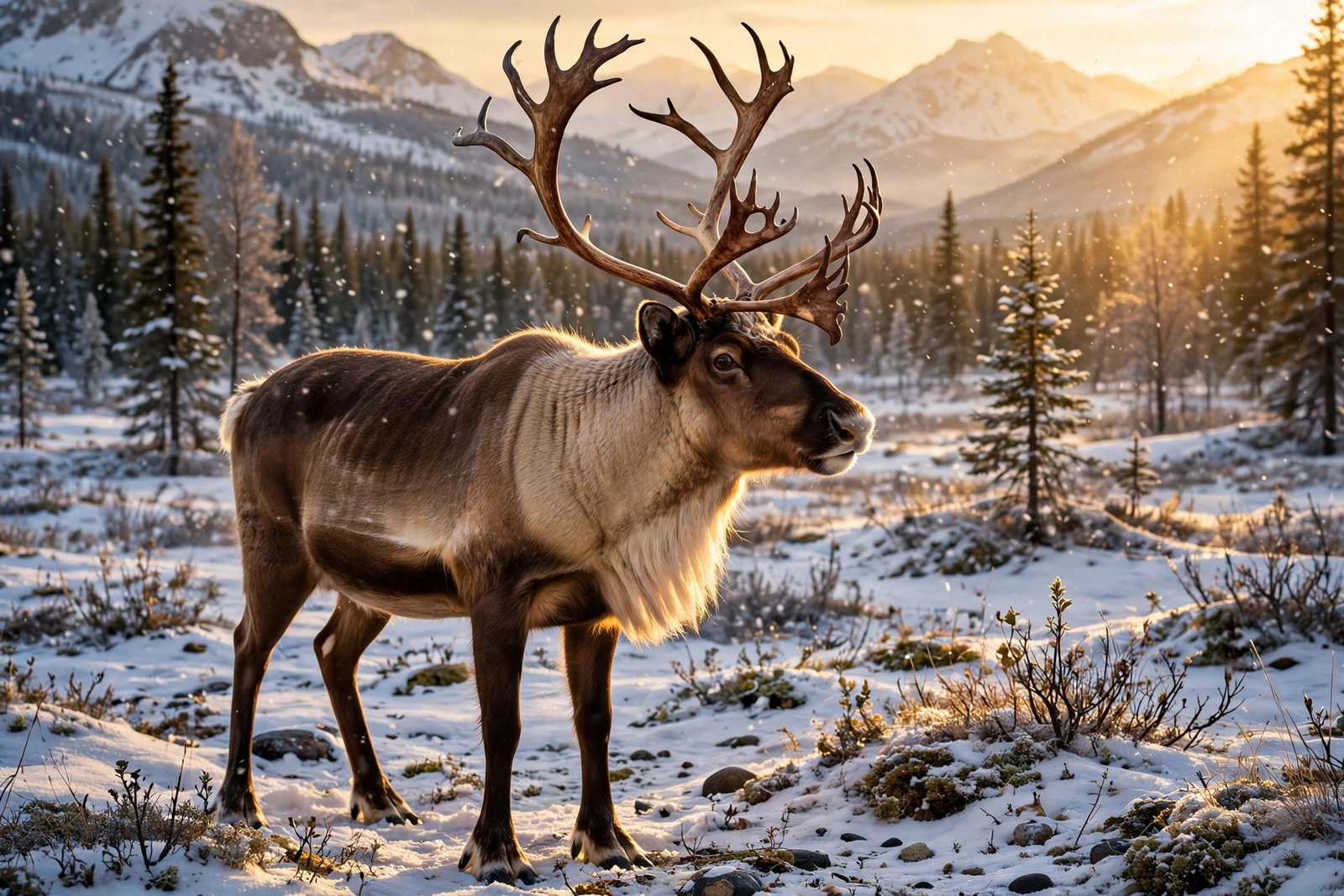
Every December, children across America leave out cookies for a jolly man in a red suit and the nine reindeer that pull his sleigh. The reindeer are the stuff of songs and storybooks — but the real animals behind the legend are even more remarkable than the folklore. Reindeer and caribou are tough, clever survivors of the far north, built to thrive in a landscape where winter lasts most of the year and temperatures plunge far below zero.
Here in the United States, these animals live wild in Alaska, where herds numbering in the hundreds of thousands still migrate across the tundra much as they have for thousands of years. They are also the only deer in the world in which females routinely grow antlers, and the owners of one of the longest migrations of any land mammal on Earth. This guide separates the facts from the Christmas magic — and shows you where you can meet a real reindeer for yourself.
One Animal, Two Names: Reindeer vs. Caribou
First, the question almost everyone asks: are reindeer and caribou the same animal? Yes. Reindeer and caribou are the same species, Rangifer tarandus, a member of the deer family with a circumpolar distribution across the Arctic and subarctic regions of North America, Europe, and Asia. The difference is not biology — it is geography and domestication.
In North America, the wild animals are called caribou, while domesticated animals are called reindeer. In Europe and Asia, the animals are called reindeer whether they are wild or tame. The U.S. Food and Drug Administration puts it plainly: in Europe they are called reindeer, while in North America the animals are called caribou if they are wild and reindeer if they are domesticated. So the caribou crossing the Alaskan tundra and the reindeer pulling a sleigh in a Christmas parade are the same kind of animal, living very different lives.
Scientists recognize several subspecies, and the animals vary a great deal in size and color. The smallest, the Svalbard reindeer of the high Arctic islands, is a fraction of the size of the largest, the woodland caribou of North America. Alaskan bulls typically weigh 350 to 400 pounds, with some recorded at 700 pounds, while mature females usually weigh 175 to 225 pounds. Newborn calves weigh only about 13 pounds at birth.
Reindeer are also the only deer species ever successfully domesticated on a large scale. For thousands of years, Arctic peoples have herded reindeer for meat, milk, hides, and transport. That long partnership with people is part of why reindeer feel at home around humans — and part of why they ended up pulling Santa’s sleigh.
The Only Deer Where Females Grow Antlers
Of all the deer species on Earth, reindeer are the only one in which females routinely grow antlers. In most deer, only the males carry antlers. In reindeer, both bulls and cows grow them — and relative to body size, reindeer have the largest and heaviest antlers of any living deer species. A bull’s antlers can reach 51 inches long, while a cow’s antlers can reach 20 inches, according to the U.S. Food and Drug Administration.
Unlike horns, which animals keep for life, antlers are shed and regrown every year, growing back larger each time. The timing is one of nature’s neat tricks. Males begin growing their antlers in February and shed them in late fall after the breeding season, leaving them bare-headed through the winter. Females begin growing theirs in May and keep them all winter, shedding them only around the time their calves are born in the spring.
That timing has a practical purpose. In winter, a cow uses her antlers to defend feeding spots, sweeping snow aside to reach the lichen below. New research published in the journal Ecology and Evolution in 2025 even suggests the antlers serve as a nutritional storehouse: females shed them just before giving birth, then munch on the shed antlers for a boost of protein, calcium, and phosphorus after their calves arrive.
Here is the delightful consequence for Christmas lovers: since males drop their antlers in November and females keep theirs through the winter, any reindeer pulling a sleigh on Christmas Eve with a full set of antlers would almost certainly be female. That includes Rudolph. As the National Park Service notes, male reindeer shed their antlers every November and grow them back in February — suggesting that Santa’s reindeer would have been female.
Built for the Arctic: Hooves, Hollow Hair, and Changing Eyes
A reindeer is a walking collection of cold-weather engineering. Start with the hooves. They are wide and splayed, spreading the animal’s weight across the snow like a snowshoe so it does not sink. And they change with the seasons: in summer, the pads soften and spread for grip on wet, muddy tundra, while in winter the hooves harden and narrow, with a sharp rim that cuts through ice and snow and gives traction on slippery ground. Reindeer also use those hard winter hooves to dig, or crater, through the snow to reach food buried below.
The coat is just as clever. Reindeer wear two layers: a dense, woolly undercoat that traps warm air close to the body, and a longer outer coat of hollow guard hairs. Each hollow hair holds a pocket of air, which insulates the animal against brutal cold — and also provides buoyancy, helping reindeer float when they swim across icy rivers and lakes. Their noses are specially adapted too, with passages that warm freezing air before it reaches the lungs.
Then there are the eyes. In 2011, researchers at University College London discovered that reindeer change their eye color with the seasons, shifting from gold in the summer to deep blue in the winter. The winter-blue eyes are more sensitive to light, helping the animals see during the long Arctic twilight, when the sun barely rises above the horizon. Reindeer can also detect ultraviolet light, which helps them spot lichen and the urine trails of other animals against the snow — and spot wolves moving across the white landscape.
Fast, Strong Swimmers, and Long-Distance Migrants
For all their bulk, reindeer are athletes. They can run at 25 to 35 miles per hour over distance and reach sprinting speeds of up to 50 miles per hour when escaping wolves or bears — about as fast as a racehorse. They are also strong swimmers, crossing wide rivers and lakes during migration at speeds of around 6 miles per hour, roughly three times faster than an average human swimmer. Their hollow fur helps them stay afloat, and their hooves act as paddles.
Migration is the defining rhythm of a caribou’s life. Herds travel between summer calving grounds on the Arctic coastal plain and winter ranges in the forests to the south, following the same routes year after year. The Porcupine caribou herd, which ranges across northeastern Alaska and Canada’s Yukon, migrates some 1,500 miles a year — the longest land migration of any land mammal on Earth. Individual animals have been tracked covering extraordinary distances: the National Park Service reports that the longest recorded movement of a Western Arctic Herd female it monitored was 2,700 miles.
Migration is not a leisurely stroll. The herds cross rivers, climb mountains, and push through snow, all while pregnant females carry the next generation, and calves are born on the coastal plain in early June.
What’s for Dinner? Lichen, the Reindeer Moss
In winter, when the tundra is buried under snow and green plants are gone, reindeer eat lichen — the pale, crusty growth often called reindeer moss, though it is not a moss at all. Lichen is a partnership between a fungus and an alga, and it grows slowly on rocks, trees, and the tundra floor. Reindeer find it with their excellent sense of smell, detecting it beneath the snow, then dig down with their hooves to reach it.
Their digestive system is specially adapted to the job. Reindeer have a four-chambered stomach that can break down the tough compounds in lichen, which most animals cannot digest at all. In summer, the menu broadens to grasses, leaves, herbs, shrubs, and mushrooms, and the animals put on fat for the long winter ahead. A reindeer’s diet changes with the seasons, but lichen is the food that gets the herds through the hardest months — which is why the health of the lichen matters so much to the health of the herds.
That dependence also makes caribou vulnerable: when warming temperatures change the tundra, or rain freezes into a hard crust the animals cannot dig through, the herds feel it immediately.
Alaska’s Great Herds: Porcupine and Western Arctic
Alaska is home to about 32 caribou herds totaling roughly 950,000 animals, and two of them dominate the story of the American Arctic. The Porcupine caribou herd, which calves on the coastal plain of the Arctic National Wildlife Refuge, is now the state’s largest herd. A photocensus completed in July 2025 by the Alaska Department of Fish and Game estimated the herd at 143,000 animals, down from its all-time high of 218,000 in 2017. The herd remains large enough to support normal hunting guidelines, but the decline is a reminder that even the great herds are not immune to change.
The Western Arctic herd tells a starker story. Once the largest herd in Alaska, it peaked at about 490,000 animals in 2003. The latest estimate puts it at about 121,000 animals — a decline of roughly three-quarters from its peak. The Central Arctic herd, smaller than both, was estimated at 26,600 animals in the same 2025 photocensus, down from 34,600 in 2022. State biologists say the declines were expected based on monitoring of adult survival and calf numbers, but they are watching closely.
These herds matter far beyond Alaska. They are a vital food source for Alaska Native communities, including the Gwich’in people, for whom the Porcupine herd’s calving grounds on the coastal plain are sacred. They are also a keystone species of the Arctic, shaping the tundra as they graze and feeding wolves, bears, and eagles in turn.
Where to Meet Real Reindeer in America
You do not need to travel to the Arctic Circle to meet a reindeer. Alaska offers several chances to get close to the real thing. In the town of North Pole, a short drive from Fairbanks, the Santa Claus House has a big red barn next door — Antler Academy — where visitors can view Santa’s reindeer team as they prepare for their big night. The town celebrates Christmas year-round, with candy-cane-striped light posts outside.
Nearby, the Running Reindeer Ranch in Fairbanks offers guided walks through a birch forest alongside a herd of reindeer, with hot chocolate and cookies afterward. The ranch has operated since 2007 and is home to around 40 reindeer. Visitors can also see reindeer and muskoxen at the Large Animal Research Station at the University of Alaska Fairbanks, where scientists study how Arctic animals survive the cold.
Outside Alaska, reindeer farms and holiday attractions across the Lower 48 offer seasonal encounters, especially in December, when farms open for visits, sleigh rides, and photos. If you go, look for places that let the animals roam and rest, and remember that real reindeer are not pets — they are powerful wild animals with sharp antlers and strong opinions about personal space. A respectful distance makes for a better visit for everyone, reindeer included.
How Santa’s Reindeer Got Their Names
The nine reindeer we all know by name come from two works of American popular culture. The first eight — Dasher, Dancer, Prancer, Vixen, Comet, Cupid, Donner, and Blitzen — were named in the poem A Visit from St. Nicholas, published anonymously in the Troy Sentinel newspaper in New York on December 23, 1823, and usually attributed to Clement Clarke Moore. In the poem’s original text, the last two were called Dunder and Blixem — Dutch words for thunder and lightning — before later versions changed them to Donner and Blitzen.
The ninth reindeer arrived more than a century later. In 1939, the Montgomery Ward department store chain commissioned copywriter Robert L. May to write a children’s Christmas booklet, and he created Rudolph, the reindeer with the glowing red nose who guides Santa’s sleigh through a blizzard. The booklet was a huge success, with more than 2 million copies given away that year. May’s brother-in-law, songwriter Johnny Marks, turned the story into the song we all know, recorded by Gene Autry in 1949.
So when you sing about Dasher and Dancer, you are singing an 1823 poem, and when you sing about Rudolph, you are singing a 1939 department-store giveaway. The real animals, meanwhile, have been migrating across the Arctic for thousands of years — no flying required. Their real story, of antlers and lichen and 1,500-mile journeys, is more extraordinary than the legend.
Related Reading
If you enjoyed this guide to America’s Arctic wildlife, keep exploring: Polar Bears of Alaska: A Wildlife Guide, Snowy Owls: Winter Migration Across the USA, and Bison of Yellowstone: America’s Wildlife Comeback.
Frequently Asked Questions
Are reindeer and caribou the same animal?
Yes. Reindeer and caribou are the same species, Rangifer tarandus. In North America, wild animals are called caribou and domesticated animals are called reindeer, while in Europe and Asia the animals are generally called reindeer. The difference is geography and domestication, not biology.
Do female reindeer really have antlers?
Yes. Reindeer are the only deer species in which females routinely grow antlers. A cow’s antlers can reach about 20 inches long, while a bull’s can reach 51 inches. Females keep their antlers through the winter and shed them around the time their calves are born in spring, while males shed theirs in late fall.
How big are Alaska’s caribou herds?
Alaska has about 32 caribou herds totaling roughly 950,000 animals. The Porcupine herd, the state’s largest, was estimated at 143,000 animals in a July 2025 photocensus, down from its 2017 peak of 218,000. The Western Arctic herd peaked at about 490,000 in 2003 and is now estimated at about 121,000 animals.
Can reindeer really run 50 miles per hour?
Reindeer can reach sprinting speeds of up to 50 miles per hour in short bursts when escaping predators, and they typically run at 25 to 35 miles per hour over longer distances. They are also strong swimmers, crossing rivers and lakes at around 6 miles per hour during migration.
Where can I see a real reindeer in the United States?
Alaska is the best place. You can see reindeer at the Santa Claus House in North Pole, take a guided walk with a herd at the Running Reindeer Ranch near Fairbanks, or visit the Large Animal Research Station at the University of Alaska Fairbanks. Seasonal reindeer farms and holiday attractions also operate across the Lower 48, especially in December.