
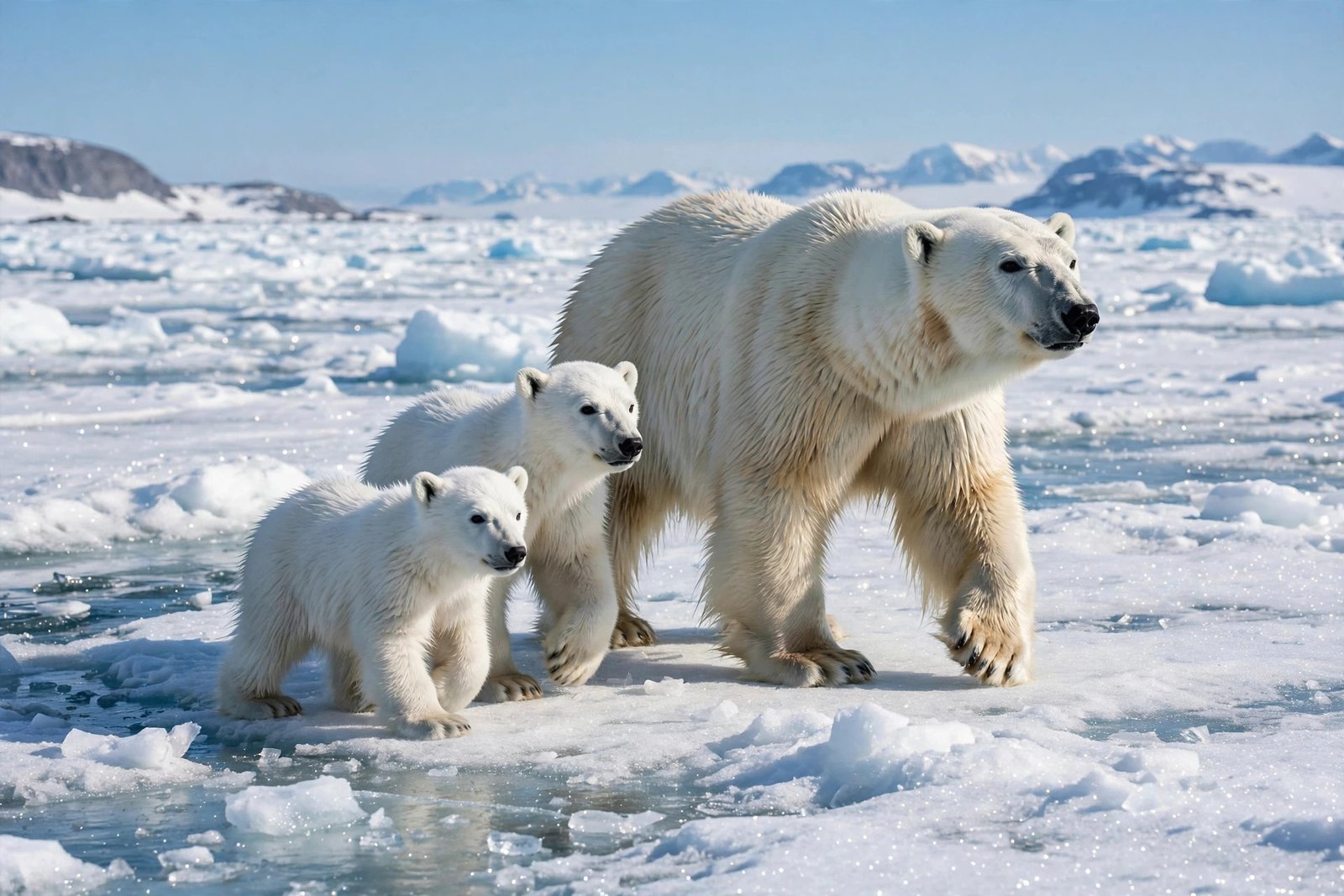
There is no animal that captures the Arctic quite like the polar bear. Huge, powerful, and almost impossibly white against the ice, it is the largest land carnivore on Earth, a hunter that spends its life on frozen seas, and a symbol of a warming world. In the United States, polar bears live only in Alaska, along the state’s northern and western coasts, where the sea ice meets the land. To understand the polar bear is to understand the Arctic itself: its seasons, its ice, and the changes sweeping across the far north. Here is what makes Alaska’s polar bears so remarkable, how they live, and what their future depends on.
Two populations share Alaska’s Arctic coast
Scientists recognize 19 polar bear populations around the world, and two of them occur in the waters off Alaska. The Chukchi Sea population, sometimes called the Chukchi and Bering Seas population, ranges along Alaska’s northwest coast and is shared with Russia. The Southern Beaufort Sea population ranges along Alaska’s northern coast and is shared with Canada. According to the Marine Mammal Commission’s polar bear profile, the two Alaska populations are the only ones that occur in United States waters. The populations behave differently because their homes are different. The Chukchi Sea is rich in seals and other marine life, and its bears have so far coped better with the loss of summer sea ice. The Southern Beaufort Sea population has had a harder time: its numbers fell sharply in the mid-2000s as the ice declined, and it has remained at a lower level since. A study published in 2020 estimated that the Southern Beaufort Sea population dropped from about 1,300 bears in 2003 to roughly 525 in 2006, then stabilized at a few hundred bears in the years that followed. A separate study estimated the Chukchi Sea population at between about 3,400 and 5,400 bears in 2016. Around the world, total polar bear numbers are estimated at roughly 23,000 animals. These figures come with real uncertainty, because counting bears across vast, remote stretches of Arctic sea ice is extremely difficult, and researchers are careful to say so.
Life on the ice: a hunter built for seals
A polar bear’s whole life revolves around sea ice, and the reason is food. Ringed seals are the main prey of Alaska’s polar bears, and the bears hunt them in ways that depend entirely on frozen ocean. A bear will wait silently at a seal’s breathing hole in the ice, sometimes for hours, and strike the moment the seal surfaces for air. Bears also stalk seals resting on the ice, and they break into the snow dens where seal mothers hide their pups. Bearded seals are also important prey, and polar bears will eat walrus, beluga whales, and the carcasses of whales and seals they find along the shore. The Alaska Department of Fish and Game polar bear profile describes how bears capture seals at breathing holes and in snow lairs, and how their seasonal movements follow the ice as it advances and retreats. In winter, Alaska’s bears can be found as far south as St. Lawrence Island, and they occasionally move down toward St. Matthew Island and the Kuskokwim Delta. In summer, they gather near the edge of the pack ice in the Chukchi Sea and the Arctic Ocean. Along the Beaufort Sea coast, some bears come ashore during the ice-free summer months and wait on land until the sea freezes again in late fall, resting and conserving energy until they can hunt once more.
Built for the cold: the world’s largest land carnivore
Polar bears are the largest carnivorous land mammals on Earth, and every part of them is shaped by the Arctic. Adult males in Alaska typically weigh between 600 and 1,200 pounds and measure 8 to 10 feet long, while adult females weigh 400 to 700 pounds. The largest males can weigh more than 1,700 pounds. Their fur looks white but is actually translucent, and beneath it lies black skin that absorbs heat from the sun. A thick layer of fat under the skin insulates the body, stores energy, and helps the bear float when it swims. Their paws are large and broad, with small bumps on the pads that grip slippery ice, and their front paws are partly webbed for swimming. As the National Wildlife Federation explains, polar bears are excellent swimmers that can travel long distances between shore and sea ice, and they can gain about half their body weight again in fat over a successful hunting season. Their sense of smell is extraordinary, letting them detect seals under the ice and carcasses from far away. Even their white coat is a hunting tool, blending into the snow and ice so seals do not spot them until it is too late. Few animals on Earth are so completely fitted to one environment.
Denning and cubs: the most vulnerable months
Unlike brown bears and black bears, most polar bears do not hibernate. The great exception is the pregnant female, who must den so her tiny cubs can be born in a warm, protected place. In October and November, a pregnant female finds a denning area on land or on the sea ice, digging into snow that has drifted against a river bank, a coastal bluff, or an island shore. As more snow falls, she enlarges the den. The cubs, usually twins, are born in December or January and weigh only about one to two pounds, roughly the size of a small guinea pig. They are blind, nearly hairless, and completely helpless, and they would freeze within hours outside the den. Inside, the den can be far warmer than the frigid air outside, and the mother nurses them on milk so rich in fat that they grow fast. By late March or early April, when the cubs weigh about 20 to 25 pounds, the family leaves the den and heads for the sea ice, where the mother can hunt again. The cubs stay with her for about two and a half years, learning to hunt, swim, and survive, before she mates again. A female typically has one to three cubs once every three years, which means polar bear populations grow slowly and recover slowly from hard times. That slow pace is one reason the loss of sea ice hits them so hard.
Threatened since 2008: what the listing means
In 2008, the U.S. Fish and Wildlife Service listed the polar bear as a threatened species throughout its range under the Endangered Species Act, because of the threat posed by the loss of sea ice as the climate warms. The listing was a landmark decision: the polar bear became one of the first species protected largely because of projected future habitat loss rather than current numbers alone. The Marine Mammal Commission notes that in 2016 the U.S. Geological Survey concluded that the long-term survival of polar bears would likely require stabilizing greenhouse gas emissions by the middle of this century. The threatened listing brings legal protections, and polar bears are also protected under the Marine Mammal Protection Act, which has governed their management in the United States since the early 1970s. The listing does not mean the bears are disappearing everywhere at the same speed. Some populations, including the Chukchi Sea bears, have held up better than expected, thanks to rich prey and productive waters. Others, such as the Southern Beaufort Sea population, have already declined. What the science agrees on is the direction of travel: as the Arctic warms and the ice-free season lengthens, the bears have less time to hunt, less time to build the fat reserves they need, and more time fasting on land. A 2021 study of the Southern Beaufort Sea population, published in the journal Ecology and Evolution, found that the population remained at its lowest level since the Marine Mammal Protection Act was passed, and that its potential for recovery is limited by the habitat loss it has already experienced.
A changing Arctic, measured in ice
The sea ice that polar bears depend on has been shrinking for decades. In the Southern Beaufort Sea, sea ice extent has declined since satellite observations began in 1979, and the bears there have felt it in their bodies: during the poor ice years of the mid-2000s, fewer cubs survived into their second year, and adult males weighed less and had smaller skulls. Chukchi Sea bears, by contrast, now spend almost a month less on the ice than they did twenty years ago, yet their population has remained healthy, apparently because the Chukchi Sea is so rich in seals that the bears can compensate for the lost hunting time. That contrast is important, because it shows that the effects of ice loss arrive at different speeds in different places. But the trend is the same everywhere, and the concern is the same too. As the ice-free season grows longer, bears spend more time on land, where food is scarce. They may wander into Arctic villages looking for food, which creates danger for people and for bears alike. Longer swims between shore and ice cost energy and fat, and mothers with cubs pay the highest price. Research published in Ecology and Evolution and summarized by the Marine Mammal Commission confirms that the Southern Beaufort Sea population has not returned to its earlier abundance, even though survival improved after the worst years. The Arctic is changing faster than almost any other place on Earth, and the polar bear is living through that change in real time.
Seeing polar bears responsibly in Alaska
For travelers, Alaska offers one of the few places on Earth where polar bears can be seen in the wild, but it is a trip that demands planning, respect, and a good guide. The two Alaska communities where viewing is possible are Kaktovik and Utqiagvik, formerly known as Barrow. Kaktovik, a small Inupiat village on Barter Island inside the Arctic National Wildlife Refuge, is the best-known destination. During the ice-free period between August and October, many bears gather along the coast near the village, and most visitors come in September, when the bears are most often seen near shore. The Alaska Department of Fish and Game’s polar bear viewing guidance stresses that visitors should view bears with a guide, stay in their vehicle or boat, keep noise and sudden movements to a minimum, and never approach a bear. Guides permitted to work on refuge lands have shown they meet federal and state requirements, and visitors should check that their guide is operating legally and has a safety plan. Kaktovik is remote: access is by small commercial or chartered aircraft, hotel rooms and vehicle rentals are very limited, and weather delays are common. Visitors should also know that viewing conditions change from year to year, and that boat tours in the area were halted in recent years while the Fish and Wildlife Service and the village worked on new management rules, so anyone planning a trip should check the current status before booking. Utqiagvik also offers limited viewing opportunities. Wherever you go, remember that polar bears are wild, powerful, and unpredictable, and that the privilege of seeing one depends on everyone keeping the bears and the people safe.
The people who share the bears’ home
Alaska’s Arctic coast is not empty wilderness. It is home to Inupiat communities whose relationship with polar bears stretches back generations, including the village of Kaktovik and the city of Utqiagvik. Polar bears are hunted for subsistence by Alaska Native hunters in these communities and along the coast, and harvest levels are managed through international agreements and cooperation with local communities. The bears are also part of the culture and identity of the region, and the villages are on the front line of the changes in the ice, watching the seasons shift year by year. When visitors come to see the bears, they are guests in these communities, and respectful travel means learning about the people as well as the wildlife. That includes respecting whaling and subsistence activities, asking before photographing residents, and supporting local guides and businesses. The future of Alaska’s polar bears will be decided in part by decisions made far from the Arctic, about emissions and ice. But it will also be decided closer to home, by how well people and bears can share a coastline that is changing under both their feet. The polar bear has survived in one of the harshest places on Earth for hundreds of thousands of years. Whether it thrives there for hundreds of thousands more depends on the ice, and on us.
Related reading
Explore more of America’s wild side with Famus News: Bison in Yellowstone: A Wildlife Guide, Snowy Owl Winter Migration in the USA, and The Gray Wolf Comeback in Yellowstone.
Frequently asked questions
How many polar bears live in Alaska?
Alaska is home to two polar bear populations: the Chukchi Sea population, estimated at roughly 2,900 to 5,400 bears depending on the study, and the Southern Beaufort Sea population, estimated at a few hundred bears. Counting bears across remote Arctic sea ice is difficult, so researchers give ranges rather than exact counts.
Why are polar bears listed as threatened?
The U.S. Fish and Wildlife Service listed polar bears as threatened under the Endangered Species Act in 2008 because of the projected loss of sea ice, which the bears need for hunting seals, breeding, and traveling. The listing was driven by the threat to their habitat as the Arctic warms.
What do polar bears eat?
Ringed seals are the main prey, along with bearded seals. Polar bears also eat walrus, beluga whales, and the carcasses of whales and seals they find. They hunt mainly on sea ice, waiting at seal breathing holes or stalking seals resting on the ice.
Where is the best place to see polar bears in Alaska?
Kaktovik, a small village on Barter Island in the Arctic National Wildlife Refuge, is the best-known place, with bears gathering along the coast during the ice-free months of August to October, especially September. Utqiagvik also offers limited viewing. Always go with a permitted local guide and check current tour availability before planning a trip.
How long do polar bear cubs stay with their mother?
Cubs stay with their mother for about two and a half years. They are born in a snow den in December or January, weighing only one to two pounds, and leave the den in spring when they weigh about 20 to 25 pounds. A female usually has cubs once every three years.