
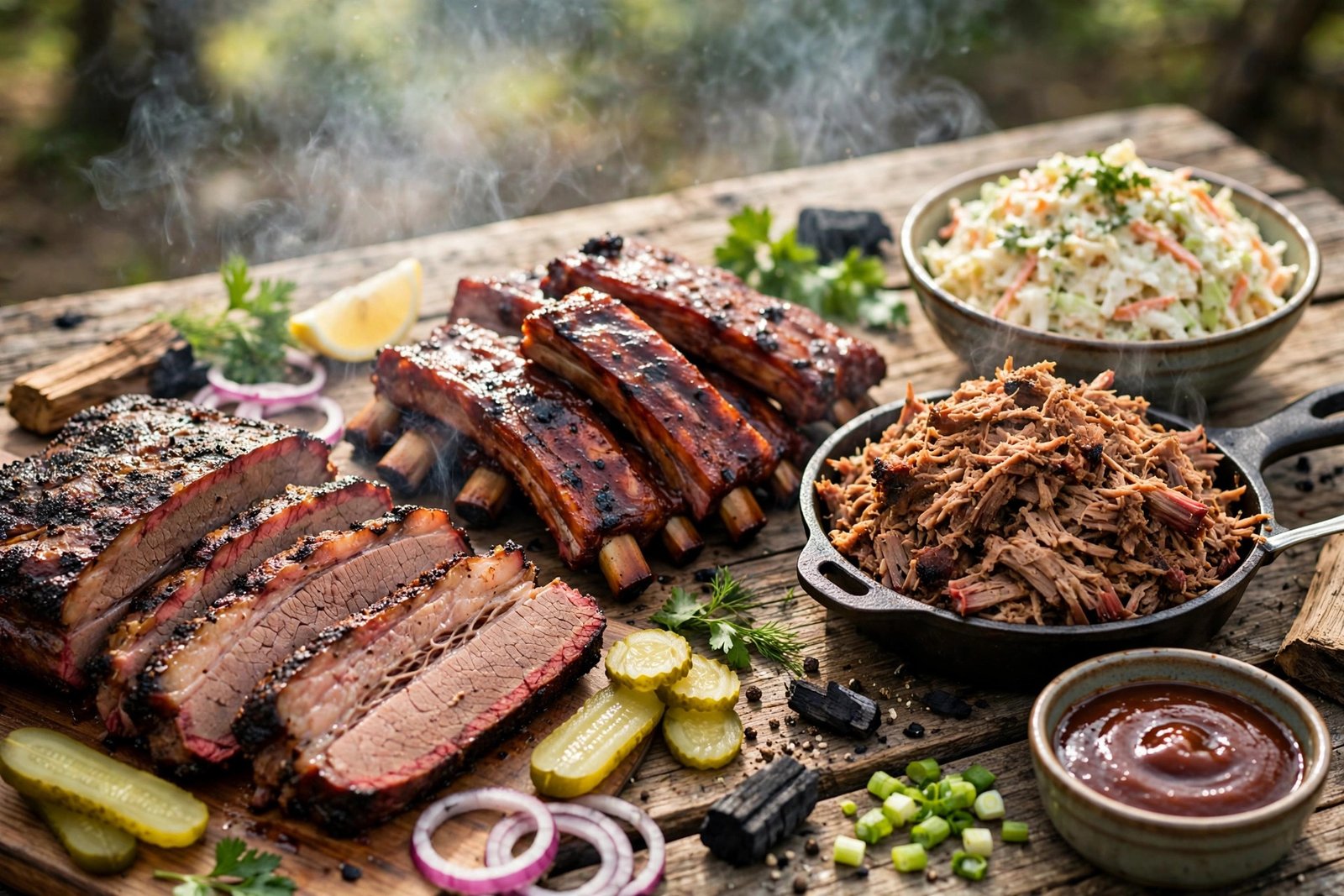
Ask ten Americans what barbecue means and you will get ten different answers — and probably a friendly argument. In Texas, barbecue means a slab of smoked brisket seasoned with little more than salt and pepper. In Kansas City, it means a plate piled high with saucy ribs and burnt ends. In Memphis, it means dry-rubbed ribs eaten with your hands. In the Carolinas, it means slow-smoked pork dressed in vinegar or mustard sauce. Every one of them is right, and every one of them is convinced the others are doing it wrong.
That disagreement is the whole point. American barbecue is not one dish but a family of regional traditions, each shaped by the livestock, wood, settlers, and history of its home turf. The result is one of the most delicious maps in American food — four great regional styles, plus a few proud outliers, that you can taste your way across like a road trip.
This guide explains what makes each style different, where it came from, and what to order when you visit.
Where American Barbecue Came From
Barbecue did not start in the United States. Its roots reach back to the Taíno people of the Caribbean, who slow-cooked meat on a raised wooden platform called a barbacoa over a smoldering fire. Spanish explorers encountered the technique in the 1500s and carried it north, where it met European animal husbandry, African seasoning traditions, and the smoking methods already familiar to Indigenous peoples of North America.
By the 1700s and 1800s, barbecue had taken hold in the American South, especially where pigs roamed freely and wood was plentiful. Whole hogs were cooked slowly over pits for community gatherings, church suppers, and political rallies.
As settlers moved west and railroads stitched the country together, local conditions began to split barbecue into distinct regional styles. Texas had cattle, so it smoked beef. The Carolinas had pigs, so they smoked pork. Memphis sat on the Mississippi River with easy access to transported goods, including molasses and spices. Kansas City sat at the crossroads of cattle drives and meatpacking, and it welcomed everything.
Texas Barbecue: Beef, Salt, Pepper, and Patience
Texas barbecue is built around one cut of meat above all others: brisket. The tough, fatty chest muscle of a cow becomes something extraordinary after many hours in a smoker, and Texas pitmasters treat it with a reverence that borders on religion.
The style traces back to Central Texas in the 1800s, when German and Czech immigrants opened butcher shops and meat markets across the region. They brought old-world smoking and sausage-making traditions with them, and they had access to abundant, inexpensive beef from the cattle trade. Rather than hide the meat under sauce, they let the beef speak for itself. The classic Central Texas approach is famously simple: a rub of coarse salt and black pepper, post oak smoke, and time — often 12 to 16 hours for a brisket.
That simplicity is the point. A properly smoked Texas brisket has a dark, crusty exterior called bark, a pink smoke ring just beneath it, and meat so tender it bends without breaking. Sauce, if it is offered at all, comes on the side and is used sparingly. Many of the most famous joints in the state consider sauce almost an afterthought, something for the table rather than the pit.
Brisket is the star, but Texas barbecue has a deep supporting cast. Beef ribs, with their enormous, meaty bones, are a second signature. Pork ribs, turkey, and sausage — especially the snappy, coarse-ground links descended from those German and Czech butcher shops — round out the tray, usually served on butcher paper with white bread, pickles, and onions.
Texas is a big state, and its barbecue is not entirely uniform. Central Texas is the brisket heartland. East Texas leans more Southern, with pork and a sweeter sauce, and the meat is often cooked until it falls apart. But when most people say Texas barbecue, they mean Central Texas brisket.
Must-try dishes: sliced brisket, beef ribs, jalapeño-cheddar sausage, and a brisket sandwich on white bread.
Kansas City Barbecue: Sweet Sauce and Burnt Ends
If Texas barbecue is about restraint, Kansas City barbecue is about abundance. The city at the crossroads of cattle drives, railroads, and the meatpacking industry became a melting pot of barbecue traditions, and it embraced them all. Beef, pork, chicken, turkey, sausage, ribs — in Kansas City, everything gets smoked, and everything gets sauce.
The style owes much to Henry Perry, a Memphis steamboat cook who arrived in Kansas City in 1908 and began selling smoked meats from a stand near downtown. Perry’s cooking drew crowds, and his successors turned his stand into an institution. The Kansas City style grew out of that mix: Memphis roots, Texas beef, and a city full of hungry workers.
The signature Kansas City sauce is thick, tomato-based, sweet, and tangy, usually built on molasses or brown sugar. It is the sauce most Americans picture when they think of barbecue sauce, and for good reason: the bottled sauces on supermarket shelves across the country are mostly modeled on the Kansas City style. Unlike Texas, where sauce is optional, Kansas City sauce is part of the identity — brushed on during cooking and served generously at the table.
The city’s most famous dish is the burnt end. These are the caramelized, cubed pieces cut from the point end of a smoked brisket, seasoned again and smoked a second time until they are crusty on the outside and meltingly tender inside. They began as scraps handed out to customers waiting in line, and they became so beloved that they are now a headline item.
Must-try dishes: burnt ends, baby back ribs with sweet sauce, smoked sausage, and a pulled pork sandwich.
Memphis Barbecue: Dry Rub Ribs and Pulled Pork
Memphis barbecue is pork country, and its most famous dish needs no sauce at all. Memphis dry-rub ribs are coated in a generous blend of spices — paprika, garlic, onion, brown sugar, cayenne, and more — then smoked low and slow until the meat pulls cleanly from the bone. The rub forms a flavorful crust, and the ribs are served as they are, with sauce offered on the side for those who want it.
The city became a barbecue hub because of its position on the Mississippi River. In the late 1800s and early 1900s, Memphis grew into a transportation and distribution center, and barbecue restaurants flourished to feed workers, travelers, and river crews. The style exploded after World War II, when legendary joints like Charlie Vergos’ Rendezvous, founded in 1948, put Memphis ribs on the national map.
Memphis also has a second great tradition: pulled pork. Pork shoulder is smoked until it can be pulled apart by hand, then piled onto a bun and topped with a thin, tangy slaw. The Memphis version of the pulled pork sandwich is a study in balance — rich pork, bright slaw, soft bun — and it is the dish many locals reach for when they are not ordering ribs.
Visitors should know about the great Memphis debate: dry versus wet. Dry ribs are served with rub only, while wet ribs are finished with a tangy tomato-based sauce during the last part of cooking. Both are legitimate, both are delicious, and regulars will happily argue about which one is the real Memphis style. The honest answer is to try both and pick your own side.
Must-try dishes: dry-rub ribs, wet ribs, pulled pork sandwich with slaw, and barbecue spaghetti — a Memphis original.
Carolina Barbecue: The Oldest Tradition in America
The Carolinas are often called the cradle of American barbecue, and the claim is a fair one. Barbecue traditions in North and South Carolina stretch back further than anywhere else in the country, to the earliest colonial settlements, when whole hogs were cooked over pits for community gatherings. Pork was abundant, cheap, and easy to raise, so pork became the meat of Carolina barbecue — and it still is.
What makes Carolina barbecue confusing to newcomers is that it is not one style but several, divided by geography and sauce. The dividing lines matter enormously to the people who live there.
Eastern North Carolina keeps the oldest tradition: the whole hog, cooked slowly over wood coals, chopped or pulled, and dressed with a thin vinegar-and-pepper sauce. There is no tomato in the sauce, no sweetness to hide behind. The vinegar cuts through the richness of the pork and sharpens every bite. This style dates back to the 18th century, when vinegar was a common preservative and flavoring, and it has changed remarkably little since.
Western North Carolina, often called Lexington style after the town of Lexington, does things differently. Pitmasters there cook pork shoulder rather than the whole hog, and they add a touch of tomato — usually in the form of ketchup — to the vinegar base. The result is a slightly sweeter, redder sauce. This style emerged in the early 1900s, when commercial barbecue stands found shoulders more practical than whole hogs.
South Carolina adds a third branch, and it is the most distinctive of all: mustard sauce, known as Carolina Gold. German immigrants who settled in the Midlands of South Carolina brought their love of mustard with them, and over generations it became a sweet, tangy, golden sauce served over pulled pork. It is unlike any other barbecue sauce in America, and for many South Carolinians it is the only sauce that counts.
Carolina barbecue is traditionally served with simple sides: hushpuppies, coleslaw, and Brunswick stew. The pork is chopped or pulled, never sliced like brisket, and the sauce is mixed in or served on the side depending on the joint. The whole point is the pork itself — smoky, juicy, and seasoned by the sauce rather than buried under it.
Must-try dishes: Eastern-style whole hog with vinegar sauce, Lexington-style chopped pork shoulder, and South Carolina pulled pork with Carolina Gold mustard sauce.
Alabama White Sauce: The Outlier Worth Knowing
Every barbecue map needs one rule-breaker, and Alabama provides it. While the rest of the South argues about red and vinegar sauces, northern Alabama serves its smoked chicken with a sauce that is white.
The sauce was created by Robert Gibson, a railroad worker known as Big Bob, who began smoking pork and chicken in a hickory-fired pit in his Decatur backyard in 1925. He opened Big Bob Gibson Bar-B-Q that same year, and the restaurant is still operating in Decatur today. The original recipe is a simple mixture of mayonnaise, vinegar, black pepper, and salt, with a touch of lemon juice. Gibson created it to solve a practical problem: whole chickens dried out during a long smoke, and the fat in the mayonnaise kept the meat moist while the vinegar added tang.
For decades, white sauce stayed mostly confined to northern Alabama. It has since spread across the country. The classic way to eat it is with smoked chicken — either dipped or dunked. If you think barbecue sauce has to be red, one taste of Alabama white sauce will change your mind.
How the Regions Compare at a Glance
Here is the quick version for anyone planning a barbecue road trip:
- Texas: beef brisket, salt-and-pepper rub, oak smoke, sauce on the side or not at all.
- Kansas City: all meats welcome, thick sweet tomato-molasses sauce, burnt ends.
- Memphis: pork ribs and pulled pork, dry spice rub, tangy sauce optional.
- Carolina: whole hog or pork shoulder, thin vinegar sauce in the east, tomato-vinegar in the west, mustard sauce in South Carolina.
- Alabama: smoked chicken with tangy mayonnaise-based white sauce.
The wood matters too. Texas favors post oak, while Memphis and the Carolinas lean on hickory — each wood gives the smoke a slightly different character.
How to Taste Them Like a Local
If you are visiting a barbecue region for the first time, a few habits will help you get the most out of it. First, order the house specialty, not the thing you already know. In Texas, that means brisket. In Memphis, dry-rub ribs. In Kansas City, burnt ends. In the Carolinas, pulled pork. The specialty is the dish the pitmaster has spent a lifetime perfecting.
Second, taste the meat before you reach for the sauce. A great pitmaster builds flavor into the meat itself, and the sauce is meant to complement it, not cover it. If you sauce first, you will never know what the smoke and the rub were doing.
Third, go to the counter-order joints, not the white-tablecloth places. The best barbecue in America is usually served on a tray, eaten with your hands, in a room that smells like wood smoke.
Finally, do not expect to settle the debate about which style is best. Texans, Carolinians, Memphians, and Kansas Citians have been arguing about this for generations, and every one of them has a point.
FAQ
What is the oldest American barbecue style?
Carolina barbecue is generally considered the oldest, tracing back to colonial-era whole-hog cooking in the 1700s. Eastern North Carolina’s vinegar-sauce whole-hog tradition is the closest living link to how barbecue began in America.
What is the difference between Texas and Kansas City barbecue?
Texas barbecue centers on beef brisket with a simple salt-and-pepper rub and minimal sauce, cooked over oak. Kansas City barbecue welcomes all meats and is defined by its thick, sweet, tomato-and-molasses sauce.
What are burnt ends?
Burnt ends are cubes cut from the point end of a smoked brisket, seasoned again and smoked a second time until caramelized. They originated in Kansas City, where they were once given away as scraps to customers waiting in line.
What is Alabama white sauce made of?
Alabama white sauce is a mayonnaise-based sauce made with vinegar, black pepper, salt, and a touch of lemon juice. It was created in 1925 by Big Bob Gibson of Decatur, Alabama, to keep smoked chicken moist, and it is traditionally served with smoked chicken.
Should barbecue sauce go on the meat or on the side?
It depends on the region. In Texas, sauce is almost always on the side. In Kansas City and Memphis, sauce is often brushed on during cooking. In the Carolinas, the thin vinegar or mustard sauce is usually mixed into the chopped pork. When in doubt, taste the meat first, then add sauce to your liking.
Related reading: American Diner Culture: A History Guide | American Tailgating Culture: A Football Tradition | Farmers Markets in America: A Saturday Ritual
Sources: BBQ Journey Online: America’s Regional BBQ Styles; Foodal: Regional Tastes of American Barbecue; AMAC: Regional BBQ Styles — Texas, Memphis, Kansas City & Carolina; Mental Floss: The History of Alabama White Barbecue Sauce; It’s a Southern Thing: The Story of Alabama White Sauce; Fraser’s BBQ: A Journey Through Regional American Barbecue Styles