
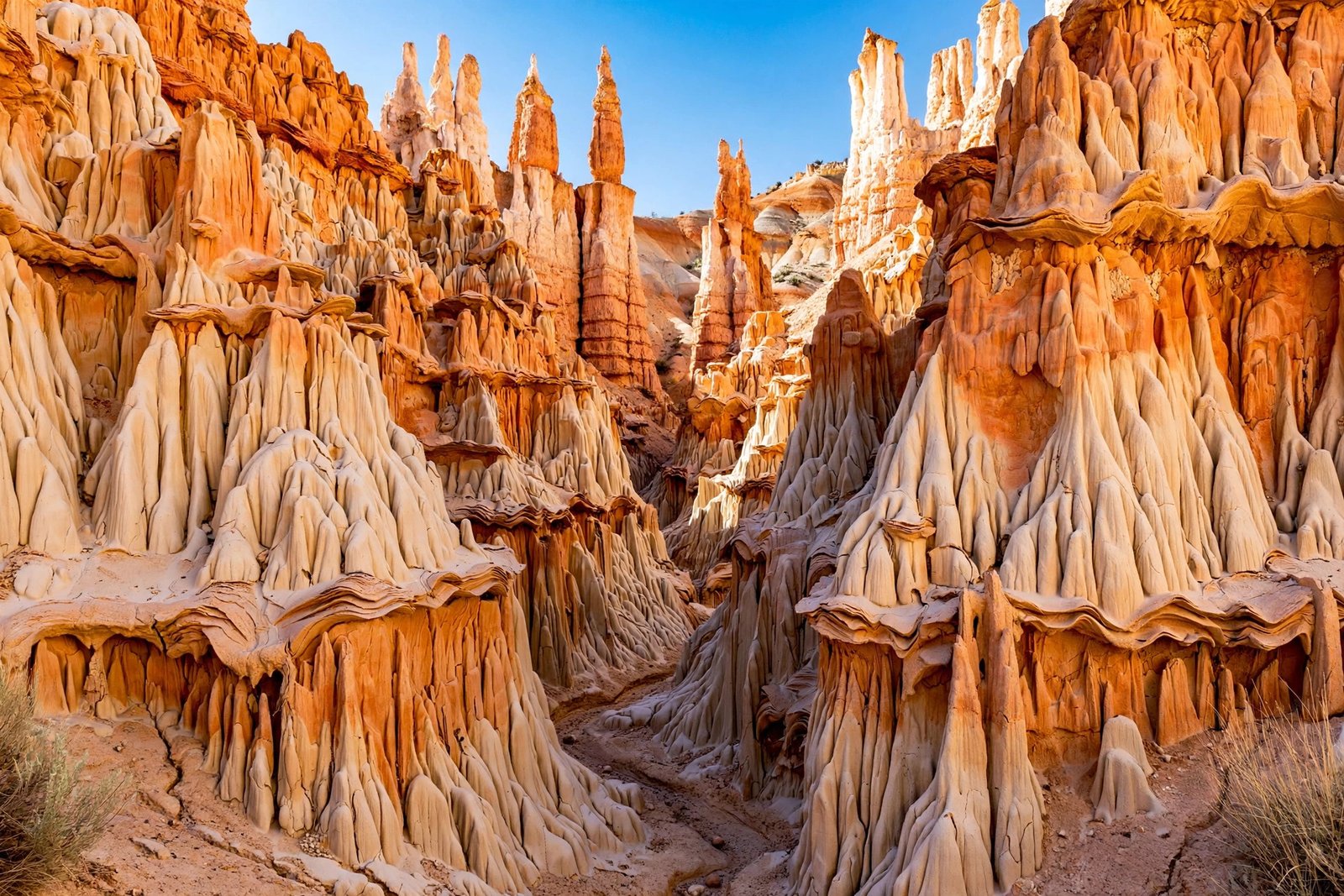
Drive about two and a half hours northeast of Las Vegas, past the neon and the noise, and the Nevada desert does something unexpected. The flat valley floor suddenly rises into pale, fluted towers that look like the flying buttresses of a Gothic cathedral. Narrow cracks split the cliffs, and if you step inside one, the walls close in until the sky is a thin ribbon overhead and the desert heat gives way to cool shadow. This is Cathedral Gorge State Park, one of Nevada’s oldest and most surprising state parks, and one of the best hidden gems in the American West.
Most travelers racing up U.S. Highway 93 toward Utah never stop here. That is their loss, and your gain. Cathedral Gorge covers roughly 1,800 acres in Lincoln County, Nevada, just two miles northwest of the small town of Panaca, and it packs an astonishing amount of scenery into a compact, easy-to-explore park. You can walk through slot canyons barely wide enough to squeeze through, climb to a panoramic overlook, camp under some of the darkest skies in Nevada, and be back on the road the same day. This guide explains what Cathedral Gorge is, how it formed, the best trails and viewpoints, when to visit, and the practical tips that will make your trip smooth.
What Is Cathedral Gorge State Park?
Cathedral Gorge State Park is a public recreation area and geologic preserve that protects a dramatic landscape of eroded soft bentonite clay in eastern Nevada. The park sits along U.S. Route 93 at the west end of State Route 319, in the long, narrow Panaca Valley of Meadow Valley, and its centerpiece is a maze of spires, fins, and deep slot canyons carved from ancient lakebed sediments. The formations are not made of hard sandstone like the famous slot canyons of southern Utah. They are made of bentonite clay, siltstone, and volcanic ash, which gives them a soft, pale, almost sculpted look and a texture you can feel with your fingertips.
The park was established in 1935, making it one of Nevada’s first four state parks. Governor James Scrugham had begun acquiring and setting aside the area for preservation in 1924, and the Civilian Conservation Corps developed the park during the Great Depression, building stone structures that are still visible today, including a water tower and picnic shelters. The name goes back further still. In the 1890s, a resident of a nearby mining camp called the area Cathedral Gulch because the towering spires reminded him of cathedrals. The name stuck, and it fits.
Nearby Panaca, founded by Mormon pioneers in 1864, is Nevada’s oldest permanent settlement, and it makes a quiet base for a visit. The park’s address is 111 Cathedral Gorge State Park Road, Panaca, NV 89042, and the Nevada Division of State Parks manages the site. You can find current hours, fees, and conditions on the official Nevada State Parks website, and the Travel Nevada guide to Cathedral Gorge is a useful starting point for planning a road trip through eastern Nevada.
How Cathedral Gorge Formed: An Ancient Lake, Then Rain
The story of Cathedral Gorge begins about five million years ago, during the Pliocene epoch, when most of Meadow Valley was covered by a freshwater lake. Over time, clay, silt, and volcanic ash settled on the lake floor, building up thick layers of soft sediment known as the Panaca Formation. The ash came from volcanic eruptions to the north, in the area of the Caliente Caldera Complex, and the bentonite clay itself is derived from that volcanic ash. When the lake eventually drained away, it left those soft sediments exposed to the sky.
Then erosion went to work, and it has never really stopped. Rainwater and melting snow cut tiny rivulets into the soft siltstone and clay shale. Each storm widened the cracks a little, splitting them into gullies, then canyons. Freezing temperatures, desert wind, and flash floods all helped, prying at the soft rock and carrying loose material away. Because bentonite clay is so soft, the carving happened fast by geologic standards, producing the sharp fins, fluted walls, and cathedral-like spires that give the park its name. The same softness is also why the formations look so smooth and sculpted compared with the blocky cliffs of harder rock country.
That softness is also a warning. Bentonite clay becomes extremely slippery when wet, and the narrow canyons can channel flash floods during desert storms. Never enter a slot canyon when rain is falling nearby or forecast, and never climb on the formations when they are wet. The park’s beauty is the direct result of its fragility, so stay on trails, avoid touching the walls more than necessary, and leave the formations exactly as you found them.
The Slot Canyons: Moon Caves, Cathedral Caves, and Canyon Caves
The slot canyons are the reason most people come to Cathedral Gorge, and they are unlike the sandstone slots most visitors know. Locally they are called caves, but they are not true caves at all. They are deep, narrow erosion channels cut into the clay, where the walls close in so tightly overhead that it feels like you have stepped inside a cave system. There are three distinct slot canyon areas in the park: Moon Caves, Cathedral Caves, and Canyon Caves.
The Moon Caves are where most visitors start. The passages wind back into the cliff face, twist around corners, and open into small hidden chambers that stay cool even on a hot summer day. Some stretches are barely wide enough for one person to squeeze through, so go slowly, watch your footing, and be ready to turn around if a passage gets too tight.
Cathedral Caves offers the most dramatic slot canyon experience in the park, with taller walls and longer, darker passages. Canyon Caves, meanwhile, gives you a quieter, less crowded walk through the same kind of sculpted clay. You do not need technical gear or canyoneering experience for any of these. Sturdy shoes, water, and a willingness to duck, scramble, and squeeze are enough. Allow at least an hour to explore one canyon area properly, and longer if you like to photograph the light. The walls glow golden in late afternoon, and the patterns of light and shadow change by the minute as the sun moves across the sky.
Best Trails and Viewpoints
Cathedral Gorge is a small park, and that is part of its charm. The trails are generally short, with the longest, the Juniper Draw Loop, running about four miles. You can see the highlights in half a day and the whole park in a full day, without the crowds or the long drives of a big national park.
Start at Miller Point Overlook, the park’s signature viewpoint. You can drive to it from Highway 93 via Miller Point Road, which makes it accessible even if you do not want to hike, or you can walk the Miller Point Trail, about a mile round trip, which climbs via a steel staircase to the overlook. From the top, a Civilian Conservation Corps gazebo built in the 1930s frames a panoramic view of the eroded formations spread across the valley floor. It is the best place in the park for sunrise or sunset, when the low light picks out every fluted ridge.
From the Miller Point area, the Miller Point Trail connects down to the day-use and picnic area, and the Eagle Point Trail offers another ridge-top view looking down into the canyons. The Juniper Draw Loop, about four miles, takes you through the quieter northern part of the park, past juniper trees and open desert, and it is the best choice if you want a longer walk and a sense of solitude. Shorter connector trails link the canyon areas, so you can mix and match a route that fits your energy and the heat of the day.
For photographers, the rules are simple. Shoot early or late, when the light is low and warm, and look for the contrast between sunlit spires and shadowed canyons.
Camping and Stargazing Under Dark Skies
The park’s campground has 22 developed sites, each with a picnic table, grill, and shade ramada, plus flush toilets and coin-operated showers. Many sites have electric hookups, and two are accessible. Sites are generally first come, first served, and camping is limited to 14 days in a 30-day period. Fees are charged per vehicle and per night, so check the current fee schedule on the Nevada State Parks site before you go, because rates for Nevada residents and non-residents differ. A handy visitor guide with trail and campground details is also available from America’s State Parks.
Camping here is worth it for the night sky alone. Cathedral Gorge sits in remote eastern Nevada, far from city lights, and the park is known for some of the darkest night skies in the state. On a clear, moonless night, the Milky Way arches over the spires, and the silence is almost total.
If camping is not your style, the small towns of Panaca and Pioche offer motels and a handful of places to eat, and the city of Caliente, to the south on Highway 93, has more options.
When to Visit Cathedral Gorge
Spring and fall are the best seasons to visit Cathedral Gorge. From March through May and September through November, daytime temperatures are comfortable for hiking, the light is good for photography, and the crowds are thin. Summer brings intense desert heat, with daytime temperatures that can climb well above 90 degrees Fahrenheit, so if you visit in summer, hike early in the morning, carry more water than you think you need, and spend the hot middle of the day in the shaded slot canyons or at the picnic area. Winter is quiet and beautiful, with crisp air and the chance of snow dusting the spires, but nights are cold and some facilities may be limited, so check conditions before a winter trip.
Whatever the season, the park rewards an early start. Arrive at sunrise for Miller Point, explore the canyons in the morning, picnic at midday, and return to the overlook for sunset. That rhythm gives you the best light, the coolest hiking, and the fewest people, and it leaves the evening free for stargazing if you are camping.
Practical Tips for Your Visit
A few practical notes will make your visit smoother. First, bring water, and then bring more. There is potable water in the park, but the desert is dry, the sun is strong, and the clay trails offer almost no shade outside the canyons. Sunscreen, a hat, and sturdy closed-toe shoes are essential, because the clay surface is uneven and can be slick. Cell service is limited in the valley, so download maps and park information before you arrive, and let someone know your plans if you are hiking the longer loops alone.
Before you drive out, check the forecast for Panaca with the National Weather Service, since desert weather can change fast. Second, respect the clay. Do not climb on the formations, do not carve your name into the walls, and do not enter the canyons during or after rain. Flash floods are rare here, but the canyons are designed by water, and they can fill fast. If you see dark clouds building over the valley, get out of the narrow passages and onto high ground. Third, plan your fuel and supplies. Panaca is a small town with limited services, so fill up and stock up in Caliente, Pioche, or Las Vegas before you arrive. Finally, leave no trace. Pack out everything you bring in, stay on established trails, and keep the park as quiet and clean as you found it.
Cathedral Gorge is not the biggest or the most famous park in Nevada, and that is exactly why it is worth the drive. It is a place where a vanished lake, a few million years of rain, and a soft clay valley conspired to build something that looks like a cathedral and feels like a secret. Go slowly, look closely, and let the desert surprise you.
FAQ
Where is Cathedral Gorge State Park? Cathedral Gorge State Park is in Lincoln County, Nevada, about two miles northwest of Panaca on U.S. Highway 93, roughly 150 miles northeast of Las Vegas. The park entrance is on Cathedral Gorge State Park Road, off Highway 93 near the junction with State Route 319.
How much does it cost to visit Cathedral Gorge? Nevada State Parks charges a day-use fee per vehicle and a separate camping fee per night, with different rates for Nevada residents and non-residents. Fees can change, so check the current schedule on the Nevada State Parks website before your trip.
Can you walk through the slot canyons at Cathedral Gorge? Yes. The Moon Caves, Cathedral Caves, and Canyon Caves are narrow slot canyons you can walk through without technical gear. Some passages are very tight, so wear sturdy shoes, carry a light, and never enter during or after rain because of flash flood risk.
Is Cathedral Gorge good for kids? Yes, children love the maze-like canyons, but keep them close. Passages twist out of sight quickly, some squeezes are tight, and the clay is slippery when wet. The Miller Point Trail and the overlook are good family-friendly options.
Can you camp at Cathedral Gorge State Park? Yes. The park has a 22-site campground with picnic tables, grills, shade ramadas, flush toilets, showers, and electric hookups at many sites. Sites are generally first come, first served, and camping is limited to 14 days in a 30-day period.