
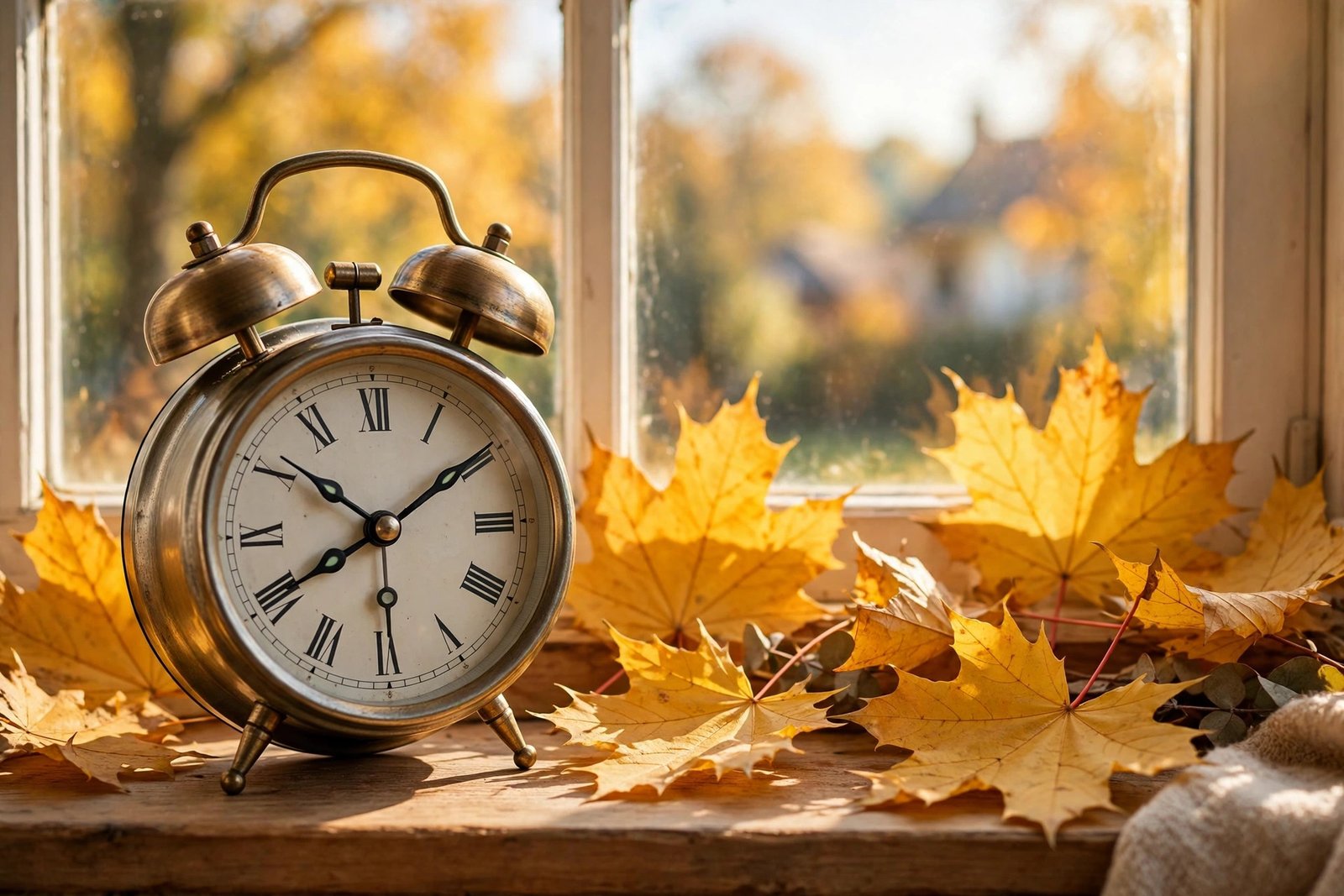
On Sunday, November 1, 2026, most Americans will do something they have done twice a year for generations: change their clocks. At 2 a.m. local time, daylight saving time ends, clocks fall back one hour to 1 a.m., and the country returns to standard time. The reward is immediate and popular — an extra hour of sleep on a Sunday morning. The trade-off arrives just as fast — sunsets that suddenly come much earlier, and afternoons that feel shorter even though the day itself has not changed at all.
Because November 1 falls on a Sunday in 2026, this is the earliest possible date the fall time change can occur under current federal law. Daylight saving time always ends on the first Sunday in November, and in 2026 that Sunday is the very first day of the month. If you have ever felt that the clock change seemed to sneak up on you, this year it genuinely does: Halloween night is Saturday, October 31, and the clocks change the very next morning.
Here is everything you need to know about the November 1 time change, why it still happens despite years of debate in Washington, who does not observe it, and how to get through the darker evenings that follow.
When exactly do the clocks fall back in 2026?
Daylight saving time ends at 2 a.m. local time on Sunday, November 1, 2026. At that moment, clocks in areas that observe daylight saving time move back one hour to 1 a.m. The hour between 1 a.m. and 2 a.m. effectively happens twice, which is why November 1 is a 25-hour day. Most people will sleep through the whole thing and simply wake up to find their phones and computers have already adjusted themselves.
That automatic adjustment is one of the quiet conveniences of modern life. Smartphones, computers, smartwatches and other internet-connected devices update on their own. The clocks that still need a human hand are the familiar ones: the microwave, the oven, the car dashboard, the wall clock in the hallway, and the old alarm clock on the nightstand. Fire safety agencies have long used the clock change as a reminder to check smoke detectors and carbon monoxide alarms, and that advice still holds — when you walk around resetting clocks on Sunday morning, check the batteries too.
The 2026 daylight saving period began on March 8, 2026, the second Sunday in March. The next spring-forward will come on Sunday, March 14, 2027. Until Congress changes the law, that rhythm — spring forward in March, fall back in November — remains the national schedule.
Why do we still change the clocks?
The short answer is that Congress has not changed the law. The longer answer is that Americans broadly agree the twice-yearly switch is annoying, but disagree about what should replace it — and that disagreement has kept the old system in place.
Under the Uniform Time Act of 1966, as amended in 2007, daylight saving time runs from the second Sunday in March to the first Sunday in November. The idea, in its original form, was to shift an hour of daylight from the morning to the evening during the warmer months, when people are more likely to be out and about after work. Supporters of the current system argue that lighter evenings encourage shopping, recreation and outdoor activity. Critics argue that the switching itself disrupts sleep, schedules and health, and that the energy-saving case for it has weakened as lighting has become more efficient.
Polling consistently shows a majority of Americans want to stop changing the clocks. A 2023 YouGov survey found 62 percent favored ending the practice, and a January 2025 Gallup poll found 54 percent wanted it gone. Where consensus breaks down is the follow-up question: should the country stay on daylight saving time permanently, with lighter evenings and darker winter mornings, or stay on standard time permanently, with lighter mornings and earlier sunsets? Parents worried about children waiting for school buses in the dark tend to favor standard time. People who prize evening daylight tend to favor permanent daylight time. That split has stalled reform again and again.
The Sunshine Protection Act: what happened in 2026
The latest reform effort is the Sunshine Protection Act, which would make daylight saving time permanent and end the twice-yearly changes. In July 2026, the House of Representatives passed the bill, raising hopes among supporters that the November 1 change might be the last. But the bill has not advanced through the Senate, and with lawmakers out of session as the deadline approached, the existing schedule remains in force.
President Donald Trump has repeatedly voiced support for ending the clock changes, which added political momentum to the effort this year. Still, until a bill passes both chambers and is signed into law, the advice for Americans is simple and unchanged: plan to turn your clocks back on November 1. Anyone telling you otherwise is getting ahead of the legislative process. You can read USA TODAY’s reporting on the 2026 schedule here, and a local explainer on the November 1 change here.
Who does not fall back?
Not every part of the United States changes its clocks. Hawaii and most of Arizona stay on standard time year-round — the exception in Arizona is the Navajo Nation, which does observe daylight saving time. Several U.S. territories also skip the switch, including American Samoa, Guam, the Northern Mariana Islands, Puerto Rico and the U.S. Virgin Islands. If you live in one of those places, November 1 is just another Sunday.
For everyone else, the change is national and simultaneous in local time: 2 a.m. becomes 1 a.m. whether you are in New York, Chicago, Denver or Los Angeles. That is why a phone call scheduled for Sunday morning can feel oddly timed if one party is in Arizona and the other is not — the time difference between Phoenix and Los Angeles, for example, shifts when the rest of the country falls back.
What the early sunsets really mean
The most noticeable effect of the fall change is not the extra hour of sleep, pleasant as that is. It is the darkness that arrives in the late afternoon. After November 1, sunsets in northern and Midwestern cities come before 5:30 p.m., and the effect deepens as the days continue to shorten toward the winter solstice in December. Mornings, by contrast, get brighter: sunrise comes an hour earlier by the clock, which is welcome for early commuters and schoolchildren.
That shift matters for more than mood. Evening darkness affects road safety, outdoor exercise routines and the simple feeling of how long the day lasts. People who walk or run after work often move their routines to the morning or to well-lit routes. Retailers and restaurants notice it too, since foot traffic tends to follow the light. None of this is new — it happens every year — but it always feels abrupt, because the change happens overnight rather than gradually.
There is also a sleep angle worth taking seriously. Gaining an hour sounds purely good, and for most people the fall change is easier on the body than the spring change, when an hour is lost. Still, the shift in light exposure can throw off sleep patterns for a few days, especially for children and for people with rigid morning schedules. Keeping a consistent wake-up time, getting bright light in the morning, and avoiding screens late at night all help the body settle into the new pattern faster.
A brief history of daylight saving time in America
Daylight saving time is often said to have been created for farmers. That is a myth. Farmers, who work by the sun rather than the clock, were among its earliest critics. The practice was first broadly adopted by Germany during World War I as a fuel-saving measure, and the United States followed during the war. Congress then standardized the system with the Uniform Time Act of 1966, and the Energy Policy Act of 2005 extended daylight saving time to its current March-to-November span, starting in 2007.
Over the decades, the dates have been adjusted several times, usually in the name of energy conservation or public safety. The current framework has been stable since 2007, which is part of why the debate now centers on whether to keep the system at all rather than on tinkering with its dates. Every few years, a new bill promises to end the switching for good. So far, none has made it all the way into law.
How to prepare for November 1
The practical checklist is short, and most of it can be done on Saturday night or Sunday morning. First, remember that the change happens at 2 a.m. Sunday, so if you have a Sunday morning appointment, double-check which time it is set for — the first 1 a.m. or the second. Second, reset the manual clocks: microwave, oven, car, wall clocks and any alarm clock that does not sync itself. Third, use the occasion to test smoke and carbon monoxide detectors. Fourth, if you drive, remember that your evening commute will suddenly be darker; check headlights and be extra alert for pedestrians in the first week after the change, when everyone is still adjusting.
For families, the change is a good moment to reset routines deliberately rather than letting the darkness dictate them. Move an evening walk to lunchtime, shift outdoor play earlier, or plan a bright, social Sunday evening to counter the feeling that the day has ended early. Small adjustments like these make the transition feel like a seasonal shift rather than a loss.
Will this be the last fall back?
That is the question Americans ask every autumn, and 2026 is no exception. The House vote in July gave supporters their best opening in years, but the Senate has not acted, and the clock is literally running out for this year. If the Senate were to pass the bill and the president were to sign it, a future November could pass without a time change. Until that happens, though, the honest answer is that nobody knows — and the safe plan is to fall back on November 1 and watch what Congress does next.
What is certain is that the debate will return. The twice-yearly ritual has survived a century of complaints precisely because it sits at the intersection of health, safety, business and habit, and every proposed fix creates winners and losers. Permanent daylight time pleases evening people and worries morning people. Permanent standard time does the reverse. The current system pleases almost nobody but offends everybody equally, which may be why it endures.
So enjoy the extra hour on Sunday morning. Set the clocks back, check the smoke detectors, and step outside to notice the earlier sunset. Winter is coming, one hour at a time — and like it or not, we are all on the same clock.
Related reading
Planning travel around the time change? Read REAL ID for Domestic Flights: What Travelers Need, American Flag Facts: Stars, Stripes, and the Real History, and FEC Filing System Goes Offline Days Before Midterms.
Frequently asked questions
Do I gain or lose an hour on November 1, 2026? You gain an hour. At 2 a.m., clocks fall back to 1 a.m., so the night lasts one hour longer.
Do I need to change my phone’s clock? No. Phones, computers and other connected devices update automatically. Only manual clocks, appliances and car dashboards need to be reset by hand.
Which states do not observe daylight saving time? Hawaii and most of Arizona do not observe it, except for the Navajo Nation in Arizona. Several U.S. territories also stay on standard time year-round.
Is the Sunshine Protection Act now law? No. The House passed it in July 2026, but it has not passed the Senate or been signed into law, so the November 1, 2026 time change goes ahead as scheduled.
When do clocks spring forward again? Daylight saving time returns on Sunday, March 14, 2027, when clocks move forward one hour.