
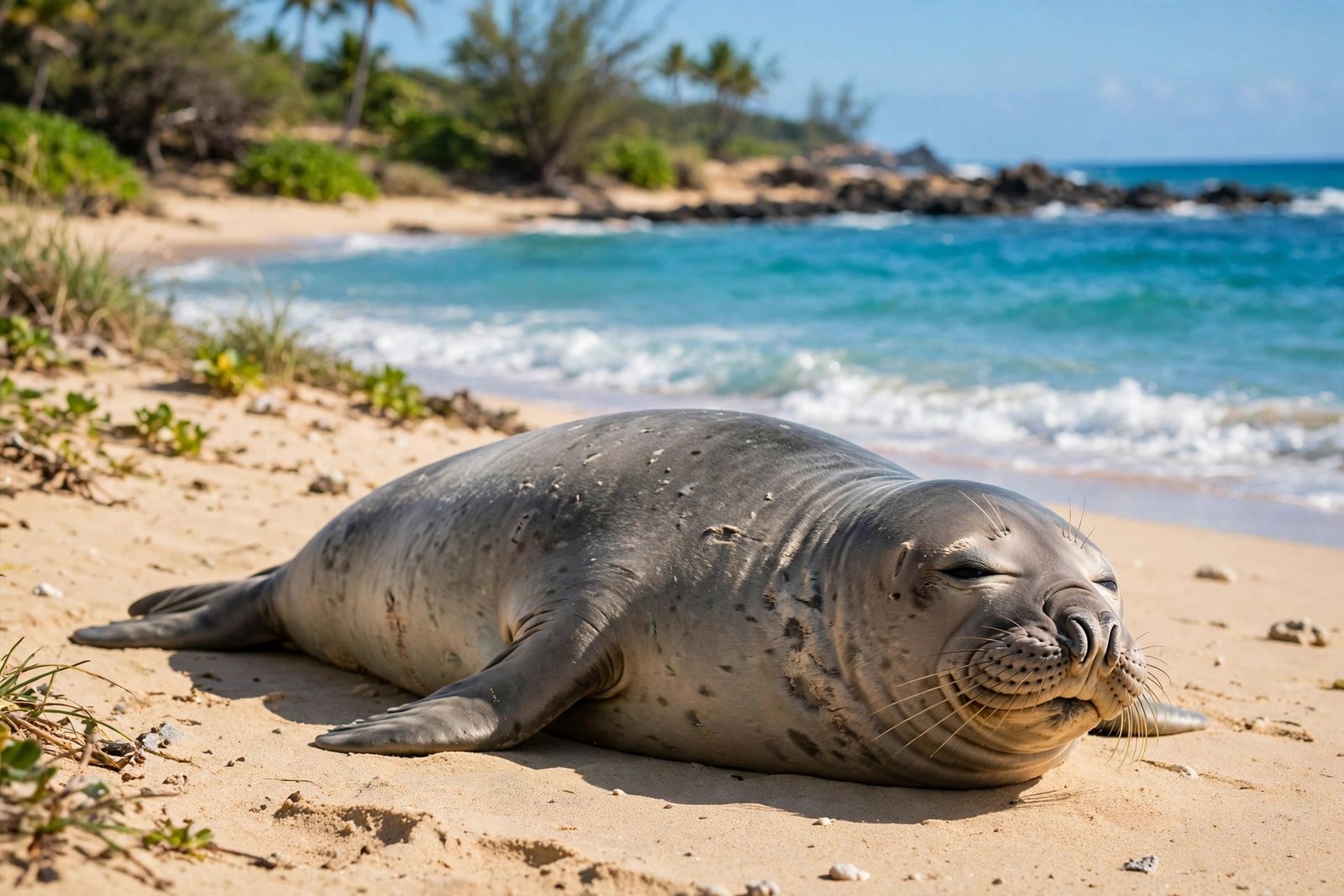
On a quiet beach in Hawaii, a grey-brown seal hauls itself out of the surf, shakes the water from its coat, and settles down for a long nap in the sun. Beachgoers keep their distance, a volunteer in a red shirt stands watch nearby, and a small crowd gathers at a respectful remove to take photographs. The animal at the center of it all is a Hawaiian monk seal — one of the rarest seals on Earth, found nowhere else in the world, and the subject of one of America’s most determined wildlife recovery efforts.
Known in the Hawaiian language as ‘ilio holo i ka uaua, the Hawaiian monk seal is the only seal species that lives entirely in tropical waters, and it is also one of the most endangered marine mammals in the world. Only about 1,600 of them remain, and their numbers are roughly one-third of what they once were. Yet after decades of decline, the population has been growing slowly since 2013, thanks to an intensive program of monitoring, rescue, and protection led by NOAA Fisheries and its partners. This is the story of Hawaii’s rarest seal — where it lives, what threatens it, and how America is working to save it.
Found Nowhere Else on Earth
The Hawaiian monk seal is endemic to the Hawaiian archipelago, which means it lives nowhere else on the planet. Its range stretches across some 1,500 miles of ocean, from Hawaii Island in the southeast to Kure Atoll, known in Hawaiian as Holaniku, at the far northwestern end of the chain. It is also the last surviving species in its genus, Neomonachus schauinslandi, a lineage with no close living relatives — when the Caribbean monk seal was declared extinct, the Hawaiian monk seal became the only monk seal left in the Americas.
Unlike most seals, which favor cold northern waters, the Hawaiian monk seal is a tropical animal through and through. It forages on coral reefs and in deep water, dives for fish, octopus, and eels, and comes ashore on sandy beaches to rest, give birth, and nurse its pups. Monk seals spend much of their lives alone rather than in large colonies, which is part of what makes them so hard to study — and so vulnerable. A seal that rests alone on a public beach is a seal that needs people to give it space.
The species is protected under two powerful federal laws: the Endangered Species Act, under which it is listed as endangered, and the Marine Mammal Protection Act, which prohibits harassing, harming, or disturbing it. It is also one of NOAA Fisheries’ Species in the Spotlight, a program that focuses extra attention and resources on the most at-risk species, where targeted action can halt a decline and stabilize a population. That spotlight is well earned. The Hawaiian monk seal’s numbers fell for decades before the recent turnaround, and recovery is still far from secure.
About 1,600 Seals — and a Population Coming Back
NOAA Fisheries estimates the Hawaiian monk seal population at around 1,600 animals. Nearly 1,200 of them live in Papahanaumokuakea, the vast protected marine area of the Northwestern Hawaiian Islands, while about 400 live around the main Hawaiian Islands — Hawaii Island, Maui, Oahu, Kauai, Molokai, and Lanai. The population is about one-third of its historical levels, but the direction of travel has changed. The population began to increase gradually in 2013, in both the Northwestern and the main Hawaiian Islands, and it surpassed 1,500 seals in 2021 for the first time in more than two decades.
That growth is real, but it is also slow and fragile. Monk seals reproduce slowly — females typically give birth to a single pup at a time — and the population gains ground only pup by pup, year by year. Growth in the main Hawaiian Islands has been especially significant, because seals there are far more likely to encounter people, dogs, fishing gear, and disease. Every pup that survives to adulthood matters enormously when the entire species numbers about 1,600 animals.
The recent history of the species shows just how quickly that progress can be threatened. In August 2026, NOAA reported the deaths of several young seals on Oahu, including a juvenile that died of toxoplasmosis, a disease linked to land-based contamination, and a three-month-old pup found entangled in an unattended fishing net. Each loss is recorded, investigated, and reported publicly by NOAA, because in a population this small, every individual counts — and every death is a lesson for the recovery effort. The latest monk seal updates from NOAA track these births, rescues, and losses as they happen.
The Threats: Entanglement, Disease, Sharks, and People
NOAA Fisheries lists predation, marine debris, starvation, disease, and fisheries interactions as the main threats to the Hawaiian monk seal population. Each one strikes a different part of the seal’s life, and together they explain why a species with a protected range and legal protection still struggles to recover.
Entanglement in marine debris is one of the most visible dangers. Seals become caught in discarded fishing nets, lines, and other debris, and an entangled seal can drown, starve, or suffer injuries that leave it unable to feed. NOAA and its partners run disentanglement teams and remove debris from beaches and reefs, but the ocean delivers a constant supply of new hazards. The death of a three-month-old pup in an unattended fishing net in August 2026 is a reminder that even a single piece of gear can kill.
Disease is a quieter threat, and one of the most worrying. Toxoplasmosis, a disease caused by a parasite spread through cat feces that washes into the ocean, has killed Hawaiian monk seals — including the juvenile known as RU02, whose death NOAA confirmed in August 2026. Because the disease comes from land, it connects the health of the ocean to the health of the land: keeping cats indoors and managing runoff are part of saving a marine mammal. NOAA has also run vaccination programs to protect seals from diseases such as morbillivirus, a virus related to canine distemper that could devastate a small, isolated population, as described in NOAA’s account of protections and vaccinations.
Shark predation, especially by Galapagos sharks, takes a toll on pups in the Northwestern Hawaiian Islands, where young seals are most vulnerable in their first months. Starvation is another pressure, particularly for young seals learning to hunt, and for seals in years when prey is scarce. And human disturbance — people approaching, touching, or crowding a resting seal — can drive a seal off a beach, interrupt a mother nursing her pup, or cause a seal to abandon a resting spot it needs. A monk seal on the sand is usually not in trouble. It is resting, and rest is as essential to a seal as food.
How America Is Saving the Hawaiian Monk Seal
The recovery effort for the Hawaiian monk seal is one of the most hands-on wildlife programs in the United States, and it is built on the idea that a population of about 1,600 animals can be helped one seal at a time. NOAA Fisheries leads the work, with the recovery plan’s ultimate goal being to bring the species back far enough that it can be down-listed from endangered to threatened.
Much of the work happens on the beaches. NOAA and its partners monitor seals across the archipelago, tagging and tracking individuals so scientists know where each seal goes, how it is doing, and whether it has pups. Trained responders and a network of community volunteers keep watch over seals that haul out on popular beaches, setting up signs and perimeters and talking to beachgoers about keeping their distance. When a seal is sick, injured, or entangled, authorized responders intervene — and the public is asked to call for help rather than trying to help the animal themselves.
Rehabilitation is a central part of the program. Seals that are underweight, injured, or orphaned are taken to facilities such as the Ke Kai Ola hospital, run by The Marine Mammal Center on Hawaii Island, where they receive medical care and are released back into the wild when they are ready. Vaccination programs protect seals against disease, and researchers study everything from foraging behavior to genetics to understand what the population needs. The work is slow, detailed, and expensive — and it is the reason the population has been growing since 2013.
The Northwestern Hawaiian Islands remain the species’ stronghold, and their protection matters enormously. Papahanaumokuakea, the marine national monument that covers the region, shelters the largest share of the population in waters where human activity is tightly limited. But the growing population in the main Hawaiian Islands is just as important to the species’ future, because it is there that seals and people must learn to share the same beaches. That is why so much of the recovery effort is about education as well as science — teaching residents and visitors that a seal on the sand is a wild animal doing what it needs to do, and that the best thing a person can do is give it room.
How to See a Monk Seal — the Right Way
Seeing a Hawaiian monk seal in the wild is one of Hawaii’s great wildlife experiences, and it is also one of the easiest to get wrong. Pupping season peaks from March through August, though monk seals can give birth year-round, and seals haul out on beaches throughout the year to rest. The rules for watching them are simple, and they are set by NOAA Fisheries. For the season’s latest guidance, see this overview of pupping season and beach rules.
Stay at least 50 feet away from a monk seal, on land and in the water. Stay at least 150 feet away from a mother seal and her pup. Stay behind any signs or barriers, keep dogs on a leash and away from seals, and limit your time watching to about half an hour. Do not approach, touch, feed, or swim with a seal, and do not try to push a seal back into the water — a seal on the beach is usually resting, not stranded. These distances are NOAA’s viewing guidelines, as set out in NOAA’s guide to viewing marine wildlife in Hawaii.
If you see a sick, injured, entangled, or dead monk seal, call the statewide NOAA Marine Wildlife Hotline at (888) 256-9840 immediately. The same number is the one to call to report any seal sighting — information about the location and time helps scientists track the population and respond quickly when a seal needs help. You can also report suspected harassment or harm to the NOAA Office of Law Enforcement at (800) 853-1964, as explained in NOAA’s frequently asked questions on preventing monk seal harm. Every call helps, because in a population of about 1,600 animals, a single report can save a life.
The best places to see monk seals are the same places they have always favored: quiet sandy beaches, particularly on Kauai, Oahu, and Molokai, and the shores of the Northwestern Hawaiian Islands for those with access. But there is no beach in Hawaii where a sighting is guaranteed, and that unpredictability is part of the experience. A monk seal sighting is a gift of patience — and the reward for giving a rare animal the space it needs is the chance to watch it, undisturbed, doing what it has done in these islands for thousands of years. National Park Service sites such as Kaloko-Honokohau on Hawaii Island are among the places where monk seals occasionally visit park beaches.
Why This Seal Matters
The Hawaiian monk seal matters because it exists nowhere else, and because it is a measure of the health of the ocean around Hawaii. A species that has lived in these islands for millions of years, that survived the arrival of people, the hunting of the nineteenth century, and decades of decline, is now growing again — slowly, pup by pup — because people decided to act. The population is still only about a third of what it once was, and the threats have not gone away. But the trend has turned, and that is no small thing.
For visitors to Hawaii, the seal is a reminder that the islands’ most famous wildlife is not only the whales offshore or the turtles in the bays. It is also the grey-brown animal napping on the sand, the one that needs nothing from us except distance and respect. Give a monk seal fifty feet, report what you see, and you have done your part in one of America’s quietest conservation success stories — a species coming back from the edge, one seal at a time.
Frequently Asked Questions
How many Hawaiian monk seals are left? NOAA Fisheries estimates the population at around 1,600 seals — nearly 1,200 in Papahanaumokuakea in the Northwestern Hawaiian Islands and about 400 in the main Hawaiian Islands. The population is about one-third of its historical levels, but it has been increasing gradually since 2013.
Are Hawaiian monk seals endangered? Yes. Hawaiian monk seals are listed as endangered under the Endangered Species Act and are protected under the Marine Mammal Protection Act. They are also one of NOAA Fisheries’ Species in the Spotlight, a program focused on the most at-risk species.
Where do Hawaiian monk seals live? They are endemic to the Hawaiian archipelago, ranging across about 1,500 miles from Hawaii Island to Kure Atoll. Most live in the Northwestern Hawaiian Islands, but a growing number — about 400 — live around the main Hawaiian Islands.
How far away should I stay from a Hawaiian monk seal? NOAA recommends staying at least 50 feet away from a monk seal, on land and in the water, and at least 150 feet away from a mother and her pup. Stay behind posted signs or barriers, keep dogs away, and report sightings or concerns to the NOAA Marine Wildlife Hotline at (888) 256-9840.
Related Reading
Keep exploring Hawaii’s marine wildlife: our guide to American sea turtles, the humpback whale season in Hawaii, and the gray whale migration and California whale-watching guide.