
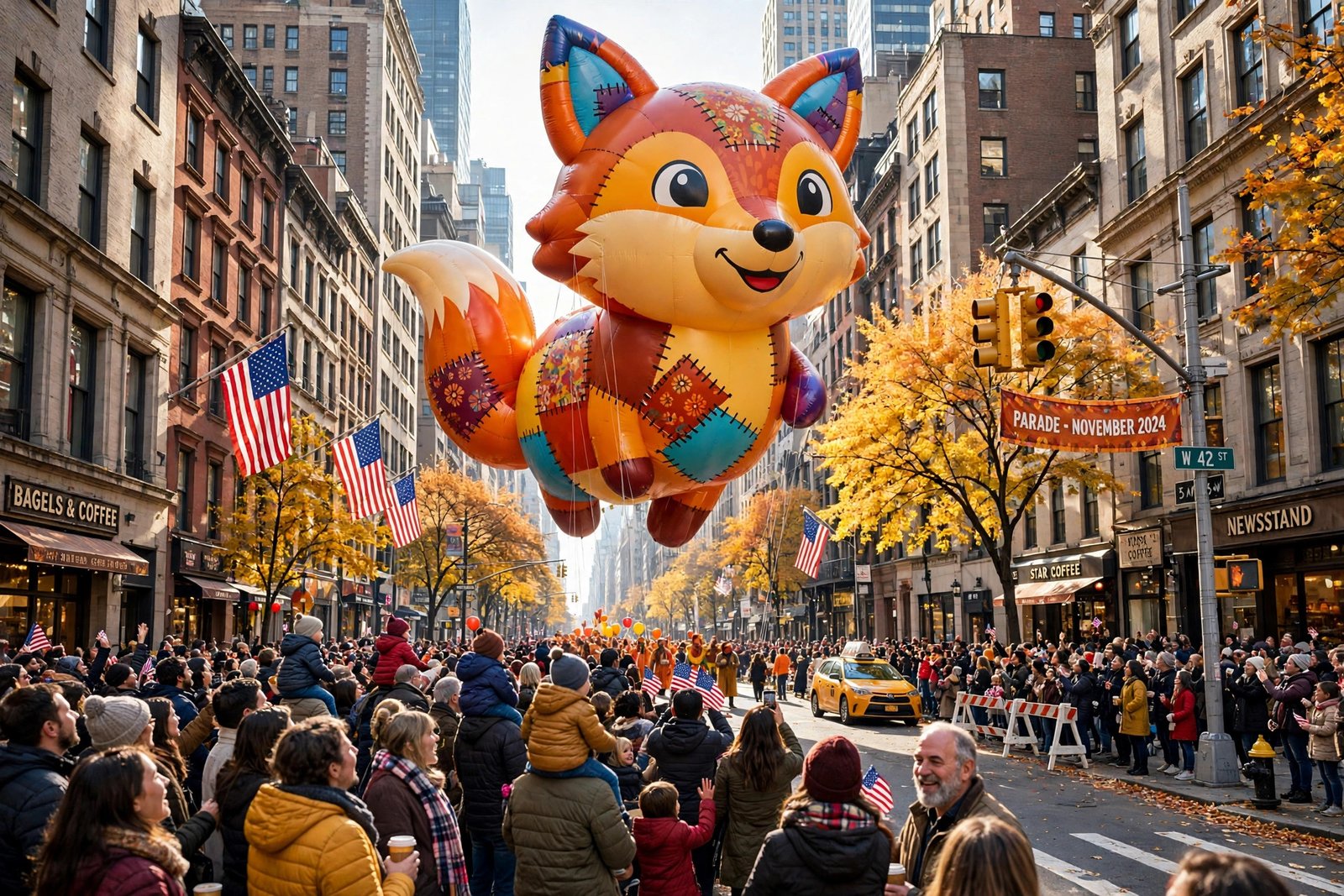
On Thanksgiving morning in New York City, long before the turkey goes into the oven and the football games kick off, something enormous floats down the streets of Manhattan. Giant balloons shaped like cartoon characters drift between the buildings, marching bands play, floats roll past, and Broadway performers sing in front of a famous department store. It is the Macy’s Thanksgiving Day Parade, and for more than a century it has been one of America’s most beloved holiday traditions. What began in 1924 as a modest employees’ march has grown into a spectacle watched by millions of people in person and on television, and it still ends the same way it always has: with Santa Claus arriving at Herald Square to open the Christmas season.
This is the story of how that parade began, how the giant balloons came to rule the skies above Manhattan, and how a store promotion became a permanent part of Thanksgiving in the United States. In 2026, the parade reaches a milestone worth celebrating: on Thursday, November 26, it will march for the 100th time.
A Christmas Parade in 1924
The first parade took place on Thanksgiving Day in 1924, and it was not originally called the Thanksgiving Day Parade at all. It was promoted as the Macy’s Christmas Parade, because its purpose was to celebrate the start of the Christmas shopping season and to show off the holiday windows at the company’s flagship store at Herald Square on 34th Street. The idea came from Macy’s own employees, many of them immigrants who wanted to bring a touch of the festive street parades and festivals of their home countries to their new city.
About ten thousand Macy’s employees took part in that first march, dressed in bright costumes and accompanied by professional entertainers, clowns, and marching bands. Floats carried scenes from nursery rhymes, including the Old Lady Who Lived in a Shoe and Little Red Riding Hood. And because Macy’s wanted the procession to feel like a real spectacle, it borrowed live animals from the Central Park Zoo. Bears, elephants, camels, monkeys, and donkeys walked the route alongside the marchers, to the delight of the crowds lining the streets.
The first parade was also far longer than the one we know today. It began in Harlem, at 145th Street and Convent Avenue, and wound its way roughly six miles through Manhattan, down Broadway and past Columbus Circle, before finally reaching Herald Square. When the procession arrived, Santa Claus was welcomed into the store and crowned “King of the Kiddies” from the balcony above the 34th Street entrance. The crowds that day were enormous, and the parade was an instant success. Macy’s had planned a one-time promotion. Instead, it had started a tradition.
Tony Sarg and the First Giant Balloons
The live animals were charming, but they were also a problem. Zoo animals are unpredictable, loud, and sometimes frightening to children, and moving elephants and bears through crowded city streets was no small undertaking. Within a few years, Macy’s began looking for something bigger, safer, and more spectacular to take their place. The answer came from a puppeteer and illustrator named Tony Sarg.
Sarg was a theatrical designer who had made his name with marionettes and puppet shows, and Macy’s hired him to rethink the parade. In 1926, he designed a balloon-covered float called the Balloonatics, a hint of what was coming. Then, in 1927, the first giant character balloons appeared in the parade. Felix the Cat, the famous cartoon character of the silent-film era, is generally credited as the first of them, floating above the crowds on a scale no one had seen before. Other early balloon characters included a human figure said to stand 21 feet tall, a 25-foot dachshund, enormous turkeys, chickens, and ducks, and a 60-foot dinosaur pulled along by cavemen.
The balloons were made of rubberized fabric and filled with helium, and they were so large that teams of handlers had to walk beneath them holding ropes to keep them steady. Sarg and his protégé, Bill Baird, went on to design many of the parade’s early balloons, and in 1934 Sarg created a Mickey Mouse balloon that became one of the most famous entries in parade history. The giant balloons had arrived, and they would never leave. Today, the people who design and build them are known as “Balloonatics,” a nickname that traces back to Sarg’s 1926 float.
The War Years: A Parade Put on Hold
For all its success, the parade has not marched every single year since 1924. The only interruption in its history came during the Second World War. From 1942 through 1944, the parade was cancelled because the rubber and helium needed for the balloons were needed for the war effort instead. The balloons themselves were donated to the government, and the streets of Manhattan fell quiet on Thanksgiving morning for three straight years.
The parade returned in 1945, and it has not missed a year since. That three-year gap is the reason for a quirk in the parade’s arithmetic: although 2026 is the 103rd year since the first parade in 1924, it is only the 100th time the parade has actually marched. The 2026 edition, on Thursday, November 26, is officially the centennial parade, and Macy’s has marked the occasion with special anniversary programming.
Television Brings the Parade Into American Living Rooms
In the years after the war, the parade changed in a way that mattered even more than the balloons. Television arrived, and the parade arrived with it. NBC began broadcasting the parade to a national audience, and what had been a New York City street celebration became a shared national ritual. Families across the country could watch the balloons from their living rooms while the turkey cooked, and the parade became part of the rhythm of Thanksgiving itself, as familiar as the meal and the football games that followed.
That broadcast is still the way most Americans experience the parade today. The 2026 parade will air live on NBC and Telemundo and stream on Peacock, starting at 8:30 a.m. Eastern Time. For many families, the broadcast is a tradition in its own right: the hosts’ commentary, the Broadway performances staged in front of the Herald Square store, and the camera shots of the balloons drifting past the Manhattan skyline are all part of the morning.
Television also changed what the parade looks like. Balloons and floats are now designed to read on camera as well as from the sidewalk, and new characters arrive each year to reflect whatever children are watching and reading. Snoopy, who has appeared in the parade in many forms over the decades, remains one of its most recognizable balloons, and newer entries have included video game heroes and characters from recent hit films and shows. The parade has always been a mirror of popular culture, and the balloons are the clearest reflection of all.
The Route: Six Miles Then, Two and a Half Miles Now
The original 1924 route was a marathon of about six miles, starting in Harlem and winding down Broadway to Herald Square. Over the decades, the route was shortened and reshaped as the city changed, as television production needed a more manageable course, and as security and crowd management became more important. The modern route is about two and a half miles long, and it has been the parade’s home for many years.
Today the parade steps off at 77th Street and Central Park West, on the Upper West Side beside the American Museum of Natural History. It travels south along Central Park West for eighteen blocks to Columbus Circle, turns east onto Central Park South, continues to Sixth Avenue, and then heads south down Sixth Avenue to 34th Street, finishing in front of the Macy’s Herald Square flagship store. The whole procession takes about three and a half hours, running from 8:30 a.m. until about noon.
One of the parade’s most charming traditions happens the night before. On the Wednesday evening before Thanksgiving, the giant balloons are inflated on the streets around the American Museum of Natural History, between 77th and 81st Streets, and the public can watch the enormous characters slowly take shape under the streetlights. For many New Yorkers, the inflation is as much a part of Thanksgiving as the parade itself, a free, open-air preview of the next morning’s spectacle.
How the Balloons Are Made
The balloons are built at the Macy’s Parade Studio, a workshop in a former Tootsie Roll factory in Hoboken, New Jersey, where a team of designers, engineers, and artists works year-round on the parade. Each balloon is a serious piece of engineering. The largest can be several stories tall and many dozens of feet long, and every one of them must be designed to fly steadily in the wind, to pass under traffic lights and around corners, and to survive the journey down Sixth Avenue without touching a building.
Handlers are a big part of the show, too. Each giant balloon is guided by a team of trained volunteers holding ropes, and in windy weather the job becomes a genuine physical challenge. Strong gusts can push a balloon sideways or force it lower, and parade officials have occasionally had to keep balloons closer to the ground or, in extreme conditions, leave some out of the lineup. The handlers train for weeks, and the sight of a hundred people working together to steer a single cartoon character through Manhattan is part of what makes the parade feel so alive.
Santa Claus and the Start of Christmas
From the very first parade, Santa Claus has had the most important job of the day: he comes last. The final float of the parade carries Santa into Herald Square, and his arrival is the official signal that the Christmas season has begun. It is a role that goes back to 1924, when Santa was crowned “King of the Kiddies” on the store’s balcony, and it has never changed.
That closing moment explains why the parade was first called a Christmas parade, and why it still feels like the bridge between the two holidays. Thanksgiving is a holiday of gratitude and family, and the parade ends it by turning everyone’s attention toward the weeks of celebration ahead. The turkey is still in the oven, the relatives are still arriving, and Santa has just rolled past the window. For many American families, that is when the holiday season truly starts.
Why the Parade Still Matters
A century after that first march from Harlem, the Macy’s Thanksgiving Day Parade endures for reasons that go beyond spectacle. It is one of the few American traditions that belongs to everyone at once: to the crowds who bundle up along Central Park West, to the families watching on television in every state, to the volunteers who hold the ropes, and to the children who see a character they love floating impossibly high above a New York street.
It is also a tradition that has grown up with the country. The parade has survived a war, adapted to television, and reinvented its balloons for every generation. The employees who marched in 1924 could not have imagined a parade broadcast to tens of millions of people, or balloons shaped like video game characters, but they would recognize the shape of the day: a procession through Manhattan, a crowd, a band, and Santa Claus at the end, arriving at Herald Square to open the season. That is the heart of the parade, and it has not changed in a hundred years.
Frequently Asked Questions
When was the first Macy’s Thanksgiving Day Parade?
The first parade took place on Thanksgiving Day in 1924. It was originally called the Macy’s Christmas Parade, and it featured store employees, bands, floats, and live animals borrowed from the Central Park Zoo marching about six miles from Harlem to the Herald Square store.
When is the Macy’s Thanksgiving Day Parade in 2026?
The 100th Macy’s Thanksgiving Day Parade takes place on Thursday, November 26, 2026, which is Thanksgiving Day. It steps off at 8:30 a.m. Eastern Time and runs until about noon, airing live on NBC and Telemundo and streaming on Peacock.
What is the parade route?
The modern route is about two and a half miles long. It starts at 77th Street and Central Park West, travels south to Columbus Circle, turns east along Central Park South to Sixth Avenue, then heads south down Sixth Avenue to 34th Street, finishing in front of Macy’s Herald Square.
When did the giant balloons first appear?
The first giant character balloons appeared in 1927, designed by puppeteer Tony Sarg. Felix the Cat is generally credited as the first famous character balloon. The balloons replaced the live zoo animals that had marched in the earliest parades.
Why is the 2026 parade the 100th, not the 103rd?
The parade began in 1924, but it was cancelled from 1942 through 1944 during the Second World War, when rubber and helium were needed for the war effort. Those three missing years mean 2026 is the 100th time the parade has actually marched.