
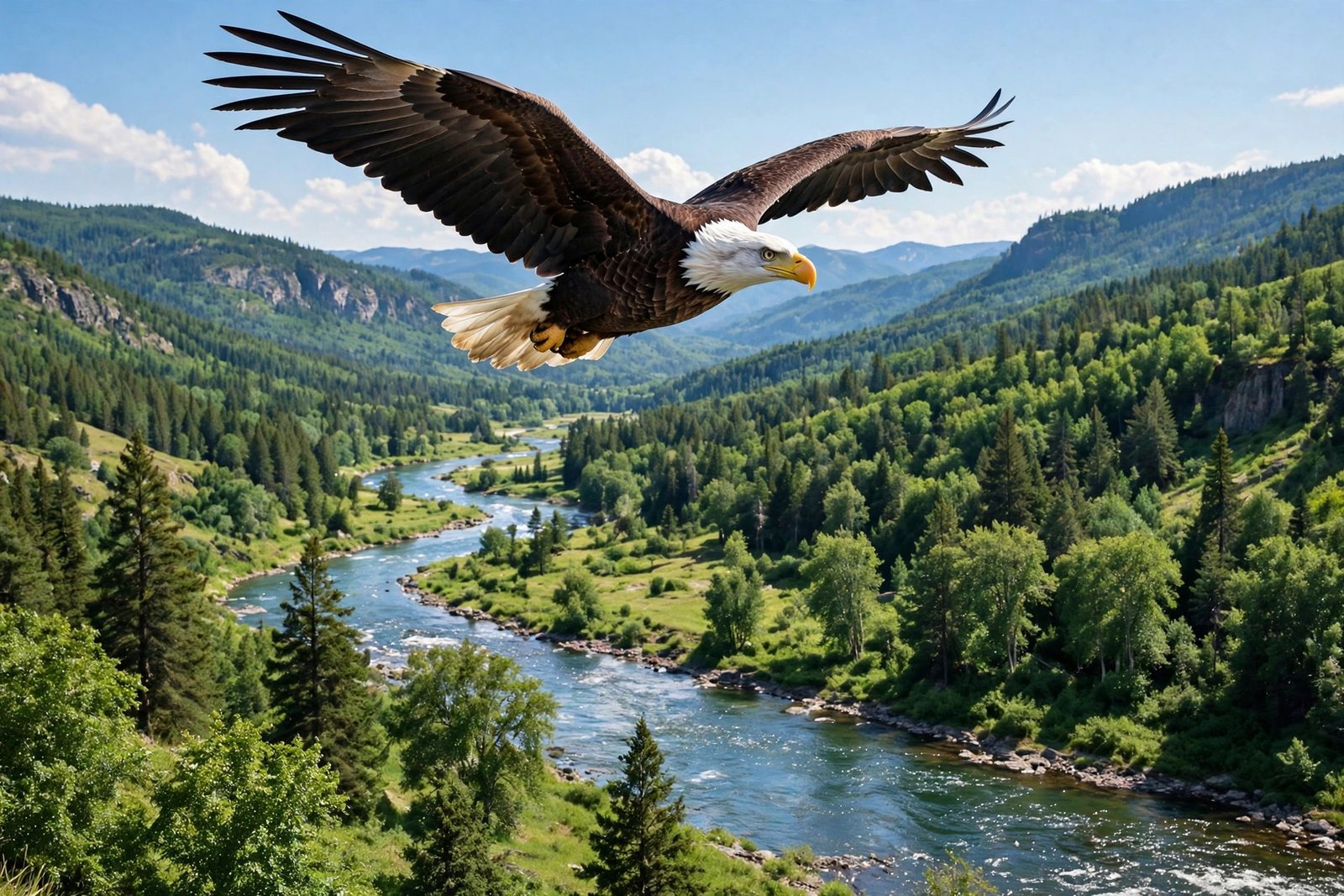
There was a time, not long ago, when the bald eagle, the very symbol of the United States, was nearly gone from the American sky. By 1963, the lower 48 states were home to barely 400 nesting pairs. The bird that appears on the Great Seal, on currency, and on the uniforms of American service members had been pushed to the edge of extinction by a pesticide, by habitat loss, and by hunting. People who grew up in that era can remember when seeing a bald eagle in the wild was a once-in-a-lifetime event.
Today, the story is very different. On June 28, 2007, the Secretary of the Interior announced the removal of the bald eagle from the list of threatened and endangered species, declaring, “the eagle has returned.” By then, the lower 48 states were home to some 10,000 nesting pairs, a 25-fold increase in roughly 40 years. The recovery of the bald eagle is now called one of the greatest conservation success stories in the world, and it happened because Americans decided, deliberately and together, to save it.
This is how the eagle fell, how it came back, and what its recovery teaches us about the wild creatures that still need help.
How the Eagle Fell
The bald eagle’s decline had several causes, but one mattered more than all the rest: DDT. The pesticide dichloro-diphenyl-trichloroethane, widely used after World War II to control mosquitoes and agricultural pests, washed into rivers and lakes and accumulated in fish, the eagle’s main food. In eagles, DDT interfered with calcium metabolism and caused females to lay eggs with shells so thin they broke under the weight of the incubating parent. Nests failed year after year, and the population collapsed.
The problem was not invisible. Rachel Carson’s 1962 book “Silent Spring” called public attention to the dangers of DDT and other pesticides, and her work is credited by the U.S. Fish and Wildlife Service as a turning point in the eagle’s story. Habitat loss added to the pressure, as wetlands were drained and shoreline nesting areas were developed. Shooting, both deliberate and accidental, took more birds. By the early 1960s, the national symbol was in real danger of disappearing from most of the country.
The federal government responded. The bald eagle had already been protected by the Bald Eagle Protection Act of 1940, which made hunting or harassing the bird illegal. In 1967, the eagle was listed as endangered under an early federal conservation law, and it later received protection under the Endangered Species Act of 1973. But laws alone could not fix eggshells. The decisive step came in 1972, when the federal government banned DDT in the United States. After the ban, the eagle’s recovery began in earnest.
The Long Climb Back
Recovery was slow, patient work, and it involved almost every tool conservation has. Captive breeding programs raised young eagles and released them into the wild. Hacking programs, in which nestlings were raised in towers and released when they could fly, re-established populations in states where eagles had vanished. Habitat protection preserved nesting territories along rivers, lakes, and coasts. Public education taught people not to disturb nests, and law enforcement cracked down on shooting and on the illegal trade in eagle parts.
The results were dramatic. From a low of 487 breeding pairs in the lower 48 states in 1963, the population grew to 9,789 breeding pairs by 2007, the year of delisting. Florida alone had 1,133 of those breeding pairs. In the Midwest, Minnesota led the lower 48 states with 1,312 breeding pairs, and Wisconsin’s population ranked third largest outside Alaska with 1,065 pairs. The bird that had been rare almost everywhere was becoming common again in places where it had been absent for decades.
The delisting itself was a celebration. At a ceremony at the Jefferson Memorial in Washington, Secretary of the Interior Dirk Kempthorne announced the decision, noting that the eagle’s recovery represented a 25-fold increase in 40 years. Major conservation groups, including the National Wildlife Federation and the Natural Resources Defense Council, approved of the move as a recognition of genuine recovery. The eagle, the secretary said, had returned.
Still Protected, Still Watched
Delisting did not mean the eagle lost all protection. The bird remains protected under the Bald and Golden Eagle Protection Act and the Migratory Bird Treaty Act, which make it illegal to hunt, harass, or trade in eagles or their parts. State laws add another layer of protection, and the U.S. Fish and Wildlife Service continues to monitor the population.
That monitoring matters, because new threats have emerged. Lead poisoning, from spent ammunition and fishing tackle left in the environment, now kills eagles that scavenge carcasses or swallow tackle. Collisions with vehicles and power lines take a toll. Habitat pressure continues as shorelines are developed. In Florida, where the population grew more than 300 percent in the 24 years after the DDT ban, wildlife officials credit science-based land management, regulation, public education, and law enforcement for keeping the recovery on track, and they continue to track nests through programs like Audubon EagleWatch.
There was also a legal wrinkle. After delisting, a federal court in Arizona reversed the delisting for bald eagles nesting in the Sonoran Desert region, reclassifying that population as threatened. The episode was a reminder that recovery is not uniform everywhere, and that local populations can face local problems even when the national picture is bright.
Where to See Eagles Today
For Americans who want to see a bald eagle in the wild, the opportunities are better than they have been in living memory. Eagles now nest in every state in the lower 48, and winter brings concentrations of birds to rivers and reservoirs where fish and waterfowl are plentiful. A few of the best-known places to look include:
- The Upper Mississippi River, where hundreds of eagles gather in winter near open water and locks and dams.
- Florida, home to one of the largest nesting populations in the lower 48, with nests visible in state parks and along the coasts.
- Minnesota and Wisconsin, which lead the lower 48 in breeding pairs and offer excellent summer viewing.
- The Chesapeake Bay region, where the population has rebounded strongly around the bay’s rivers and marshes.
- Alaska, which never lost its eagles and remains home to the largest bald eagle population in North America.
If you go looking, remember the rules that helped the recovery happen. Keep your distance from nests, especially during breeding season. Never approach a nest with a drone. If you find a nest that seems undocumented, report it to your state’s wildlife agency or to Audubon EagleWatch rather than publicizing its exact location. And if you suspect a violation of eagle protection laws, wildlife agencies ask that you report it through their wildlife alert programs.
What the Eagle’s Return Teaches Us
The bald eagle’s recovery is often described as a miracle, but it was not. It was the result of specific decisions, made by specific people, over decades. A pesticide was banned. A law was passed and enforced. Habitat was protected. Captive birds were bred and released. Citizens reported nests and watched over them. None of those steps was glamorous, and none of them worked alone, but together they brought a species back from the edge.
That is why the eagle matters beyond its own story. It is proof that conservation can work, even for a species that seemed doomed, and it is a model for the many other American species that still need help. The same combination of science, law, habitat protection, and public care that saved the eagle is now being applied to other birds, mammals, and fish across the country.
It is also a reminder of what is at stake. The bald eagle is not just a bird. It is the symbol Americans chose for themselves, and for a time, Americans nearly lost it through carelessness. Getting it back took a generation of work. Keeping it will take the same attention, and the same willingness to act before a species reaches the edge again.
The next time you see a bald eagle, whether it is soaring over a river, perched in a bare winter tree, or riding a thermal above a lake, take a moment to appreciate what you are looking at. A few decades ago, that sight was almost gone. Today, it is back, and it is back because people decided it should be. The eagle has returned. It is up to us to make sure it stays.
Frequently Asked Questions
When was the bald eagle removed from the endangered species list? The U.S. Fish and Wildlife Service removed the bald eagle from the list of threatened and endangered species effective August 8, 2007, following an announcement on June 28, 2007. The population had grown from 487 breeding pairs in the lower 48 states in 1963 to 9,789 breeding pairs in 2007.
What caused the bald eagle’s decline? The main cause was the pesticide DDT, which thinned eggshells and caused nests to fail. Habitat loss and shooting also contributed. The federal ban on DDT in 1972 was a turning point in the recovery.
Are bald eagles still protected? Yes. Even after delisting, bald eagles remain protected under the Bald and Golden Eagle Protection Act and the Migratory Bird Treaty Act, and under state laws. Hunting, harassing, or trading in eagles or their parts remains illegal.
How many bald eagles are there now? At delisting in 2007, the lower 48 states held about 10,000 nesting pairs, a 25-fold increase from 1963. Monitoring surveys indicate the population continues to do well nationally, and eagles now nest in every state in the lower 48.
What threatens bald eagles today? Lead poisoning from spent ammunition and fishing tackle, collisions with vehicles and power lines, and habitat pressure along shorelines are among the leading current threats. Wildlife agencies ask the public to report suspected violations and to keep a respectful distance from nests.
Sources: U.S. Fish and Wildlife Service: Bald Eagle Soars Off Endangered Species List and Florida Fish and Wildlife Conservation Commission: Bald Eagle FAQs.