
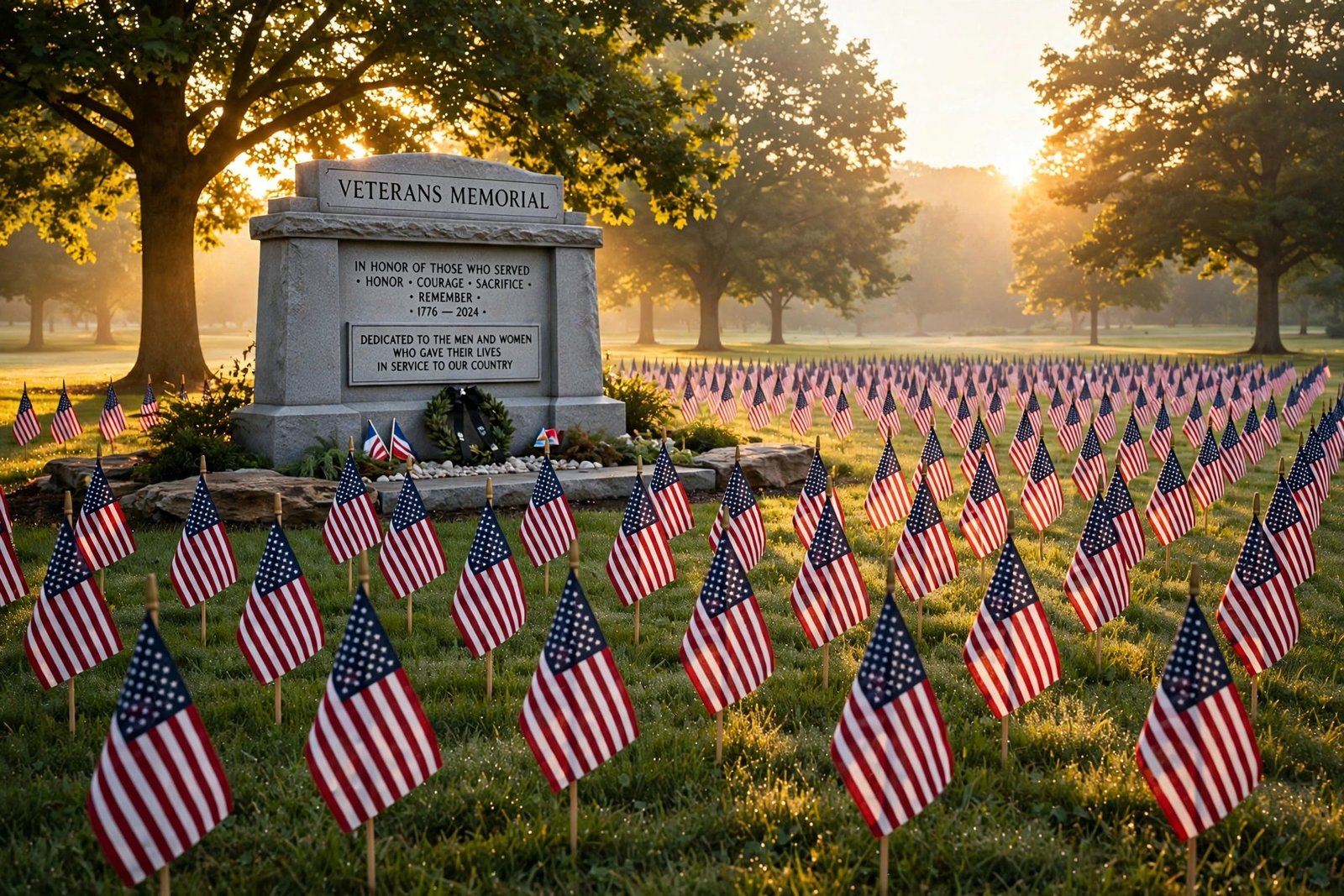
Every year on November 11, Americans pause to honor the men and women who have served in the U.S. Armed Forces. Parades march down Main Streets, flags fly at full staff, and at Arlington National Cemetery a wreath is laid at the Tomb of the Unknown Soldier at exactly 11 a.m. It is a familiar ritual, but the history behind it is richer and stranger than most people realize. Veterans Day did not start out as a day for all veterans. It started as a day to mark the end of a single war, and it took more than three decades, two more wars, and a small-town campaign to turn it into the holiday we know today.
This is the story of how Armistice Day 1918 became Veterans Day: the guns falling silent in France, the first commemorations, the long fight over the date, and the difference between Veterans Day and Memorial Day that still confuses people every year.
The 11th hour of the 11th day of the 11th month
To understand Veterans Day, you have to start in the mud and ruin of World War I. By the autumn of 1918, the war that had consumed Europe for more than four years was finally grinding toward an end. Germany’s allies had collapsed, its armies were in retreat, and its government was seeking terms. On November 11, 1918, an armistice, an agreement to stop fighting, was signed in a railway carriage in the Forest of Compiegne in France, and it took effect at 11 a.m. Paris time.
The timing is why the date stuck. The 11th hour of the 11th day of the 11th month became one of the most famous timestamps in history, a neat, unforgettable number for a moment the whole world had been waiting for. The guns fell silent along the Western Front, soldiers climbed out of trenches, and church bells rang in towns across Europe and America. The war itself was not formally over: that would wait for the Treaty of Versailles the following year. But for the people who lived through it, November 11, 1918, was the day the killing stopped, and that was enough.
The human cost behind that silence is hard to overstate. World War I, known at the time as the Great War, had killed millions of soldiers and civilians and left a generation scarred. Americans who had watched their sons, brothers, and husbands sail off to France understood November 11 as something sacred: the day the boys started coming home. That emotion is the seed from which Veterans Day grew.
The first Armistice Day: 1919 and President Wilson
One year later, on November 11, 1919, President Woodrow Wilson proclaimed the first commemoration of Armistice Day. In his message, he wrote that the reflections of Armistice Day would be filled with solemn pride in the heroism of those who died in the country’s service and with gratitude for the victory, and for the opportunity it had given America to show her sympathy with peace and justice in the councils of the nations. It was a day for both mourning and hope: grief for the dead, and a belief that the war had been fought to end war itself.
Those early observances were quieter than today’s parades. Many Americans marked the moment with two minutes of silence at 11 a.m., with businesses pausing, church bells ringing, and flags displayed. The first public celebrations of Armistice Day in 1920 added parades and speeches, and in 1921 an unknown American soldier from World War I was buried at Arlington National Cemetery, creating a focal point for national remembrance that still anchors the holiday today.
In 1926, Congress passed a resolution declaring that the anniversary of November 11, 1918, should be commemorated with thanksgiving and prayer and with exercises designed to perpetuate peace between nations. The resolution did not make Armistice Day a federal holiday, but it gave the observance official recognition and set the stage for what came next.
Armistice Day becomes a federal holiday in 1938
On May 13, 1938, Congress made November 11 a legal holiday. The act dedicated the day to the cause of world peace and declared that it would thereafter be celebrated and known as Armistice Day. At that point, the holiday was still specifically about World War I. It honored the veterans of the Great War, and its language reflected the idealism of the time: a belief that the war to end all wars had actually done so, and that the day should stand as a monument to peace.
That idealism would not survive the next decade. Within a few years, the world was at war again, on a scale even larger than before. American forces fought across Europe, North Africa, and the Pacific in World War II, and then again in Korea in the early 1950s. By the time those wars ended, the idea of a holiday that honored only World War I veterans felt badly out of date. Millions of Americans had served in new wars, and they deserved a day of their own, or rather, a share of the day that already existed.
The push to broaden the holiday came from veterans themselves. Veterans service organizations argued that November 11 should honor the veterans of all wars, not just one. The most famous local campaign came from two towns that both claimed a piece of the story: Birmingham, Alabama, where World War II veteran Raymond Weeks organized a National Veterans Day celebration with a parade on November 11, 1947, to honor veterans of all wars; and Emporia, Kansas, where a local campaign led to the town celebrating Veterans Day instead of Armistice Day in 1953. You can read the Department of Veterans Affairs’ own account of this history at the VA’s history of Veterans Day, which traces the holiday from the armistice through the renaming.
The renaming: Armistice Day becomes Veterans Day in 1954
Congress agreed with the veterans, and in 1954 it acted. On June 1, 1954, President Dwight D. Eisenhower signed legislation, Public Law 83-380, that amended the 1938 act by striking out the word “Armistice” and inserting the word “Veterans” in its place. From then on, November 11 would be known as Veterans Day, a day to honor American veterans of all wars. Eisenhower, himself a general in World War II before becoming president, also issued the first Veterans Day proclamation that October, calling on all Americans to join in the observance and designating the head of the Veterans Administration as chairman of a Veterans Day National Committee to coordinate the national celebration.
The change was deliberately simple: one word swapped for another. But that single word carried a huge shift in meaning. Armistice Day had looked backward to a single moment in 1918. Veterans Day looked at the living: the men and women who had served in every conflict, from the Revolutionary War to the present day, and who were still part of American communities. It was also a subtle shift in tone, from mourning a war’s end to thanking the people who had fought in wars, and the new name stuck immediately.
The Monday holiday experiment: 1971 to 1978
Veterans Day might have stayed simple after 1954, but Congress had one more idea. In 1968, lawmakers passed the Uniform Monday Holiday Act, which moved several federal holidays to Mondays to give federal employees more three-day weekends. Washington’s Birthday, Memorial Day, and Columbus Day were all shifted, and Veterans Day was moved to the fourth Monday in October, starting in 1971.
The experiment was deeply unpopular, and it showed how much the date itself mattered. November 11 was not an arbitrary day on the calendar. It was the anniversary of the armistice, and moving it to a random Monday in October stripped the holiday of its meaning. The first Monday-observed Veterans Day, on October 25, 1971, was marked with widespread confusion, and many states simply refused to go along, continuing to observe November 11 on their own.
The backlash worked. In 1975, President Gerald Ford signed Public Law 94-97, which returned the annual observance of Veterans Day to November 11, effective in 1978. Since then, the holiday has stayed put, regardless of what day of the week it falls on. When November 11 falls on a Saturday, the federal holiday is observed on the Friday before; when it falls on a Sunday, it is observed on the Monday after. But the day itself never moves again, and that stability is part of what gives the holiday its weight.
The national ceremony at Arlington
The focal point of Veterans Day today is Arlington National Cemetery, just across the Potomac River from Washington, D.C. Each year on November 11, the Veterans Day National Ceremony is held at the Memorial Amphitheater, built around the Tomb of the Unknown Soldier. At 11 a.m., a combined color guard representing all military services executes “Present Arms” at the tomb, and a wreath is laid by the president or another senior official. The ceremony is coordinated by the President’s Veterans Day National Committee, chaired by the Secretary of Veterans Affairs.
The Tomb of the Unknown Soldier is a fitting centerpiece. It holds the remains of unidentified American service members, and its sentinel guard, kept around the clock in all weather, has become one of the most revered sights in the country. The tomb connects the holiday back to its origins: the first unknown soldier buried there, in 1921, was a World War I casualty, honored on Armistice Day itself. Every Veterans Day ceremony at the tomb is therefore both a tribute to all veterans and a direct link to the very first Armistice Day.
Beyond Arlington, Veterans Day is observed in thousands of local ceremonies across the country. Towns hold parades, schools invite veterans to speak to students, churches hold special services, and veterans organizations host breakfasts and open houses. Many restaurants and retailers offer free meals or discounts to veterans, and community groups use the day to raise money for veterans charities or to connect former service members with benefits and support. The VA’s own news coverage of the holiday, including its account of the 1954 renaming, is available at VA News: The history of Veterans Day.
How Americans observe Veterans Day today
For most Americans, Veterans Day is a federal holiday, which means federal offices, banks, and the post office close, and many schools and businesses follow suit. But the holiday is not primarily a day off. It is a day of active gratitude, and there are many ways to take part. Attending a local parade or ceremony is the most traditional option, and most towns have one.
Thanking a veteran personally is the gesture that matters most to many former service members, and it does not require a ceremony. A phone call, a message, or a conversation with a veteran in your family or neighborhood can mean more than a parade. Volunteering with a veterans organization, donating to a veterans charity, or simply learning about the experiences of veterans from different eras are all meaningful ways to mark the day. Teachers often use the week around Veterans Day to teach students about military service and American history, which helps the next generation understand what the holiday is actually for.
Veterans Day vs. Memorial Day: the difference that matters
One confusion comes up every single year, so it is worth settling it plainly. Veterans Day honors all who have served in the U.S. Armed Forces, living and deceased. Memorial Day, observed on the last Monday in May, specifically honors those who died while serving in the military. The simplest way to remember it is this: Veterans Day is for thanking the living and remembering all who served, while Memorial Day is for mourning those who never came home.
That distinction shapes how each day feels. Memorial Day has a solemn, graveside character, with flags placed on graves and moments of silence for the fallen. Veterans Day is more celebratory, with parades, discounts, and thank-you messages directed at living veterans. Both days involve flags, ceremonies, and gratitude, but they are not interchangeable, and veterans themselves often notice when they are mixed up. Saying “Happy Memorial Day” to a veteran in May can feel off for exactly this reason, while a Veterans Day thank-you in November is almost always welcome.
There is also Armed Forces Day, observed on the third Saturday in May, which honors those currently serving on active duty. Together, the three holidays form a kind of calendar of military appreciation: Armed Forces Day for those serving now, Memorial Day for those who died in service, and Veterans Day for everyone who has ever worn the uniform. Knowing the difference is one of the easiest ways to show respect for what each day means.
Why November 11 still matters
More than a century after the guns fell silent in France, Veterans Day endures because it does two things at once. It remembers a specific moment in history, the armistice of 1918, and it honors a living community, the veterans who walk among us today. That combination of history and gratitude is rare among American holidays, and it is why the date has survived renaming, rescheduling, and more than a century of change.
So this November 11, whether you attend a ceremony, fly a flag, call a veteran, or take a moment at 11 a.m., you are taking part in a tradition that began in the silence after the Great War and grew into one of America’s most meaningful holidays. From Armistice Day to Veterans Day, the name changed, but the purpose never did: to honor those who served, and to keep faith with the peace they fought for.
Frequently asked questions
Why is Veterans Day on November 11?
November 11 marks the anniversary of the armistice that ended fighting in World War I, which took effect at 11 a.m. on November 11, 1918, the 11th hour of the 11th day of the 11th month.
When did Armistice Day become Veterans Day?
In 1954, Congress amended the 1938 holiday act, replacing the word “Armistice” with “Veterans.” President Dwight D. Eisenhower signed the change into law on June 1, 1954, to honor veterans of all wars.
When did Armistice Day become a federal holiday?
Congress made November 11 a legal holiday on May 13, 1938, dedicating it to the cause of world peace. President Wilson had proclaimed the first commemoration in 1919.
What is the difference between Veterans Day and Memorial Day?
Veterans Day honors all who have served in the U.S. Armed Forces, living and deceased. Memorial Day, in May, specifically honors those who died while serving in the military.
Why does Veterans Day have no apostrophe?
The official name is “Veterans Day” without an apostrophe because the day does not belong to one veteran or group. It is a day for honoring all veterans, and the VA and federal style use the apostrophe-free spelling.