
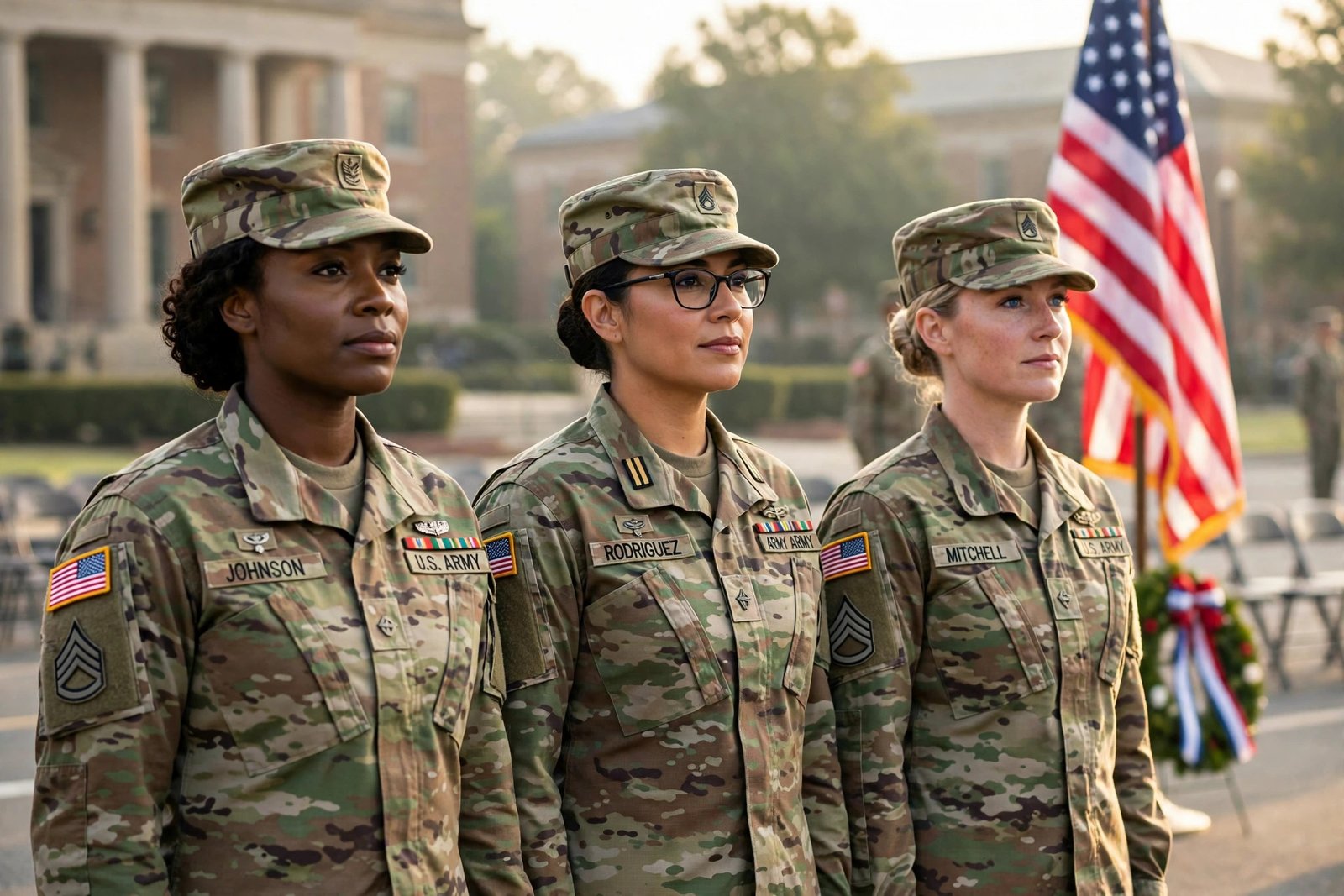
Long before women could enlist in the United States Army, they were already there — cooking over open fires, washing uniforms, nursing the sick and wounded, and keeping an army on its feet through winters that might otherwise have broken it. Their story is not a footnote to American military history. It is woven through every major war the nation has fought, and it follows a long, uneven path from unofficial service to full, formal equality in every occupation the Army offers.
That path did not move in a straight line. Women were welcomed when the need was urgent and pushed back when peacetime returned. They served without rank, then with relative rank, then with permanent status. They were barred from combat roles long after they had already served beside combat units in real wars. Understanding that history matters because it explains how the Army of today came to be — an Army in which, as long as they meet the same standards, women can serve in any job, from infantryman to Ranger to general officer.
This is the story of that journey: the camp followers of the Revolution, the nurses who built a corps, the women of the Women’s Army Corps in World War II, the slow opening of academies and assignments in the late twentieth century, and the decision in late 2015 that finally removed the last formal barrier.
The Revolutionary War: camp followers who kept an army alive
During the American Revolution, the Continental Army had no modern supply system for food, clothing, laundry, and medical care, and women filled that gap. Known as camp followers, they were mostly wives, daughters, sisters, and mothers of soldiers who traveled with the army and worked in its camps. They cooked communal meals from raw rations, washed and mended uniforms, gathered firewood, and nursed the sick and wounded.
Their work was governed by military rules and paid for in rations, and it was essential in a war in which disease killed far more soldiers than battle. At Valley Forge and other winter encampments, women boiled uniforms to fight lice, changed dressings, and sat with men dying of camp fever. Without that labor, historians of the period note, the army would have struggled simply to stay in the field.
A few women went further. Deborah Sampson disguised herself as a man to enlist and fight, and the famous figure of Molly Pitcher — said to have carried water to soldiers and worked a cannon in battle — is now understood by historians as likely a composite of several real women rather than a single person. The legend endures because it captures something true: women were not only behind the lines. Some were on them, even when the army had no place for them on paper.
Nurses and the first formal foothold
The first organized system for military nurses in America also dates to the Revolution. In July 1775, Congress approved a request from General George Washington to provide one female nurse for every ten patients, with a supervisory matron for every hundred. The pay was small and the conditions were harsh, but the precedent mattered: the army had formally recognized that it needed women to care for its wounded.
That recognition grew slowly. Women nursed in the War of 1812 and, in large numbers, in the Civil War, where figures such as Clara Barton organized relief work on and near battlefields. Yet they still served without rank, regular pay, or a permanent place in the military structure. It was not until 1901 that Congress officially established the Army Nurse Corps, giving women their first permanent corps in the Army. In 1920, the Army Reorganization Act granted Army nurses relative rank as officers — a major step, even if full equality was still decades away.
The lesson of those early decades is a recurring one in this history: women proved themselves in wartime service first, and formal recognition followed later, often only after sustained campaigns by the women themselves and their supporters.
World War II: the WAAC and the Women’s Army Corps
World War II changed the scale of women’s service entirely. In 1942, the Women’s Army Auxiliary Corps, known as the WAAC, was established as the women’s auxiliary of the Army. Its first members trained at Fort Des Moines in Iowa, and the corps grew quickly as the war demanded more hands for the vast logistical machine behind the fighting forces.
In 1943, the WAAC became a full Army branch, the Women’s Army Corps, or WAC. For the first time, women in the corps received the same pay and rank insignia as their male counterparts. They worked as drivers, clerk-typists, postal clerks, mechanics, cryptographers, and in many other roles that freed men for combat assignments. Around 150,000 women served in the WAAC and WAC during the war, at home and overseas, and their service reshaped what Americans expected women in uniform to do.
That progress, however, did not survive the war intact. As after earlier wars, demobilization shrank women’s opportunities sharply. The difference this time was that women veterans, and the organizations they formed, kept pressing for permanent status — and in 1948, they won a lasting victory.
1948 and the long road to permanent status
In 1948, Congress passed the Women’s Armed Services Integration Act, signed into law by President Harry Truman. For the first time, women gained permanent, regular, and reserve status in the Army, Navy, Marine Corps, and Air Force, along with entitlement to veterans’ benefits. It was a landmark, but it came with limits that would take decades to undo: caps on how many women could serve, limits on promotion, and a continued bar on combat roles.
Through the Korean and Vietnam eras, women served mainly in medical, administrative, and support roles, and their numbers and assignments expanded only gradually. The Army Nurse Corps continued to be a central path, and women also served in intelligence, logistics, and communications. In Vietnam, Army nurses served in field hospitals under fire, and their service became another powerful argument that the old lines between support and combat no longer matched the reality of modern war.
The next great barrier to fall was education. In 1975, President Gerald Ford signed legislation permitting women to enter the U.S. military academies as students for the first time, opening West Point, Annapolis, and the Air Force Academy to women. The first women entered West Point in 1976, and their graduation a few years later put women on the path to the Army’s senior leadership in a way that had never been possible before.
Iraq, Afghanistan, and the combat ban under strain
By the 1990s, the strain on the combat exclusion policy was becoming impossible to ignore. In 1994, the Defense Department rescinded the old risk rule and replaced it with a less restrictive ground combat policy, opening a large majority of military positions to women. Yet infantry, armor, and some special operations roles remained closed, even as women deployed to Iraq and Afghanistan in the 2000s and served in units that regularly came under fire.
In those wars, the distinction between front line and rear area largely disappeared. Women drove convoys, served on military police teams, worked in intelligence and medical units, and earned Combat Action Badges for engaging the enemy. Their performance, and the simple fact that they were already doing dangerous work in combat zones, made the formal ban look increasingly out of step with reality. Advocates inside and outside the military argued that assignments should be based on standards and ability, not on gender alone.
That argument gained ground in stages. In 2012, modifications to the policy opened thousands more positions to women, including positions collocated with ground combat units. Then, in January 2013, Defense Secretary Leon Panetta announced plans to lift the ban on women serving in combat roles, setting in motion a review that would examine every remaining closed occupation.
2015 to 2016: every occupation opens
The decisive moment came on December 3, 2015. Defense Secretary Ash Carter announced that beginning in January 2016, all military occupations and positions would be open to women, without exception. As long as they qualified and met the specific standards, he said, women would be able to drive tanks, fire mortars, and lead infantry soldiers into combat, and to serve as Army Rangers and Green Berets and in every other role previously open only to men.
Carter noted that opening more than 111,000 positions in the years before had still left about ten percent of positions — nearly 220,000 across the services, including infantry, armor, reconnaissance, and some special operations units — closed to women. After a review by senior civilian and military leaders, he concluded that no position warranted a continued exemption. The services were directed to open all specialties within thirty days and to provide implementation plans for integrating women into the newly opened roles deliberately and methodically.
The announcement capped a year of symbolic breakthroughs. In August 2015, First Lieutenant Shaye Haver and Captain Kristen Griest became the first women to graduate from the U.S. Army’s Ranger School, one of the military’s most grueling leadership courses. Their graduation showed, in the most practical terms possible, that women could meet the Army’s toughest standards — and it arrived just months before the final barrier fell.
Women serving today: what the milestone means in practice
Today, women serve in every Army occupation, at every rank, and in leadership roles that would have been unimaginable to the camp followers of the Revolution. Women command units, fly helicopters, serve in Special Forces assessment and selection, lead infantry platoons, and hold senior positions across the Army staff. The change is not only about who can hold which job. It is about how the Army thinks about talent: every qualified soldier, regardless of gender, is now eligible for every assignment.
That does not mean the work is finished. Integration has brought practical challenges — from equipment and facilities designed for a male force to questions about physical standards, unit cohesion, and family policy — and the Army continues to adjust. What has changed permanently is the principle. Assignments are now tied to standards, training, and performance, and the burden is on the institution to make integration work, not on women to justify their presence.
For young Americans considering service, the message of this history is encouraging and honest at once. The Army’s doors are open wider than ever before, but the standards have not been lowered to open them. The women who walked this path — from the laundresses at Valley Forge to the WACs of World War II to the first female Ranger graduates — earned their place by meeting the demands placed before them, and often by exceeding them.
Why this history still matters
There is a temptation to treat this story as settled, a chapter closed in 2016. It is better understood as a foundation. Every generation of women in the Army has had to prove, again, that it belongs, and every generation has left the institution a little more open than it found it. Remembering the camp followers matters because they remind us that service does not always come with a uniform or a rank. Remembering the WACs matters because they showed that large-scale integration was possible in the middle of a world war. Remembering the Ranger graduates matters because they proved that standards and inclusion are not opposites.
For families, veterans, and Americans who simply want to understand the force that defends the country, this history offers a clearer picture of who serves and why. The Army today is shaped by women who cooked, nursed, drove, typed, flew, fought, and led — and by the long struggle to give that service the recognition it deserved. That struggle is part of the Army’s story, and it is still being written by the women serving now.
Frequently asked questions
When did women first serve in the U.S. Army?
Women served informally from the Revolutionary War as camp followers who cooked, washed, and nursed, and in an organized nursing system approved by Congress in 1775. Their first permanent corps was the Army Nurse Corps, established in 1901.
What was the Women’s Army Corps?
The Women’s Army Corps, or WAC, was the women’s branch of the Army in World War II. It began in 1942 as the Women’s Army Auxiliary Corps and became a full Army branch in 1943, with the same pay and rank insignia as male soldiers.
When did combat roles open to women?
Defense Secretary Leon Panetta announced plans to lift the combat ban in 2013, and Defense Secretary Ash Carter announced on December 3, 2015, that all military occupations would be open to women beginning in January 2016, without exception.
Who were the first women to graduate from Ranger School?
First Lieutenant Shaye Haver and Captain Kristen Griest became the first women to graduate from the U.S. Army’s Ranger School in August 2015, months before all occupations were opened to women.
Do women serve in every Army job today?
Yes. Since January 2016, every Army occupation has been open to women who qualify and meet the specific standards for that role, from infantry and armor to aviation, medical, and special operations assignments.