
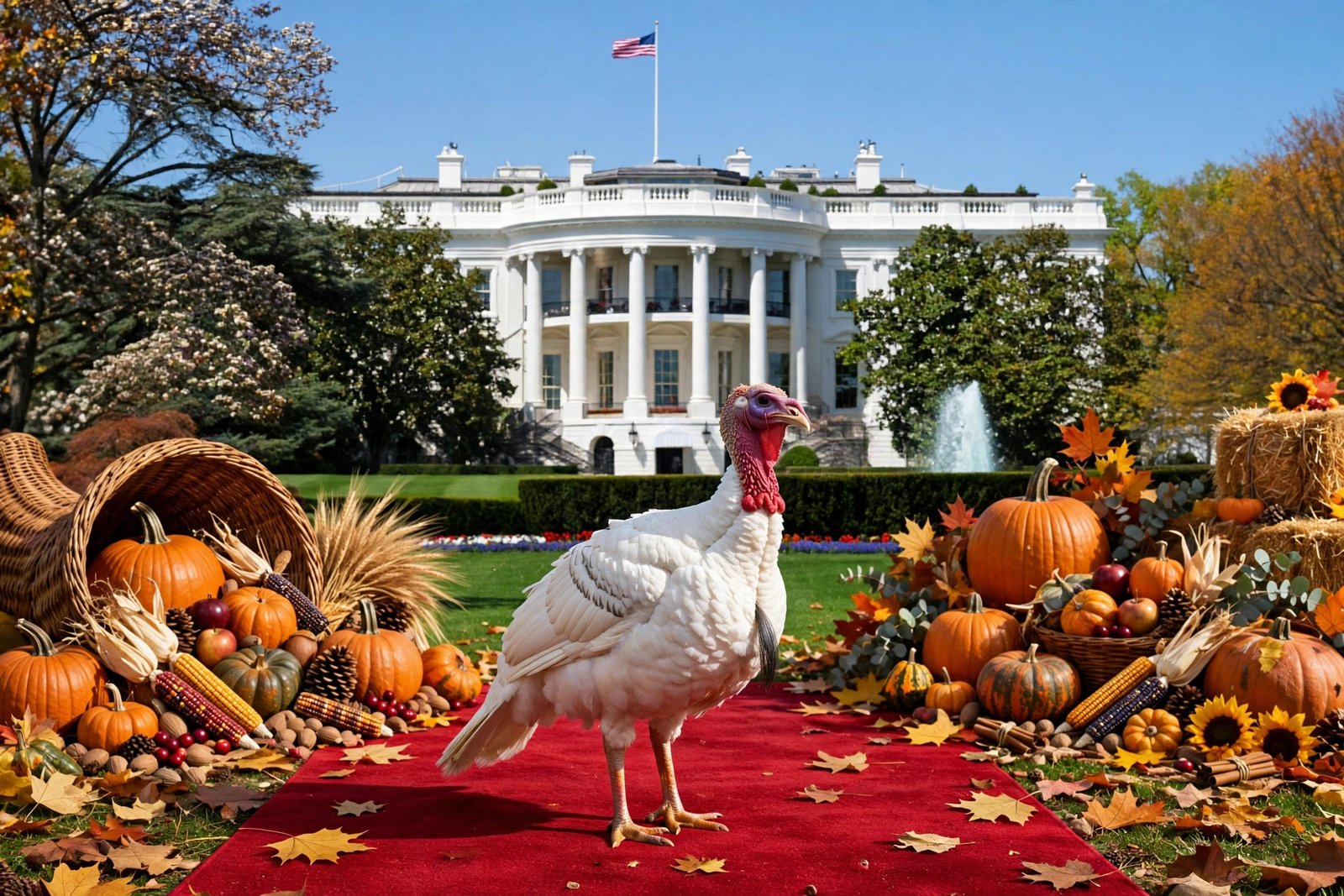
Every November, just before Thanksgiving, the President of the United States steps outside the White House, makes a few jokes, and spares a turkey’s life. Cameras roll, the crowd laughs, and within minutes the clips are everywhere on social media. It is one of the strangest and most beloved rituals in American public life: the White House turkey pardon.
The ceremony is lighthearted on purpose. The president reads a script full of turkey puns, the bird stands calmly on a table, and the whole country gets a reminder that Thanksgiving is almost here. But behind the jokes sits a surprisingly tangled history, stretching back more than 150 years, full of myths, accidents and one very famous speech. Here is how a dinner gift became a national tradition, and what really happens to the lucky bird.
What Happens at the Turkey Pardon?
Each year, the National Turkey Federation, the trade group that represents America’s turkey farmers, brings two live turkeys to the White House: a main bird and an alternate, in case the first one gets stage fright. The turkeys are usually Broad Breasted White males, the big, white-feathered breed raised for Thanksgiving tables across the country.
Days before the ceremony, the president pardons the bird in a short televised event, usually held on the White House lawn or in the Rose Garden. The president delivers a brief speech, cracks a few jokes, and declares the turkey officially pardoned, sparing it from becoming Thanksgiving dinner. The bird is then sent off to live out its days on a farm, at a park, or at a university, where it becomes a minor celebrity for the rest of its life.
The alternate bird gets pardoned too. Nobody wants a spare turkey feeling left out, and the federation has made it standard practice to pardon both. The ceremony usually takes place in the week of Thanksgiving, and it has become one of the most reliable viral moments of the American holiday season.
How the Lucky Birds Are Chosen
Being pardoned is not a random honor. It is the end of a long selection process that starts months before Thanksgiving on the farm of the current National Turkey Federation chairperson. A flock of roughly 50 to 80 birds is chosen and raised to get used to loud noises, flash photography and large crowds, the kind of chaos a turkey will face on the White House lawn.
From that flock, the 10 to 20 best-behaved and best-groomed birds are picked, and the field is eventually narrowed to two finalists. Their names are chosen by White House staff from suggestions sent in by schoolchildren from the turkey’s home state, which is why the birds end up with cheerful, alliterative names. The two finalists then travel to Washington and, in a detail Americans love, stay at the Willard InterContinental hotel before the big day, at the federation’s expense.
The chosen turkeys are usually about 21 weeks old and weigh around 45 pounds, big, healthy birds in the prime of their short lives. They are, by every measure, the most pampered poultry in America.
Turkeys at the White House: A Gift Tradition Since the 1870s
Long before any president pardoned a turkey, presidents were receiving them as gifts. The tradition began in the 1870s, when a Rhode Island poultry dealer named Horace Vose began sending a live turkey to the White House every year for the holidays. He kept it up until his death in 1913, and presidents came to expect the bird.
Those early turkeys were not spared. They were meant for the president’s dinner table, and they often arrived wearing a sign around their neck reading Good Eatin’, Mr. President. The gift was a mark of respect, and a bit of advertising for the turkey business, all in one. Nearly every year since, presidents and their families have received turkeys for the holidays, and the gift became a fixture of the season.
The National Turkey Federation took over the tradition in 1947, the year it began formally presenting a turkey to the president each Thanksgiving season. That first presentation went to President Harry S. Truman, and it is where the most famous myth about the pardon begins.
The Truman Myth: What Really Happened
Ask most Americans who started the turkey pardon, and many will say Harry Truman. The story is everywhere: that Truman pardoned the first turkey in 1947. It is a great story. It is also not true, and the Truman Library itself has said so.
What actually happened in 1947 is simpler and less heartwarming. Truman accepted a turkey from the National Turkey Federation, and like almost every turkey before it, that bird was destined for the dinner table. The federation had begun the presentation that year partly to smooth things over after Truman’s administration asked Americans to observe meatless Tuesdays and poultryless Thursdays to save grain for foreign aid, a policy that had not made the turkey industry happy.
There is no record of Truman pardoning a turkey or using the word pardon at all. The birds he received in his years in office were, as far as historians can tell, eaten. The Truman Library disputed the pardon story in writing in 2003, pointing out that the tradition of sending turkeys to presidents was a gift tradition, not a pardon tradition. The myth stuck anyway, helped along by the fact that a turkey pardoned by Truman makes a much better story than a turkey eaten by Truman.
Lincoln and the Christmas Turkey
The oldest pardon story of all belongs to Abraham Lincoln, and it may be the most charming one. According to a tale first published decades after the event, a live turkey was brought to the White House for Christmas dinner in 1863, and Lincoln’s young son Tad took a liking to it, named it Jack, and begged his father to spare it. Lincoln, the story goes, agreed, and the turkey became a White House pet.
It is a lovely story, and it is told in many histories of the tradition. But historians treat it cautiously. The tale comes from a single account written long after the fact, and there is no contemporary record of Lincoln pardoning a turkey. What is true is that the story captures something real about how Americans want to remember Lincoln: a president who could be moved by a child’s plea, even over a Christmas turkey.
Whether or not Jack the turkey ever lived, the Lincoln story set the template for everything that followed: a president, a turkey, and a moment of mercy that the whole country could smile at.
JFK’s “Just Let This One Live” Moment
The first Thanksgiving turkey on record to receive a genuine reprieve came in 1963, and it arrived just three days before one of the darkest moments in American history. On November 19, 1963, President John F. Kennedy was presented with a turkey wearing a sign that read Good Eating, Mr. President. Kennedy looked at the bird and, according to National Archives reporting, decided to spare it, saying words to the effect of, we’ll just let this one live.
Kennedy never used the word pardon, and the gesture was informal, a quick aside rather than a ceremony. But it was the first time a president had publicly decided not to eat the Thanksgiving turkey in front of him, and it mattered. Three days later, Kennedy was assassinated in Dallas. The turkey, in a strange twist of fate, outlived the president who spared it, and the bird was sent to a farm.
Kennedy’s brief act of mercy is often cited as a turning point. After 1963, it became increasingly common for presidents to send their turkeys to farms or petting zoos instead of the dinner table, and the idea of sparing the bird slowly took hold.
Reagan and the Word “Pardon”
The word pardon itself entered the story in 1987, and it arrived as a joke. President Ronald Reagan was presented with a turkey named Charlie, and a reporter asked him whether he planned to pardon the bird, a pointed question, since the Iran-Contra scandal was dominating the news and the word pardon was in the air for entirely different reasons.
Reagan, who rarely missed a chance for a laugh, played along. He said he would pardon Charlie and send him to a petting zoo, making him the first president on record to use the word pardon about a turkey, as detailed in histories of the tradition. It was a deflection wrapped in a joke, and it worked beautifully. The next year, in 1988, Reagan did not repeat the performance, and the word might have faded away entirely.
Instead, it became the seed of the modern tradition. Reagan had shown that a president could spare a turkey in public, call it a pardon, and turn it into a charming news moment. His successor would take that seed and make it permanent.
1989: George H.W. Bush Makes It Official
The modern turkey pardon began on November 14, 1989, in the first Thanksgiving season of President George H.W. Bush’s presidency. Standing in the Rose Garden, Bush looked at the turkey before him and said the words that made the tradition official: “But let me assure you, and this fine tom turkey, that he will not end up on anyone’s dinner table, not this guy. He’s granted a presidential pardon as of right now, and allow him to live out his days on a children’s farm not far from here.”
It was the first time a president had formally used the phrase presidential pardon in the ceremony, and it stuck. The White House Historical Association notes that Bush became the first president to use the language of a presidential pardon for the birds, and every president since has carried on the tradition. The phrase had apparently been inserted by a speechwriter, and Bush himself was relaxed about the wording, saying that reprieve, keep him going, or pardon, it was all the same for the turkey, as long as he did not end up on the president’s holiday table.
The 1989 bird, a 50-pound turkey, was sent to a children’s farm, just as Bush had promised. A lighthearted ceremony had become an institution, and the turkey pardon has been an annual White House event ever since.
Where Do Pardoned Turkeys Go?
A pardoned turkey does not go back to the farm it came from. It goes to a new home, usually a farm, a park, or a university, where it lives out the rest of its life as a celebrity bird. Over the years, pardoned turkeys have gone to places including Morven Park’s Turkey Hill in Virginia, a historic estate that has housed several of the birds, and to universities and children’s farms across the country.
Life after the pardon is comfortable, but it is not always long. The Broad Breasted White turkeys chosen for the ceremony are bred to grow large quickly, and that breeding makes them prone to health problems. In the early years of the tradition, pardoned turkeys often lived only a few months. In recent years, the National Turkey Federation says, lifespans have improved, and pardoned turkeys frequently live for more than two years, and occasionally three, thanks to better choices of homes after the pardons.
Some birds become genuinely famous. In 2001, President George W. Bush pardoned two turkeys named Liberty and Freedom, weighing 48 and 52 pounds, in a ceremony held just weeks after the September 11 attacks. Their names were no accident. In 2021, President Joe Biden pardoned Peanut Butter and Jelly, the names chosen by schoolchildren, continuing a naming tradition that gives each bird a personality before it ever reaches the White House lawn.
Why Americans Love the Turkey Pardon
Part of the pardon’s appeal is that it is gloriously unserious. American politics is rarely gentle, but for ten minutes each November, the president of the United States stands outside and makes turkey puns on live television. The jokes are famously corny. The bird is famously unbothered. And the whole thing is a reminder that Thanksgiving is, at its heart, a holiday about gratitude, family, and not taking yourself too seriously.
The ceremony also works because it is built for the age of social media. The image of a president pardoning a turkey is instantly shareable, the puns are instantly quotable, and the bird itself is a perfect viral star. Every year, the clips spread across every platform, and the ceremony reaches millions of Americans who might not otherwise watch a White House event.
Thanksgiving itself remains one of America’s most widely celebrated holidays. According to the National Turkey Federation, 94 percent of Americans planned to celebrate Thanksgiving in 2025, with turkey still the star of the table. The pardon is a small, joyful piece of that celebration, a moment when the most powerful person in the country pauses to spare the life of the humblest bird on the menu.
Frequently Asked Questions
When did the White House turkey pardon start?
The modern tradition began in 1989, when President George H.W. Bush became the first president to formally grant a presidential pardon to a Thanksgiving turkey. Presidents had received turkeys as gifts since the 1870s, and some had spared individual birds before that, but 1989 is when the pardon became an official annual ceremony.
Did Harry Truman really pardon the first turkey?
No, and the Truman Library has said so. Truman received the first turkey formally presented by the National Turkey Federation in 1947, but there is no record of him pardoning it. The birds presented to Truman were meant for the dinner table. The pardon story attached to Truman is a popular myth that grew up around the gift tradition.
What happens to the turkey after it is pardoned?
The pardoned turkey is sent to live on a farm, at a park, or at a university. Pardoned birds have lived at places including Morven Park’s Turkey Hill in Virginia. The National Turkey Federation says pardoned turkeys now frequently live for more than two years, and occasionally three, thanks to better choices of homes.
Why are there two turkeys at the ceremony?
The National Turkey Federation brings a main bird and an alternate, so the ceremony can go on even if one bird is unwell or uncooperative. Both birds are pardoned. Their names are chosen by White House staff from suggestions sent in by schoolchildren from the turkey’s home state.