
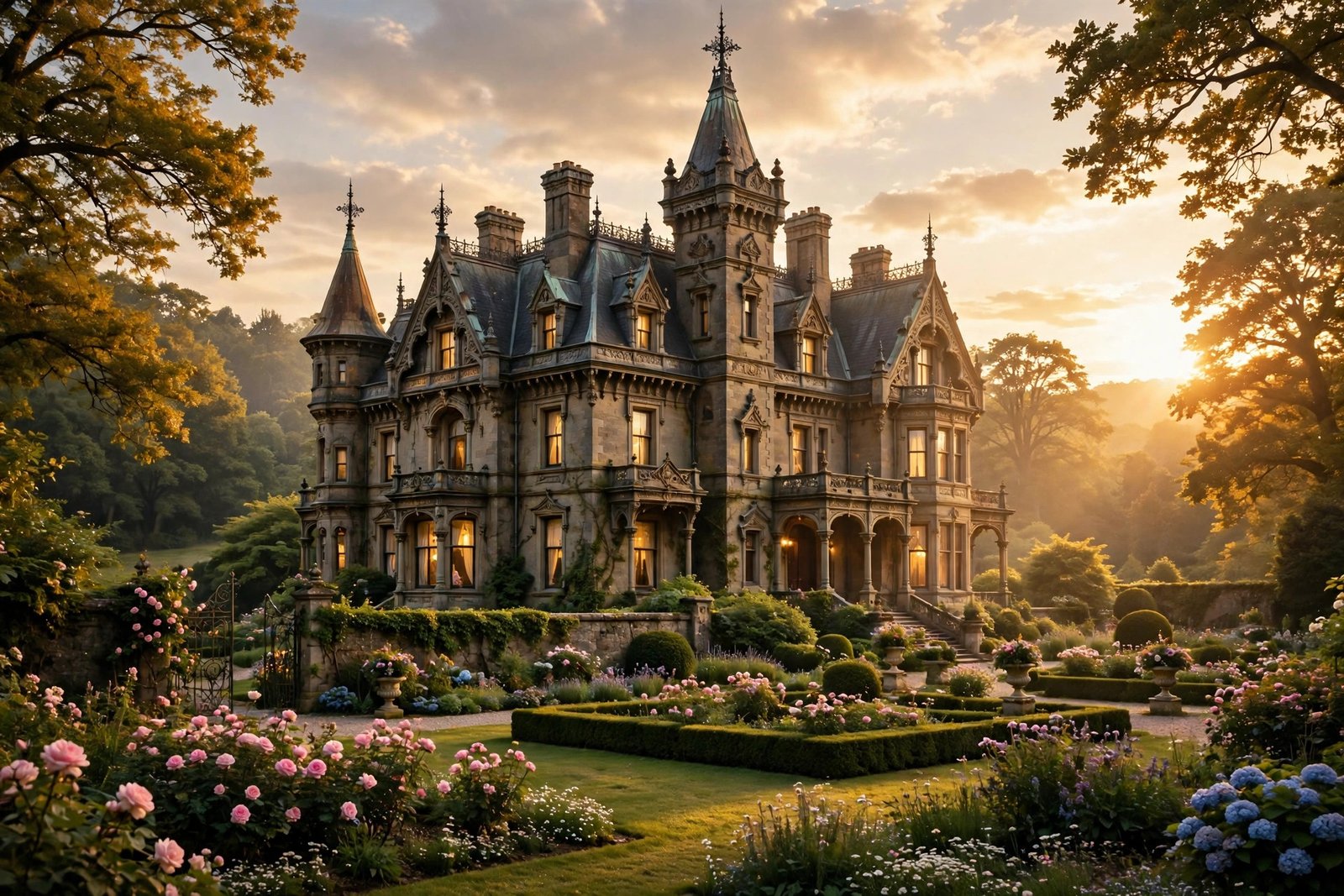
There are staircases that climb into ceilings, doors that open onto blank walls, and hallways that seem to loop back on themselves. There is a house that grew, room by room, for decades, until it held 160 rooms across some 24,000 square feet. And there is a story, told for a century, that its owner built it that way on purpose — to confuse the ghosts of people killed by her family’s rifles.
That house is the Winchester Mystery House in San Jose, California, and it remains one of America’s most visited and most mythologized landmarks. The question visitors ask, often before they even step inside, is a simple one: how much of the legend is true? The answer, as historians and the house’s own records show, is more interesting than a simple yes or no. Some of the story is documented fact. Much of the spookiest detail is folklore that hardened into fact only after Sarah Winchester’s death, when the house became a tourist attraction.
This guide separates the two. It tells Sarah Winchester’s documented story, explains where the famous ghost legend came from, looks at what historians now believe about why she really built, and covers what a visit looks like today — so you can enjoy the mystery without mistaking it for history.
Who was Sarah Winchester?
Sarah Winchester was born Sarah Lockwood Pardee in Connecticut, and on September 30, 1862, she married William Wirt Winchester, whose family was associated with the famous Winchester firearms company. The couple had one child, Annie Pardee, who died about a month after birth in 1866. William Winchester died on March 7, 1881. Those losses, recorded in the National Park Service’s account of the house, shaped the rest of Sarah’s life and, eventually, the legend that surrounds her.
After her husband’s death, Sarah Winchester was a wealthy widow, heir to a substantial firearms fortune. She left New England for California, where she would spend the rest of her life building and rebuilding a home in the Santa Clara Valley outside San Jose. The house she created there, which she called Llanada Villa, would become known after her death as the Winchester Mystery House.
It is important to hold two truths about Sarah Winchester at once. She was a real woman who suffered real tragedies, managed a large estate, and pursued an unusual, deeply personal building project for decades. She was also, after her death, turned into a character in a ghost story — a reclusive, haunted heiress taking nightly orders from spirits — that says more about how America loves a good haunting than about how she actually lived.
The house itself: from farmhouse to mansion
According to the house’s official history, Sarah Winchester purchased a two-story farmhouse near San Jose in 1886 and began remodeling it, and construction continued for 36 years until her death in 1922. The National Park Service dates the start of construction to 1884, a small discrepancy that reflects how the project grew in stages from an existing property rather than breaking ground all at once. Either way, the scale of what followed is not in dispute: an eight-room farmhouse grew into a sprawling Victorian mansion.
The official account describes the finished house as a 160-room mansion of approximately 24,000 square feet, with about 10,000 windows and 2,000 doors. Before the 1906 San Francisco earthquake, the house stood taller; the earthquake damaged it severely, and it was rebuilt at a lower height, standing four stories today. The house is a Queen Anne-style Victorian, richly decorated with stained glass, carved wood, and the handcrafted details that made it famous even before the ghost stories took hold.
One of the most repeated claims about the house is that construction never stopped — that crews worked around the clock, day and night, for decades. Historians have found no evidence for continuous, round-the-clock work. Construction came in waves, with pauses when Sarah Winchester was unwell, traveling, or spending time at her other properties. She had no formal architectural training, sketched many additions herself, and worked with a small group of foremen and carpenters who stayed with her for years. The work finally stopped, simply, when she died in September 1922.
The legend: spirits, a medium, and a house that must never be finished
The legend, as the National Park Service summarizes it, goes like this: after losing her husband and daughter, Sarah Winchester reportedly consulted a spiritualist. The medium told her that the victims killed by Winchester rifles were seeking revenge, that a curse had been placed on her family, and that to live she must move west and constantly, without ceasing, build a house for the spirits, night and day. Only by never finishing the house, the story says, could she stay ahead of the ghosts.
Later versions added vivid details: that the maze of hallways, dead-end doors, and staircases to nowhere was designed to confuse pursuing spirits; that Sarah held nightly séances in a special room to receive building instructions from the dead; that the number thirteen recurs throughout the house — thirteen windows, thirteen steps, thirteen panels — as a deliberate warding sign. These details are the ones tour guides, films, and Halloween attractions love most, and they are also the ones historians question most.
The National Park Service itself presents the medium story as a reported account, not as established proof that Winchester believed she was being pursued by spirits. That careful wording matters. It signals that the story was told about her, and repeated for generations, without the kind of contemporary documentation historians would need to call it fact.
What historians say: legend versus documented fact
Modern historians who have studied Sarah Winchester’s life, including biographers who worked from her letters, business records, and contemporary accounts, offer a very different picture from the haunted-heiress legend. They find no reliable record that she consulted a Boston medium, no evidence of nightly séances, and no sign that her staff described her as building to appease ghosts. The séance-room story, in particular, appears to be a later invention, added after the house opened to the public and its owners needed a compelling tale to draw visitors.
What the records do show is a wealthy, intelligent woman with a genuine passion for architecture and building, a love of innovation, and the means to indulge it on a grand scale. She experimented with design, tried new materials and layouts, and kept changing her mind — which, in a house built without a single master plan, naturally produced oddities: a staircase that ends at a ceiling because a floor plan changed, a door that opens onto a wall because a room was reconfigured, a window set into a floor because an addition covered it. These quirks need no supernatural explanation. They are what happens when a house is remodeled, room by room, over decades, by an owner who sketches her own ideas and revises them as she goes.
That does not make the house less fascinating. If anything, the real story is more human: a woman who, after devastating loss, poured her energy, money, and imagination into a home she never stopped improving, and who kept building because she loved to build. The ghost story, by contrast, reduces her to a frightened figure running from spirits. Historians argue that she deserves better than that — and that visitors can appreciate the house more fully when they see her as its creator, not its prisoner.
The odd architecture: what you will actually see
Whatever its cause, the architecture is genuinely strange, and it is the main reason people visit. The Mansion Tour, the house’s standard guided tour, takes guests through 110 of the 160 rooms over about an hour, covering the history and the tales that gave the house its name. Along the way, you will see the features that made the house famous: staircases that rise to ceilings, doors that open onto walls, windows set into floors, and hallways that turn back on themselves.
Look closely, and you will also see the craftsmanship that often gets lost in the ghost talk: Tiffany-style stained glass, including the famous spider-web window, finely carved woodwork, parquet floors, and the gardens that Sarah Winchester also designed and tended. The house is, at its heart, a remarkable piece of Victorian design and a window into how a wealthy Californian lived at the turn of the twentieth century — with servants’ quarters, kitchens, ballrooms, and bedrooms that tell a social history as rich as any ghost story.
The house also bears the marks of its history. The 1906 earthquake left its imprint, and later restoration work has preserved both the original fabric and the layers of change that make the house a kind of architectural diary. Guides on the standard tour distinguish, to varying degrees, between documented history and legend, and the house’s historian-led tours go deeper into construction and preservation for visitors who want the full, sourced story.
From private home to public landmark
Shortly after Sarah Winchester’s death in 1922, the house was sold and opened to the public as the Winchester Mystery House, with public tours beginning in 1923. In its early years as an attraction, the emphasis was on entertainment — dancing, food, games, and picnic grounds in the gardens — and only gradually did the mansion itself, and its ghost story, become the main draw. By the 1930s, the house was officially marketed under the Winchester Mystery House name, with postcards and publicity that cemented the legend in the public mind.
The house’s historical significance was formally recognized when it was listed in the National Register of Historic Places in 1974 and designated a California Historical Landmark. That recognition protects the property and acknowledges its architectural and historical importance beyond the ghost stories — a reminder that the house matters as heritage, not only as a haunted attraction.
Today, the house is privately owned and operated as a historic attraction in San Jose, with a mission, in its own words, to preserve Sarah Winchester’s home and gardens and make them accessible to future generations. That dual identity — historic house and mystery attraction — is the key to enjoying a visit: expect both history and lore, and enjoy sorting one from the other.
Visiting today: tours, practical tips, and what to expect
If you plan a visit, start with the official website for current hours and ticket options, since times and seasonal experiences change through the year. The estate is generally open daily, with tours beginning in the morning and the last tours departing in the afternoon, and it is closed on Thanksgiving and Christmas Day. Buying tickets online in advance is recommended, especially on weekends and during seasonal events, since box-office tickets are for the next available tour and may involve a wait.
The standard Mansion Tour is family-friendly and focuses on history, architecture, and the stories surrounding the home, rather than being a paranormal tour. Expect stairs and extensive walking: because of the historic layout, the mansion interior is not wheelchair accessible, though an accessible video tour option is available on site for guests who cannot navigate the stairs. Strollers are not permitted inside the mansion for the same reason, so plan accordingly if you visit with small children.
Non-flash photography is allowed during daytime tours, while videography and live streaming are not permitted on tour. Comfortable shoes are essential, and arriving a little early helps, since tours depart on a schedule and late arrivals may not be able to join. The gardens, gift shop, and seasonal experiences — including occasional evening and Halloween-season events — round out a visit, and the house’s location in San Jose makes it an easy addition to a Silicon Valley day trip.
For the deepest experience, consider the house’s historian-led tour if it is offered during your visit, which goes beyond the standard route into construction, preservation, and the documented history behind the legends. Whether you come as a skeptic, a believer, or simply curious, the house rewards visitors who listen for the difference between a good story and a true one — and who leave with an appreciation for the remarkable woman who built it.
Why the legend endures
Why has the Winchester ghost story lasted for a century, even as historians have dismantled its key claims? Part of the answer is the house itself: a building that genuinely looks haunted, with its dead ends and odd angles, invites a supernatural explanation. Part of it is the story’s emotional core: a grieving widow, a fortune built on rifles, and a house built to outrun guilt and grief is a powerful American fable about wealth, violence, and atonement.
And part of it is simply good marketing. The ghost story sold tickets in the 1920s, and it still sells them today, in films, books, and Halloween attractions that borrow Sarah Winchester’s name. There is nothing wrong with enjoying that story, as long as we remember what it is: a legend that grew up around a real house and a real woman, not a biography. The most respectful way to visit the Winchester Mystery House is to enjoy the mystery, honor the history, and let Sarah Winchester be what the evidence shows she was — not a haunted recluse, but a builder, a designer, and a woman who made an extraordinary home on her own terms.
Frequently asked questions
Is the Winchester Mystery House really haunted?
There is no scientific evidence that the house is haunted. The ghost stories are legend and folklore that grew after Sarah Winchester’s death, while the house’s odd architecture has documented, practical explanations in decades of remodeling.
Did Sarah Winchester really build to appease spirits?
Historians have found no reliable evidence that she consulted a medium or built to appease spirits. The National Park Service presents the medium story as a reported account, not established fact, and biographers describe her as a woman passionate about architecture.
How many rooms does the Winchester Mystery House have?
The house has 160 rooms, according to its official history, and the standard Mansion Tour takes visitors through 110 of them over about an hour.
When was the Winchester Mystery House built?
Sarah Winchester purchased a farmhouse near San Jose in 1886 and remodeled and expanded it over 36 years until her death in 1922. The National Park Service dates construction to 1884, reflecting the project’s staged growth from an existing property.
Can you visit the Winchester Mystery House today?
Yes. The house in San Jose, California, is open daily as a historic attraction, with guided Mansion Tours and seasonal experiences. Check the official website for current hours and tickets, and note that the mansion interior involves stairs and extensive walking.