
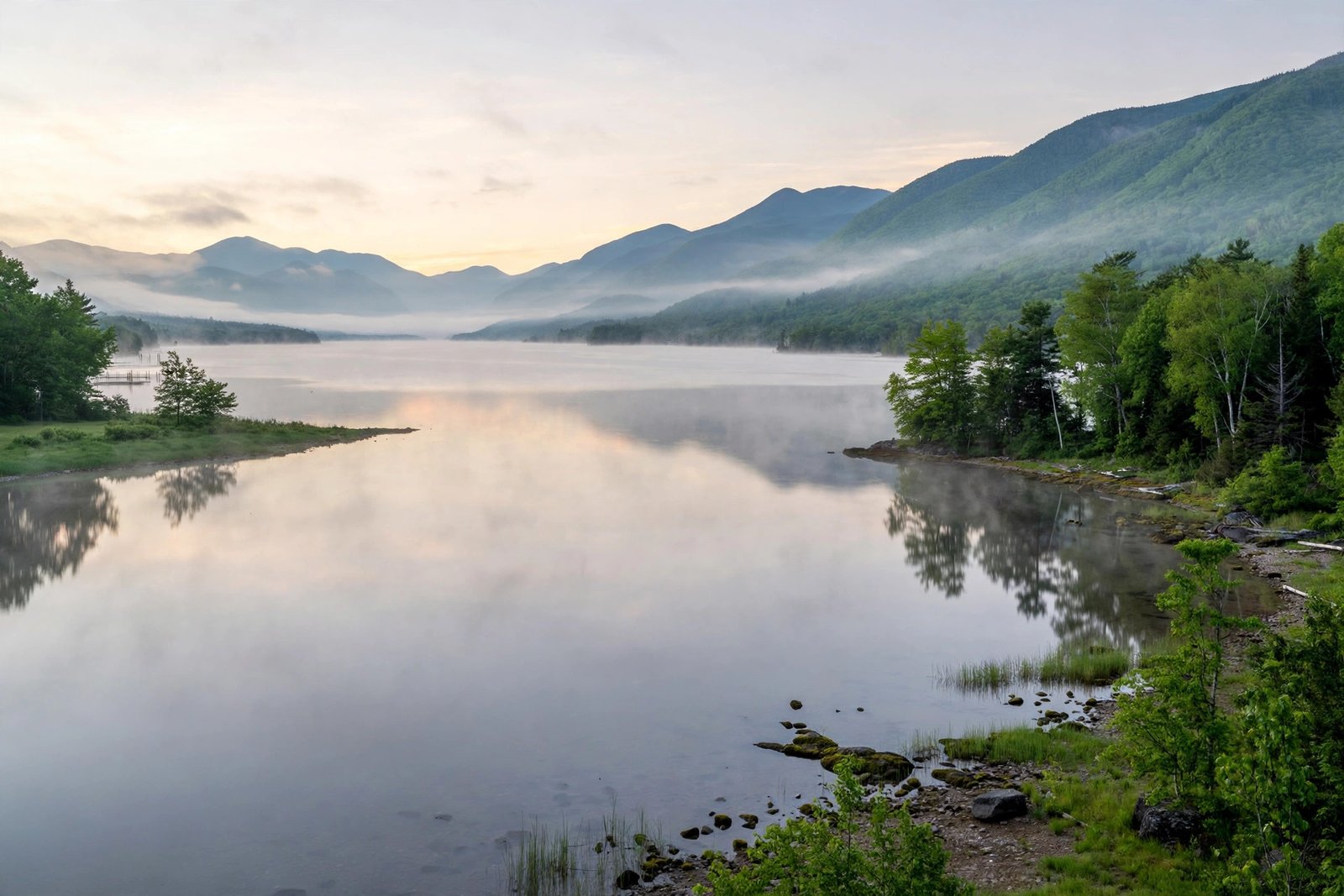
On a calm morning on Lake Champlain, the water can look deceptively ordinary. Then someone swears they see something else: a long neck rising above the surface, a row of humps rolling through a wake, or a dark shape moving too steadily to be a wave. For more than two centuries, those moments have kept one name alive on the border between Vermont and New York: Champ, the legendary monster said to live in Lake Champlain.
Lake Champlain stretches about 125 miles between New York and Vermont, with a small portion reaching into Quebec, Canada. It has long been a working waterway for trade, travel, and war, as well as a place for fishing, sailing, and summer holidays.
It is important to say this plainly at the start. There is no scientific proof that Champ exists. What exists is folklore, eyewitness reports, a famous photograph, and a lively debate about what those reports might really show. This article tells the legend as it has been told, separates claims that can be checked from those that cannot, and looks at what researchers say is most likely behind the sightings. The mystery is real as a cultural story even if the monster itself remains unproven.
The Native roots of the legend
Long before European settlers arrived, Indigenous peoples of the Champlain Valley told stories of a great serpent in the lake. The Abenaki spoke of Gitaskog, a horned or great serpent, and Iroquois traditions included a giant snake known as Onyare’kowa. In many Indigenous traditions, powerful beings in the landscape carried spiritual meaning, marking places of respect, danger, or creation, and the lake itself was central to travel, food, and community life.
The Samuel de Champlain story: a famous claim that does not hold up
Ask almost anyone about Champ’s origin and you will hear that French explorer Samuel de Champlain, for whom the lake is named, saw the monster in 1609. It is a wonderful story, and it appears in countless tourist brochures. According to researchers who have checked the original sources, however, it is not true.
The claim traces back to a 1970 article in Vermont Life magazine, which quoted Champlain as describing a serpent about twenty feet long, thick as a barrel, with a head like a horse. There is no evidence in Champlain’s own journals that he wrote those words. What Champlain did describe, in a passage later translated in 1878, was a large fish with a long snout and sharp teeth, shown to him by Indigenous guides. Historians identify that fish as the longnose gar, Lepisosteus osseus, a striking native fish that can grow more than six feet long, with silver-grey scales and a tooth-filled snout that looks strange to anyone seeing it for the first time.
1819: Captain Crum and the first newspaper monster
The first widely circulated newspaper account of a Lake Champlain monster appeared in the Plattsburgh Republican in July 1819, under a headline about the “Cape Ann Serpent on Lake Champlain.” According to the report, a man known as Captain Crum, aboard a scow on Bulwagga Bay near Port Henry, New York, saw a black, serpent-like creature that he estimated at about 187 feet long, with a head resembling a sea horse, three teeth, eyes the color of a peeled onion, a white star on its forehead, and a belt of red around its neck.
Those details should immediately raise questions. A 187-foot animal would be longer than most whales and far larger than anything that could plausibly live unnoticed in a freshwater lake. The vivid details — the star, the red belt, the onion-colored eyes — read more like a tall tale than a careful natural-history observation. Yet the account matters because it set the template: a named witness, a specific bay, a dramatic description, and a newspaper willing to print it. Bulwagga Bay would later be called Champ’s home base, and Port Henry would embrace the creature as a local icon.
1873: the year Champ went national
If 1819 introduced Champ to print, 1873 made the creature famous. That summer brought a cluster of reports that pushed the legend into national newspapers. A New York Times account described a railroad crew seeing an enormous serpent with bright, silvery scales glistening in the sun. In July, Clinton County Sheriff Nathan H. Mooney reported an enormous snake or water serpent he estimated at 25 to 35 feet long. In August, passengers aboard the steamship W.B. Eddy said the vessel struck something large in the water, nearly turning the boat, according to tourist accounts retold in later histories.
Showman P. T. Barnum saw an opportunity. In 1873, and again in 1887 according to several histories, Barnum offered a large reward for the creature, often reported as $50,000 in 1873 for its hide for his World’s Fair show, with other accounts citing $20,000 for capture dead or alive. The exact figure varies between retellings, which is itself a useful warning about how Champ stories change as they are copied. What is not in doubt is Barnum’s interest: a monster, real or not, was good publicity, and his reward ensured newspapers kept writing about Champ.
1977: the Mansi photograph
The most famous single piece of Champ evidence is a photograph taken by Sandra Mansi in the summer of 1977, while she was vacationing with her family near St. Albans, Vermont. The image appears to show a long neck and small head rising from the water, with humps behind it. Published years later, including in the New York Times in 1981 according to regional histories, it became the defining image of Champ and remains the picture most people think of when they hear the name.
Enthusiasts point out that the photograph has never been conclusively proven to be a hoax, and some examinations found no obvious signs of tampering. Skeptics point to a serious problem: the bay where the photograph was reportedly taken is shallow, no deeper than about 14 feet in places, which makes it an unlikely hiding place for a giant animal. Investigator Joe Nickell and others have argued that a creature of the size suggested could hardly swim, let alone hide, in such shallow water. Without the original negative and a precisely confirmed location, researchers have said it is impossible to determine with certainty what the photograph shows.
The Mansi photograph therefore sits in the same frustrating middle ground as much Champ evidence: intriguing, widely reproduced, and ultimately inconclusive. It could show a living animal, a floating object, or a trick of light and water. What it does not do, on its own, is prove that an unknown species lives in Lake Champlain. Honest accounts of Champ must keep that distinction clear, even when the photograph itself is genuinely striking.
Underwater sounds and modern searches
In 2003, researchers from the Fauna Communications Research Institute recorded underwater sounds in Lake Champlain as part of a Discovery Channel program. The team described sounds similar to those produced by beluga whales or dolphins, animals not known to live in the lake. A later scientific write-up suggested the sounds resembled a form of echolocation. Believers cited the recordings as fresh evidence that something large and unknown was communicating beneath the surface.
Skeptical researchers urge caution here too. Lakes are noisy places, full of boat engines, fish, shifting ice, and water movement, and unusual sounds do not automatically point to an unknown animal. No animal was seen making the sounds, no matching visual evidence was captured at the same time, and no follow-up survey has produced a specimen or a repeatable detection of the same source. The recordings are interesting, but they are not identification. Unexplained and supernatural are not the same thing — the first simply means researchers have not yet pinned down a cause. Modern sonar scans, drone footage claims, and organized watches have likewise produced no verified discovery, even though the lake is heavily fished, boated, and studied.
What researchers say Champ probably is
Most scientists and skeptical investigators who have examined Champ reports favor ordinary explanations, and they are refreshingly specific about them. The leading candidates are large native fish, especially lake sturgeon and longnose gar. Sturgeon can grow to impressive sizes, with ridged, armored bodies that can look serpent-like when they roll at the surface. Gar have long snouts, sharp teeth, and an ancient appearance. A large gar or sturgeon seen briefly, at a distance, in choppy water could easily be misread as something stranger.
Other explanations include waves and wakes that form lines of humps, floating logs, swimming deer or otters seen in sequence, and optical illusions caused by light, distance, and expectation. People who have just heard a Champ story, or who are actively looking for Champ, are more likely to interpret an ambiguous shape as the monster. That is not an accusation of lying. Human perception fills in gaps, especially over water, where size and distance are hard to judge and where a witness has only seconds to make sense of a moving shape.
Some enthusiasts propose that Champ could be a surviving plesiosaur or another prehistoric reptile. Researchers reject that idea for a straightforward reason: Lake Champlain itself is only about 12,000 years old, formed as glaciers retreated, so it cannot have sheltered a dinosaur-era survivor continuously since prehistoric times. A small, isolated population of giant reptiles would also need food, mates, and a way to remain undetected by modern science — a combination that strains belief far more than the fish-and-waves explanation.
Champ today: protection, tourism, and local pride
Whether or not Champ exists, Champ matters to the region. Vermont passed a resolution protecting Champ in the early 1980s, and New York’s legislature followed with its own measure, in a playful but telling sign of how seriously local communities take their monster. Port Henry, New York, has embraced Champ with a statue and a “Big Board” of sightings, and Burlington and Plattsburgh both use the legend to draw visitors. Champ has appeared as the mascot of the Vermont Lake Monsters baseball team, on T-shirts and mugs, and in children’s books, including the story behind the film project Lucy and the Lake Monster, reported in 2022.
That tourism layer is part of the legend now, and visitors should enjoy it for what it is: a celebration of local identity, storytelling, and the lake itself. The best way to “hunt” for Champ is also the best way to enjoy Lake Champlain — by getting out on the water responsibly, visiting lakeside towns, learning about the lake’s real ecology and history, and keeping an eye on the horizon. If you see something odd, photograph it carefully, note the time, location, and conditions, and share it with local naturalists. Even if it turns out to be a sturgeon, you will have seen something genuinely remarkable. Champ endures because the story honors older traditions, preserves a colorful newspaper history, gives a region a shared mascot, and keeps alive a very human question: what else might be out there, just below the surface, that we have not yet understood? Science has not found a monster in Lake Champlain, but the lake still rewards anyone willing to look closely — and that, for most visitors, is mystery enough.
Frequently Asked Questions
Is Champ real?
There is no scientific proof that Champ exists. More than 300 sightings have been reported over the years, but none has produced a specimen, clear multi-angle video, or other verifiable evidence of an unknown species. Researchers generally explain sightings as misidentified fish, waves, logs, or optical illusions.
Did Samuel de Champlain really see Champ in 1609?
Almost certainly not. The famous 1609 quote traces to a 1970 magazine article, not to Champlain’s journals. Champlain’s own description matches a longnose gar, a large native fish with a long, toothy snout, rather than a lake monster.
What is the most famous Champ evidence?
The 1977 Mansi photograph, taken near St. Albans, Vermont, which appears to show a long neck rising from the water. It has never been conclusively proven to be a hoax, but it has also never been verified as a monster, and skeptics note the shallow water where it was reportedly taken.
What do scientists think people are seeing?
Most often, large fish such as lake sturgeon and longnose gar, along with waves, floating debris, and animals seen briefly at a distance. Size and distance are difficult to judge over open water, which makes misidentification easy.
Where is the best place to learn about Champ?
Port Henry, New York, on Bulwagga Bay, is often called Champ’s home base and has a statue and a sightings board, while Burlington, Vermont, and Plattsburgh, New York, both celebrate the legend. The lake itself, its museums, and its lakeside towns offer the fullest picture of the folklore and the real natural history behind it.