
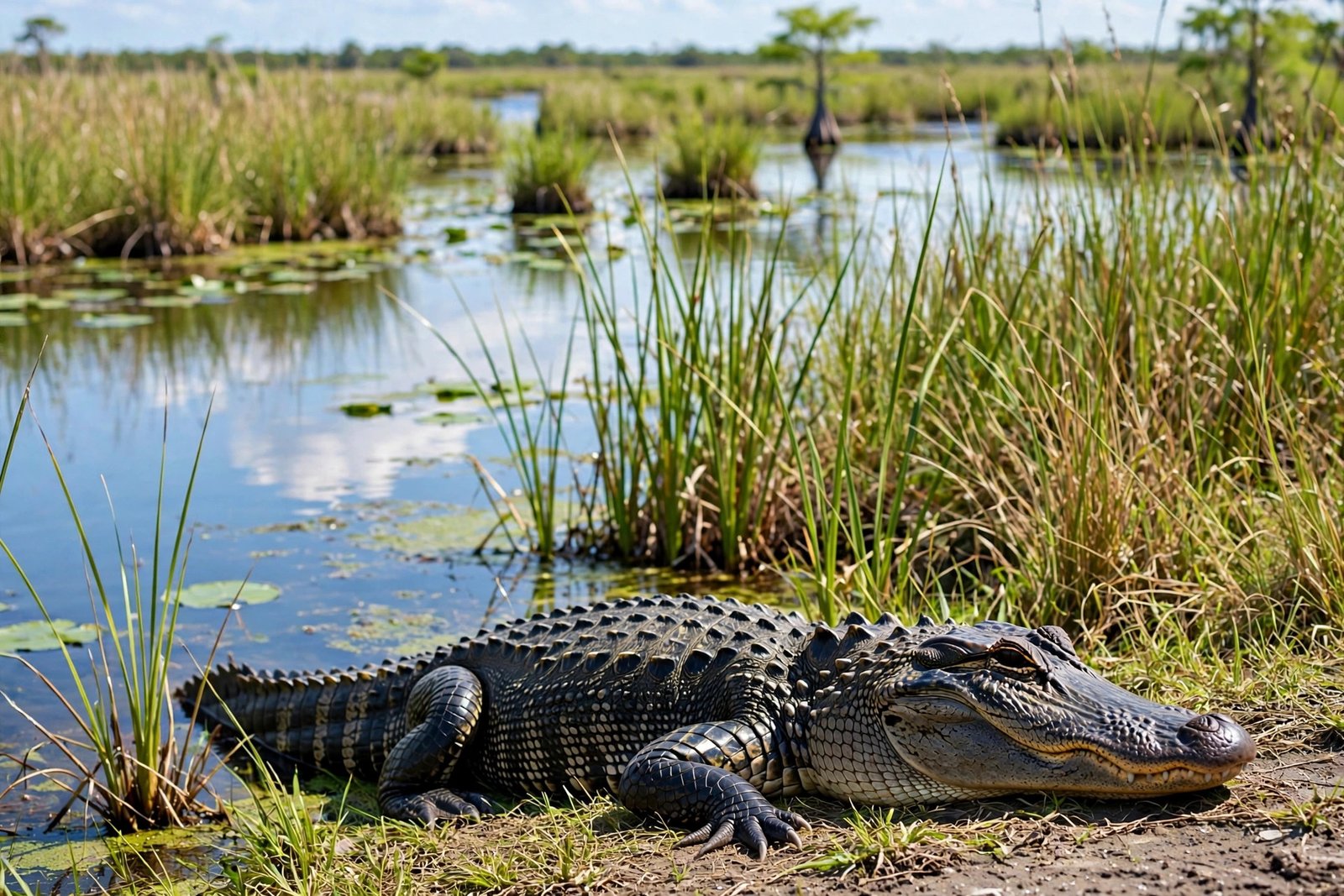
Few sights say Everglades like an American alligator basking on a muddy bank, eyes and nostrils just above the waterline, perfectly still in the sun. The American alligator, Alligator mississippiensis, is the Everglades’ most famous resident, and for good reason: it is a powerful predator, a devoted parent, and an engineer whose digging shapes the wetland itself. Yet the animal most visitors see lounging beside a boardwalk is also a survivor, brought back from the edge of extinction by decades of protection.
This guide explains where alligators live in the Everglades, how they behave through the seasons, how their comeback happened, and how to watch them safely. The facts here draw on the National Park Service, the Florida Fish and Wildlife Conservation Commission, the Smithsonian’s National Zoo, and the University of Florida extension service, so you can enjoy these remarkable reptiles with confidence and respect.
An Everglades native at the southern edge of its range
Everglades National Park sits at the southern extreme of the American alligator’s range, which stretches across the southeastern United States from North Carolina to Texas. Within the park, alligators primarily inhabit freshwater swamps and marshes, and they can also be found in rivers, lakes, and smaller bodies of water. They tolerate brackish water for short periods, especially around mangrove swamps, even though they lack the salt-secreting glands that true crocodiles possess. That freshwater preference is one easy way to tell the two species apart in South Florida, the only place in the United States where alligators and American crocodiles both live in the wild.
Alligators are ectotherms, meaning they rely on their surroundings for warmth rather than generating their own body heat. That is why basking matters so much: an alligator sprawled in the sun is not lazy or tame, it is regulating its temperature. In cold weather they become dormant, sheltering in dens they have burrowed into banks, and in dry conditions they use those same dens to wait out falling water. Even outside their dens, the Park Service notes, they can tolerate limited periods of freezing conditions, a toughness that surprises many first-time visitors.
Alligator holes: the wetland’s life-support system
The alligator’s most important Everglades habit is also its least visible. During the dry season, alligators excavate and maintain depressions known as alligator holes, using their snouts and tails to clear mud and peat. These holes retain water long after surrounding marshes have dried, becoming refuges for fish, turtles, snakes, wading birds, and countless smaller creatures. When the rains return, animals disperse from these pockets back across the wetland, carrying the food web with them.
That is why scientists call the American alligator a keystone species in the Everglades. Remove the alligator, and the whole system shifts: dry-season refuges shrink, nesting sites disappear, and species that depend on those pockets struggle. Female alligators also shape the landscape through nesting. They build mound nests of vegetation, sticks, leaves, and mud above the water level, because flooding can kill most eggs within about twelve hours of submergence. Several turtle species, including the Florida red-bellied turtle, even incubate their eggs inside active or abandoned alligator nests, borrowing the warmth and elevation the mother alligator created.
What alligators eat, and when they hunt
Alligators are opportunistic carnivores, and their menu changes as they grow. Juveniles eat insects, small fish, frogs, and other small invertebrates. Adults take fish, turtles, birds, small mammals, and other reptiles, including smaller alligators. They hunt mostly at night, from dusk to dawn, and they are astonishingly patient, waiting motionless for prey to come within range before striking with jaws strong enough to crack a turtle’s shell.
Feeding is governed by water temperature. The Park Service reports that foraging ceases when water temperature drops below about 68 to 73 degrees Fahrenheit, which is why alligators seem so quiet on cool winter days. They are also built for a life split between water and land. In water they propel themselves with powerful side-to-side sweeps of the muscular tail, aided by partially webbed feet. On land they walk with their legs beneath their bodies, and they can move in a short, surprising burst when startled — one more reason never to assume a still alligator is a harmless one.
Family life: nests, mothers, and hatchlings
Mating season runs from mid-April through the warmer months, and females take unusual care for a reptile. After building her mound nest, a mother alligator guards it against raccoons, large fish, birds, and even other alligators, especially large dominant males. When the eggs hatch, she may carry the tiny hatchlings to the water in her mouth, a gentle image that surprises people who only know alligators as predators. The young stay close to their mother for protection during their most vulnerable stage, often for about a year and sometimes longer.
That protection is badly needed. The Smithsonian’s National Zoo notes that a large share of young alligators fall victim to predators such as birds, raccoons, bobcats, otters, snakes, large bass, and larger alligators. Once an alligator reaches about four feet long, it is largely safe from predators other than humans and occasionally other alligators. Adults show the opposite pattern of the hatchlings: females average about 8.2 feet long and males about 11.2 feet, according to the Smithsonian, with exceptionally large males reaching nearly half a ton. In the wild, alligators can live around 50 years, and they may go through thousands of teeth in a lifetime as worn teeth are replaced.
A conservation comeback, from endangered to least concern
The alligator’s recovery is one of America’s great wildlife success stories. By the mid-twentieth century, hunting for hides and meat, combined with habitat loss, had severely depleted populations across the Southeast. The species was placed on the federal endangered species list in 1967, and protections under the Endangered Species Act of 1973 banned trafficking in hides. With hunting controlled, habitat protected, and populations monitored, numbers rebounded so strongly that the alligator was removed from the endangered list in 1987.
Today the International Union for Conservation of Nature lists the American alligator as Least Concern, and the National Wildlife Federation notes that the main threat now is habitat loss from wetland drainage and development rather than hunting. The legal picture carries a quirk worth knowing: the alligator remains listed as threatened under U.S. law only because it closely resembles the genuinely threatened American crocodile, which helps officers enforce protections for the crocodile. That “similarity of appearance” listing is a sign of success, not danger — the alligator itself is thriving, even as its wetland home faces pressure from development, water management, and pollution.
Where to see alligators in the Everglades
For most visitors, the best alligator viewing is also the easiest: the park’s boardwalks and tram roads. The Anhinga Trail at Royal Palm is a short, paved boardwalk over sawgrass marsh and freshwater slough, where alligators, turtles, herons, and anhingas are often visible at close but safe range. Shark Valley, on the park’s northern side, offers a long loop road popular with cyclists and tram riders, where alligators bask beside the path and slide into canals as you pass. Both spots concentrate wildlife because water, sun, and shelter meet there, and both reward slow, quiet walking and a good pair of binoculars.
Timing matters. Alligators are most active in warm weather and in the morning and late afternoon, when they bask and move between water and bank. The dry season, roughly winter into spring, is often the best viewing season because falling water concentrates fish and wildlife into sloughs, canals, and alligator holes, bringing predators and prey into the open. The wet season, typically May through November, brings lush growth, afternoon storms, and mosquitoes, but alligators are still present and often visible near trails and waterways. Whatever the season, check current park advisories before you go, since trail closures and water levels change.
Watching safely: the rules that protect you and the alligator
The National Park Service rule is simple and non-negotiable: keep a safe and respectful distance of at least 15 feet from alligators and crocodiles, and remember that if an animal is hissing, you are too close even beyond that distance. A motionless alligator is alive, alert, and capable of reacting lightning fast. Touching an alligator is never a good idea, and feeding or harassing wildlife — including throwing objects at an animal — is a criminal offense that carries a fine. Park safety guidance also warns that swimming and snorkeling are prohibited in canals, ponds, freshwater lakes, marked channels, and boat basins inside the park.
The Florida Fish and Wildlife Conservation Commission gives the same message for the state as a whole: keep a safe distance, never feed an alligator, keep pets on a leash and away from the water’s edge, and swim only in designated swimming areas during daylight hours. Feeding is the most dangerous habit of all, because fed alligators lose their natural wariness and learn to associate people with food, which is why the Park Service notes that most attacks on humans are attributed to illegal feeding. Serious injuries remain rare, but they are almost always preventable. Keep small children close and supervised near water, keep dogs leashed and well back from the shoreline since small dogs can resemble prey, and never approach a nest or a group of hatchlings — the mother is almost certainly nearby and will defend them.
If you see someone feeding an alligator, or if you believe an alligator poses a threat to people, pets, or property, call the FWC Nuisance Alligator Hotline at 866-FWC-GATOR (866-392-4286). The agency generally considers an alligator a nuisance if it is at least four feet long and believed to pose a threat, and it will dispatch a contracted trapper. An alligator simply basking in its natural habitat, on the other hand, is not a problem to report — it is the Everglades working exactly as it should. Give it space, take your photograph from the boardwalk, and let it be wild.
Frequently Asked Questions
Are alligators dangerous to visitors?
Alligators are wild predators and must be treated with respect, but human conflicts are rare and generally not serious, according to the National Park Service. Most attacks are linked to illegal feeding, which makes alligators bolder and less wary. Keeping at least 15 feet away, never feeding them, and supervising children and pets near water keeps the risk very low.
What is the difference between an alligator and a crocodile?
The American alligator is darker, broader-snouted, and far more common in the Everglades, living mainly in freshwater marshes and sloughs. The American crocodile has a narrower, triangular snout and lighter, greyish-green coloring, and favors coastal, brackish, and salt water around Florida Bay. South Florida is the only place in the United States where both species live in the wild.
When is the best time to see alligators in the Everglades?
Warm mornings and late afternoons are best, and the dry season often offers the most concentrated viewing as falling water gathers wildlife into sloughs, canals, and alligator holes. Alligators can be seen year-round, but they are quieter and less active when water temperatures drop below about 68 degrees Fahrenheit.
How big do Everglades alligators get?
On average, adult females reach about 8.2 feet and adult males about 11.2 feet, according to the Smithsonian’s National Zoo, with exceptionally large males approaching half a ton. Alligators in the Everglades, at the southern edge of the range, tend to run smaller than the largest animals found farther north.
What should I do if I see an alligator near a trail?
Stay on the trail, keep at least 15 feet away, and enjoy it from there with binoculars or a zoom lens. If it hisses, back away calmly and add distance. Never feed, touch, or throw anything at it, keep pets leashed and away from the water, and call the FWC Nuisance Alligator Hotline at 866-FWC-GATOR if the animal appears to pose a genuine threat. Learn more from the Smithsonian’s alligator profile, the National Wildlife Federation, and the University of Florida extension guide to living with alligators.