
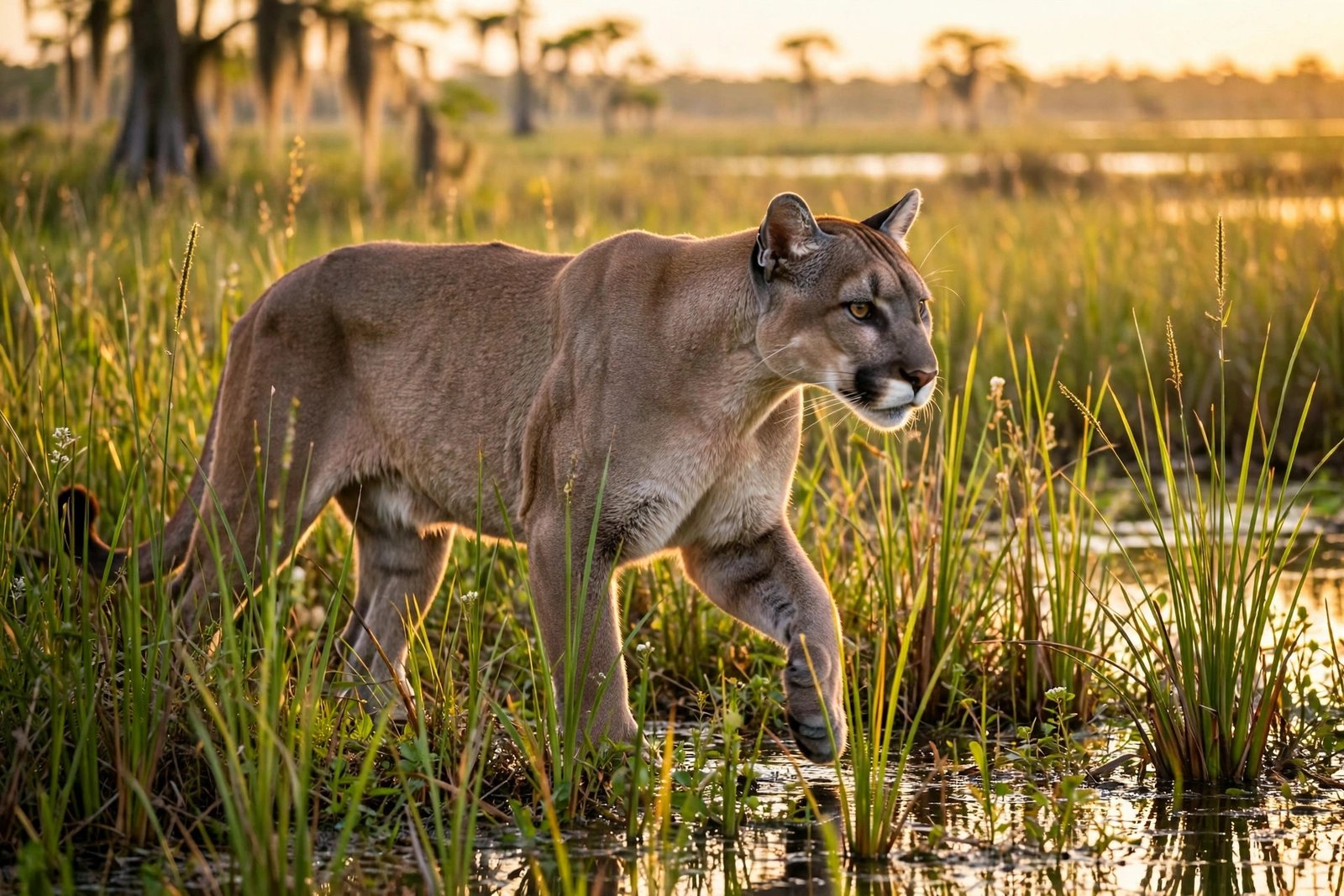
Somewhere in the sawgrass and cypress of South Florida, a tawny ghost is moving through the dark. You will almost certainly never see it. Trail cameras catch it, biologists track it by radio collar, and drivers glimpse it for a heartbeat at the edge of a highway. The Florida panther is the rarest big cat in America, a cougar that lives nowhere else on Earth. Fifty years ago, there were so few left that scientists openly wondered whether the animal was already finished. Today the cats are back in numbers that would have seemed impossible in the 1970s, yet they remain endangered, hemmed into a fraction of their old range by roads, suburbs, and rising seas. This is how the Florida panther nearly vanished, the bold gamble that saved it, and what it will take to finish the job.
What Is a Florida Panther?
The Florida panther is a population of North American cougar, also known as a puma or mountain lion, that lives in South Florida. Its scientific name is Puma concolor coryi, and it is the only confirmed breeding population of cougars in the eastern United States. Cougars once roamed from coast to coast, but hunting, trapping, and habitat loss wiped them out of the East more than a century ago. The Florida cats are the survivors, the last eastern branch of a species that still thrives out West.
An adult male typically weighs around 100 to 160 pounds, while females are smaller, usually 60 to 100 pounds. They stand about two feet tall at the shoulder and can stretch six to seven feet from nose to tail tip. Kittens are born with dark spots that fade as they grow. Unlike the big cats of Africa and Asia, panthers cannot roar. They communicate with chirps, whistles, growls, and a high-pitched scream that has startled more than one camper in the Big Cypress swamp.
Panthers are solitary by nature. Adults live alone, coming together only to mate, and mothers raise their kittens on their own for well over a year. Each cat needs a huge amount of room: a male’s home range runs to roughly 200 square miles, while a female uses about 75 square miles. That appetite for space is the central fact of panther conservation. Saving the cat means saving enormous, connected stretches of wild Florida.
How the Panther Nearly Vanished
The Florida panther once ranged across the entire southeastern United States, from Florida through Georgia, Alabama, Mississippi, and Louisiana, and into parts of Arkansas, Tennessee, and South Carolina. Today it occupies roughly 5 percent of that historic range. The collapse was fast, and it was entirely human-made.
For much of the 19th and early 20th centuries, panthers were treated as vermin. Florida paid bounties on them, and hunters, ranchers, and settlers shot them on sight. At the same time, the forests and wetlands the cats depended on were drained, logged, and carved into farms and towns, and the deer and wild hogs that panthers hunt declined as their own habitat shrank. By the time the panther was listed as endangered in 1967, the population was already a shadow of itself.
The low point came in the 1970s, when biologists estimated that only 20 to 30 panthers remained in the wild, confined to the swamps and forests of southwest Florida. The cats that remained showed the damage in their bodies: many had a dramatic kink in the tip of the tail and a whorled cowlick of fur on the middle of the back. Beneath those quirks were more serious problems, including heart defects, undescended testes in males, poor sperm quality, and weakened immune systems. The population was not just small. It was sick, and the sickness was written into its genes.
Federal protection helped. The Endangered Species Act of 1973 made it illegal to harm or harass a panther, and the first Florida Panther Recovery Plan, approved in 1981, gave state and federal agencies a shared framework for research and habitat protection. The Florida Panther National Wildlife Refuge was established in 1989, protecting more than 26,000 acres of prime habitat. But protection alone could not fix the genetic problem: the cats were too few and too closely related.
The Bold Gamble of 1995: Eight Texas Cougars
In 1995, wildlife managers made one of the most daring decisions in American conservation history. They released eight female cougars from Texas into South Florida panther habitat. The idea, known as genetic rescue, was simple and controversial in equal measure: bring in fresh genes from a closely related population, let the newcomers breed with the inbred Florida cats, and give the next generation a healthier genetic starting point.
Texas cougars were chosen deliberately. The historic ranges of the two populations once met, and they had exchanged genes before settlement cut them apart, so the Texas cats were the closest living relatives available. Some scientists worried the newcomers’ genes could swamp the Florida cats’ unique local ancestry, and others questioned whether mixing populations was legal under the Endangered Species Act. After years of debate, the agencies went ahead.
The results were remarkable. Five of the eight Texas females bred in the wild, producing a dozen litters, and their kittens appeared free of the defects that had plagued the Florida cats. The Texas females were eventually removed from the wild, the last of them by 2003. A landmark study published in the journal Science in 2010 found that the panther population had roughly tripled, genetic diversity had roughly doubled, and the signs of inbreeding had fallen sharply.
A genomic study published in the Proceedings of the National Academy of Sciences in 2025 checked the long-term results and found the rescue had worked without erasing the Florida cats’ local ancestry. The Texas genes reduced the harmful effects of inbreeding, mainly by breaking up pairs of harmful recessive variants, rather than by replacing Florida DNA. The researchers warned the benefits might fade over time without continued management, a reminder that genetic rescue was a treatment, not a cure.
Where Panthers Live Today
Today’s Florida panthers are concentrated in southwest Florida, south of Lake Okeechobee and mostly south of the Caloosahatchee River, a natural barrier few cats have crossed. The Florida Fish and Wildlife Conservation Commission (FWC), which runs the state’s panther program, estimates the population at roughly 120 to 230 adult and subadult panthers, a fivefold increase from the low point of the 1970s, and relatively stable in recent years.
The cats live in a mosaic of habitats that defines wild South Florida: pine flatwoods, tropical hardwood hammocks, cypress swamps, freshwater marshes, and sawgrass prairies. Big Cypress National Preserve, which covers about 720,000 acres, holds one of the largest concentrations of panthers. The Florida Panther National Wildlife Refuge protects more than 26,000 acres of prime habitat next door. Everglades National Park, Fakahatchee Strand Preserve State Park, and Picayune Strand State Forest all hold cats too, and panthers have been documented across much of the Florida peninsula and even into Georgia, though the breeding population remains anchored in the south.
A Day in the Life of a Panther
Panthers are most active at dawn and dusk, the hours when their prey is moving and the Florida heat is bearable. They are ambush hunters, using cover and stealth rather than speed over distance. A panther will stalk a deer through palmetto and pine, freeze, and then explode into a short sprint, killing with a bite to the neck. White-tailed deer are the main prey, along with wild hogs, raccoons, armadillos, and smaller mammals. A study from the University of Georgia found that panthers are now the main cause of death for white-tailed deer in southwest Florida, a sign that the cats have reclaimed their role as the region’s top predator. Females give birth to one to four kittens in a secluded den, and the young stay with their mother for well over a year. Seeing a panther in the wild is rare, and that is by design: the cats are secretive, mostly nocturnal, and deeply wary of people.
The Threats That Remain
For all the progress of the past thirty years, the Florida panther is still endangered, and the threats it faces have not gone away. They have changed shape, and in some ways they have grown.
Vehicle collisions are the leading cause of panther deaths. In 2024, state wildlife officials documented 36 panther deaths, the highest annual toll since 2016, and 30 of them were killed on roads. The numbers swing from year to year, but the pattern is steady: as Florida grows and more roads cut through panther habitat, more cats die on them. Young dispersing males are hit most often, which is doubly damaging because those are exactly the cats the population needs to expand its range.
Habitat loss is the slower, deeper threat. Florida is one of the fastest-growing states in the country, and every new subdivision, shopping center, and highway takes a bite out of the connected wild lands panthers need. In April 2026, conservation groups sued the U.S. Fish and Wildlife Service and the U.S. Army Corps of Engineers over a 10,264-acre residential and commercial development called Rural Lands West in Collier County, arguing that the agencies violated the Endangered Species Act by approving it in occupied panther breeding habitat near the Florida Panther National Wildlife Refuge. Disease adds risk too: state officials are investigating a spinal disorder called feline leukomyelopathy in some panthers and bobcats. And sea level rise looms over everything, with the U.S. Fish and Wildlife Service projecting tides could rise by as much as half a meter by 2040, flooding roughly 11 percent of panther habitat.
Roads, Crossings, and the Wildlife Corridor
If there is a hopeful chapter in the panther’s recent story, it is written in concrete and fencing. The model is Alligator Alley, the stretch of Interstate 75 that cuts across South Florida through prime panther habitat. When the highway was rebuilt in the early 1990s, the Florida Department of Transportation added 24 wildlife underpasses, 12 modified bridges, and continuous wildlife fencing along 40 miles of road. Researchers have documented panthers, bobcats, deer, and black bears all using the crossings.
Florida now has about 60 wildlife crossings and bridges in operation. A crossing on State Route 29 at Owl Hammock, one of the deadliest stretches of road for panthers, cost 8.67 million dollars, and Florida’s first wildlife overpass, spanning Interstate 4 near Lakeland, is scheduled to open in 2027. Crossings work best when they connect large, protected landscapes, and that is the idea behind the Florida Wildlife Corridor, a statewide network of connected natural lands. The corridor also depends on private landowners: a Panther Payment for Ecosystem Services pilot program pays ranchers to keep their land wild and connected and to host cameras that help biologists monitor the cats.
What Full Recovery Would Actually Take
The U.S. Fish and Wildlife Service’s recovery plan sets a high bar. Before the cats can be considered recovered and removed from the endangered species list, there must be three viable, self-sustaining populations of at least 240 panthers each, with enough quality habitat to support them long term. Today there is effectively one breeding population, in the southwest, numbering somewhere around 120 to 230 adults. The gap between where the panther is and where recovery demands is the work of the next generation.
Closing that gap means growing the southwest population, establishing a second breeding population north of the Caloosahatchee River, and defending the habitat the cats already have against development, road building, and sea level rise. The Florida panther is not a lost cause and it is not a finished success. It is a species in the middle of a comeback, and the middle is the fragile part. Whether the cats survive the next thirty years of Florida’s growth will depend on decisions made now: where to build, where to leave wild, and how much room Americans are willing to give a cat most of them will never see.
If You See a Panther
Panther sightings should be reported to the Florida Fish and Wildlife Conservation Commission through its panther sightings page or its Wildlife Alert Hotline at 888-404-3922. If you encounter a panther, do not approach it and do not run. Face the animal, make yourself look large, make noise, and back away slowly. Drive carefully through panther habitat, especially at dawn, dusk, and night.
FAQ
How many Florida panthers are left?
The Florida Fish and Wildlife Conservation Commission estimates roughly 120 to 230 adult and subadult panthers are left in the wild, up from an estimated 20 to 30 in the 1970s. The species remains listed as endangered.
Are Florida panthers dangerous to people?
Panthers are not usually aggressive toward people and attacks are extremely rare. If you encounter one, face it, make yourself look big, make noise, and back away slowly. Never run, and never approach a panther or its kittens.
Where do Florida panthers live?
Panthers live mostly in southwest Florida, south of Lake Okeechobee and the Caloosahatchee River. Strongholds include Big Cypress National Preserve, the Florida Panther National Wildlife Refuge, Everglades National Park, and Fakahatchee Strand Preserve State Park.
What do Florida panthers eat?
White-tailed deer are the main prey, along with wild hogs, raccoons, armadillos, and other small mammals. Panthers are ambush hunters, and research has found they are now the main cause of death for white-tailed deer in southwest Florida.
Why did Texas cougars save the Florida panther?
By the 1990s, the tiny Florida population was suffering from inbreeding, with kinked tails, heart defects, and low fertility. In 1995, managers released eight female Texas cougars, close relatives whose ancestors had once interbred with Florida cats. Five of the eight bred, and the kittens were healthier. A 2025 genomic study confirmed the rescue reduced harmful inbreeding effects without erasing the Florida cats’ local ancestry.
Related Reading
More Florida wildlife and American comeback stories on Famus News:
- American Alligator: Everglades Wildlife Guide
- Florida Manatee Season Guide
- Bald Eagle Comeback: A Conservation Success Story
Sources: Florida panther, Wikipedia; UF/IFAS, Wildlife Watch: Florida Panther Breeding Season; Discover Magazine, The Daring Ploy That Saved the Florida Panther; Phys.org, Genetic Rescue Reduces Harmful Mutations in Florida Panthers; Environment America, Constructing a Lifeline for Florida Panthers; Business Observer, Trail Cameras Help Protect Florida Panthers; Center for Biological Diversity, Lawsuit Seeks to Protect Endangered Florida Panthers.