
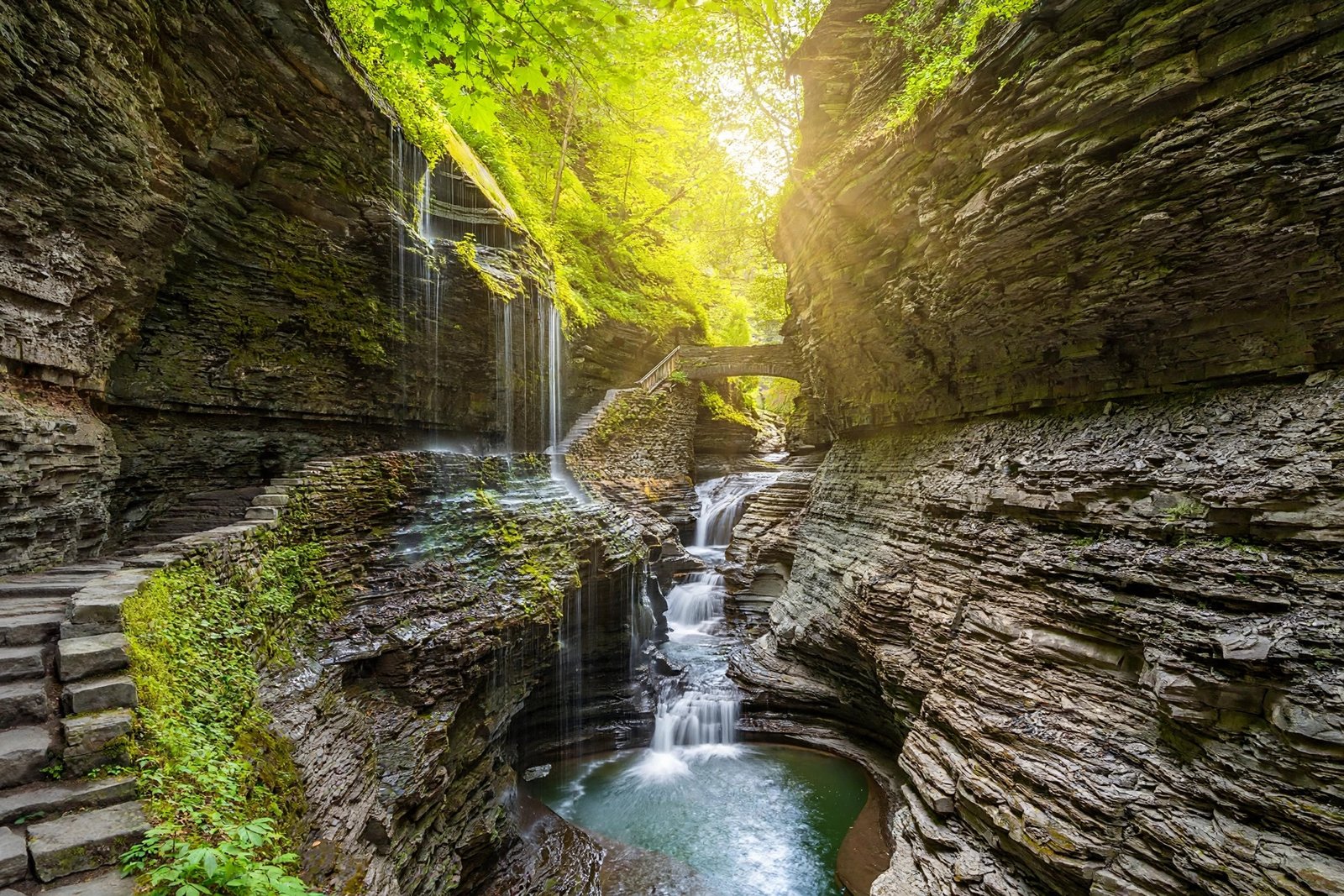
There is a place in upstate New York where a village main street ends and a fairy-tale canyon begins. Walk past the last storefront in Watkins Glen, step through a stone tunnel, and suddenly you are inside a 400-foot-deep gorge, with water pouring off mossy cliffs on every side and a trail that ducks behind waterfalls, spirals through tunnels carved into solid rock, and climbs more than 800 stone steps. That is Watkins Glen State Park, and once you have walked it, you will understand why New York State Parks calls it the most famous of the Finger Lakes State Parks.
The park sits at the southern tip of Seneca Lake, in the heart of New York’s Finger Lakes region, and its centerpiece is one of the most concentrated waterfall walks in America. In just about two miles, Glen Creek drops 400 feet past 200-foot cliffs, creating 19 waterfalls along its course. For travelers who love waterfalls, gorges, and the kind of scenery that makes you stop mid-sentence, Watkins Glen is one of New York’s great hidden gems, hiding in plain sight.
What Makes Watkins Glen So Special
Plenty of parks have a waterfall or two. Watkins Glen has 19 of them packed into a single trail, and that density is what makes it extraordinary. The Gorge Trail is not a long, punishing hike to a single payoff at the end. It is a steady sequence of payoffs, one after another, so the wonder never has time to wear off. You cross arched stone bridges over foaming pools, you walk through the spray of Cavern Cascade, you pass under Rainbow Falls while sunlight turns the mist into color, and you climb the Spiral Tunnel, a stone staircase that corkscrews up through the rock itself.
The setting helps too. The park covers 778 acres at the southern end of Seneca Lake, the deepest of the 11 Finger Lakes, and the village of Watkins Glen wraps right around the park’s main entrance. It is one of the rare American natural wonders that requires no long drive down a dirt road and no backcountry permit. You simply show up, pay the vehicle fee, and walk into the gorge.
How the Gorge Was Carved: Glaciers, Water, and 12,000 Years
The story of Watkins Glen begins long before there was a park, or even a village. About 400 million years ago, during the Devonian period, this part of New York lay beneath a shallow sea, and layers of sand, silt, and mud settled on the sea floor. Over time those layers hardened into the shale, sandstone, and limestone that now form the gorge walls. Then, much more recently, the ice ages arrived. Glaciers gouged out the deep trough that became Seneca Lake, and when the ice melted, the lake filled the valley while its tributary streams were left hanging high above the new valley floor.
Glen Creek was one of those hanging streams, and for roughly 12,000 years it has been cutting its way down to the lake, eroding the soft shale faster than the harder sandstone and limestone. The result is a staircase of waterfalls, plunge pools, and potholes, each layer of rock creating its own drop.
People have been drawn to the gorge for a long time. The gorge became a tourist attraction in 1863, when a Vermont newspaper editor named Morvalden Ells opened the site to the public and built crude wooden bridges, stairs, and railings so ordinary visitors could walk through it. In 1906, New York State bought the property and Watkins Glen became one of the state’s earliest state parks. In the 1930s, the Civilian Conservation Corps built the stone walls, bridges, and staircases that still define the trail today, including the famous 832 stone steps.
Walking the Gorge Trail, Waterfall by Waterfall
The Gorge Trail runs about 1.5 to 2 miles one way, from the main entrance in the village up to the upper entrance, climbing more than 800 stone steps along the way. Most visitors walk up through the gorge and then return along one of the rim trails, which makes a loop of roughly three miles. Plan on two to three hours if you like to stop for photos, which you will, constantly. The trail is one-way in spirit if not always in rule: it is narrow, and on busy days the flow of people moves mostly upward, so it is best to start at the main entrance and climb.
Cavern Cascade is the moment everyone remembers. Here the trail passes directly behind the waterfall, so the falling water becomes a moving curtain beside you and the spray cools your face on a hot day.
Just beyond Cavern Cascade, the trail enters the Spiral Tunnel, a stone staircase that winds upward through a tunnel carved into the rock. It is short, dark, and wonderfully disorienting, and when you emerge, the gorge has changed character again, wider and brighter, with the creek spread out below in a series of broad, stair-stepped falls. Rainbow Falls comes next, and on a sunny morning the mist catches the light and throws real rainbows across the gorge. The trail passes behind this waterfall too, and the combination of falling water, sunlight, and spray is the single most photographed spot in the park.
Higher up, Central Cascade drops more than 60 feet in a powerful, twisting plunge, the tallest waterfall in the park. Above it, the Suspension Bridge hangs 85 feet above Glen Creek, a narrow footbridge that sways just enough to remind you where you are. The final climb is Jacob’s Ladder, a long flight of 180 stone steps that lifts you to the upper entrance.
The Rim Trails: A Different View of the Gorge
The Gorge Trail gets all the attention, but the North Rim and South Rim trails deserve a walk too, and they are the reason most visitors make a loop instead of retracing their steps. The rim trails run along the wooded top edges of the gorge, offering wide views down into the canyon and across to the far wall. In autumn, when the maple and oak canopy turns, the rim trails are arguably the prettiest walk in the park.
There is a practical reason to know about the rim trails as well: they stay open all year, from sunrise to sunset, even when the Gorge Trail is closed for the winter. From November to May, the rim trails give you overlooks and forest walks, but no access to the gorge floor or the waterfalls, so set your expectations accordingly.
Best Time to Visit Watkins Glen
The Gorge Trail typically opens in mid to late May and closes in mid to late October, depending on weather and trail conditions. In 2026, the trail closed for the season on October 25 and is scheduled to reopen in mid to late May 2027, so always check the official New York State Parks page before you travel. Within that window, each season offers something different, and the best time depends on what you want from the visit.
Late spring is the classic choice. The snowmelt and spring rains swell Glen Creek, so the waterfalls run at their fullest and most dramatic, and the gorge is at its greenest, with ferns and wildflowers filling every damp crevice. Early mornings in May and June are especially magical: the light slants into the gorge, the mist hangs in the air, and the crowds have not yet arrived. Summer brings warm weather, the fullest park services, and the Olympic-size swimming pool, but it also brings the biggest crowds, so arrive early or visit on a weekday if you can.
Fall is the connoisseur’s season. The Finger Lakes are famous for fall foliage, and the gorge framed in red and gold maple leaves is spectacular. Peak color usually arrives in late September through mid-October, which coincides with the last weeks of the Gorge Trail season, so the timing works beautifully if you plan ahead.
Practical Tips for Your Visit
A few simple choices will make your Watkins Glen visit much better. First, start at the main entrance in the village and walk up. The climb is steady but manageable, and walking up through the gorge means the waterfalls keep getting better as you go. Going the other direction means walking down 800 wet stone steps, which is harder on the knees and much less rewarding.
Second, wear shoes with real grip. The stone steps are beautiful, but they are also smooth and often wet from spray, and the trail narrows in places with low rock overhangs. Sneakers with good tread are fine; flip-flops and smooth-soled shoes are not. Bring a light rain jacket or a waterproof layer even on a sunny day, because the spray at Cavern Cascade and Rainbow Falls will find you, and it is part of the fun.
Third, arrive early. The park opens at dawn, and the first hour or two of the day is when the light is best and the trail is quietest. By midday on a summer weekend, the narrow sections can feel crowded, and parking fills up.
Finally, respect the rules that keep the gorge safe. Pets are not allowed on the Gorge Trail, swimming is not permitted in the gorge waters, and staying on the marked trail is not just polite, it is essential: the cliffs are steep, the rock is slippery, and the gorge has claimed lives over the years.
Camping, Swimming, and Staying Longer
Watkins Glen is more than a half-day hike. The park has a campground with 305 campsites, including tent and trailer sites, some with electric hookups, plus rustic cabins and a group camp. Campsites can be reserved up to nine months in advance through ReserveAmerica, and summer weekends and race weekends at the nearby Watkins Glen International racetrack fill up fast, so book early.
For day visitors and campers alike, the park’s Olympic-size swimming pool is a summer highlight, open from late June through Labor Day, with a kiddie pool alongside it. After a hot climb up Jacob’s Ladder, a swim feels like the perfect ending. The park also has picnic areas, pavilions that can be rented for gatherings, a playground, and excellent fishing in nearby Seneca Lake and Catharine Creek, which is known for its spring run of rainbow trout.
Beyond the Gorge: The Finger Lakes Around Watkins Glen
One of the best things about Watkins Glen is where it sits. The village is at the southern tip of Seneca Lake, the deepest of the Finger Lakes at 632 feet deep, and the lake’s shoreline is lined with wineries. The Seneca Lake Wine Trail counts more than 30 wineries, and the region is especially known for Riesling and Gewürztraminer, cool-climate wines that thrive in the lake-moderated climate. A slow afternoon of tastings after a morning in the gorge is one of the great Finger Lakes days, and the lake views from the winery patios are worth the trip on their own.
Waterfall lovers should also make time for Taughannock Falls State Park, about 30 minutes north near Ithaca. Its namesake waterfall plunges 215 feet, taller than Niagara Falls, past cliffs that tower nearly 400 feet above the gorge. Ithaca itself, home to Cornell University, is about 40 minutes away and offers restaurants, shops, and two more gorge parks, Buttermilk Falls and Robert H. Treman. To the south, the village of Montour Falls is just a few minutes away and has its own roadside waterfall, Shequaga Falls, right behind the Main Street.
FAQ
How long is the Gorge Trail at Watkins Glen?
The Gorge Trail is about 1.5 to 2 miles one way, from the main entrance in the village to the upper entrance, climbing more than 800 stone steps past 19 waterfalls.
When is the Gorge Trail open?
The Gorge Trail typically opens in mid to late May and closes in mid to late October, depending on weather and trail conditions. In 2026 it closed on October 25 and is scheduled to reopen in mid to late May 2027. The north and south rim trails stay open all year, sunrise to sunset, but they offer no access to the gorge floor or waterfalls from November to May.
How many waterfalls are in Watkins Glen State Park?
There are 19 named waterfalls along the Gorge Trail. Glen Creek drops 400 feet through the gorge in about two miles, past 200-foot cliffs, which makes it one of the densest concentrations of waterfalls in the eastern United States.
Is Watkins Glen State Park good for kids?
Yes, with supervision. The Gorge Trail is a popular family hike, and children love walking behind Cavern Cascade and through the Spiral Tunnel. Keep kids close on the narrow sections and the stone steps, which can be wet and slippery, and note that strollers are not practical on the Gorge Trail. The park also has a playground, a pool, and picnic areas for younger visitors.
Can you swim in Watkins Glen gorge?
No, swimming is not allowed in the gorge waters. The creek is fast, the rocks are slippery, and the pools are deceptively deep. Visitors who want to swim can use the park’s Olympic-size swimming pool during the summer season, from late June through Labor Day.
What is near Watkins Glen State Park?
The park sits at the southern tip of Seneca Lake in the Finger Lakes. Nearby highlights include the Seneca Lake Wine Trail with more than 30 wineries, Taughannock Falls State Park about 30 minutes north, the village of Montour Falls a few minutes south, and Ithaca with its Cornell University campus and two more gorge parks about 40 minutes away.
Related reading
- Pictured Rocks, Michigan: A Hidden Gem on Lake Superior
- Apostle Islands, Wisconsin: A Sea Caves Guide
- America’s 63 National Parks: The Complete Guide
Sources: New York State Parks: Watkins Glen State Park; Wikipedia: Watkins Glen State Park; America’s State Parks: Watkins Glen; New York State Parks: Watkins Glen Gorge Geology; NYFalls: Watkins Glen History Timeline; ReserveAmerica: Watkins Glen State Park Camping