
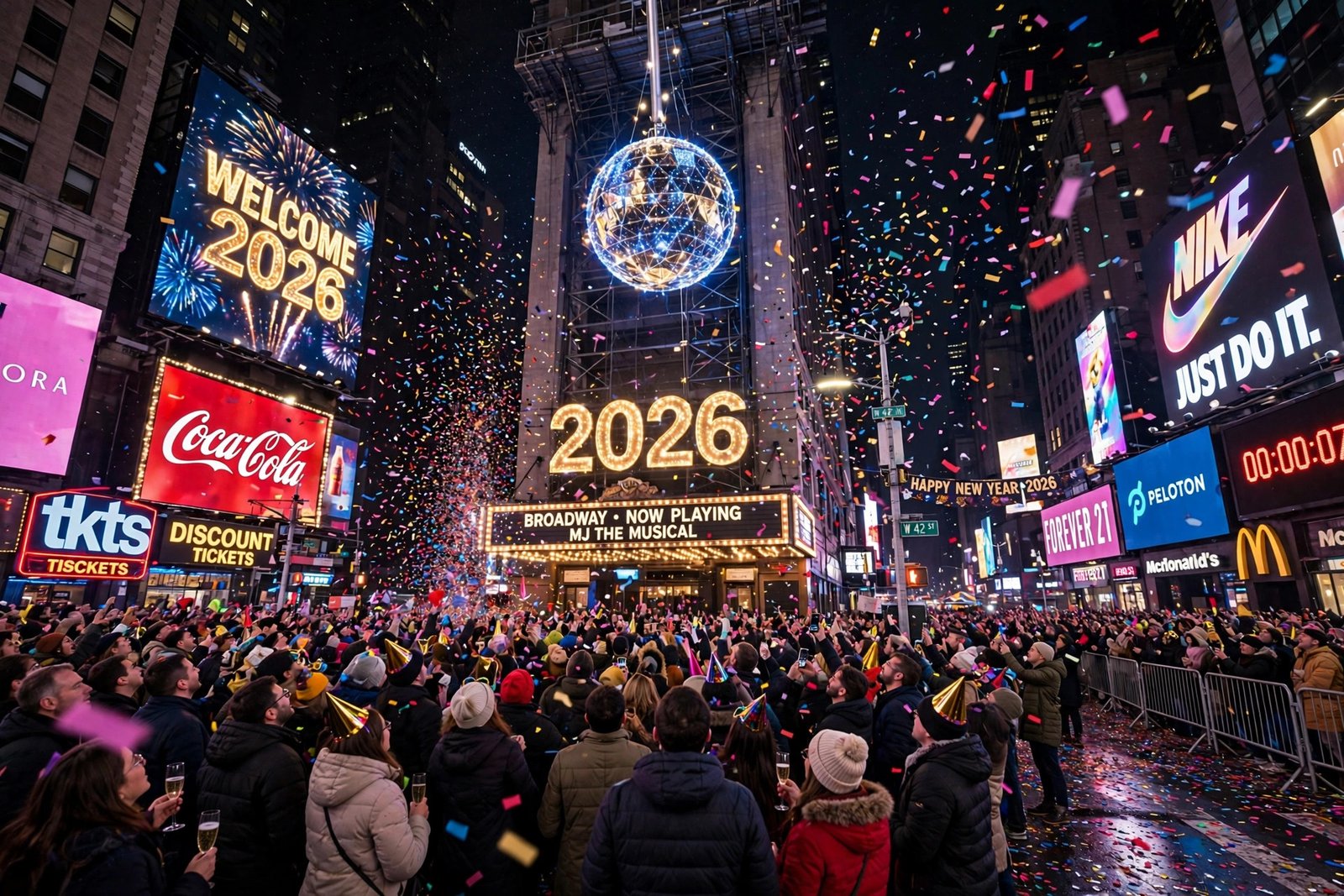
There is one night a year when the whole world watches the same street corner. On December 31, 2026 — a Thursday — hundreds of thousands of people will crowd into Times Square in New York City, millions more will watch on television and online, and at the stroke of midnight a glittering ball will slide down a pole on top of One Times Square to ring in 2027. It is the most famous New Year’s Eve celebration on the planet, and it has been going for well over a century. Whether you dream of standing in the crowd or plan to watch from your couch, this guide covers the history, the ball itself, how to get a spot for free, what you cannot bring, the parties with a view, and how to watch from home.
A Tradition Born in 1907
The Times Square New Year’s Eve celebration began in 1904, when Adolph Ochs, the owner of The New York Times, threw a fireworks display from the roof of the newspaper’s new headquarters at One Times Square to celebrate the building’s opening and welcome in 1905. The party was a hit, and Ochs kept it going for a few years — until the city banned fireworks from the rooftop. Ochs needed something else, something spectacular that did not involve explosives.
His answer was a time ball, an idea borrowed from maritime history. In the age of sail, harbor time balls dropped at a set hour each day so ship captains could set their chronometers. Ochs hired the sign company Artkraft Strauss to build a ball that would drop at midnight to mark the new year. The first Times Square ball drop took place on December 31, 1907, welcoming in 1908. The original ball was five feet across, made of iron and wood, weighed 700 pounds, and was lit by 100 twenty-five-watt light bulbs. It took exactly 60 seconds to slide down the flagpole — a timing that has never changed.
The tradition has been held every year since, with only two exceptions: 1942 and 1943, when wartime blackouts during the Second World War meant the ball stayed dark and the new year was marked by a moment of silence and chimes. The ball itself has been rebuilt several times as lighting technology changed, from incandescent bulbs to the LED-lit crystal sphere that hangs over Times Square today.
The Ball Today
The current ball, known as the Constellation Ball, is the ninth version of the Times Square ball, and it is a permanent fixture on the roof of One Times Square. It is a geodesic sphere about 12 feet across and weighing nearly 12,000 pounds, covered in thousands of Waterford crystal triangles and lit by tens of thousands of LED lights that can shift through a rainbow of colors and patterns. During the year it sits above the square as a landmark; on December 31 it is raised to the top of its pole in the early evening and then, at 11:59 p.m., begins its 60-second descent, landing at midnight to signal the start of the new year.
The ball is not the only spectacle. At midnight, around 3,000 pounds of confetti rain down over Times Square, tossed by hand from the rooftops by a team of volunteers led by a confetti director — a role held for decades by balloon artist Treb Heining. Since the 2007–08 celebration, some of the confetti has carried handwritten wishes for the new year, collected from visitors at the Times Square Wishing Wall and submitted online from around the world.
How the Night Unfolds
The celebration is a full evening, not just a single minute. Here is how December 31 typically runs in Times Square, based on the most recent editions of the event. Exact times for 2026 will be confirmed by the Times Square Alliance in December, so check the official schedule closer to the date. A 2026 planning guide for New Year’s Eve in New York City confirms the same pattern, including the free first-come, first-served viewing areas.
In the afternoon, the NYPD opens the public viewing areas — in the most recent celebration, entry began at 3 p.m. — and the crowds stream in from Sixth and Eighth Avenues. The ball is raised to the top of its pole and lit at about 6 p.m., which marks the official start of the evening’s entertainment, with live musical performances, celebrity appearances, and hourly countdown segments building toward the final hour.
The last hour is the one everyone waits for. At 11:59 p.m. Eastern Time, the ball begins its 60-second drop, and the crowd counts down the final seconds together. At midnight, the ball lands, the confetti falls, “Auld Lang Syne” plays, and the new year begins. The official live webcast runs from 6 p.m. on December 31 until about 12:15 a.m. on January 1, and the crowds begin to disperse in the minutes after midnight as the NYPD reopens the streets.
As of early November 2026, the official performer lineup for this year’s celebration has not yet been announced. In past years the Times Square Alliance has revealed the musical acts and hosts in December, often in stages. If a particular artist matters to you, do not make travel plans around a rumored name — wait for the official announcement.
Watching in Person: The Free Viewing Areas
Standing in Times Square on New Year’s Eve costs nothing, and that is exactly what makes it both wonderful and demanding. Here is how it works.
The NYPD divides the streets into viewing areas, often called pens, using metal barricades. The pens start at 43rd Street, near the ball itself, and fill from south to north as more people arrive — so the closest spots go to the earliest arrivals. The best views run along Broadway from 43rd to 50th Streets and along Seventh Avenue. If you arrive late, you may be directed to pens north of 50th Street, where the ball looks like a small glowing dot.
You enter from the sides, not from the south. Police direct crowds in from Sixth and Eighth Avenues, with viewing-area access points in recent years at 45th, 49th, 52nd, and 56th Streets. Once Broadway and Seventh Avenue are closed to cross traffic, nobody crosses them, so pick your side before you enter. Police close the blocks street by street as they fill, and the Times Square Alliance says it cannot predict exactly when each one will fill — but the prime spots near 43rd Street are usually gone soon after the pens open.
How early should you arrive? For a spot with a real view of the ball, plan to be there around midday, and expect to be on your feet for eight hours or more before midnight. Crowds start gathering in the afternoon, the pens open at about 3 p.m. in recent years, and by 6 p.m. the closest areas are long gone. People who arrive after 6 p.m. should expect a distant view at best — this is not an event you can drop into casually at 11 p.m.
The hardest rule of the night is the one about leaving. Once you enter a viewing pen, you cannot leave and come back to your spot. There are no portable restrooms inside the viewing areas, and no food vendors. If you step out — for a bathroom, for food, for warmth — your spot is gone. That means eating a real meal before you go in, using the restroom beforehand, and dressing for a full night outdoors in New York in late December, when temperatures often sit near freezing by midnight. Layers, insulated boots, gloves, a hat, and hand warmers are not optional extras; they are the difference between a magical night and a miserable one.
What to Bring — and What to Leave Behind
The NYPD searches bags at the entry checkpoints, and a long list of items is not allowed inside the viewing areas. Backpacks and large bags are barred, as are umbrellas, chairs, large coolers, and alcohol. Bring as little as possible — a small bag with the essentials, your phone, and warm clothing you can wear rather than carry. Leave valuables at the hotel.
A few practical tips from seasoned attendees: charge your phone fully and bring a portable charger, because cold weather drains batteries fast. Wear comfortable, waterproof shoes — you will be standing on cold pavement all night. Eat a big, warm meal before you arrive, and agree on a meeting point with your group in case you get separated, because cell service in a crowd of hundreds of thousands of people can be unreliable.
Parties and Hotel Views: The Comfortable Way In
If eight hours standing in the cold is not your idea of a celebration, Times Square offers a warmer way to watch — for a price. Dozens of restaurants, bars, and hotels around the square host ticketed New Year’s Eve parties, many with a view of the ball drop from a window, a terrace, or a rooftop. Prices vary widely: parties with a full view of the ball generally start at several hundred dollars per person and can run well past $1,000 at the most exclusive venues, with some premium terrace packages reaching $1,500 or more.
The difference between these parties is where you stand at midnight. Some venues offer a direct window view of the ball; others have outdoor terraces; still others give you dinner and drinks indoors and then let you step out to a street viewing area at midnight. Before you book, read the fine print: does every ticket include the view, or only certain tables? At some venues, only VIP tables carry a view, and the rest of the room watches on screens.
Two warnings are worth taking seriously. First, the Times Square Alliance cautions against “all access” or multi-venue passes that promise entry to many Times Square venues — police checkpoints do not honor them, and the Alliance reports that scalpers have sold counterfeit versions. Second, anyone offering to sell you a ticket to stand in the public street viewing areas is selling you something that is free. Buy party tickets only from the venue itself or a reputable seller.
Watching From Home
Here is an honest secret about the Times Square ball drop: for many people, watching from home is the better experience. The broadcasts show you the ball up close, the performances in full, and the confetti in slow motion, all from a warm room with food and a bathroom nearby. The Times Square Alliance streams the whole night commercial-free on its official webcast, from 6 p.m. on December 31 to about 12:15 a.m. on January 1, with captioned and American Sign Language versions available.
A travel guide to New Year’s Eve celebrations in New York City in 2026 lists the same key facts: a free event, a 6 p.m. ball raising, and a 60-second drop at 11:59 p.m. You can also watch on the major networks, which each carry their own New Year’s Eve specials from Times Square, and on the official Times Square channels online. If you are watching with kids, the early evening is the sweet spot: the performances run from 6 p.m., and the ball raising is a good moment to gather the family.
Planning Tips for the Trip
If you are traveling to New York for the night, book early and plan for a city that is crowded, cold, and largely closed to cars around Times Square. Hotels in Midtown fill up fast for New Year’s Eve and charge peak rates, so reserve as early as you can and read the cancellation policy before you commit. Public transportation is the best way to get to the area — the subway runs all night, but expect station closures and detours around Times Square, and check the MTA’s holiday service notices before you go.
Road closures are another reason to leave the car behind. A Midtown hotel’s guide to New Year’s Eve in New York City notes the same Thursday date and the morning street closures. The NYPD publishes its street closure details for each year in late December, and on the day itself Broadway and Seventh Avenue are closed to traffic from the morning. If your hotel is inside the frozen zone, ask the hotel in advance how guests get in and out on December 31.
After midnight, do not rush. The crowds take time to clear, and the subway stations nearest Times Square will be packed. Give yourself an hour or more to get moving, and if your hotel is within walking distance, walking is often faster than waiting for a train.
Frequently Asked Questions
Is it free to watch the ball drop in Times Square?
Yes. Standing in the public viewing areas in Times Square is completely free, with no tickets required. Entry works on a first-come, first-served basis, and the NYPD manages the viewing pens. Anyone selling tickets for a spot in the public viewing areas is running a scam — only private parties in restaurants, bars, and hotels charge for admission.
What time does the ball drop?
The ball begins its 60-second descent at 11:59 p.m. Eastern Time on December 31 and lands at midnight to ring in the new year. The ball is raised to the top of its pole and lit at about 6 p.m., and the evening’s performances run from 6 p.m. until midnight. For the 2026–27 celebration, the ball drops on Thursday, December 31, 2026, at midnight Eastern, welcoming in 2027.
When was the first Times Square ball drop?
The first ball drop took place on December 31, 1907, welcoming in 1908. The original ball was five feet across, made of iron and wood, weighed 700 pounds, and was lit by 100 light bulbs. The tradition has been held every year since, except in 1942 and 1943, when it was suspended during the Second World War because of wartime blackout rules.
How early do I need to arrive to get a good spot?
For a spot with a real view of the ball, plan to arrive around midday and be in place when the viewing areas open in the afternoon — in the most recent celebration, entry began at 3 p.m. The pens fill from south to north starting at 43rd Street, so the closest spots go first. Arriving after 6 p.m. usually means a distant view north of 50th Street, and once you leave a pen you cannot return to your spot.
Related reading
Keep the holiday season going on Famus News: Macy’s Thanksgiving Day Parade: History of America’s Favorite Parade, Friendsgiving: History and How to Host the Perfect One, and Thanksgiving Travel 2026: Best and Worst Days to Travel.