
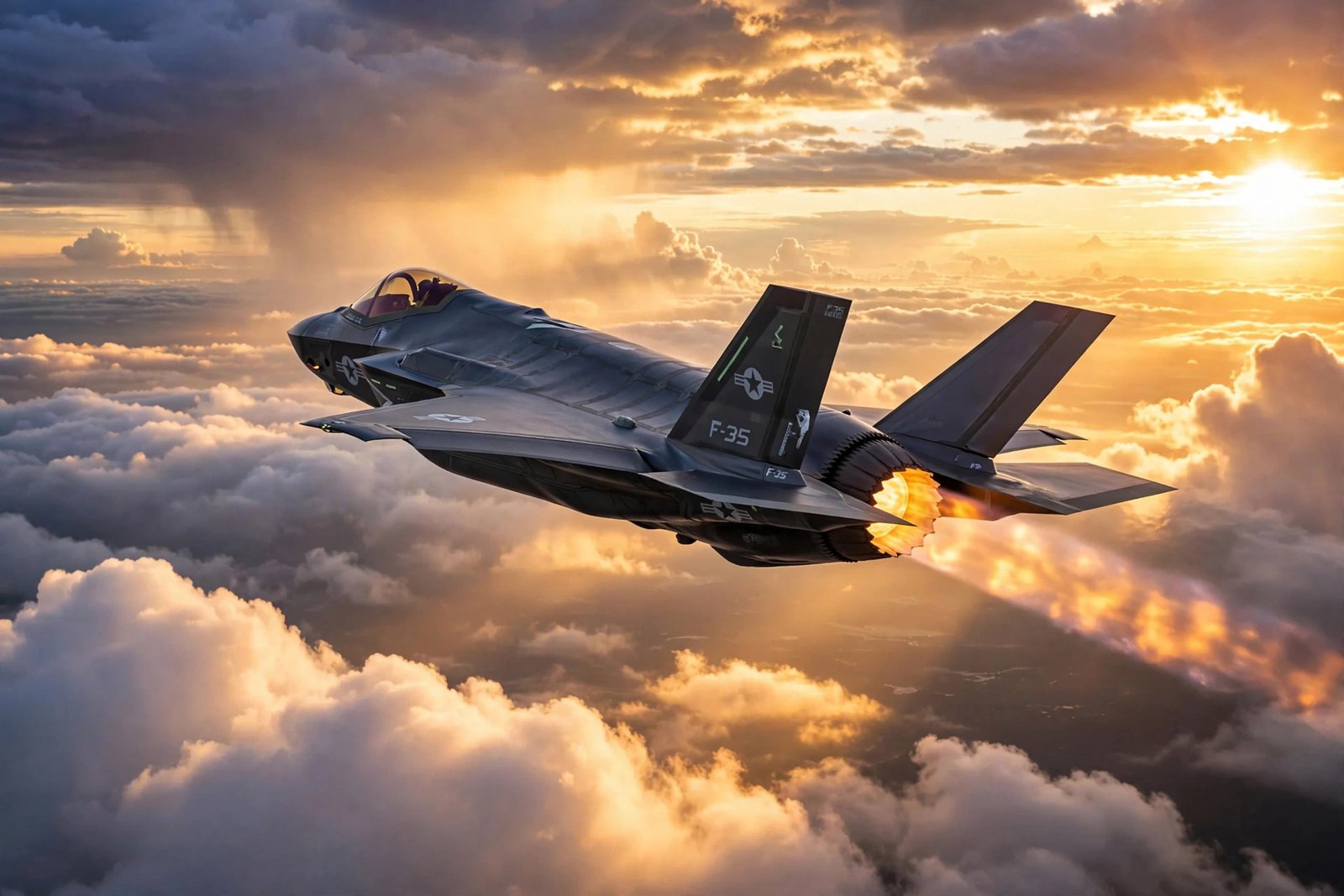
When the United States needs to show strength in the skies, one aircraft does most of the talking. The F-35 Lightning II is the fighter jet at the center of American air power today, flown by the Air Force, the Marine Corps and the Navy, and by allies on four continents. It is fast, hard to spot on radar, and packed with sensors that see the battlefield in ways older jets never could. Pilots who fly it call it the quarterback of the skies, because it does more than fight its own battles: it gathers information and shares it with everyone else in the fight.
Built by Lockheed Martin, the F-35 is a fifth-generation stealth fighter, the most advanced class of combat aircraft in service anywhere in the world. More than 1,375 of them had been delivered by early October 2026, according to Lockheed Martin, and the fleet has passed one million flight hours. That scale matters. The F-35 is not a niche aircraft or a technology experiment. It is the backbone of the American fighter force, and it is becoming the standard fighter of the Western world.
What Is the F-35 Lightning II?
The F-35 Lightning II is a single-seat, single-engine stealth multirole fighter. That description packs in a lot of meaning. Single-seat means one pilot flies it and manages everything. Single-engine means it is powered by one Pratt & Whitney F135 turbofan, an engine that produces 43,000 pounds of thrust, according to the United States Air Force. Multirole means it is built to do several jobs at once: fight other aircraft in the air, strike targets on the ground, and gather intelligence while it does both.
The jet grew out of the Joint Strike Fighter program of the 1990s, an ambitious idea to build one fighter family that could replace several different aircraft across the three military services. In a competitive fly-off, Lockheed Martin’s X-35 demonstrator beat Boeing’s X-32, and in October 2001 Lockheed Martin won the contract to build the jet. The name Lightning II honors the Lockheed P-38 Lightning, the famous twin-engine fighter of the Second World War.
The Air Force’s own fact sheet says the F-35A will replace its aging fleets of F-16 Fighting Falcons and A-10 Thunderbolt IIs, aircraft that have been the primary fighters for more than 20 years. The Navy and Marine Corps are replacing their F/A-18 Hornets and AV-8B Harriers with their own versions. In other words, the F-35 is not one more jet in the inventory. It is the replacement for almost everything that came before it.
One Jet, Three Variants
The clever idea behind the F-35 is that three very different aircraft share the same core design. They use the same engine, the same sensors and the same software. What changes is how each one takes off and lands, and that difference shapes everything else about the jet, from its wingspan to how much fuel it carries.
The F-35A is the conventional takeoff and landing version, built for ordinary runways. It is the version flown by the United States Air Force and by most allied air forces. It is also the only version with an internal 25 mm cannon, and the Air Force describes it as a 9g-capable fighter, meaning it can pull nine times the force of gravity in a hard turn. It carries the most internal fuel of the land-based versions and, with a top speed of Mach 1.6, or about 1,200 miles per hour, it can get anywhere in a hurry. Its range is more than 1,350 miles on internal fuel, and with aerial refueling it is effectively unlimited.
The F-35B is the showstopper. Built for the United States Marine Corps, it can take off from a short runway and land vertically, hovering down onto a deck like a helicopter. It does this with a lift fan mounted behind the cockpit, driven by the main engine, plus a rear nozzle that swivels downward. That trick lets the Marines fly the jet from amphibious assault ships and from rough forward bases with no runway at all. The United Kingdom, Italy and Japan also fly the F-35B. The price of the vertical-landing trick is fuel and payload: the B model carries less of both than its sisters.
The F-35C is the carrier version, built for the United States Navy and the Marine Corps. It has a larger wing with folding wingtips, stronger landing gear, and a tailhook for arrested landings. It launches from a carrier deck by catapult and comes back by catching a wire, the hardest landing in all of military aviation. It also carries the most internal fuel of the three, about 20,000 pounds, which gives it the longest legs at sea. Together, the three variants mean the same jet can operate from a concrete runway in Utah, a small ship in the Pacific, or the deck of a nuclear-powered aircraft carrier.
Stealth: Built to Be Hard to See
The first thing that sets the F-35 apart is stealth. The jet is shaped to scatter radar waves away from their source: its edges are aligned at careful angles, its surfaces curve smoothly, and its engine face is hidden from radar view. Radar-absorbing materials are baked into the skin, and weapons are carried inside internal bays rather than hanging under the wings, where they would light up on an enemy radar screen.
Stealth does not make the jet invisible. No aircraft is. What it does is shrink the distance at which enemy radars can detect and track it. That buys the pilot time: time to see the threat first, time to decide, and time to act. In a fight against modern air defenses, seeing first is often the whole battle.
Sensor Fusion: The Jet That Thinks
If stealth is the F-35’s most famous feature, sensor fusion is its most important one. The jet carries an array of sensors that would each be impressive on their own. The AN/APG-81 active electronically scanned array radar, built by Northrop Grumman, tracks targets in the air and on the ground. The electro-optical targeting system under the nose handles laser targeting and infrared search and track. The Distributed Aperture System, six infrared cameras spread around the airframe, gives the pilot a 360-degree view and warns of incoming missiles.
Sensor fusion is what happens when a powerful computer merges everything those sensors see into one clear picture. Instead of checking a radar screen, then an infrared display, then a radio report, the pilot sees a single fused image of the battlespace on a large touchscreen and in the helmet. The jet does the sorting, so the pilot can do the deciding. That is why the F-35 is often described as a flying computer network as much as a fighter.
The networking goes further. F-35s share what they see with each other over a hard-to-detect data link, and with other forces over the standard Link 16 network. A flight of four F-35s can build one shared picture of the sky and divide up the work, with one jet tracking a target while another fires at it. One F-35 makes every other aircraft, ship and unit around it more effective, which is why the jet is called a force multiplier.
Three Services, One Airframe
Each American service uses the F-35 differently, and each has made it the center of its future plans. The Air Force flies the F-35A and plans to buy 1,763 of them, the largest single fleet in the program. The first operational F-35As arrived at Hill Air Force Base in Utah in 2015, the jet was declared combat ready in August 2016, and in April 2019 Hill’s jets flew the first F-35A combat deployment, to Al Dhafra Air Base in the United Arab Emirates.
The Marine Corps flies both the F-35B and the F-35C, and plans to buy 353 of the B model and 67 of the C model. The Marines value the F-35B most, because it can operate from their amphibious ships and from short, rough airstrips near the front lines, bringing stealth fighter support to troops ashore without waiting for a carrier or a long runway.
The Navy flies the F-35C and plans to buy 273 of them. The carrier version is the newest member of the family to reach the fleet, as described in Navy test and evaluation reporting, and it is now a standard part of carrier air wings alongside the F/A-18E/F Super Hornet, the EA-18G Growler and the E-2D Hawkeye. Together, the three services give the United States a stealth fighter that can operate from land, from small ships, and from the largest warships ever built.
A Global Fleet: Allies Flying the F-35
The F-35 was designed from the start as a coalition aircraft. The United Kingdom was the only top-tier partner in the original Joint Strike Fighter program, contributing about 10 percent of the development cost, with Italy and the Netherlands at the next tier and Australia, Canada, Denmark and Norway below them. Later customers, including Japan, South Korea, Poland and Belgium, joined through the Pentagon’s Foreign Military Sales program.
Today the jet flies with the United States and 19 allied nations, according to Lockheed Martin. The United Kingdom flies the F-35B from its Queen Elizabeth-class aircraft carriers. Italy flies both the A and B models, including the B from its carrier Cavour. Japan operates both the A and B models, and is modifying ships to carry the B. Australia, the Netherlands, Norway, Denmark, South Korea, Poland and Belgium fly the F-35A, while Israel flies its own customized F-35I, known as the Adir. Canada, the Czech Republic, Finland, Germany, Greece, Romania, Switzerland and Singapore have ordered jets and are awaiting delivery.
That shared fleet is a strategic asset in itself. Because so many allies fly the same jet, their pilots train together, their maintainers share parts and procedures, and their aircraft can operate as one force on short notice. When an American F-35 lands in Norway or Japan, the ground crew already knows the jet.
The F-35 in Combat
The F-35 has gone from a new aircraft to a combat-proven one. Israel has said it used its F-35I jets in combat, and American F-35As flew combat missions from the Middle East beginning in 2019. The jet’s most dramatic recent test came in 2025, when pilots of the 34th Fighter Squadron at Hill Air Force Base recorded the first air-to-air kills by an F-35A, shooting down one-way attack drones during operations in the Middle East.
That same squadron made headlines again on June 22, 2025, during Operation Midnight Hammer, when F-35s escorted B-2 Spirit bombers into Iranian airspace to strike underground nuclear sites at Fordow, Natanz and Isfahan. According to Air Combat Command, the F-35s were the first aircraft to penetrate Iranian airspace, suppressing enemy air defenses and escorting the bombers to their targets. It was the kind of mission the jet was built for: slipping past defenses, clearing the way, and bringing everyone home.
The jet is not without critics. It has faced questions about cost, maintenance, and the long road to full readiness. But its combat record and its growing fleet have answered the biggest question of all, which is whether the aircraft works when it matters.
What the F-35 Costs
The F-35 is expensive, and it is worth saying plainly what the numbers are. According to F-35 program figures, the average flyaway cost for production Lots 15 through 17 was about 82.5 million dollars for the F-35A, 109 million dollars for the F-35B, and 102.1 million dollars for the F-35C.
Supporters argue that the price has fallen sharply from the early years of the program, and that no other aircraft offers the same combination of stealth, sensors and numbers. Critics argue that the sustainment costs remain too high. The F-35 is a costly aircraft to own, and it is also the aircraft the United States and its allies have chosen to bet their air power on for the next several decades.
Why the F-35 Matters to American Air Power
The F-35 matters because air power is not just about airplanes. It is about seeing first, deciding first, and acting first, and the F-35 is built around that idea. Its stealth lets it go where other jets cannot. Its sensors let it understand the battlefield better than any single aircraft before it. Its networking lets it share that understanding with the whole force. Put together, it changes how the United States fights, not just how fast it flies.
There is also a simpler reason the jet matters: numbers. More than 1,375 F-35s have been delivered, the fleet has flown more than a million hours, and allied nations keep ordering more. In a world where advanced air defenses are spreading fast, the United States needs a fighter that can survive them, and it needs a lot of them.
Frequently Asked Questions
How many F-35s have been built?
More than 1,375 F-35s had been delivered by early October 2026, according to Lockheed Martin, and the fleet has passed one million flight hours. The United States plans to buy 2,456 aircraft in total across the three services, and allied orders bring the planned worldwide fleet to more than 3,000 jets. A full list of operators is maintained on Wikipedia’s F-35 operators page.
What is the difference between the F-35A, F-35B and F-35C?
The F-35A takes off and lands on conventional runways and is flown by the Air Force and most allies. The F-35B can take off from a short runway and land vertically, and is flown by the Marine Corps, the United Kingdom, Italy and Japan. The F-35C is the carrier version with a larger folding wing, flown by the Navy and Marine Corps from aircraft carriers.
Is the F-35 the most advanced fighter jet in the world?
Lockheed Martin describes it as the most lethal, survivable and connected fighter aircraft in service, and it is the most widely flown fifth-generation fighter in the world. Its combination of stealth, sensor fusion and networking is unmatched among aircraft in service today, though rivals including China and Russia are developing their own fifth-generation jets.
Which countries fly the F-35?
The United States flies all three variants. The United Kingdom flies the F-35B, Italy and Japan fly the A and B models, and Australia, Belgium, Denmark, the Netherlands, Norway, Poland and South Korea fly the F-35A. Israel flies its own F-35I variant, and Canada, Finland, Germany, Switzerland, Singapore and several other nations have orders in place.