
When most Americans picture American military power, they think of aircraft carriers cutting through the Pacific, stealth fighters screaming across the sky, or submarines slipping silently beneath the waves. Yet one of the most active and versatile branches of the United States Armed Forces works much closer to home, on the water that touches every American coastline, river, lake, and port. The United States Coast Guard is smaller than the Army, the Navy, the Air Force, and the Marine Corps, but no other service does so many different jobs in so many different places. It rescues fishermen in a storm off Alaska, stops drug smugglers in the Caribbean, breaks ice in Antarctica, inspects cruise ships in Miami, guards ports after a terror threat, and sails alongside the Navy in wartime. It is a military service, a law enforcement agency, a rescue service, and a maritime regulator all at once, and that unusual combination is exactly what makes it such an important piece of American power.
A Service Born to Collect Taxes and Catch Smugglers
The Coast Guard traces its origins to the Revenue Cutter Service, created on August 4, 1790, under Treasury Secretary Alexander Hamilton. The young United States was struggling to pay its debts, and most of its federal revenue came from tariffs on imported goods. Smugglers who slipped cargo ashore without paying those tariffs were not just cheating the government out of money. They were threatening the financial survival of the new republic. Hamilton argued in the Federalist Papers that a few armed vessels stationed at the entrances to American ports could serve as useful sentinels of the laws, and Congress agreed. President George Washington signed the legislation creating a fleet of ten cutters, small, fast sailing vessels built to enforce customs laws and chase down smugglers along the East Coast.
Those first ten cutters were the only naval force the United States had in its earliest years, because the Navy was not established until later in the 1790s. That fact shaped the service from the beginning. Revenue cutter crews did far more than collect tariffs. They carried mail, charted dangerous waters, rescued shipwrecked sailors, and enforced quarantine laws. They were, in effect, the federal government afloat, the only arm of Washington that most coastal Americans ever saw. The first cutter masters were appointed by Washington himself, and their ships bore names that still echo in Coast Guard history, including Massachusetts, Scammel, and Vigilant.
The modern Coast Guard was born on January 28, 1915, when President Woodrow Wilson signed the Act to Create the Coast Guard, merging the Revenue Cutter Service with the United States Life-Saving Service, the network of surfmen and lifesaving stations that had guarded American beaches since 1878. The merger joined two traditions: the cutter’s law enforcement and maritime authority, and the surfman’s rescue mission. The Life-Saving Service had already built a reputation for extraordinary courage, with crews rowing wooden surfboats into storms that no sane sailor would face. Putting those two traditions together created a service whose identity has always been split between the badge and the life ring, between enforcing the law and saving lives, and it has never chosen one over the other.
Why the Coast Guard Is Different From Every Other Branch
The difference starts with the law. The Posse Comitatus Act generally bars the Army, Navy, Air Force, and Marine Corps from enforcing civilian law inside the United States. The Coast Guard is exempt from that restriction. It is both a military service and a federal law enforcement agency, with authority to board vessels, make arrests, and seize contraband in American waters and on the high seas under international agreements. A Navy destroyer cannot pull over a smuggling boat off Florida and arrest its crew. A Coast Guard cutter can, and does, every week of the year.
The second difference is the breadth of the mission. Federal law assigns the Coast Guard eleven statutory missions, grouped under three broad roles: maritime safety, maritime security, and maritime stewardship. The non-homeland security missions are search and rescue, aids to navigation, marine safety, living marine resources, marine environmental protection, and ice operations. The homeland security missions are ports, waterways, and coastal security, drug interdiction, migrant interdiction, defense readiness, and other law enforcement. No other American service carries a list anything like it. In most countries, that work is split among a navy, a coast guard, a customs service, a fisheries agency, and a lighthouse authority. In the United States, one service does it all.
The third difference is size. The Coast Guard is by far the smallest of the armed services, with roughly 40,000 active duty personnel, along with several thousand reservists, thousands of civilian employees, and about 20,000 uniformed volunteers in the Coast Guard Auxiliary. That small size is both a strength and a strain. It forces the service to be flexible, with the same cutter crew shifting from a rescue to a drug patrol to a fisheries inspection in a single deployment. It also means the service is stretched thin, with aging ships and aircraft doing work that has only grown more demanding. When Americans debate military budgets, the Coast Guard is often an afterthought, yet its daily workload touches trade, safety, security, and the environment in ways that affect the whole country.
Finally, the Coast Guard is the most visible armed service to ordinary Americans. Its stations dot the coastline from Maine to Hawaii, its helicopters fly over beaches and bays, and its small boats patrol rivers and lakes deep inland. Many Americans will never see a tank or a fighter jet up close, but they have seen a Coast Guard boat, or watched a rescue on the evening news. That closeness to civilian life is part of the service’s identity, and part of its power. It is the armed service that most often meets Americans on their worst day, and helps them get home.
The Eleven Missions That Define the Service
Search and rescue is the mission Americans know best, and the one the Coast Guard takes the most pride in. Coast Guard crews respond to distress calls around the clock, in weather that grounds other aircraft and keeps other boats in port. They pull sailors from sinking ships, hoist injured hikers from cliffs, and evacuate patients from cruise ships far offshore. The service’s unofficial motto among its own people is that it has to go out, but it does not have to come back, a line that captures the rescue tradition better than any official slogan. Every year, the service saves thousands of lives, and it does so without asking who the person in the water voted for or how they got into trouble.
Aids to navigation is a quieter mission, but it underpins the entire American maritime economy. The Coast Guard maintains tens of thousands of buoys, beacons, and lights that mark safe channels into American ports. When a buoy drifts off station or a light goes dark, a Coast Guard buoy tender goes out to fix it, often in rough water and bad weather. Without that work, the ships that carry American exports and imports could not move safely. Marine safety goes further, with Coast Guard inspectors examining commercial vessels, licensing merchant mariners, and investigating accidents, so that the ferries, tankers, and cruise ships Americans ride are held to a common standard.
Drug interdiction is the mission that most often makes headlines. Coast Guard cutters patrol the transit zones of the Caribbean Sea and the eastern Pacific Ocean, where smugglers move cocaine and other illegal drugs toward the United States in go-fast boats, fishing vessels, and even semi-submersible craft. Working with partner nations and other American agencies, Coast Guard crews seize large quantities of illegal drugs each year, keeping them from reaching American streets. The work is dangerous and relentless. Smugglers are well funded and creative, and the ocean is vast. Yet the Coast Guard’s combination of long-range cutters, helicopters, and boarding teams makes it the lead American agency for stopping drugs at sea.
The Fleet: Cutters, Boats, and Aircraft
The Coast Guard’s fleet is built around its cutters, defined as any Coast Guard vessel more than 65 feet long with a permanently assigned crew and accommodations for extended deployments. The service operates roughly 240 cutters of many types, along with nearly 2,000 smaller boats and about 200 aircraft. The fleet is aging in places, and replacing it is the service’s biggest long-term challenge, but the ships it has are purpose-built for the multi-mission life.
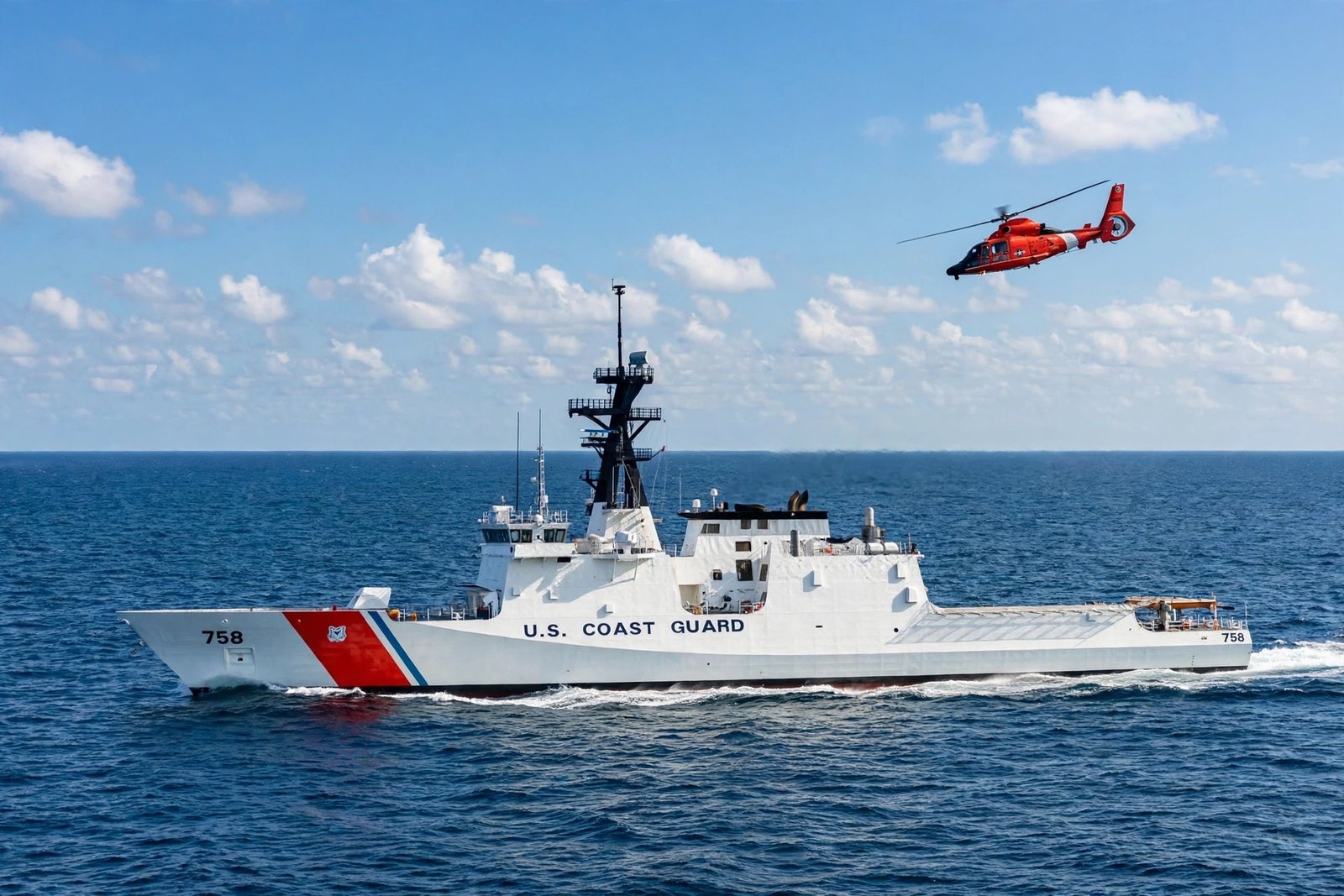
The flagship of the fleet is the National Security Cutter, known as the Legend class. At 418 feet long, these are the largest cutters in active service, roughly the size of a Navy frigate, and they are designed for long patrols far from home. Ten of the class have entered service, with the first, USCGC Bertholf, commissioned in 2008. A National Security Cutter can stay at sea for months, launch helicopters and small boats, track contacts over a wide area, and serve as a command platform for a whole task force. They are the ships that patrol the distant drug transit zones and show the American flag in the Pacific, and they have replaced the older Hamilton-class cutters that served for decades.
At the top of the fleet in a different sense are the icebreakers. The USCGC Polar Star is the United States’ only active heavy icebreaker, a 399-foot ship commissioned in 1976 that breaks a channel through the ice to McMurdo Station in Antarctica each year so that supply ships can reach American researchers. Her sister ship, Polar Sea, is no longer in active service, and the medium icebreaker Healy, at 420 feet, handles Arctic research and icebreaking. The Coast Guard is now building a new generation of heavy icebreakers, the Polar Security Cutters, to replace Polar Star, because the polar regions have become a new arena of competition and the United States cannot afford to be without icebreaking power.
In the air, the Coast Guard flies helicopters and fixed-wing aircraft from stations around the country. The MH-60T Jayhawk is the service’s medium-range recovery helicopter, the orange-and-white aircraft that Americans recognize from rescue footage, capable of flying hundreds of miles offshore, hoisting survivors from the water, and returning in weather that keeps other aircraft on the ground. The smaller MH-65 Dolphin flies from cutters and shore stations for shorter-range rescue and law enforcement work. Fixed-wing aircraft, including the HC-130 Hercules and the HC-144 Ocean Sentry, patrol vast stretches of ocean, searching for vessels in distress, tracking smugglers, and watching over American waters. Together, the fleet and the aircraft give the Coast Guard eyes and reach far beyond the shoreline.
Ice, the Arctic, and the New Frontier
As the Arctic warms and sea ice retreats, the polar regions have become a new frontier for American power, and the Coast Guard is the service that operates there. The United States is an Arctic nation through Alaska, and the Coast Guard is the primary American presence in Arctic waters. Its icebreakers keep shipping lanes open, support scientific research, and show the flag in waters where Russia and China are increasingly active.
The challenge is stark. Russia operates a large fleet of icebreakers, including nuclear-powered vessels, while the United States has only two active polar icebreakers, and only one of them is heavy. The Coast Guard has warned for years that it needs more icebreaking capacity, and the Polar Security Cutter program is the answer. The new ships will be the largest Coast Guard vessels ever built, designed to break heavy ice and operate for months in polar conditions. The first of the class is expected to enter service in the coming years, and the program is now one of the service’s highest acquisition priorities.
The Arctic mission is about more than ships. It is about presence, about being able to respond when a cruise ship runs aground in remote waters, or when an oil spill threatens a fragile ecosystem, or when a foreign vessel tests American resolve. The Coast Guard’s Arctic strategy calls for a persistent presence in the region, with cutters, aircraft, and shore facilities that can operate in the far north. As shipping through the Arctic grows, that presence will only become more important.
FAQ
Is the Coast Guard part of the military?
Yes. The Coast Guard is one of the six armed services of the United States, and it is a military service at all times. It operates under the Department of Homeland Security in peacetime and transfers to the Department of the Navy in wartime or when directed by the President.
How old is the Coast Guard?
The service traces its origins to August 4, 1790, when President George Washington signed the legislation creating the Revenue Cutter Service. The modern Coast Guard was formed in 1915 by merging the Revenue Cutter Service with the Life-Saving Service.
What are the Coast Guard’s main missions?
Federal law assigns eleven statutory missions, grouped under maritime safety, maritime security, and maritime stewardship. They include search and rescue, drug interdiction, maritime law enforcement, aids to navigation, marine safety, ice operations, port security, migrant interdiction, marine environmental protection, living marine resources, and defense readiness.
What is the largest Coast Guard ship?
The National Security Cutter, or Legend class, is the largest cutter in active service at 418 feet long. The icebreaker Healy is slightly longer at 420 feet, and the heavy icebreaker Polar Star is 399 feet long.
How is the Coast Guard different from the Navy?
The Navy is a warfighting service focused on sea control and power projection. The Coast Guard is a multi-mission service that is also a federal law enforcement agency, with authority to board vessels and make arrests in American and international waters, and it handles rescue, port security, and maritime regulation that the Navy does not.