
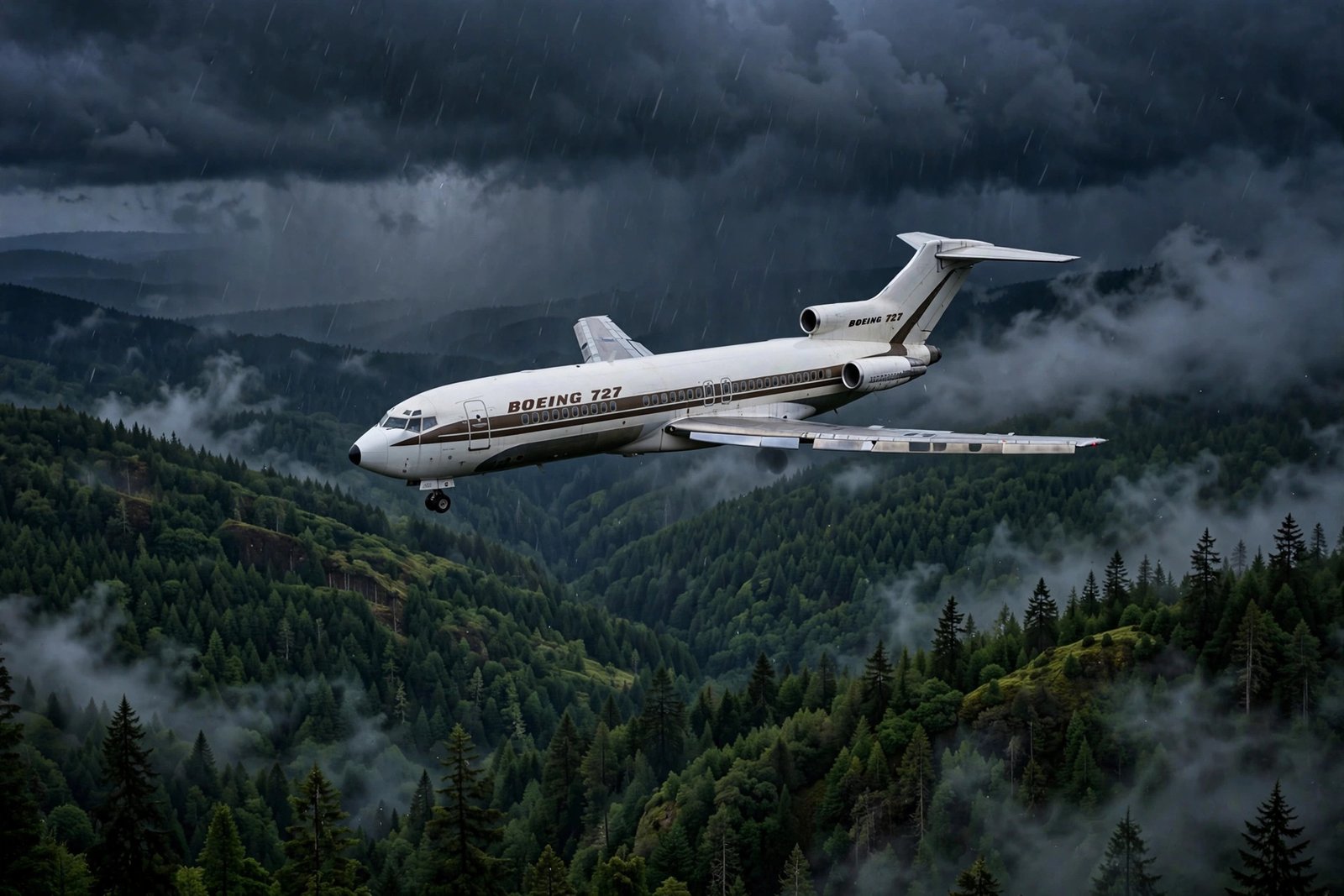
On the afternoon of November 24, 1971, the day before Thanksgiving, a quiet man in a dark suit boarded a short flight from Portland, Oregon, to Seattle, Washington. He carried a briefcase, ordered a bourbon and soda, and lit a cigarette. Within an hour, he had committed one of the most daring crimes in American history, and then he vanished so completely that more than five decades of investigation have never found him. His name, as the world came to know it, was D.B. Cooper.
Cooper’s crime was simple in design and extraordinary in execution. He hijacked a commercial airliner, demanded a fortune in cash and four parachutes, and then jumped out of the plane into the night sky over the forests of the Pacific Northwest. He was never seen again. The Federal Bureau of Investigation spent 45 years chasing him, considered more than 1,000 suspects, and still could not say who he was or whether he survived the jump. It remains the only unsolved case of air piracy in the history of commercial aviation in the United States.
The Day Before Thanksgiving
The story begins at Portland International Airport on a rainy Wednesday afternoon. A nondescript man who appeared to be in his mid-forties approached the counter of Northwest Orient Airlines and used cash to buy a one-way ticket on Flight 305, bound for Seattle. He gave his name as Dan Cooper. He wore a business suit with a black tie and a white shirt, carried a briefcase, and looked, by every account, like an ordinary businessman on an ordinary trip.
Cooper settled into a seat near the rear of the Boeing 727, ordered a drink, and lit a cigarette, as passengers could still do in those days. The flight from Portland to Seattle was a short hop, scheduled to take about half an hour, and nothing about the man or the moment suggested that history was about to be made. The plane took off on time, climbed into the gray November sky, and began its brief journey north.
What made Cooper’s plan possible was the era itself. In 1971, airport security was nothing like it is today. Passengers walked to their gates without passing through metal detectors, and carry-on bags were rarely searched. A man with a briefcase and a calm manner could board a plane with almost no questions asked. Cooper understood that, and he used it.
Forty-Five Minutes That Changed Aviation
About forty-five minutes after takeoff, Cooper handed a folded note to Florence Schaffner, a young flight attendant working the rear of the cabin. She tucked it into her pocket without reading it, assuming it was a phone number from a flirting passenger. Cooper leaned toward her and told her to read it. The note said he had a bomb in his briefcase and would use it if his demands were not met.
Cooper told Schaffner to sit beside him, and he calmly explained what he wanted: $200,000 in cash and four parachutes, delivered when the plane landed in Seattle. He also asked for a fuel truck to be waiting so the plane could be refueled. Schaffner carried the message to the cockpit, where Captain William Scott radioed the airline and the authorities. The FBI was alerted while the plane was still in the air, and the race to meet Cooper’s demands began.
What struck everyone who dealt with Cooper was his composure. He was not shouting, threatening the passengers, or acting erratically. He spoke quietly, gave clear instructions, and seemed to know exactly what he was doing. He even ordered a second bourbon while he waited. The crew later described him as polite and businesslike, a man carrying out a plan rather than a criminal losing control.
The Ransom Drop in Seattle
When Flight 305 landed at Seattle-Tacoma Airport, the scene on the ground was extraordinary. The FBI, working with Northwest Orient and the Federal Reserve Bank of San Francisco, had assembled the ransom: 10,000 unmarked $20 bills, with every serial number recorded. The money was delivered to the plane, along with the four parachutes Cooper had requested.
Cooper kept his word. Once the money and parachutes were aboard, he released all of the passengers. They walked off the plane into the arms of waiting FBI agents, unharmed after an ordeal they had barely understood. Cooper had never made a scene in front of them, and most had no idea a hijacking was even taking place until they were safely on the ground.
With the passengers gone, Cooper gave his next order. He wanted the plane refueled and flown toward Mexico City, with the aft airstair lowered so he could jump. The crew would stay aboard, and the plane would fly low and slow, exactly as he instructed. The FBI agreed to his terms, hoping to keep the crew safe and to catch Cooper when he landed. The plane took off again into the dark, and the most famous manhunt in American aviation history was about to begin.
The Jump Into the Night
Somewhere between Seattle and Reno, Nevada, a little after 8 p.m., Cooper did the incredible. He lowered the rear airstair of the Boeing 727, a feature that made the plane uniquely suited to his plan, and jumped out of the back of the aircraft with a parachute and the ransom money. He disappeared into the cold, dark night over the forests of southwest Washington. The pilots landed the plane safely in Reno, but Cooper was gone.
The conditions of the jump were brutal. It was a stormy November night, with rain, wind, and near-freezing temperatures at altitude. Cooper was jumping into heavily forested, mountainous terrain in the dark, wearing a business suit and street shoes. He had chosen two of the four parachutes to take with him, and one of them, the FBI later learned, was a training parachute that had been sewn shut and could not be used. Many investigators came to believe he could not have survived the landing.
But no body was ever found, and no trace of Cooper ever turned up in the vast search that followed. Military aircraft, helicopters, and ground teams combed the forests of southwest Washington for weeks. The FBI’s investigation, codenamed NORJAK for Northwest Hijacking, would become one of the longest and most exhaustive in the bureau’s history. And yet the man who had jumped from the sky seemed to have vanished into thin air.
The Money on the Riverbank
For nearly nine years, the case went cold. Then, in February 1980, an eight-year-old boy named Brian Ingram was playing on a sandy bank of the Columbia River near Vancouver, Washington, when he found something extraordinary: bundles of decaying $20 bills, partially buried in the sand. The FBI examined the money and confirmed that the serial numbers matched the ransom paid to D.B. Cooper.
The find was worth about $5,800, a small fraction of the $200,000 Cooper had taken. It remains the only confirmed physical evidence from the hijacking ever found outside the aircraft, and it is the single most important clue in the entire case. The bills were badly decomposed, suggesting they had been in the river or buried for years, but how they got there has never been explained.
Theories about the money have filled books and documentaries. Some believe Cooper buried the cash after surviving the jump and never returned for it. Others think the bundles washed downstream from wherever he landed. Still others argue the money was deliberately planted to mislead investigators. Whatever the truth, the discovery proved one thing beyond doubt: Cooper, or at least his money, had come down somewhere near the Columbia River.
NORJAK: The Investigation That Would Not Quit
The FBI’s investigation into the Cooper hijacking was staggering in its scale. Agents interviewed hundreds of people, tracked leads across the nation, and scoured the aircraft for forensic evidence. By the five-year anniversary of the hijacking, the bureau had considered more than 800 suspects and eliminated all but two dozen. Over the full course of the investigation, the number of suspects considered passed 1,000.
The case produced a mountain of evidence and a parade of theories, but no answers. The FBI released the serial numbers of the ransom bills to banks and businesses across the country, hoping someone would try to spend the money. None of it ever turned up in circulation. The bureau examined a tie Cooper left on the plane, tested it for DNA decades later, and still found no match. The parachutes were never recovered.
On July 8, 2016, after 45 years, the FBI announced it was suspending active investigation of the case to redirect resources to other priorities. The bureau’s case file, running to dozens of volumes, remains open to legitimate new evidence, and amateur sleuths continue to study it. But officially, the trail has gone cold, and the mystery is no closer to being solved than it was on the night Cooper jumped.
The Suspects and the Theories
Over the decades, a long list of men have been proposed as D.B. Cooper. One of the most famous is Richard Floyd McCoy, a former Army Green Beret and experienced skydiver who was arrested for a strikingly similar airplane hijacking and parachute escape less than five months after Cooper’s flight. McCoy was convicted of that crime, and many investigators considered him a strong candidate, but the FBI could never tie him conclusively to the Cooper case.
Other suspects have included paratroopers, smokejumpers, airline employees, and career criminals, each with a piece of the puzzle that seemed to fit. Some had parachuting experience, others had knowledge of the Boeing 727, and a few had been in the Pacific Northwest at the right time. None of them could be proven to be Cooper, and several were cleared by evidence. The bureau’s own lead agent on the case in its later years came to believe Cooper probably did not survive the jump, a view shared by many investigators.
The theories about Cooper’s fate fall into two camps. The first holds that he died on impact or in the freezing forest that night, his body lost in the wilderness. The second holds that he survived, lived quietly on the money or buried it, and took his secret to the grave. The discovery of the riverbank money keeps both theories alive. It proves Cooper’s money reached the ground near the Columbia River, but it does not prove Cooper did.
The case file itself has become part of the story. The FBI has released large portions of the NORJAK file to the public through its online Vault, and citizen investigators, journalists, and professional researchers have spent years combing through the documents for clues the bureau may have missed. New theories surface regularly, from claims about the parachute rigging to fresh analysis of the tie Cooper left behind on the plane. None of them has produced a breakthrough, but the open file keeps the case alive in a way few unsolved crimes manage. As long as the documents are public, someone somewhere will keep looking for the man who jumped out of the sky and never came back.
Why D.B. Cooper Still Matters
The Cooper case changed American aviation forever. Within a year of the hijacking, airlines began screening passengers and searching carry-on bags, and the era of easy airport access came to an end. The Boeing 727 itself was modified with a device, later nicknamed the Cooper vane, that prevents the rear airstair from being lowered in flight. No hijacker would ever again be able to repeat what Cooper did.
But the case endures for another reason. D.B. Cooper has become a folk hero in the American imagination, a symbol of the clever outlaw who beat the system and disappeared. He has inspired songs, books, movies, and television shows, and his name has become shorthand for the perfect crime. Part of the fascination is the mystery itself: a crime with no body, no arrest, and no ending.
There is also something deeply American about the story. Cooper was an ordinary-looking man who walked onto a plane with a briefcase and a plan, took on the most powerful law enforcement agency in the country, and won. Whether he lived or died that night, he achieved something no one else ever has. He committed the perfect skyjacking, and he got away with it. More than fifty years later, the sky over southwest Washington still keeps his secret.
Related reading
If you enjoy unsolved mysteries, keep exploring: the mystery of Area 51 explained, the Bermuda Triangle mystery explained, and the Roswell UFO incident of 1947 explained.
Frequently Asked Questions
When did the D.B. Cooper hijacking happen?
The hijacking took place on November 24, 1971, the day before Thanksgiving. A man calling himself Dan Cooper hijacked Northwest Orient Airlines Flight 305, a Boeing 727 flying from Portland, Oregon, to Seattle, Washington.
How much money did D.B. Cooper demand?
Cooper demanded $200,000 in cash and four parachutes. The ransom was paid in 10,000 unmarked $20 bills, with the serial numbers recorded by the FBI. Only about $5,800 of it was ever recovered.
Was D.B. Cooper ever caught?
No. Cooper parachuted from the plane over southwest Washington on the night of November 24, 1971, and was never found. The FBI considered more than 1,000 suspects over 45 years but never identified him.
Where did the name D.B. Cooper come from?
The hijacker called himself Dan Cooper, but the name D.B. Cooper came from a reporting error in the press shortly after the hijacking. The FBI later questioned a man with the initials D.B., but he was not the hijacker.
Is the D.B. Cooper case still open?
The FBI suspended active investigation of the case on July 8, 2016, after 45 years, to redirect resources to other priorities. It remains the only unsolved case of air piracy in the history of commercial aviation in the United States.