
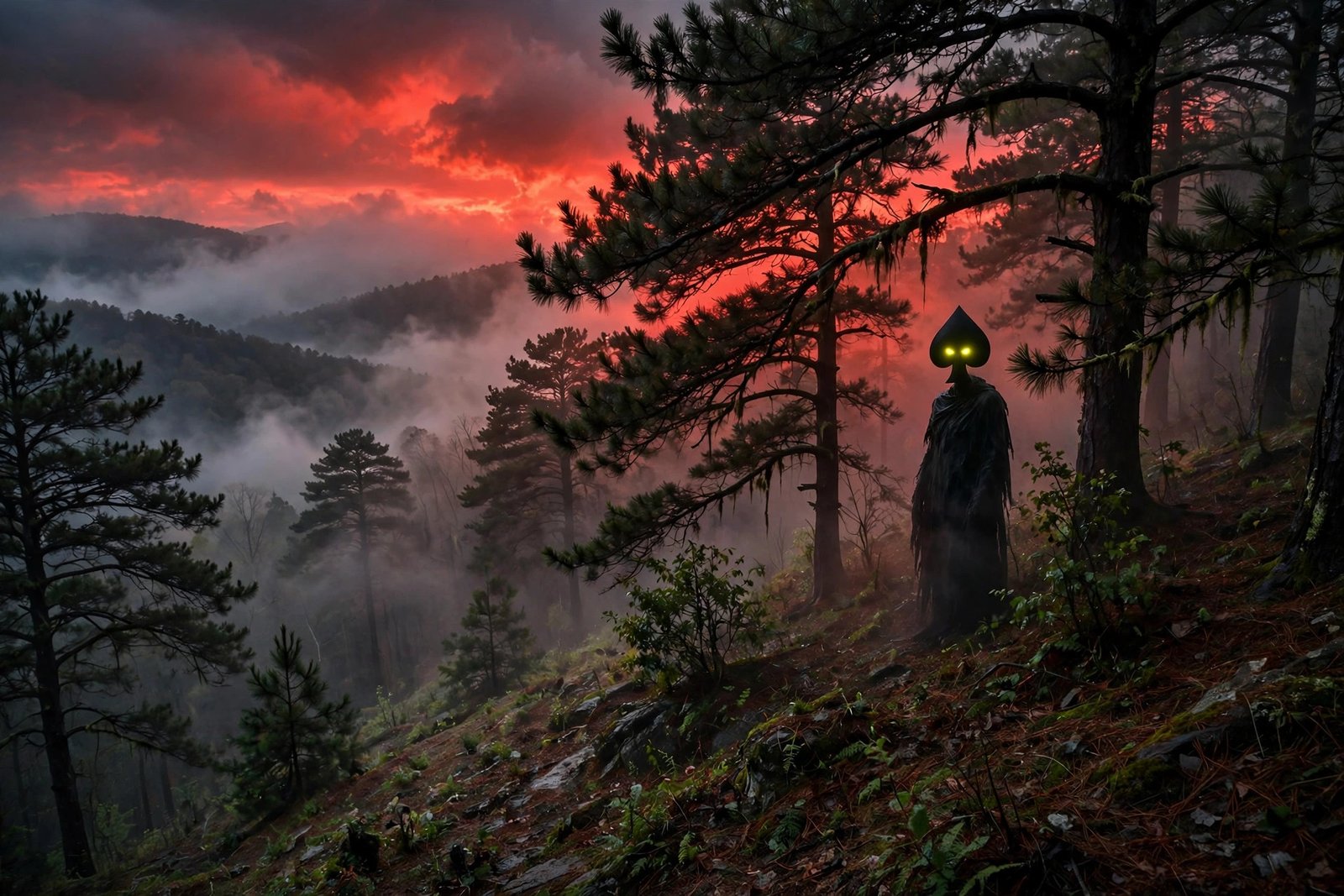
Some American legends are born slowly, passed down over generations until nobody remembers where the story started. The Flatwoods Monster is not one of them. It arrived all at once, on a single September evening in 1952, in front of seven witnesses who agreed on what they had seen — and then it never came back. More than seventy years later, the little town of Flatwoods, West Virginia, still lives in the shadow of that one strange night, and the question it raised has never really been settled: what did those people see on the hill?
The story sits at the crossroads of several very American obsessions: a small-town mystery, a Cold War flying saucer tale, and a piece of Appalachian folklore. It has been investigated by the United States Air Force, picked apart by skeptics, and turned into a museum and a video game character. Yet the core of it remains simple. Some local boys saw something fall from the sky, went to look, and ran from what they found.
A Quiet Saturday Evening in Braxton County
Flatwoods is a small town in Braxton County, in the central part of West Virginia. In 1952 it was the kind of place where everybody knew everybody, where kids played outside until dark, and where the biggest news of the week might be a church supper or a football game. The evening of Saturday, September 12, 1952, started out like any other early-autumn evening in the mountains.
That evening, brothers Edward and Fred May, aged thirteen and twelve, were playing with their friend Tommy Hyer, who was ten, on the playground of the Flatwoods Elementary School. It was around 7:15 p.m., just as dusk was settling over the town. Then something crossed the sky. The boys later described it as a bright, pulsing red ball of light, moving fast and trailing fire, that seemed to come down and land on a hillside on the farm of a local man named G. Bailey Fisher, just outside town.
To a group of boys in 1952, a fiery object falling from the sky meant one thing: a plane crash. The boys ran to the May family home to tell their mother, Kathleen May, what they had seen. Kathleen May, a local beautician, did not dismiss them. She gathered the boys, called on seventeen-year-old Eugene Lemon, a member of the West Virginia National Guard, and set out with the group — and the family dog — to investigate.
The Climb to Fisher’s Hill
The group made its way up the steep, wooded slope of the Fisher farm in the dark, with Lemon leading the way by flashlight. As they climbed, they noticed a strange smell in the air — a sharp, acrid odor that burned their eyes and throats. Ahead of them, through the trees, they could see a pulsing red glow.
Then Lemon’s flashlight beam caught something: a figure enormously tall, with estimates ranging from around seven feet to as much as ten feet. Its body seemed dark and metallic, draped in what Kathleen May described as a pleated, skirt-like garment. Its head was the strangest part: elongated and pointed, shaped like the ace of spades on a playing card, with a large cowl flaring out behind it.
The figure’s face glowed, and its eyes shone in the flashlight beam. It had long, claw-like hands, and witnesses said it appeared to hover or glide rather than walk. Then it made a shrill hissing sound, and a sickening mist seemed to fill the air. The dog panicked, Lemon reportedly felt faint, and the whole group ran back down the hill.
Kathleen May called the sheriff’s department, which was busy that night with reports of a possible plane crash. A state trooper sent local newspaper reporter A. Lee Stewart Jr. of the Braxton Democrat to the scene that same night, and Stewart later reported that he could still smell the strange odor. The next morning, investigators found skid marks, matted-down grass, and a strange oily substance — details documented at the time that have kept the case alive ever since.
What the Witnesses Said They Saw
One reason the Flatwoods case has endured is that the witnesses stuck to their story. Kathleen May and the boys were interviewed repeatedly in the days that followed, and their accounts stayed remarkably consistent. A week after the encounter, on September 19, 1952, Kathleen May appeared on the CBS television program We the People, alongside a drawing of the creature made from her description. That drawing became the definitive image of the Flatwoods Monster, still seen on museum posters and T-shirts today.
The witnesses also reported physical aftereffects: throat irritation, nausea, and vomiting in the days after the encounter. Skeptics have argued these symptoms were the result of fear, but the witnesses were clear that they felt genuinely ill, and the symptoms were recorded in contemporary reporting rather than added decades later. It is also worth noting what they did not claim: they never said they saw a spaceship, and they never claimed the creature spoke to them. They said they saw a bright object fall, went to look, and found something frightening they could not explain.
The Night the News Spread
Within days, the Flatwoods story was national news. The case landed in the middle of the great UFO wave of 1952, a year when flying saucer sightings were reported all over the United States. The summer of 1952 had already seen famous sightings over Washington, D.C., and public interest was at a fever pitch. Flatwoods fit the mood perfectly: a small town, a mysterious light, a monster on a hill.
UFO researchers soon descended on Braxton County. Gray Barker, a West Virginia native who became one of the era’s most famous UFO writers, interviewed the witnesses and published an account in Fate magazine in January 1953. The Flatwoods Monster became one of the defining entity encounters of the early flying saucer age. The timing mattered, too: America in 1952 was deep in the Cold War, and a strange light over a West Virginia farm could be a Soviet weapon, a secret experiment, or a visitor from another world.
The Air Force Investigates
The United States Air Force took the case seriously enough to investigate. The night of the sighting, the Air Force contacted the commander of the West Virginia National Guard, Captain Dale Leavitt, who was already in Braxton County looking into the reported plane crash, and asked him to inspect the scene. Two plainclothes Air Force investigators later visited the area as part of the military’s broader UFO inquiry, the effort that would become known as Project Blue Book.
The Air Force’s conclusion, relayed to UFO researcher Donald Keyhoe by public liaison Albert Chop in January 1953, was that the witnesses had probably seen a meteor, and that the creature was likely a misidentified natural object. The official explanation pointed to a meteor observed that same night across three states — Maryland, Pennsylvania, and West Virginia — and mistaken in some places for a flaming aircraft crashing into a hillside. As for the monster, the Air Force suggested the witnesses may have seen a barn owl, perched on a branch, its shape distorted by darkness, fear, and a flashlight’s glare.
The Meteor Explanation
The meteor theory is the strongest part of the official explanation. On the night of September 12, 1952, a bright meteor was observed across a wide area of the eastern United States, and near the Elk River, about eleven miles southwest of Flatwoods, it was reported as a flaming aircraft crashing into a hillside. A meteor breaking up in the atmosphere can produce exactly the kind of bright, pulsing, red-orange fireball the Flatwoods boys described.
What the meteor theory does not do is explain the whole evening. A meteor burns out in seconds. It does not leave a glowing light pulsing on a hillside minutes later, or a smell a reporter can still detect hours afterward. The boys saw the light at about 7:15 p.m., and the group reached the hilltop some time after that — long enough for a meteor’s fire to have faded. Something was still glowing on that hill when they arrived.
The Barn Owl Theory
The most famous skeptical explanation comes from investigator Joe Nickell, who revisited the case nearly fifty years later and published his findings in 2000. Nickell concluded that the bright light was a meteor, the pulsing red light was likely an aircraft beacon, and the creature itself was a barn owl. The barn owl, with its pale heart-shaped face and upright posture on a branch, can look uncannily humanoid in the dark — especially in a flashlight beam, seen by frightened children.
Nickell’s theory has convinced many skeptics. A barn owl startled on a branch will spread its wings, hiss, and stare with dark, unblinking eyes. In the dark, a large owl could plausibly be mistaken for a tall, hooded figure, the hiss matches an owl’s defensive hiss, and the glowing eyes match the way an owl’s eyes catch the light.
But the owl theory has its own problems, and the witnesses themselves rejected it. Kathleen May and the others insisted that the figure was far too large to be a bird, that it had a distinctly humanoid shape with arms and clawed hands, and that it appeared to move toward them rather than sitting on a branch. A barn owl is about a foot and a half tall. The witnesses described something closer to ten feet. Fear can distort size, but a gap that large is hard to explain away entirely. As with the meteor, the owl theory explains part of the story very well — and leaves the rest untouched.
Hoax, Hysteria, or Visitors?
Other explanations have been offered. Some have suggested a hoax, but no evidence of one has ever surfaced, and the witnesses had nothing to gain: they did not get rich, only interviewed, doubted, and sometimes ridiculed. Another suggestion is mass hysteria — that the boys, excited by the meteor, frightened each other into seeing a monster. Groups can reinforce each other’s misperceptions in the dark, but hysteria does not easily explain the physical traces found the next morning, or the fact that a reporter smelled the odor himself.
Then there is the explanation the witnesses themselves leaned toward: that what they saw was not of this Earth. Believers point to the consistency of the testimony, the physical traces, and the aftereffects as evidence that something genuinely unexplained happened on that hill. Skeptics point to the meteor and the owl. Neither side can prove its case — and that is exactly why the story endures.
Why Flatwoods Still Matters
Whatever happened on September 12, 1952, the Flatwoods Monster has become a permanent part of American folklore. The town of Flatwoods and the nearby county seat of Sutton have embraced the legend. The Flatwoods Monster Museum in Sutton, which doubles as the Braxton County visitors center, tells the story with artifacts and original drawings, and draws cryptid fans from across the country. Giant green monster chairs dot the area, and the creature has become a beloved local mascot.
The monster has traveled far beyond West Virginia. It appeared in the video game Fallout 76, set in a fictionalized version of the state, and on television shows like Mountain Monsters. In 2026, West Virginia released a special cryptid license plate featuring nine of the state’s legendary creatures, with the Flatwoods Monster as the biggest figure on the design. The monster that scared seven people on a dark hillside in 1952 is now, improbably, a symbol of West Virginia itself.
That transformation — from frightening encounter to folk hero — is part of what makes the Flatwoods story so American. We take our mysteries and make them ours: we build museums for them and put them on license plates. There have been no credible sightings since that night, and the hillside on the old Fisher farm is private property, so visitors are asked not to trespass. But the legend does not need another sighting. It has everything it needs already: a clear night, a falling light, seven witnesses, and a question that has outlived them all.
Frequently Asked Questions
When did the Flatwoods Monster sighting happen?
On Saturday, September 12, 1952, at around 7:15 p.m., in Flatwoods, Braxton County, West Virginia. The witnesses first saw a bright red object cross the sky and appear to land on the farm of G. Bailey Fisher.
Who saw the Flatwoods Monster?
Seven people went up the hill together: Kathleen May, her sons Edward and Fred May, their friends Tommy Hyer, Neil Nunley, and Ronnie Shaver, and seventeen-year-old National Guardsman Eugene Lemon. The family dog went along, and Kathleen May later described the encounter on national television.
What did the Flatwoods Monster look like?
According to the witnesses, it was a very tall figure — estimates range from about seven to ten feet — with a dark, metallic-looking body draped in a pleated, skirt-like garment, long clawed hands, and an elongated head shaped like the ace of spades, with glowing eyes. It was said to hiss and glide toward the group through a strange mist.
What did the Air Force conclude about Flatwoods?
The U.S. Air Force concluded that the light in the sky was most likely a meteor seen across three states that night, and that the creature was probably a misidentified barn owl. Skeptic Joe Nickell reached a similar conclusion in 2000.
Can you visit the Flatwoods Monster site today?
The original sighting location on the old Fisher farm is private property, so visitors should not trespass. Instead, fans can visit the Flatwoods Monster Museum in nearby Sutton, West Virginia, which is free to enter and tells the full story of the 1952 encounter.
Related reading
If the Flatwoods Monster captured your imagination, keep exploring. Read about the Mothman legend of Point Pleasant, another West Virginia mystery that terrified a small town. Then dive into the Roswell UFO incident of 1947, the case that started America’s flying saucer age. And for another unexplained light in the mountains, check out the Brown Mountain Lights of North Carolina, a glow that has puzzled witnesses for more than a century.
Sources and further reading: the Flatwoods Monster case file collects the witness accounts and the investigation; a modern retelling of what really happened in 1952 lays out the timeline and theories; the Clio entry on the Braxton County Monster crash site places the event in its Cold War context; and a recent overview of the 1952 encounter covers the museum and the folklore.