
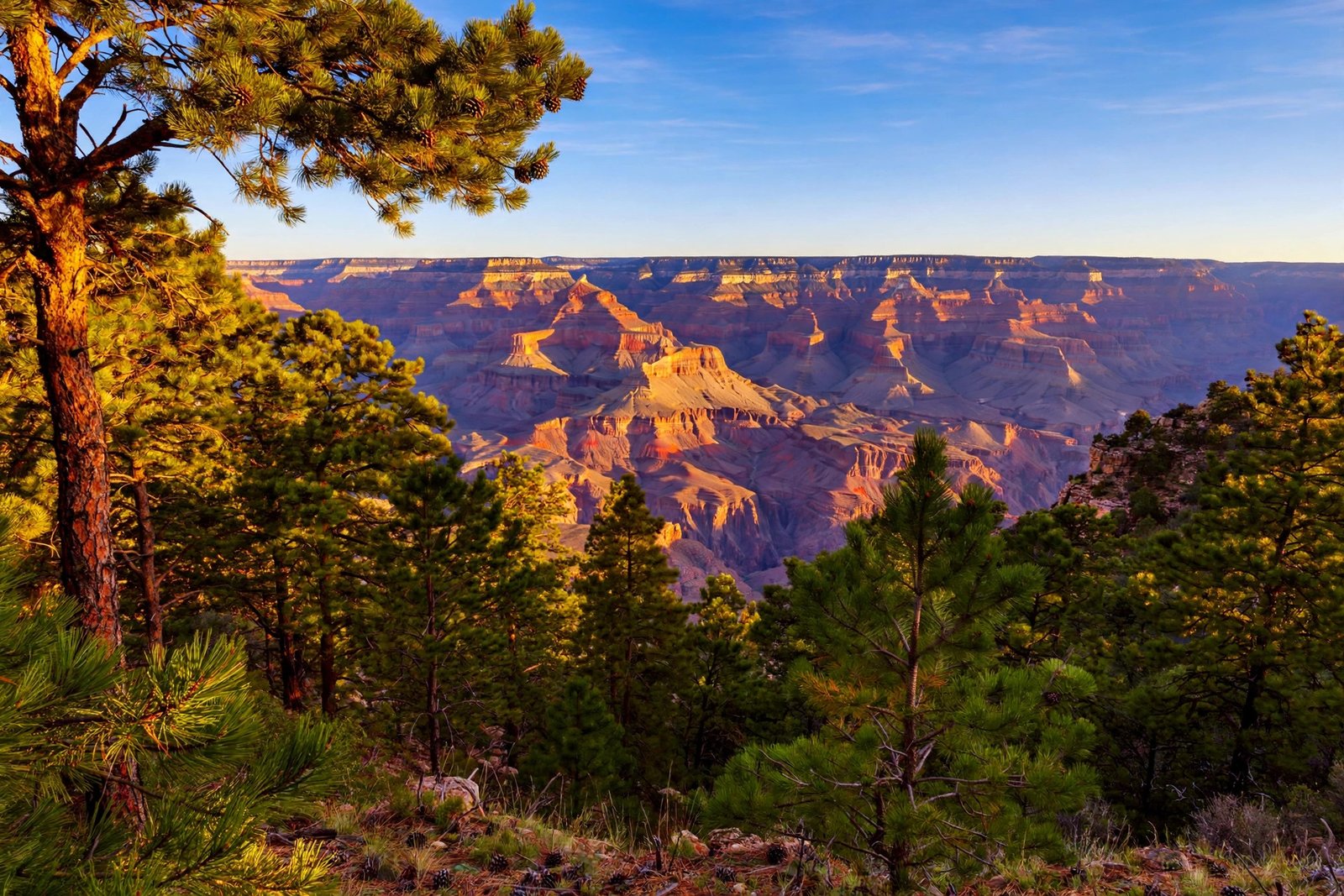
Most people who visit the Grand Canyon never see its North Rim. They drive to the South Rim, join the crowds at the viewpoints, and go home believing they have seen the canyon. They have seen only half of it, and arguably the busier half. Across the great chasm, about 212 miles away by road, the North Rim waits on a cool, forested plateau more than 1,000 feet higher than the South Rim, wrapped in ponderosa pine and aspen, with a fraction of the visitors and a silence that feels almost unreal after the South Rim’s shuttle buses and parking lots.
The North Rim receives only about 10 percent of the park’s visitors. It is open only for a short season each year, it has always had far fewer services than the South Rim, and reaching it takes a deliberate detour. But for travelers willing to make that detour, the reward is one of the great experiences in the American national park system: the same mile-deep canyon, seen from a greener, cooler, quieter world. This guide covers what makes the North Rim different, when to go, how to get there, the viewpoints and trails worth your time, and what has changed since the summer of 2025, when a wildfire reshaped the rim.
This guide covers what makes the North Rim different, when to go, how to get there, the viewpoints and trails worth your time, and, importantly, what has changed since the summer of 2025. A wildfire reshaped the North Rim, and the 2026 season looked very different from the seasons before it. If you are planning a trip, the practical details here matter as much as the scenery.
Why the North Rim Feels Like a Different Park
The first thing you notice is the elevation. The rim sits at more than 8,000 feet, roughly 1,000 feet higher than the South Rim, and the air feels different: cooler, thinner, and scented with pine. In midsummer, when the South Rim bakes, the North Rim runs about 10 to 15 degrees cooler, with summer highs often in the 70s. You might want a jacket in July, and a morning frost is possible in late May or late September.
The second thing you notice is the forest. The South Rim is high desert, all juniper, rock, and open sky. The North Rim is a mountain forest of ponderosa pine, spruce, fir, and aspen, with wildflower meadows breaking up the trees; in autumn the aspen turn gold and the whole plateau glows. Mule deer graze the meadows at dawn, and the Kaibab squirrel, found nowhere else on Earth, lives only in the ponderosa forests of the Kaibab Plateau. The third thing you notice is the quiet. With only about a tenth of the park’s visitors, the North Rim never feels crowded, and from its viewpoints you look south across a wider, deeper-feeling expanse of rock. The canyon looks bigger from here, and somehow more remote.
What Changed in 2025, and What It Means for Your Trip
Any guide to the North Rim written before the summer of 2025 is now out of date. On July 4, 2025, a lightning strike ignited the Dragon Bravo Fire on the Kaibab Plateau. The fire burned approximately 149,399 acres, including more than 71,000 acres on the North Rim of the park, according to the National Park Service, and destroyed or severely damaged more than 100 structures. Among them was the historic Grand Canyon Lodge, the stone-and-timber lodge that had anchored the North Rim since the 1930s, along with the visitor center, guest cabins, and critical utility systems such as the water pipeline and wastewater treatment plant.
The North Rim reopened on May 15, 2026, as a day-use destination, with no overnight lodging inside the park, no in-park dining, and only limited services. The North Rim Campground reopened on June 1, 2026, by reservation through Recreation.gov, but without water or RV hookups, so campers had to haul in their own water. The nearest beds, food, fuel, and water were outside the park at Kaibab Lodge, the North Rim Country Store, and Jacob Lake Inn, roughly 18 to 45 miles back up Highway 67. The season was extended into a limited fall day-use period until November 30, 2026, unless a major snowstorm closed it earlier, but the campground, gas station, general store, and backcountry office closed in mid-October, and no drinking water or food was available on the rim between October 16 and November 30. The park has said a gradual return of services is expected in 2027 and 2028, with no dates yet announced for the 2027 season, so check the conditions page the day before you go.
When to Go
The North Rim has a short season, and the calendar matters more here than at almost any other national park destination. In a typical year, the season runs from mid-May through mid-October. Highway 67, the only paved road to the rim, closes from December 1 through May 15 because of snow, and services close with the road. The South Rim, by contrast, is open all year.
The best times to visit are late May and June, and again from mid-September to mid-October. Early summer brings wildflowers and long days, while autumn brings golden aspen, crisp air, and the thinnest crowds of the year. July and August bring the monsoon, with afternoon thunderstorms, lightning, and sudden temperature drops, so never hike below the rim in a storm. Winter is a hard closure: deep snow buries the plateau and the road is gated. If your dates fall between mid-October and mid-May, plan on the South Rim instead.
Getting There
Getting to the North Rim is part of the adventure, and part of the reason so few people make it. The entrance is located 30 miles south of Jacob Lake, Arizona, on Highway 67, and the actual rim is another 14 miles south of the entrance.
The drive between the North and South Rims is about 212 miles, or roughly four and a half hours each way, even though the two rims are only about 10 miles apart as the crow flies. The road must loop all the way around the canyon, east past the Navajo Bridge near Marble Canyon or west through Fredonia and Kanab. There is no shortcut, so give each rim its own day. Fill up at Jacob Lake, since there is no gas at the rim, and note the entrance fee is 35 dollars per private vehicle for a seven-day pass, valid at both rims. Cell service is limited on the plateau, so download offline maps before you go.
The Viewpoints You Should Not Miss
The North Rim’s viewpoints are reached by a short network of scenic roads, and you can see the best of them in half a day, or stretch them across a full day with walks and picnics. Start at Bright Angel Point, near the old lodge area. A paved trail of about half a mile round trip, roughly 30 minutes, leads to a narrow promontory with sweeping views from the Transept in the west to Bright Angel Canyon in the east.
Then drive the Cape Royal Road across the Walhalla Plateau to Cape Royal, about a half-hour drive. The Cape Royal Trail is an easy, flat, paved walk of about six-tenths of a mile round trip, ending at one of the finest viewpoints in the park, with a broad panorama of the canyon and the Colorado River far below. Along the way you pass Angels Window, a natural arch in the Kaibab limestone that frames the river. On the same drive, stop at Point Imperial, the highest viewpoint in the park at 8,803 feet, and at Roosevelt Point and the Cape Final Trail, about two miles round trip, to the easternmost viewpoint on the North Rim. Bring a picnic and give yourself time to watch the light change on the rock.
Trails Worth Your Time
The North Rim’s trails range from easy strolls to one of the hardest hikes in the national park system, and the rule is to match the trail to your fitness, your water supply, and the heat. The North Kaibab Trail is the only maintained trail into the canyon from the North Rim. The full route descends about 14 miles one way to the Colorado River, dropping nearly 6,000 feet, and the 28-mile round trip is not a day hike under any circumstances. Most visitors sample it instead: the Coconino Overlook is about 1.5 miles round trip, the Supai Tunnel about 4 miles, and Roaring Springs, 3,050 feet below the rim, is a strenuous 9.4-mile round trip that takes a full day and should be started before 7 a.m. Check current conditions first, because flooding in August 2026 affected the lower trail, and never hike from the rim to the river and back in one day.
For a gentler walk, the Widforss Trail runs about 10 miles round trip through aspen and ponderosa forest to Widforss Point, with canyon views along the way. Shorter options include the Transept Trail and the Uncle Jim Trail. Whatever you hike, the elevation matters: at 8,000 feet and above, the air is thin, and visitors commonly underestimate how much it affects breathing, energy, and hydration. Drink more water than you think you need, and take the first hour slowly.
Where to Stay and Eat
With no in-park lodging during the 2026 season, the practical question is where to sleep. The closest options are outside the park along Highway 67. Kaibab Lodge, about 18 miles north of the rim, offers cabins and a restaurant. The North Rim Country Store, a few miles further north, has basic supplies. Jacob Lake Inn, at the junction of Highways 89A and 67, about 45 miles from the rim, is the largest nearby base, with rooms, cabins, a restaurant, a bakery famous for its cookies, and a gas station. Kanab, Utah, about 80 miles north, has the widest choice of hotels and restaurants.
Camping inside the park is possible when the North Rim Campground is open, by reservation through Recreation.gov. The campground has 90 sites and fills quickly in summer, so book early. In 2026 it operated without water or hookups, so campers needed to bring their own water. Dispersed camping is available in the surrounding Kaibab National Forest. With no dining on the rim in 2026, bring a cooler with sandwiches, snacks, and plenty of water, and plan your main meal at Kaibab Lodge, Jacob Lake Inn, or Kanab.
Practical Tips for a Smooth Visit
A few practical notes will make your visit smoother. First, altitude: the rim sits above 8,000 feet, so take it easy on arrival, drink water steadily, and watch for headaches or shortness of breath. Second, water: there may be no potable water on the rim at all, depending on the season, so carry at least a gallon per person per day in summer. Third, fuel: fill the tank at Jacob Lake, because there is no gas at the rim. Fourth, weather: temperatures swing widely between day and night, so pack layers even in July. Fifth, wildlife: mule deer cross the roads, especially at dawn and dusk, so drive slowly on Highway 67. Finally, respect the recovery: the Dragon Bravo Fire burned much of the plateau, so stay on trails and roads and do not enter closed areas. The forest will come back, and visiting now, carefully, is a chance to see a landscape in the middle of its recovery.
North Rim or South Rim?
If it is your first visit, if you are traveling with children or older relatives, if you want restaurants, lodges, shuttle buses, and ranger programs, or if you are visiting in winter, choose the South Rim. It is open all year, it has the most services, and it is the easiest way to see the canyon.
If you have already seen the South Rim, if you love quiet forests and long empty viewpoints, or if you are driving a loop through Utah’s parks, choose the North Rim. It is higher, cooler, greener, and far less crowded. The best answer, if your schedule allows it, is both: give the South Rim a day, drive the long way around, and give the North Rim a day. The Grand Canyon is not one place. It is two rims, two worlds, and a mile of rock between them.
Frequently Asked Questions
Is the North Rim open right now?
The North Rim is open seasonally, typically from mid-May through mid-October, with the 2026 season extended into a limited fall day-use period until November 30, 2026, unless a major snowstorm closes it earlier. Highway 67 closes from December 1 through May 15. Check the National Park Service conditions page before you go.
How much higher is the North Rim than the South Rim?
The North Rim sits at more than 8,000 feet, about 1,000 feet higher than the South Rim, which averages around 7,000 feet. Point Imperial, at 8,803 feet, is the highest viewpoint in the park, and the North Rim runs about 10 to 15 degrees cooler.
Can I stay overnight on the North Rim?
Not inside the park during the 2026 season. The Grand Canyon Lodge was destroyed in the Dragon Bravo Fire of July 2025, and there was no in-park lodging or dining in 2026. The campground ran by reservation, without water or hookups. The nearest lodging is at Kaibab Lodge and Jacob Lake Inn, 18 to 45 miles north on Highway 67, with more options in Kanab, Utah.
How far is the North Rim from the South Rim?
About 212 miles by road, roughly four and a half hours each way. The rims are only about 10 miles apart across the canyon, but the road must loop around it. Plan one day per rim.
Is the North Rim good for families?
Yes, with planning. The Bright Angel Point and Cape Royal trails are short, paved, and suitable for most visitors, including children. Bring food, water, and layers, keep children close at unfenced viewpoints, and watch the altitude.
Related Reading
- America’s 63 National Parks: The Complete Guide
- White Sands National Park: A New Mexico Guide
- Channel Islands: California’s Galapagos Hidden Gem
Sources: National Park Service, How Do I Travel to the North Rim?; National Park Service, 2026 North Rim Pocket Map and Services Guide; More Than Just Parks, Things to Do in the North Rim; DesertUSA, Grand Canyon North Rim Hiking Trails; GrandCanyon.com, Best Things to Do at Grand Canyon North Rim; Etaperia, Visiting the Grand Canyon: South Rim or North Rim?.