
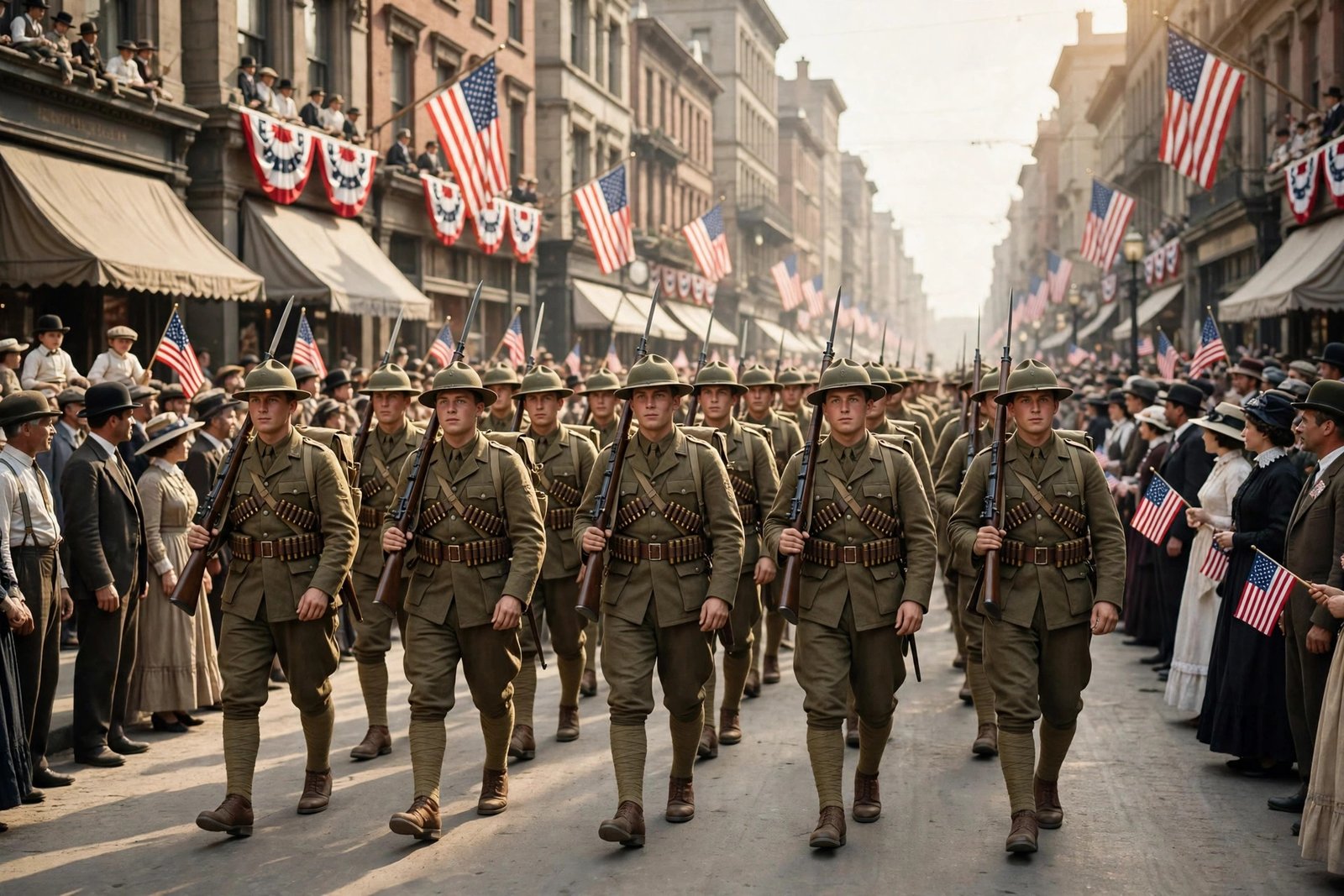
On February 17, 1919, nearly 3,000 Black soldiers marched up Fifth Avenue in New York City while hundreds of thousands of cheering New Yorkers packed the sidewalks. Their band played, their bayonets caught the winter sun, and flowers rained down on them from windows above. They were the men of the 369th Infantry Regiment, and they had just come home from a war that had asked everything of them and given them almost nothing in return. The Germans who had faced them in France called them the Hellfighters. History remembers them as the Harlem Hellfighters, one of the most decorated American units of World War I, and one of the most wronged.
Their story is not just a war story. It is a story about men who volunteered to fight for a country that would not let them fight beside its own white soldiers, who were handed over to a foreign army, and who answered that insult by becoming the finest combat regiment the United States fielded in the Great War. They spent 191 days under fire, longer than any other American unit of their size. They never lost a foot of ground. They never lost a single man as a prisoner. And when they came home, the country they had served still refused them a seat at the table.
From the 15th New York to the 369th
The regiment began as the 15th Infantry Regiment of the New York National Guard, authorized in 1913 and organized in 1916. It was the first and only all-Black National Guard unit in New York, and its ranks were filled mostly by men from Harlem and other Black communities across New York City and the surrounding states. When the United States entered World War I in April 1917, the men of the 15th were ready. Their country was not ready for them.
At the time, the United States Army was strictly segregated, and its senior commanders had little interest in sending Black troops into combat. The men of the 15th were denied a farewell parade when they shipped out in 1917, a slight that stung deeply in a city that loved a parade. They trained at Camp Wadsworth in South Carolina, where they faced the daily humiliations of Jim Crow, and then sailed for France, arriving in late December 1917. Even then, the Army had no plan to use them as fighters. For months they were assigned to unloading ships, building roads, and other labor details while white regiments went to the front.
It was only in the spring of 1918, when the German spring offensive was hammering the Allies and France was desperate for fresh troops, that the regiment finally got its chance. On March 1, 1918, the 15th New York was redesignated the 369th Infantry Regiment. Soon after, General John J. Pershing, the commander of the American Expeditionary Forces, agreed to loan the regiment to the French Army. The 369th would fight under French command, wearing French helmets, carrying French rifles, and eating French rations. It was a humiliating arrangement, and it was also the opening the men had been waiting for.
Loaned to the French, Feared by the Germans
The French welcomed the 369th in a way the American Army never had. French officers treated the Black soldiers as fellow soldiers, not as a problem to be managed. The regiment was assigned to the French 161st Division, and in April 1918 its men entered the trenches for the first time. They would not leave the front for long stretches again until the war ended.
The nickname came quickly. German soldiers who faced the regiment in battle began calling them the Hellfighters, a name that captured the ferocity with which the men fought. The French called them the Men of Bronze. Back home, newspapers picked up the German name, and the Harlem Hellfighters were born. The regiment adopted a rattlesnake as its emblem, along with the motto “Don’t Tread On Me.”
What made the 369th so effective was not just courage but discipline. The men held their ground under artillery bombardments that shattered less steady units. They took objectives other regiments had failed to take. And they did it while knowing that every mistake would be held against not just them but every Black American who might ever wear the uniform. They fought, in a very real sense, for the right of Black men to be counted as soldiers at all.
The Night Henry Johnson Became a Legend
The most famous night in the regiment’s history came in May 1918, in the Argonne Forest. Privates Henry Johnson and Needham Roberts were on sentry duty at a forward outpost when a German raiding party of about a dozen men attacked them in the dark. Roberts was badly wounded early in the fight. Johnson, fighting alone, used his rifle, then his bolo knife, to drive the raiders off, killing several of them and saving Roberts from capture. Johnson himself was wounded many times in the fight, and he refused to leave his wounded comrade behind.
The French were the first to honor what Johnson and Roberts had done. Both men received the Croix de Guerre, France’s award for valor in combat, becoming among the first Americans to receive the decoration. Johnson was celebrated in the American press and given the nickname “Black Death” by the newspapers. He came home a hero, and then he was forgotten. The United States Army gave him no medal for the fight. He struggled after the war, his wounds made steady work impossible, and he died in 1929, largely unrecognized by the country he had served.
It took nearly a century for America to catch up with France. Johnson was posthumously awarded the Purple Heart in 1996 and the Distinguished Service Cross in 2002. In 2015, President Barack Obama awarded him the Medal of Honor, the nation’s highest award for valor, in a White House ceremony. He became only the second African American to receive the Medal of Honor for actions in World War I. Needham Roberts, his fellow sentry that night, has never received the same level of recognition, a gap that historians and advocates still point to today.
191 Days Under Fire
The Johnson and Roberts fight was a single night. What set the 369th apart was the relentless grind that followed. The regiment spent 191 days on the front line, more than any other American regimental-sized unit in the war. For six months, the men lived under fire, in trenches and in open attacks, through the Champagne-Marne, Meuse-Argonne, Champagne 1918, Alsace 1918, and Lorraine 1918 campaigns.
The cost was enormous. The regiment suffered roughly 1,500 casualties, the highest total of any American regiment in the war. Yet the record the men left behind was almost unbelievable: the 369th never lost a foot of ground to the enemy, and never had a man taken prisoner. When the war ended on November 11, 1918, the regiment was among the first Allied units to reach the Rhine River, an honor the French Army bestowed on them in recognition of their service.
France awarded the entire regiment the Croix de Guerre, and more than 170 individual soldiers received the decoration as well. It was an extraordinary honor. No other American regiment received a unit Croix de Guerre in World War I. The 369th had gone to France as a unit nobody wanted and came out of the war as the most decorated American regiment of its size.
The Band That Brought Jazz to Europe
The 369th carried another weapon into France, and it was not a rifle. Its regimental band, led by Lieutenant James Reese Europe, was one of the finest musical ensembles in the American Army. Europe was already a famous bandleader in New York, and the band he built in the regiment mixed ragtime, blues, and the new sound that would soon be called jazz. Wherever the regiment went, the band played, and European audiences had never heard anything like it.
Historians credit the 369th’s band with introducing jazz to Europe. In the spring and summer of 1918, the band gave concerts across France, and French audiences were electrified. The music mattered for more than entertainment. In a war defined by misery, the band gave the men of the 369th a way to carry their culture with them, and it gave European audiences a new sound that would shape popular music for the rest of the century. James Reese Europe did not live to see the full impact of what he started. He was killed in 1919, shortly after returning home, but his band’s tour of France remains one of the great cultural moments of the war.
The Homecoming Parade and the Country They Came Back To
The regiment arrived back in the United States at Hoboken, New Jersey, on February 10, 1919. A week later, on February 17, the men marched up Fifth Avenue, from 23rd Street to 145th Street and Lenox Avenue in Harlem, a route of more than seven miles. The parade passed a reviewing stand that included New York Governor Al Smith and Mayor John Hylan. The city had denied these men a farewell parade in 1917. In 1919, it gave them one of the great homecomings in New York history.
The celebration was real, and it was also brief. The men came home to a country that had not changed. The summer of 1919 brought the Red Summer, a wave of racial violence across American cities, including attacks on Black veterans still in uniform. The jobs the men had been promised were not waiting for them. The voting rights they had fought for were still denied across much of the South. The regiment was demobilized on February 28, 1919, just eleven days after the parade, and its men scattered back into civilian life with little help from the government they had served.
That contradiction is the heart of the Harlem Hellfighters’ story. They proved, beyond any doubt, that Black soldiers could fight as well as any soldiers in the world. The proof changed nothing in the short term. The Army stayed segregated for another generation, until President Harry Truman ordered its desegregation in 1948. But the record the 369th left behind became a weapon in the long fight for civil rights, and for the integration of the armed forces. Every time the question was asked, the answer was already written in France in 1918.
Recognition That Took a Century
For decades, the Hellfighters were a footnote in most histories of World War I. That has changed in recent years. In 2021, Congress passed the Harlem Hellfighters Congressional Gold Medal Act, awarding the regiment the Congressional Gold Medal in recognition of its bravery and service. The law’s findings repeat the facts that now define the regiment: 191 days on the front line, more than any other American regimental-sized unit, and a record of never losing ground or a man to capture.
Today, the 369th Sustainment Brigade of the New York National Guard carries the regiment’s lineage, and the Hellfighters’ story is told in museums, books, and classrooms across the country. A graphic novel by Max Brooks and Caanan White, The Harlem Hellfighters, brought the story to a new generation. The National Guard, the Smithsonian, and the National Archives all preserve the regiment’s photographs and records, including the famous images of the men marching up Fifth Avenue in February 1919.
The lesson of the 369th is not only about courage under fire. It is about what happens when people are given a fair chance to prove themselves, and about how long a country can take to honor a debt. The men of the Harlem Hellfighters did not wait for permission to be heroes. They fought for a nation that had not yet decided they were full citizens, and they left behind a record no one has ever been able to take away from them.
The regiment’s story also lives on in the streets of Harlem itself. The 369th Regiment Armory, the unit’s historic home at 2366 Fifth Avenue, still stands as a landmark, listed on the National Register of Historic Places in 1994 and designated a New York City landmark in 1985. For visitors to New York, the armory is a quiet reminder that the city’s history was written by men it once refused to honor.
Frequently Asked Questions
How long did the Harlem Hellfighters spend in combat?
The 369th Infantry Regiment spent 191 days on the front line in World War I, more than any other American regimental-sized unit. The figure is confirmed in the findings of the Harlem Hellfighters Congressional Gold Medal Act of 2021.
Why did the Harlem Hellfighters fight under French command?
The United States Army was segregated in World War I, and American commanders were unwilling to deploy Black troops in combat alongside white units. General Pershing loaned the 369th to the French Army, which welcomed the regiment, equipped it with French weapons, and sent it to the front.
Who were Henry Johnson and Needham Roberts?
Johnson and Roberts were privates in the 369th who fought off a German raiding party of about a dozen men while on sentry duty in the Argonne Forest in May 1918. Both received the French Croix de Guerre. Johnson was posthumously awarded the Medal of Honor in 2015.
Did the Harlem Hellfighters really never lose a man as a prisoner?
Yes. According to the regiment’s official record, the 369th never lost a foot of ground to the enemy and never had a man taken prisoner, despite suffering roughly 1,500 casualties, the highest total of any American regiment in the war.