
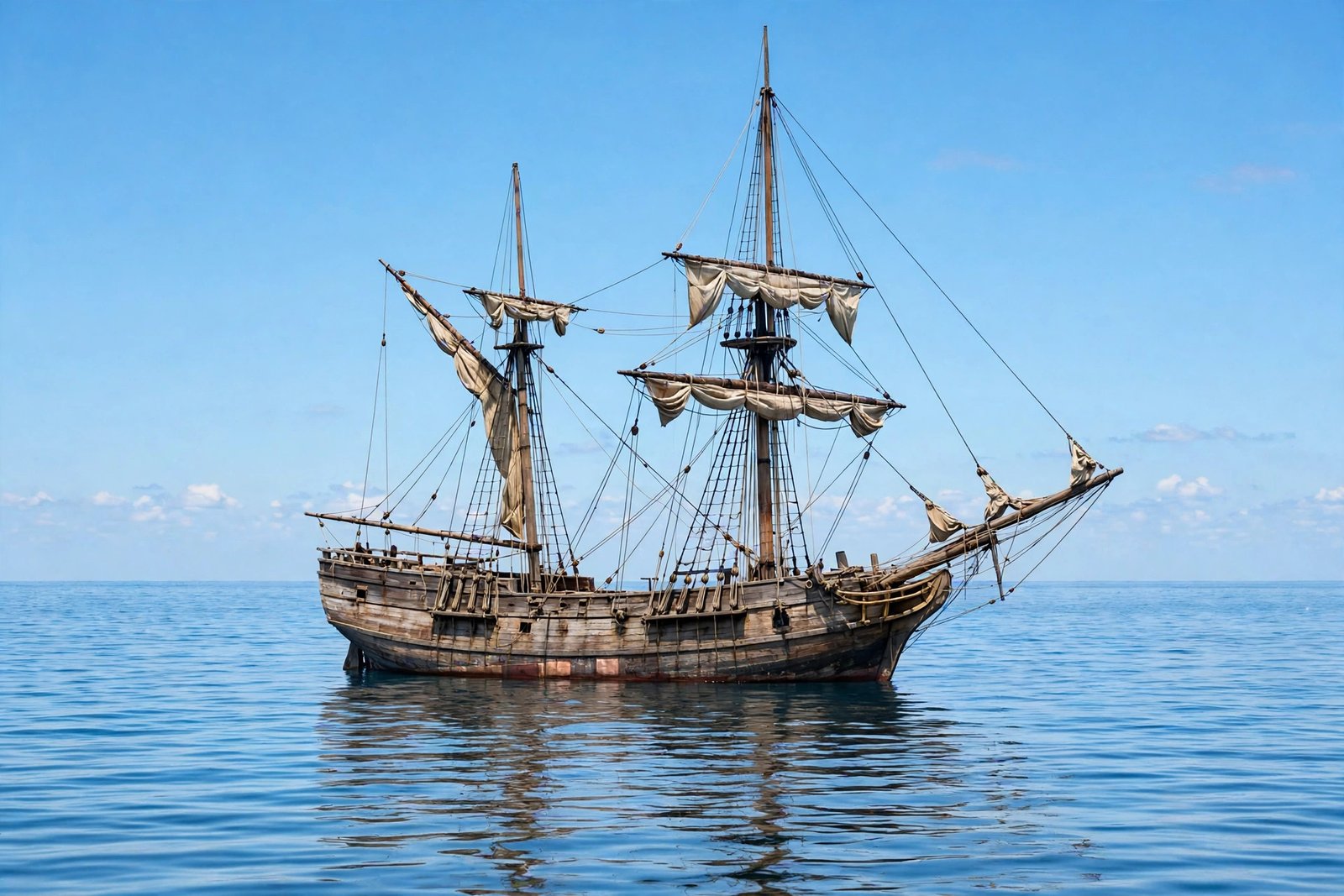
On a grey December afternoon in 1872, a Canadian brigantine crossing the Atlantic spotted a ship behaving strangely, sailing under a ragged set of sails with no one at the wheel. When sailors from the Dei Gratia climbed aboard, they found a seaworthy vessel, a full cargo, six months of food and water, and not a single human being. The ship was the American merchant brigantine Mary Celeste, and the ten people who had sailed in her — Captain Benjamin Briggs, his wife, their two-year-old daughter, and seven crewmen — were gone without a trace.
More than 150 years later, no one has explained what happened. The Mary Celeste is the most famous ghost ship in history, and the facts alone are strange enough: a sound ship, an experienced captain, a missing lifeboat, and nine days of silence in the log. Here is what we actually know — and what we can only guess.
A Ship With Two Names
The vessel that became the Mary Celeste was launched in 1861 in the small Nova Scotia village of Spencer’s Island, on the shore of the Bay of Fundy. Built under British registration, she was first christened the Amazon, and her early career was troubled: she ran aground, changed hands several times, and was at one point wrecked and rebuilt. In 1868 she was sold to American owners, and after an extensive refit in New York she was renamed the Mary Celeste.
By the autumn of 1872 the ship was owned by a consortium of investors, and her new captain, Benjamin Spooner Briggs, held a share in her himself. Briggs was born in Wareham, Massachusetts, on April 24, 1835, one of five sons of a sea captain. He was a devout Christian and a well-regarded master mariner. He had married his cousin Sarah Elizabeth Cobb in 1862, and the couple had two children: Arthur, born in 1865, and Sophia Matilda, born in October 1870. For his first voyage in command of the Mary Celeste, Briggs brought Sarah and baby Sophia along, leaving seven-year-old Arthur at school at home with his grandmother.
At Pier 50 on New York’s East River, the Mary Celeste loaded 1,701 barrels of alcohol bound for Genoa, Italy. She left the pier on November 5, 1872, anchored off Staten Island to wait out uncertain weather, and put to sea on November 7 with ten people aboard: the Briggs family and seven crewmen — first mate Albert Richardson, second mate Andrew Gilling, cook Edward Head, and seamen Volkert Lorenzen, Arian Martens, Boy Lorenzen, and Gottlieb Goodschaal.
The Voyage That Should Have Been Routine
Nothing in the ship’s log suggests trouble in the first days at sea. The Mary Celeste was a working merchant vessel on a well-travelled Atlantic route, and the crossing to the Mediterranean was the kind of trip Briggs had made many times before. Eight days behind her, the Canadian brigantine Dei Gratia, under Captain David Morehouse, left Hoboken, New Jersey, with a cargo of petroleum bound for Genoa via Gibraltar. Morehouse and his first mate, Oliver Deveau, were experienced Nova Scotian seamen, and the two captains knew each other — they had reportedly dined together in New York before sailing. The Dei Gratia put to sea on November 15, eight days behind the Mary Celeste, on the same general route across the Atlantic.
For nearly three weeks the two ships sailed the same ocean without meeting. The Mary Celeste battled heavy weather for about two weeks before reaching the Azores, according to Smithsonian magazine. Her log recorded the ship’s progress day by day until the morning of November 25, when it stopped. The final entry, written at 8 a.m., placed the ship off Santa Maria Island in the Azores. Nothing in it suggested alarm. After it, the log falls silent for nine days.
The Discovery: An Empty Ship in Mid-Ocean
At about 1 p.m. on December 4, 1872, the Dei Gratia was midway between the Azores and the coast of Portugal — at 38 degrees 20 minutes north, 17 degrees 15 minutes west — when her helmsman spotted a ship about six miles away, moving unsteadily under an odd set of sails. The crew hailed her. There was no answer.
Captain Morehouse sent his first mate, Oliver Deveau, and second mate John Wright across in a boat. They read the name on the stern, climbed aboard, and found her deserted. The sails were partly set and much of the rigging was damaged, with ropes hanging over the sides.
The most important discovery was what was missing: the ship’s only lifeboat, a small yawl stowed across the main hatch, was gone. The cargo of 1,701 barrels of alcohol was largely intact, though nine barrels were found empty. About three and a half feet of water was sloshing in the hold — significant, but not alarming for a ship of her size. A six-month supply of food and water sat untouched below, and the crew’s personal belongings appeared undisturbed. There was no sign of violence anywhere on board.
Morehouse put Deveau and two men aboard the derelict and sailed both ships together on the roughly 800-mile journey to Gibraltar, arriving in mid-December. It was a dangerous undertaking — the Dei Gratia was short-handed for the rest of the voyage — but the salvage payment for a recovered ship and cargo was worth the risk.
What the Boarding Party Actually Found
The details recorded by the boarding party matter, because so much of what people think they know about the Mary Celeste is wrong. The ship was not found with a warm meal on the table or a fire burning in the galley, and the log had not been written up to the hour of discovery. Those dramatic touches came later, mostly from fiction.
Here is what the sworn testimony and the court’s examination actually established. One of the ship’s two pumps had been taken apart and lay disassembled on deck, suggesting someone had been trying to repair it. The main hatch was secured, but the fore hatch and the lazarette hatch were open. The ship’s chronometer, sextant, and navigational papers were missing — the instruments a captain would take with him into a lifeboat. The nine empty barrels were made of red oak, a more porous wood than the white oak used for the others, and the ship’s charts had been tossed about.
The Gibraltar authorities also tested the reddish stains found on the deck and on a sword, which some had taken for blood. Scientific tests showed the stains were rust, not blood. The boarding crew from the Dei Gratia ate the ship’s food for more than a week with no ill effects, which ruled out contaminated provisions.
The ship had sailed on with nobody aboard for nine days, and the lifeboat was never recovered.
The Gibraltar Hearings: Suspicion Without Proof
The salvage hearing in Gibraltar began in December 1872 before the Vice-Admiralty Court and ran for more than three months, until late February 1873. What should have been a routine hearing about payment for the Dei Gratia‘s crew became something else entirely, because Gibraltar’s attorney general, Frederick Solly-Flood, treated the case as a possible crime scene. He suspected in turn that the crew had drunk the cargo alcohol and murdered the captain’s family, that pirates — possibly the Dei Gratia crew themselves — had struck, and that an insurance or salvage fraud had been staged. Each theory was investigated, and each collapsed for lack of evidence: the stains were not blood, there was no sign of a struggle, and the Dei Gratia crew’s own log supported their account.
After more than three months, the court found no evidence of foul play and released the ship on February 25, 1873. But the suspicions never fully lifted: the salvors were paid only about one-sixth of the $46,000 for which the ship and cargo had been insured. The ship herself went on to an ignominious end: in 1885 her captain deliberately wrecked her off the coast of Haiti as part of an attempted insurance fraud.
The Leading Theories
So what happened to the ten people aboard the Mary Celeste? No theory has ever been proven. But a handful of explanations have survived more than a century of scrutiny, and each one fits at least part of the evidence. The fullest accounts of the case lay them out side by side, and none of them closes the mystery.
Alcohol fumes and a flash explosion. This is the most popular theory, and the one with the most science behind it. The cargo was 1,701 barrels of alcohol, nine of them were found empty, and the open hatches suggest someone may have been trying to vent fumes from the hold. The theory holds that Briggs feared the alcohol vapor was about to explode and ordered everyone into the lifeboat until the danger passed, towing the boat behind the ship on a line that later parted. The idea long had one big problem: there was no sign of fire or scorching on board. In 2006, chemist Andrea Sella of University College London tested it for a television documentary, igniting gas inside a model of the hold — and produced a pressure-wave explosion that left no soot and no scorching. In 2026, chemists at the University of Manchester returned to the idea with a model ship and reached a similar conclusion, as recent coverage of the case describes. The experiments show the scenario is physically possible, but they cannot prove it happened in 1872 — and the boarding party reported no smell of fumes and found the main hatch shut.
A faulty pump and a captain who thought his ship was sinking. This is the explanation favored by the Smithsonian Channel’s 2007 investigation, The True Story of the Mary Celeste. The ship had previously carried coal, whose dust was known to clog pumps, and one pump was found disassembled on deck. With the hull packed full of cargo, Briggs would have had no reliable way to judge how much water the ship had taken on. The filmmakers also proposed that the ship’s chronometer was faulty, so Briggs may have believed he was close to Santa Maria Island when he was actually some 120 miles farther west — and ordered everyone into the lifeboat to wait out what he believed was a sinking ship near land.
Rough weather and a waterspout. The Mary Celeste had battled heavy weather for about two weeks before reaching the Azores, and some accounts suggest a waterspout — a tornado over water — may have struck the ship or passed close enough to damage her rigging. A frightened crew might have taken to the lifeboat during a storm, but that does not explain why the lifeboat never returned to the ship.
Mutiny, piracy, or insurance fraud. These were the theories the Gibraltar court investigated most seriously, and all failed for lack of evidence. A mutiny leaves signs of violence, and there were none. Pirates would have taken the cargo, and the cargo was intact. An insurance fraud would have required disposing of ten people without a trace, and no evidence of any conspiracy ever emerged.
The Myths That Aren’t True
Many of the best-known “facts” about the Mary Celeste are inventions, and the most persistent comes from a writer who would later become far more famous than the ship. In January 1884, a young doctor named Arthur Conan Doyle, not yet known as the creator of Sherlock Holmes, published a short story in Cornhill Magazine called “J. Habakuk Jephson’s Statement.” It was fiction. Conan Doyle changed the ship’s name to the Marie Celeste, invented a motive involving a vengeful ex-slave, and moved the story to a different city. Gibraltar’s attorney general publicly called it a fabrication — which only made more people read it, as modern retellings of the case still note.
Later writers added the rest of the familiar furniture: the warm meal left on the table, the pipe still smoking, the tea still hot in the cups. None of it appears in the actual court testimony. The real Mary Celeste was found in some disorder, not frozen in a perfect moment. Even the name is often wrong — the ship was the Mary Celeste, not the Marie Celeste, an error that traces directly back to Conan Doyle’s story. There is also a small honest confusion about the date: most accounts place the discovery on December 4, 1872, while Smithsonian magazine dates it December 5, reflecting the difference between ship’s time and land time.
Why the Mystery Endures
The Mary Celeste has been investigated by courts, historians, chemists, and documentary filmmakers, and the most careful of them have all reached the same conclusion: the evidence tells us what did not happen far more reliably than it tells us what did. There was no murder, no piracy, no poisoned food — the ship was sound, the cargo was intact, and ten people got into a small boat and vanished from history. That is why the case still fascinates us: a mystery with a beginning, a middle, and no ending, and a question the ocean has kept for more than 150 years.
Frequently Asked Questions
When was the Mary Celeste found? The American brigantine was found adrift on December 4, 1872, by the crew of the Canadian brigantine Dei Gratia, about 400 nautical miles east of the Azores. Some accounts, including Smithsonian magazine, date the discovery December 5 — the difference between ship’s time and land time.
Who was aboard the Mary Celeste? Ten people: Captain Benjamin Spooner Briggs, his wife Sarah, their two-year-old daughter Sophia, and seven crewmen — first mate Albert Richardson, second mate Andrew Gilling, cook Edward Head, and seamen Volkert Lorenzen, Arian Martens, Boy Lorenzen, and Gottlieb Goodschaal. None of them was ever seen again.
What was the Mary Celeste carrying? A cargo of 1,701 barrels of alcohol bound for Genoa, Italy, found largely intact, though nine barrels were empty. A six-month supply of food and water was also aboard.
What is the most likely explanation for the Mary Celeste mystery? No explanation has ever been proven. The most discussed theories are that the crew feared an alcohol vapor explosion and abandoned ship temporarily, or that a faulty pump and chronometer led Captain Briggs to believe his ship was sinking near land — but there is no proof either is what happened in 1872. For a broader look at the case alongside other unsolved maritime mysteries, see this roundup of chilling lost-ship cases.
Related Reading
If you enjoy unsolved American mysteries, keep exploring: the Lost Colony of Roanoke and what really happened to the settlers, the Flatwoods Monster legend of West Virginia, and the Jersey Devil of the New Jersey Pine Barrens.