
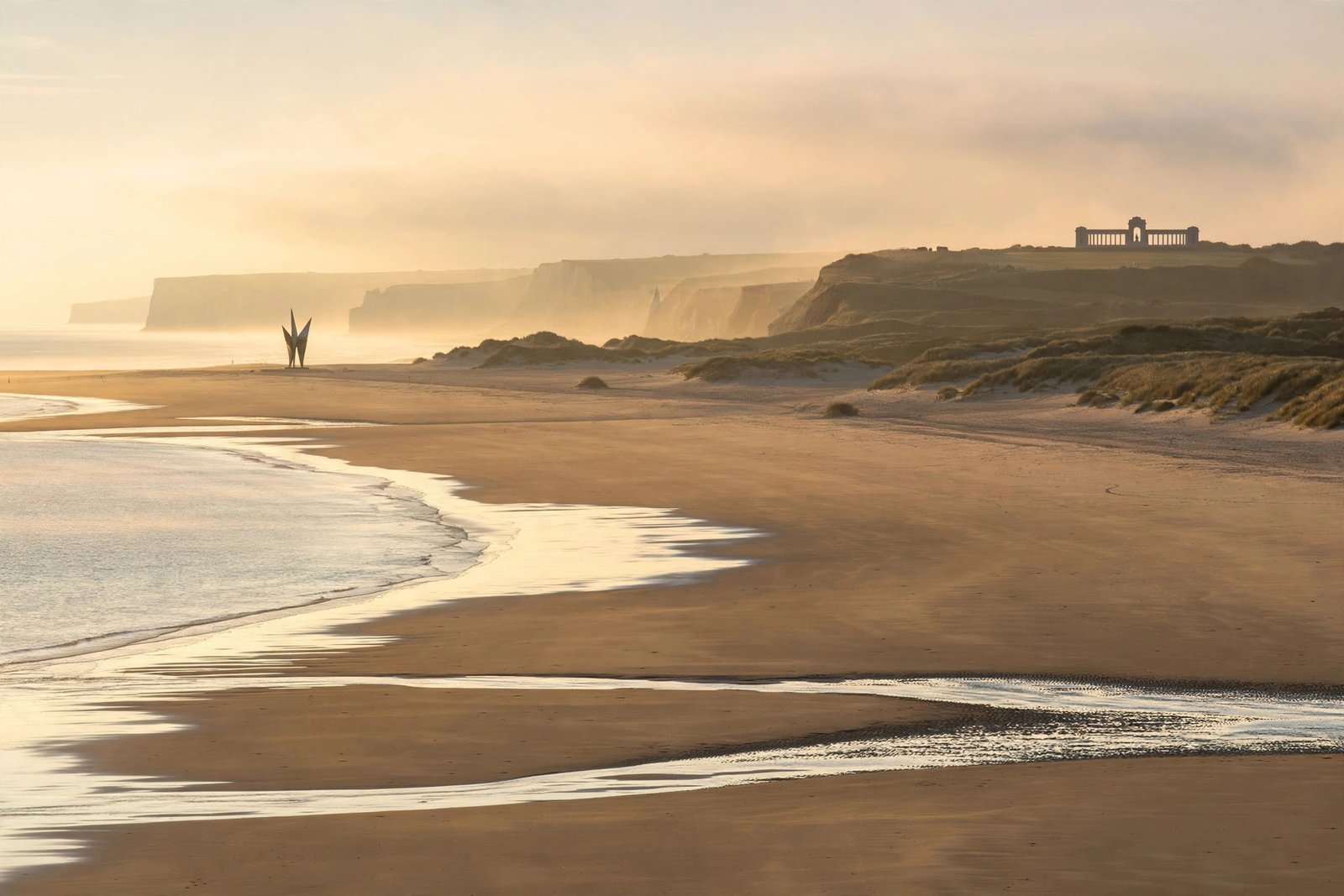
Before dawn on June 6, 1944, the largest seaborne invasion in history was already underway. In the dark skies over Normandy, thousands of paratroopers were drifting down behind German lines. Out in the English Channel, a fleet of more than 5,000 ships carried the hopes of the free world toward five stretches of French coastline. By the time the sun set that evening, about 156,000 Allied troops had landed in France, and the liberation of Europe had finally begun. That day is remembered as D-Day, and more than eighty years later, it remains one of the most studied and honored days in American military history.
D-Day was not a single battle but the opening act of a much larger campaign. The landings were codenamed Operation Neptune, the assault phase of Operation Overlord, the Allied plan to invade German-occupied France and begin the liberation of Western Europe. The Supreme Allied Commander was General Dwight D. Eisenhower. He had spent months balancing the demands of British and American commanders, the limits of available shipping and landing craft, and the weather over the Channel. The night before the invasion, he visited paratroopers of the 101st Airborne Division as they prepared to board their planes, and he later wrote a short note accepting full blame if the landings failed.
This article tells the story of that day: the planning, the airborne drops, the five beaches, the bloodshed at Omaha, the Rangers’ climb at Pointe du Hoc, and the hard fighting that followed.
The Plan: Operation Overlord and Operation Neptune
By early 1944, the Allies had been planning the invasion of France for more than two years. The Soviet Union had been pressing its Western partners to open a second front in Europe, and the United States and Britain knew that the only way to defeat Nazi Germany was to land a large army on the continent and fight toward Berlin. The question was where and when. The Germans expected an attack at the Pas-de-Calais, the narrowest point of the Channel, and they had fortified it heavily. The Allies chose Normandy instead: its beaches were less heavily defended, and the element of surprise was stronger.
The plan divided the Normandy coast, a stretch of about 50 miles, into five landing sectors. From west to east they were Utah, Omaha, Gold, Juno, and Sword. American forces would land at Utah and Omaha, British forces at Gold and Sword, and Canadian forces at Juno. Behind the beaches, airborne troops would drop inland before dawn to seize causeways, bridges, and crossroads so the men coming ashore could move inland quickly. Two artificial harbors, codenamed Mulberry, would be towed across the Channel to supply the invasion.
Everything depended on the weather. The invasion was first set for June 5, but a storm swept across the Channel and Eisenhower postponed it by a day. His meteorologists told him a brief window of calmer weather would open on June 6, and he made the decision to go. Had he waited, the next suitable combination of tides and moonlight would not have come for weeks, and the Germans might have discovered the deception campaign that had convinced them the attack would come at Calais.
Before the first landing craft touched the sand, Allied bombers and warships pounded the German defenses. But the bombing was less effective than hoped. At Omaha Beach in particular, the bombs fell too far inland, leaving the German gun positions on the bluffs largely intact. The men who landed there would pay for that failure within minutes.
The Night Before: Airborne Drops Behind Enemy Lines
The invasion began in the air, hours before the first boat reached shore. Shortly after midnight, more than 24,000 Allied airborne troops began dropping into Normandy. The American 82nd and 101st Airborne Divisions landed in the Cotentin Peninsula behind Utah Beach, where their job was to seize the causeways across flooded farmland so troops landing at Utah could move inland. The British 6th Airborne Division dropped east of the invasion area to capture bridges over the River Orne and the Caen Canal, and to silence a German gun battery at Merville.
The drops were scattered and chaotic. Heavy cloud, German anti-aircraft fire, and inexperienced pilots sent many paratroopers miles from their intended landing zones. Men landed alone in fields and hedgerows, far from their units, and had to find each other in the dark while German patrols searched the countryside. Yet the confusion worked in the Allies’ favor in one respect: the Germans could not tell where the main attack was coming from, and their commanders hesitated to send reinforcements toward the coast.
The paratroopers fought in small, improvised groups through the night. They cut telephone lines, ambushed German patrols, and seized key bridges and crossroads. Their casualties were heavy, but they held long enough for the seaborne forces to come ashore. The 101st Airborne’s stand at Sainte-Mère-Église, one of the first French towns liberated on D-Day, became part of the legend of the day.
The Five Beaches: Utah, Omaha, Gold, Juno, and Sword
At 6:30 in the morning, the first waves of infantry landed at Utah and Omaha, the American beaches. Within the hour, British and Canadian troops were landing at Gold, Juno, and Sword. Each beach had its own character and its own story, and the fighting that day varied enormously from one sector to the next.
Utah Beach, the westernmost landing site, went better than anyone had dared to hope. Strong currents pushed the first landing craft almost a mile south of their intended target, but the troops found themselves facing lighter defenses there, and Brigadier General Theodore Roosevelt Jr., who had insisted on landing with the first wave at the age of 56, made the quick decision to land where they were and move inland from there. By midnight, more than 23,000 troops had come ashore at Utah, and the beach was secure. American casualties at Utah were comparatively light, with fewer than 300 men killed or wounded.
Gold Beach, in the British sector, saw determined fighting around the fortified town of Le Hamel, but the British 50th Infantry Division pushed inland and linked up with the Canadians from Juno Beach by the end of the day. Sword Beach, the easternmost sector, was attacked by the British 3rd Infantry Division with French commandos under Philippe Kieffer, the first French troops to land in France on D-Day. Their goal was Caen, about eight miles inland, but German counterattacks stopped them short. Caen would not fall until July, after weeks of bitter fighting.
Juno Beach belonged to the Canadians, and they advanced further inland on D-Day than any other Allied force, pushing several miles toward Caen despite heavy fighting in the seaside towns. By nightfall, every one of the five beachheads was secure, even though only Gold and Juno had linked up and the key objectives of Caen, Bayeux, and Carentan were still in German hands.
Omaha Beach: The Bloodiest Morning of D-Day
Omaha Beach was the exception to the day’s successes, and it came close to disaster. The beach was a five-mile stretch of sand backed by steep bluffs, and the German 352nd Infantry Division, a far stronger force than Allied intelligence had expected, held the high ground with machine guns, artillery, and mortars. When the first waves of the American 1st and 29th Infantry Divisions landed at 6:30 a.m., they walked into a wall of fire.
The problems began before the troops even reached the shore. The amphibious tanks meant to support them, known as DD tanks, were launched too far out in rough seas, and most of them sank before reaching the beach. The naval bombardment had missed its targets. Landing craft hit obstacles and mines, and men were forced to wade through deep water under fire, weighed down by heavy equipment. Many never made it to the sand. Those who did found almost no cover: the beach was wide and flat, and the only shelter was a low bank of shingle at the foot of the bluffs.
For hours, the landing stalled. Men huddled behind beach obstacles and the shingle bank while officers tried to reorganize shattered units. Destroyers moved in close to shore, risking grounding, to fire directly at German positions on the bluffs. Gradually, small groups of soldiers began climbing the draws, the narrow valleys that led up through the bluffs, and by early afternoon the first exit off the beach was open. By the end of the day, about 34,000 Americans were ashore at Omaha, holding a thin strip of ground a mile or so deep. The cost was about 2,400 American casualties, the highest of any beach on D-Day.
Omaha Beach is remembered today as the bloodiest of the D-Day landings, and the American cemetery that overlooks it, with its rows of white crosses and Stars of David, is one of the most visited memorial sites in Europe.
Pointe du Hoc: The Rangers’ Climb
Between Omaha and Utah beaches stood Pointe du Hoc, a rocky promontory rising about 100 feet above the Channel, where German guns were believed to threaten both landing beaches. The mission to silence those guns fell to 225 men of the 2nd Ranger Battalion under Lieutenant Colonel James Earl Rudder. Their plan was to land at the base of the cliff, fire grappling hooks attached to ropes and ladders up the rock face, and climb while under fire.
The Rangers’ landing went wrong almost immediately. Strong currents and navigation errors delayed them, and the men who were supposed to land at Pointe du Hoc were carried toward Omaha Beach instead. Rudder redirected the force, and the Rangers finally came ashore at the base of the cliff at about 7:10 in the morning, more than half an hour late. They scaled the cliffs under fire, using ropes and ladders, and reached the top within the hour. But when they got there, they found the gun positions empty: the Germans had moved the heavy 155mm guns inland days earlier, and the concrete casemates were unoccupied.
The Rangers did not stop. They pushed inland through hedgerows and minefields, found the missing guns in a concealed position, and destroyed them with grenades. Then they dug in and held the point for two days against repeated German counterattacks, cut off from support and running low on ammunition and water. When relief finally arrived on June 8, only about 90 of the 225 Rangers who had landed were still able to fight. Their stand at Pointe du Hoc remains one of the most celebrated feats of arms of the Second World War, and President Ronald Reagan’s 1984 speech at the site, delivered on the fortieth anniversary of D-Day with surviving Rangers seated before him, is remembered as one of the great speeches of his presidency.
By Nightfall: A Foothold in France
When darkness fell on June 6, the Allies had achieved something extraordinary and incomplete at the same time. About 156,000 men were ashore and all five beachheads were held, but the beachheads were shallow and disconnected. Only Gold and Juno had linked up, and it would take until June 12 for all five to join into a continuous front. The port of Cherbourg was still in German hands, and Caen, the main objective, was still defended.
Over the following weeks, the Battle of Normandy ground on through hedgerow country that favored the defenders. The breakout finally came in late July, when Operation Cobra smashed through the German lines near Saint-Lô and American armor raced across France. Paris was liberated on August 25, 1944, when French forces under General Philippe Leclerc entered the city alongside American troops, and by the end of the summer the Allies were approaching the German border. The war in Europe would last until May 1945, but the outcome was decided on the beaches of Normandy.
Why D-Day Still Matters
D-Day matters because it was the moment the liberation of Europe became real. For four years, much of Europe had lived under Nazi occupation. The invasion gave occupied Europe hope and gave the Allied cause an army on the continent. It also mattered because of what it cost. The men who landed in Normandy were mostly very young, many of them teenagers or in their early twenties, and the freedom they fought for was paid for with their lives.
If you visit Normandy today, the traces of June 6, 1944, are everywhere. The American Cemetery at Colleville-sur-Mer overlooks Omaha Beach. The guns at Pointe du Hoc still point out to sea, and the craters from the naval bombardment still scar the ground. The beaches themselves are quiet now, used by walkers and families, but the tide still comes in twice a day over the same sand where so many men fell. The National D-Day Memorial in Bedford, Virginia, honors the Americans who died that day, and the National WWII Museum in New Orleans tells the full story of the war that D-Day helped to end.
Related reading
- The Army Rangers at Pointe du Hoc: The Climb That Changed D-Day
- The Battle of the Bulge: Hitler’s Last Gamble in the Winter of 1944
- Iwo Jima and the Flag Raising: The Story Behind America’s Most Famous Photograph
Frequently Asked Questions
How many troops landed on D-Day?
About 156,000 Allied troops landed in Normandy on June 6, 1944, by sea and by air. That figure includes the airborne troops who dropped behind enemy lines overnight and the infantry who came ashore on the five beaches. Nearly 200,000 naval personnel supported the landings from more than 5,000 ships.
Which beach had the most casualties on D-Day?
Omaha Beach had by far the highest casualties. About 2,400 Americans were killed or wounded there, compared with far lighter losses at Utah, Gold, Juno, and Sword. Across all five beaches, Allied casualties were at least 10,000 men, with 4,414 confirmed killed. The strong German defenses on the bluffs above Omaha, the failure of the preliminary bombardment, and the loss of most of the supporting tanks in rough seas all contributed to the bloodshed.
What were the five D-Day beaches?
The five landing beaches, from west to east, were Utah and Omaha, where American forces landed; Gold and Sword, where British forces landed; and Juno, where Canadian forces landed.
Who commanded the D-Day invasion?
General Dwight D. Eisenhower, the Supreme Allied Commander, had overall command of the invasion. The ground forces were led by British General Bernard Montgomery, and Admiral Bertram Ramsay commanded the naval forces.
When was Paris liberated after D-Day?
Paris was liberated on August 25, 1944, about eleven weeks after the Normandy landings. French forces under General Philippe Leclerc entered the city alongside American troops, and the German garrison surrendered that afternoon. The liberation followed the Allied breakout from Normandy in late July and a rapid advance across France.