
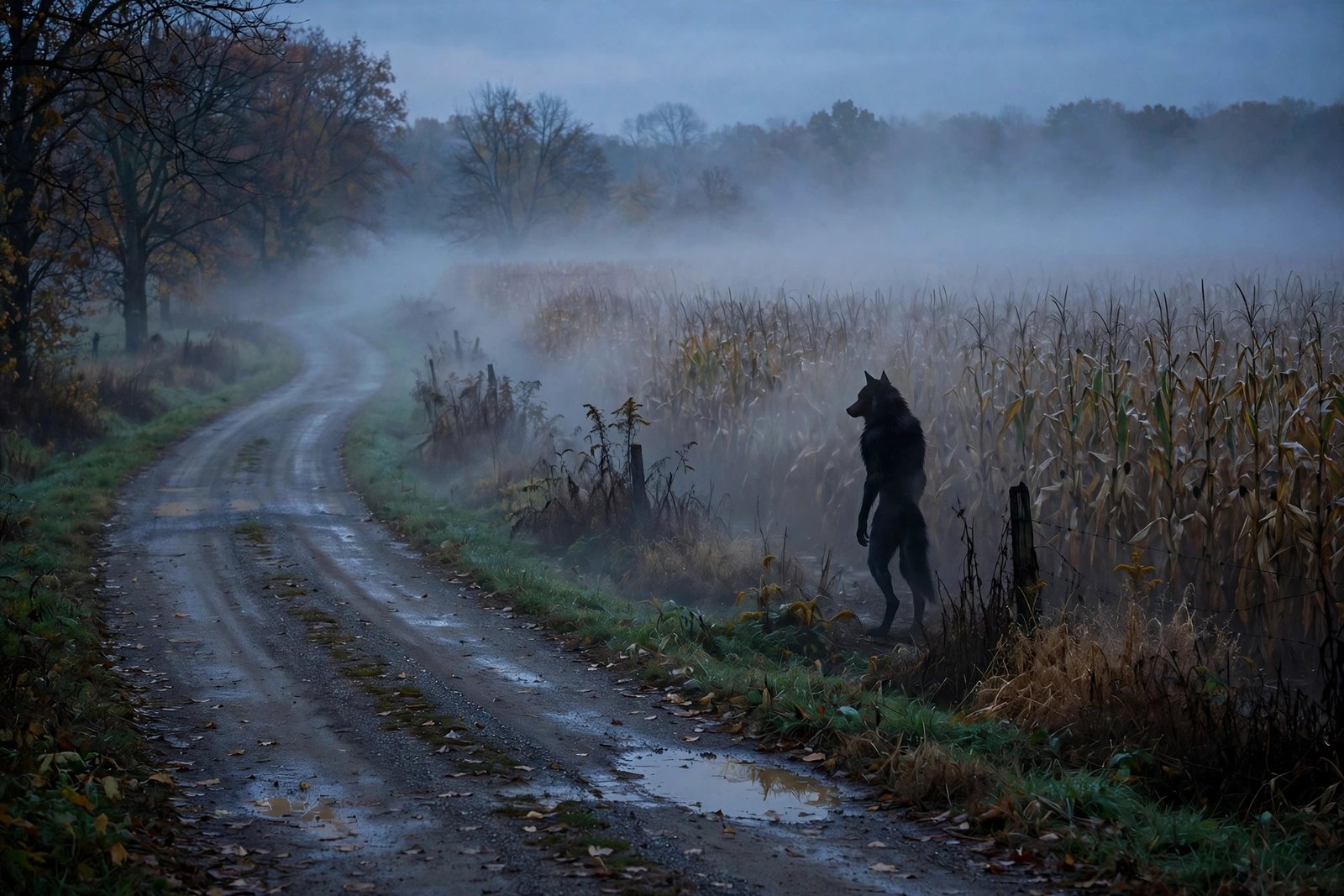
On a quiet country road outside Elkhorn, Wisconsin, drivers have reported seeing something that should not exist. It stands upright like a person, yet it is covered in fur, with a wolf-like head, pointed ears, and eyes that catch the headlights. For more than thirty years, that figure has been known as the Beast of Bray Road, and it has become one of the most famous legends in the American Midwest.
The story is not a single sighting. It is a collection of reports, gathered over decades, that share a strikingly similar description. Some witnesses describe a creature kneeling beside the road. Others describe it running on two legs, or standing in a field and watching them. No photograph or body has ever proved what it is. Yet the reports keep coming, and the legend keeps growing. This article explains what witnesses say they saw, how a local journalist made the story famous, what skeptics believe happened, and why the Beast still fascinates people. Where a detail comes from a witness account rather than a confirmed fact, this article says so plainly.
What Is the Beast of Bray Road?
The Beast of Bray Road is the name given to a wolf-like creature reported in and around Elkhorn, in Walworth County, Wisconsin. It takes its name from Bray Road, a rural road where many of the sightings were reported. The creature has become part of Wisconsin folklore and has been the subject of books, documentaries, television programs, and a 2005 horror film.
Witnesses generally describe a tall, hairy figure with a human-like body and the head of a wolf or a large dog. The reported height is usually between six and seven feet. The fur is usually described as dark, brownish-gray, or black. The creature is said to have pointed ears, a long snout, sharp teeth, and large eyes. Some witnesses say the eyes glowed yellow, red, or orange in the dark, and some mention long claws and a strong smell, sometimes compared to rotting meat. Not every account agrees: some say it walked upright, others say it moved on all fours. That inconsistency is one reason researchers disagree about whether witnesses saw one thing, several things, or something shaped by fear and memory.
The 1936 Sighting at St. Coletta School
The earliest account usually attached to the Beast of Bray Road dates to 1936, decades before the modern sightings near Elkhorn. According to later retellings, Mark Shackelman was a night watchman at the St. Coletta School for Exceptional Children, near Jefferson, Wisconsin. One night, while making his rounds, he heard a sound like raking near a Native American burial mound on the school grounds. He reportedly saw a creature digging at the mound, standing more than six feet tall, with dark hair and a wolf-like head. It is said to have growled, and he reportedly smelled rotting meat. He never saw it again.
There are important limits to this account. Shackelman is said to have told only his wife about the experience at first, and he did not share it more widely until the 1950s, when he told his son Joe. Joe Shackelman later shared his father’s story with Linda Godfrey, and it appeared in her book about the Beast of Bray Road. That means the 1936 account reached the public through family retelling, many years after the event, rather than through a report made at the time. That does not prove the story false, but it should be treated differently from the 1989 and 1991 accounts, reported to a newspaper soon after they happened. The 1936 story is best understood as the oldest chapter of the legend, not a confirmed sighting.
The Night Lori Endrizzi Saw Something on Bray Road
The modern legend begins in the fall of 1989. Lori Endrizzi, who was working as a manager at a lounge in Elkhorn called The Jury Room, was driving home along Bray Road late at night. In the original newspaper report, she appeared only under the name Barbara. Her full name became attached to the account in later retellings. Endrizzi said she saw a large creature kneeling at the side of the road, holding something dead in its hands. She described it as roadkill, and said the creature appeared to be tearing at the flesh. At first, she thought she was looking at a person. Then she noticed the fur, the pointed dog-like ears, and the shape of the head. She described the creature as roughly the size of an adult man, covered in dark, grayish fur.
According to accounts of the encounter, she watched the creature for about forty-five seconds. It turned toward her, and she saw its fangs and wolf-like snout in her headlights. She drove on, frightened, and the next morning she went to the local library to look for an explanation. There, she found an illustration labeled werewolf in a book called The Golden Book of the Mysterious, published in 1976. Endrizzi stuck to her story in later interviews, telling Godfrey she did not believe in werewolves as such, but believed something could have been conjured up. Her account is sincere, detailed, and consistent, which is why it became the central sighting. Sincerity, however, is not proof: a witness can be honest and still be mistaken about an animal in the dark, at a distance, in headlights.
Halloween Night, 1991: The Doris Gipson Encounter
Two years after Endrizzi’s sighting, another Elkhorn resident reported an encounter on Bray Road. Doris Gipson, who appeared as Pat in the original newspaper report, was driving along Bray Road on Halloween night in 1991 when she felt her car hit something. Thinking she had struck an animal, she got out to look. Gipson said she then saw a creature running toward her, a large, hairy figure moving upright, and she fled back to her car. The Halloween timing has led some readers to wonder about a person in a costume, though there is no evidence her account was a hoax. The two accounts share a core description: a tall, fur-covered figure with a canine head, seen on Bray Road at night by a driver alone in a car. That similarity turned two separate scares into a pattern, and once the newspaper published both stories, more people came forward. The county’s humane officer, Jon Fredrickson, reportedly kept a file folder labeled Werewolf, holding six or seven reported sightings.
How Linda Godfrey Turned Local Rumors Into a National Legend
Linda Godfrey was working as a cartoonist and features reporter for The Week, also known as the Walworth County Week, a weekly newspaper serving Walworth County. In 1991, a few writers had been reporting sightings of what they called a werewolf, but nobody wanted to take the story, and Godfrey was assigned to follow it up. In a file drawer she found a folder labeled Werewolf, and as she asked around town she found the rumors had circulated for about two years, among adults as well as teenagers. Her report, Tracking down the Beast of Bray Road, appeared on December 29, 1991, and it gave the creature the name by which it is still known.
Godfrey’s reporting cast a national spotlight on Walworth County. She was interviewed by news outlets and television programs, wrote a book on the Beast of Bray Road, and went on to write nearly twenty books covering the paranormal. Her book, The Beast of Bray Road: Tailing Wisconsin’s Werewolf, was published in 2003. She died in 2022, but her work remains the main source for the legend. Godfrey was careful in a way many retellings are not. She never claimed to know definitively what the creature was. As a transcript of interviews about the case records, she said there is a high probability that everyone is not always seeing the same thing, and she acknowledged that some reports could be misidentifications or hoaxes. That honesty is why her work is still trusted on both sides of the debate. A retelling of Godfrey’s original reporting notes the same care: she collected the stories, checked what she could, and left the hardest question open.
The Skeptical Case: Bears, Wolves, Dogs, and Folklore
Skeptics maintain that the Beast of Bray Road is most likely the result of misidentification of known animals, most likely gray wolves. That is the central skeptical explanation, and it is a serious one. Wisconsin is home to wolves, coyotes, black bears, and large dogs, and each of those animals can look startling in the dark, especially when seen briefly from a moving car. A black bear standing upright can reach six feet or more, and its silhouette can look human-like. A gray wolf is large, with a long snout and pointed ears, and a wolf seen kneeling or feeding on roadkill could be mistaken for something stranger. A large dog, especially a German shepherd or a similar breed, can stand on its hind legs and appear to have a human-like posture.
Hoaxes are another possibility that Godfrey herself acknowledged. Once a story becomes famous, some people invent sightings for attention, or dress up to frighten drivers on a road already associated with a monster. There is also a folklore explanation. Once a community has a name for a creature, people are more likely to interpret an unclear sighting through that name. A strange shape in the dark becomes the Beast, rather than an unidentified animal, because the Beast is the story everyone already knows. Researchers call this a feedback loop, and it can keep a legend alive long after the original sightings have faded. None of these explanations has been proved for any single sighting, but they show the case does not need a new species to make sense.
The Beast and the Michigan Dogman
The Beast of Bray Road is often compared to the Michigan Dogman, a legendary canine-like humanoid said to inhabit the forests and rural areas of Michigan. The two legends share a strikingly similar description: a large, upright canine creature, six to seven feet tall, with a human-like body and the head of a dog or wolf. That similarity is real, and it is one reason the two stories are often told together. The way the two legends became famous, however, is very different.
The Beast of Bray Road became known through a cluster of sightings tied to one road and one Wisconsin community, investigated by a local journalist. The Michigan Dogman became widely known after radio personality Steve Cook recorded a novelty song called The Legend in 1987 for station WTCM-FM in Traverse City. Cook created the song for entertainment, combining fictional elements with Michigan folklore, and after it aired, listeners began calling the station to say they had encountered similar creatures. The song included a claim that lumberjacks in Wexford County first saw the creature in 1887, and that it appears in ten-year cycles, in years ending in seven. Researchers have found no record of the 1887 sighting in any source that predates the song, and Cook himself has said more than once that he does not believe the legend. As one account of the Dogman legend notes, the 1887 date appears to come from the song, not from nineteenth-century records. The Wisconsin story rests on named witnesses who spoke to a reporter; the Michigan story rests in part on a song written as a joke.
Why the Legend Endures in Elkhorn
Sightings dropped off after the 1990s, but they never stopped entirely. New witnesses emerged in 2018 and 2020 to say they had seen a large, hairy, upright beast in Walworth County, as local coverage of the legend has reported. Elkhorn has leaned into the legend in a friendly way, organizing events such as a Beast Feast, and the story has become part of the town’s identity, alongside its older nickname, the Christmas Card Town. Part of the appeal is the setting: Bray Road is an ordinary rural road, where a driver is alone at night, with fields and woods on either side. Part of the appeal is the mystery itself. Godfrey never solved the case, and no one else has either. There is no body, no clear photograph, and no physical trace. The whole case lives in testimony, and testimony leaves room for belief, doubt, and imagination at the same time. Anyone who visits Bray Road should do so safely and respectfully. It is a public road through a rural community, not a tourist attraction. Drive carefully and do not trespass on private land.
Related reading
If you enjoyed this look at Wisconsin’s most famous cryptid, keep exploring American legends with these stories from Famus News:
- Mothman: The Legend of Point Pleasant
- Bigfoot: The Legend of the Pacific Northwest
- The Loveland Frogman: Ohio’s Strangest Legend Explained
Frequently Asked Questions
Is the Beast of Bray Road real?
There is no confirmed evidence that the Beast of Bray Road is a real, unknown animal. Witnesses have reported a tall, wolf-like creature, and those reports are sincere and detailed, but no body, clear photograph, or physical trace has ever been produced. Skeptics believe the sightings are most likely misidentified wolves, bears, or large dogs.
When was the Beast of Bray Road first seen?
The earliest account usually attached to the legend dates to 1936, when night watchman Mark Shackelman reportedly saw a tall, hairy creature at St. Coletta School. The modern sightings began in fall 1989, when Lori Endrizzi reported a creature kneeling beside Bray Road. The story became widely known after Linda Godfrey’s report on December 29, 1991.
Who was Linda Godfrey?
Linda Godfrey was a journalist and author who investigated the Bray Road reports for The Week, a newspaper in Walworth County, Wisconsin. Her 1991 article, Tracking down the Beast of Bray Road, gave the creature its name. She later wrote the book The Beast of Bray Road: Tailing Wisconsin’s Werewolf (2003) and nearly twenty books on the paranormal before her death in 2022.
What does the Beast of Bray Road look like?
Witnesses generally describe a creature six to seven feet tall, covered in dark fur, with a human-like body and the head of a wolf or large dog, pointed ears, a long snout, sharp teeth, large eyes, and long claws. Some say it walks upright, others say it moves on all fours.
Is the Beast of Bray Road the same as the Michigan Dogman?
The two legends are similar, but they are not the same story. The Beast of Bray Road is tied to one road near Elkhorn, Wisconsin, and became famous through Linda Godfrey’s reporting. The Michigan Dogman became widely known after a 1987 radio song by Steve Cook, and its 1887 origin story appears to come from that song rather than earlier records.