
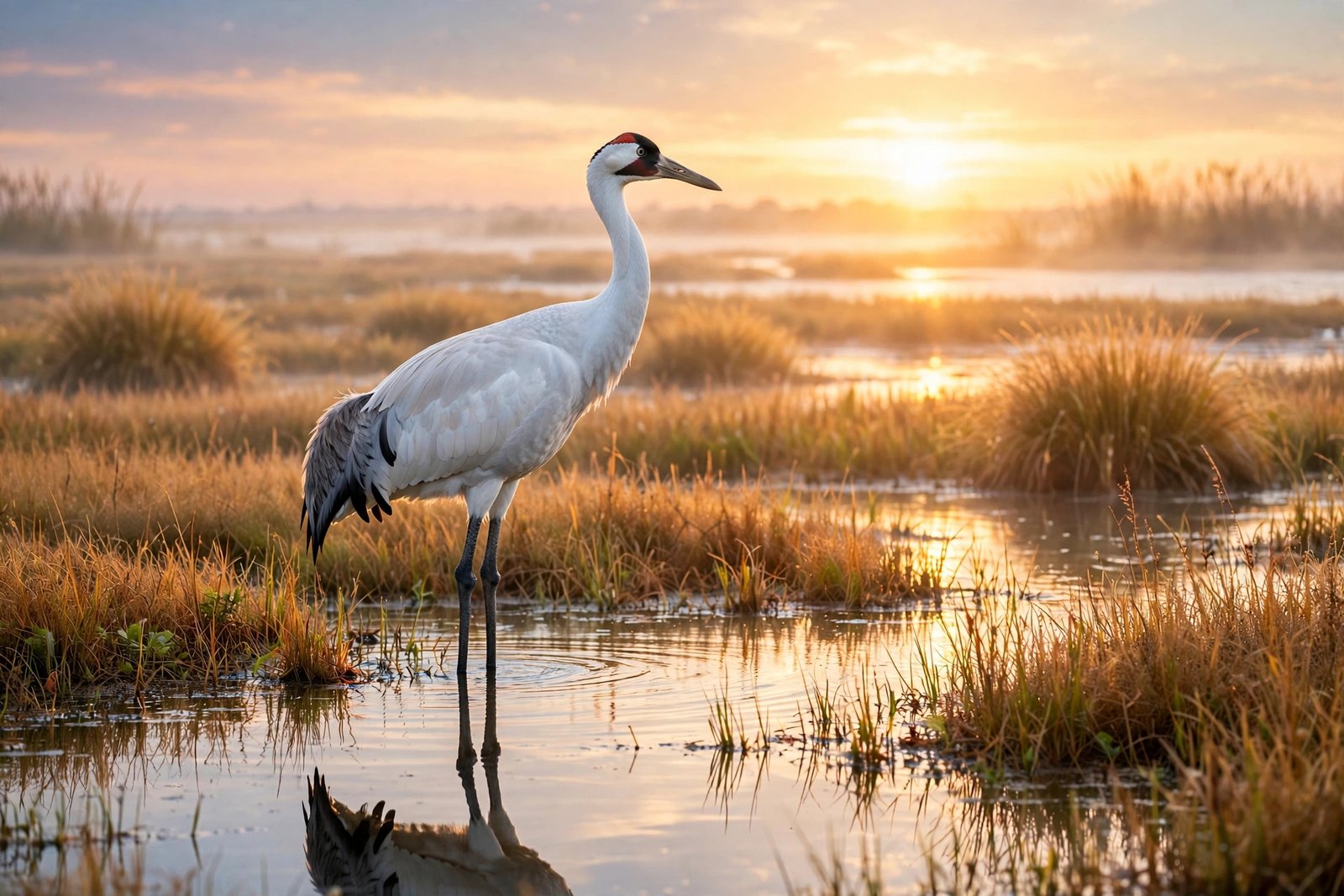
Imagine a bird so tall that it stands eye to eye with a child, so white that it seems to glow against a marsh, and so rare that the entire species could once have fitted into a single small room. That is the whooping crane, North America’s tallest bird, and its story is one of the greatest comebacks in the history of wildlife conservation.
In the winter of 1941-42, the migratory flock that still survives today had fallen to about fifteen birds. Counting a small, separate flock in Louisiana, about twenty-one wild whooping cranes remained in the world. The species was sliding toward extinction, and many people believed it was already too late. It was not too late. Decades of captive breeding, habitat protection, and reintroduction brought the species back. At the beginning of 2025, the total population was about 846 birds, including about 703 in the wild and about 143 in human care, with the main wild flock estimated at 557 birds during the 2024-25 winter survey. The crane is still listed as endangered, but the direction of the story has changed completely.
Meet the Whooping Crane
The whooping crane, Grus americana, is the tallest bird in North America. Adults stand about five feet tall, with a wingspan of up to seven and a half feet. They are mostly white, with black wingtips, black legs, and a red crown on the head. Their call is a loud, bugling whoop, which gives the species its name. According to the U.S. Fish and Wildlife Service, whooping cranes are North America’s tallest bird, reaching about five feet tall with a wingspan of more than seven feet.
Whooping cranes are long-lived, typically living twenty-two to thirty years or more in the wild, and they usually mate for life, returning to the same breeding territory year after year. A pair usually lays two eggs, but often only one chick survives to migrate, because the older or stronger chick may drive its sibling away. That slow reproduction is one reason the species recovers so slowly. The whooping crane is one of only two crane species in North America; the other is the far more common, gray sandhill crane. Whooping cranes feed in wetlands on crabs, fish, frogs, small animals, and plants, probing shallow water with their long bills. In Texas, blue crabs are an important winter food.
How a Common Bird Became Rare
Before European settlement, whooping cranes were widespread across the prairies and wetlands of North America. They nested across the northern United States and southern Canada, and wintered along the Gulf Coast and in other southern wetlands. They were never as numerous as some other birds, but they were a normal part of the landscape. That changed quickly in the nineteenth century. Unregulated hunting took a heavy toll, and the draining and plowing of prairie wetlands removed the habitat the cranes needed to nest and feed.
By the winter of 1941-42, the crisis was almost complete. The migratory flock that bred in Wood Buffalo National Park in Canada and wintered at Aransas National Wildlife Refuge in Texas had fallen to about fifteen birds. A small, non-migratory flock at White Lake in Louisiana held about six more, bringing the wild total to about twenty-one birds. Some sources give sixteen living birds in 1941, reflecting how the count was made at the time, but the meaning is the same: the species was down to a handful of birds, and one bad winter could have ended it. The Louisiana flock did not survive; the last whooping crane was removed from the wild there in 1950. Only the migratory flock survived, and every whooping crane alive today descends from it.
The Laws and Refuges That Bought Time
The whooping crane’s survival was not an accident. It was the result of laws and protected places that were created before the full scale of the crisis was understood, and that later became the foundation of the recovery. The Migratory Bird Treaty Act of 1916 gave whooping cranes legal protection from hunting, at a time when unregulated hunting was still a major threat. Wood Buffalo National Park in Canada was established in 1922, protecting a vast area of boreal wetlands in the north. The breeding grounds of the whooping crane were not discovered there until decades later, but the park was already in place when they were found, which meant the nesting habitat was protected.
Aransas National Wildlife Refuge in Texas was established in 1937, protecting the coastal marshes where the cranes spend the winter. The refuge covers salt flats and marshes along the Gulf Coast, and it remains the heart of the winter range. Without those two protected areas, the species would have had nowhere safe to breed or winter. The whooping crane was listed as endangered in 1967, under the law that came before the modern Endangered Species Act, and it has remained protected ever since. The Cornell Lab of Ornithology notes that the U.S. Fish and Wildlife Service and the Canadian Wildlife Service both list the whooping crane as endangered, and that today’s only self-sustaining population migrates between those two refuges.
Captive Breeding: Raising Cranes to Save Cranes
Protection alone was not enough. With only about fifteen birds in the migratory flock, the species needed help to rebuild its numbers, and that help came from captive breeding. In the 1960s, the Canadian Wildlife Service and the United States Fish and Wildlife Service began captive breeding programs, using eggs collected from nests in Wood Buffalo National Park. The first program was based at the Patuxent Wildlife Research Center in Maryland, where scientists learned how to hatch crane eggs, raise chicks, and keep the birds healthy in captivity. Sandhill cranes were used as foster parents in some early efforts, and later programs used costume-rearing, in which human caretakers wore crane costumes so the chicks would not become too attached to people.
The idea was simple, and the work was painstaking. Eggs that might have been lost in the wild could be hatched safely in captivity, chicks raised to adulthood, and their offspring released to start new flocks. Over time, the captive population became a safety net, holding birds for breeding and release even if a wild flock suffered a bad year. At the beginning of 2025, about 143 whooping cranes were in human care, in a program coordinated by the Association of Zoos and Aquariums and its partners. Managed for genetic diversity, they produce the eggs and chicks that support reintroduction.
The Great Migration: Texas to Canada and Back
The main wild flock, known as the Aransas-Wood Buffalo population, is the only remaining wild, self-sustaining population of whooping cranes. It is also one of the greatest endangered species success stories. The population has rebounded from about fifteen birds in the migratory flock in 1941 to an estimated 557 birds during the 2024-25 winter survey, according to the United States Fish and Wildlife Service. Each year, these cranes make a migration of about 2,500 miles. They breed in the summer in Wood Buffalo National Park, in the Northwest Territories and Alberta, Canada, where they nest in shallow wetlands, bogs, and marshes. In the fall, they fly south to the Gulf Coast of Texas, where they spend the winter in and around Aransas National Wildlife Refuge, near Rockport.
The migration takes weeks, and the cranes stop along the way to rest and feed. The Salt Plains National Wildlife Refuge in Oklahoma is a major stopover, hosting sixty to seventy-five percent of the species each year, which shows how important a single place can be. Migration is mostly learned: young cranes follow their parents on their first journey south. That is why reintroduction is hard: a captive-raised crane does not automatically know where to go. Researchers have taught young cranes to migrate, sometimes by leading them with ultralight aircraft, and sometimes by releasing them with older birds that already know the way.
Reintroduction: New Flocks in Wisconsin, Louisiana, and Florida
Conservationists knew that one wild flock was not enough. If a disease, a storm, or a habitat disaster struck the Aransas-Wood Buffalo population, the species could be wiped out again. The recovery plan therefore called for new, separate populations, so that no single event could end the species. The Eastern Migratory Population was established in Wisconsin, with birds bred in captivity and released in central Wisconsin, around Necedah National Wildlife Refuge. From 2001 to 2005, seventy-one costume-reared juvenile whooping cranes were led by ultralight aircraft from Wisconsin to a winter release site on the Gulf Coast of Florida, so they could learn the migration route. As of July 2025, the Eastern Migratory Population numbered around sixty-eight birds.
A separate, non-migratory flock was reintroduced in Louisiana, at White Lake Wetlands Conservation Area, beginning in 2011, to recreate a resident flock where whooping cranes had lived historically. At the beginning of 2025, it consisted of seventy-three birds, which live there year-round because the habitat and climate suit them. A reintroduction in Florida, on the Kissimmee Prairie, was halted and is considered a failure, because of high adult mortality, low juvenile recruitment, and habitat loss. Only a few birds remained there, and six were transferred to Louisiana between 2019 and 2024. That failure matters: reintroduction is hard, and not every attempt works. The Louisiana Department of Wildlife and Fisheries confirms those figures and notes that the reintroduced populations are experimental and non-essential, protected but not counted as essential to the species’ survival.
Why the Comeback Is Still Fragile
The whooping crane has come a long way, but it is still endangered, and the recovery is still fragile. At the beginning of 2025, the total population was about 846 birds, with about 703 in the wild and about 143 in human care. That is a remarkable recovery from about twenty-one wild birds in 1941, but it is still a small number for a species that once ranged across a continent. Habitat loss remains the greatest threat. Whooping cranes need wetlands to breed, to feed, and to rest during migration, and wetlands are still being drained, filled, and developed across North America. In Texas, the cranes depend on coastal marshes and on the freshwater flows that keep those marshes healthy. Drought, water diversion, and sea-level rise can all reduce the food and habitat available in winter, when the birds are already stressed by migration.
Power lines and other structures are a danger during migration, and illegal shooting still occurs; the United States Fish and Wildlife Service has offered rewards for information about cranes found dead, including a five thousand dollar reward in one Louisiana case in 2024. Disease, predators, and bad weather also take a toll, especially on chicks. Climate change adds risk, as changes in rainfall and the timing of seasons can affect when wetlands and food are available. That is why the recovery plan does not stop at 846 birds. Conservationists hope to build the population to about a thousand birds, when the United States Fish and Wildlife Service could reconsider its status. Until then, the crane remains endangered, depending on continued wetland protection, captive breeding, and monitoring of the wild flocks.
How to See a Whooping Crane
For most people, the best chance to see a wild whooping crane is at Aransas National Wildlife Refuge in Texas, typically from late October through April, when the main flock is wintering there. Visitors should keep a respectful distance, stay on marked paths and viewing areas, and use binoculars or a spotting scope rather than approaching the birds. Texas Parks and Wildlife notes that the cranes breed in Wood Buffalo National Park and spend the winter on the Texas coast at Aransas, and that the refuge’s salt flats and marshes are their winter home.
Whooping cranes can also be seen in Wisconsin in summer, where the Eastern Migratory Population breeds, and in Louisiana, where the non-migratory flock lives year-round. The birds are sensitive to disturbance, especially during breeding and when feeding with chicks, so a quiet, distant view is better for the birds and the viewer. If you see a whooping crane outside a refuge, report it to the Texas Whooper Watch program or your state wildlife agency, so researchers can track where the birds are going and whether any are in trouble. Do not feed a whooping crane, and do not approach a nest. Feeding wild cranes can make them dependent on people and put them in danger, and a nest is where a pair is raising the next generation of a species that nearly disappeared. For a full overview, see the whooping crane species profile and the National Geographic whooping crane fact page.
Related reading
Love wildlife comeback stories? These Famus News features follow other species that returned from the edge:
- The Bald Eagle Comeback: America’s Conservation Success
- The California Condor Comeback: From 27 Birds to 600
- The Florida Panther Comeback: A Guide to the Wild Cat’s Return
Frequently Asked Questions
How many whooping cranes are left?
At the beginning of 2025, the total whooping crane population was about 846 birds, including about 703 in the wild and about 143 in human care. The main wild flock was estimated at 557 birds during the 2024-25 winter survey. The species is still listed as endangered.
How many whooping cranes were left in 1941?
The migratory flock that survives today had fallen to about fifteen birds in the winter of 1941-42. Counting a small Louisiana flock, about twenty-one wild whooping cranes remained. Some sources give sixteen living birds in 1941, reflecting a different count of the birds then known. The Louisiana flock later disappeared, and every whooping crane alive today descends from the migratory flock.
Where do whooping cranes migrate?
The main wild flock breeds in Wood Buffalo National Park in Canada and winters at Aransas National Wildlife Refuge in Texas, a migration of about 2,500 miles. The Eastern Migratory Population breeds in Wisconsin and winters in the southeastern United States. The Louisiana population lives year-round in coastal Louisiana.
Why are whooping cranes still endangered?
Whooping cranes are still endangered because their total population is small, about 846 birds at the beginning of 2025, and they depend on wetlands still being lost or degraded. Habitat loss, drought, power lines, illegal shooting, and climate change all pose risks, and most wild birds still depend on a single migratory flock. Conservationists hope to reach about a thousand birds before reconsidering its status.
Can I see a whooping crane in the wild?
Yes, the most reliable place is Aransas National Wildlife Refuge in Texas, typically from late October through April. Whooping cranes can also be seen in Wisconsin in summer and in Louisiana year-round. Keep a respectful distance, stay on marked paths, use binoculars, and report sightings to Texas Whooper Watch or your state wildlife agency.