
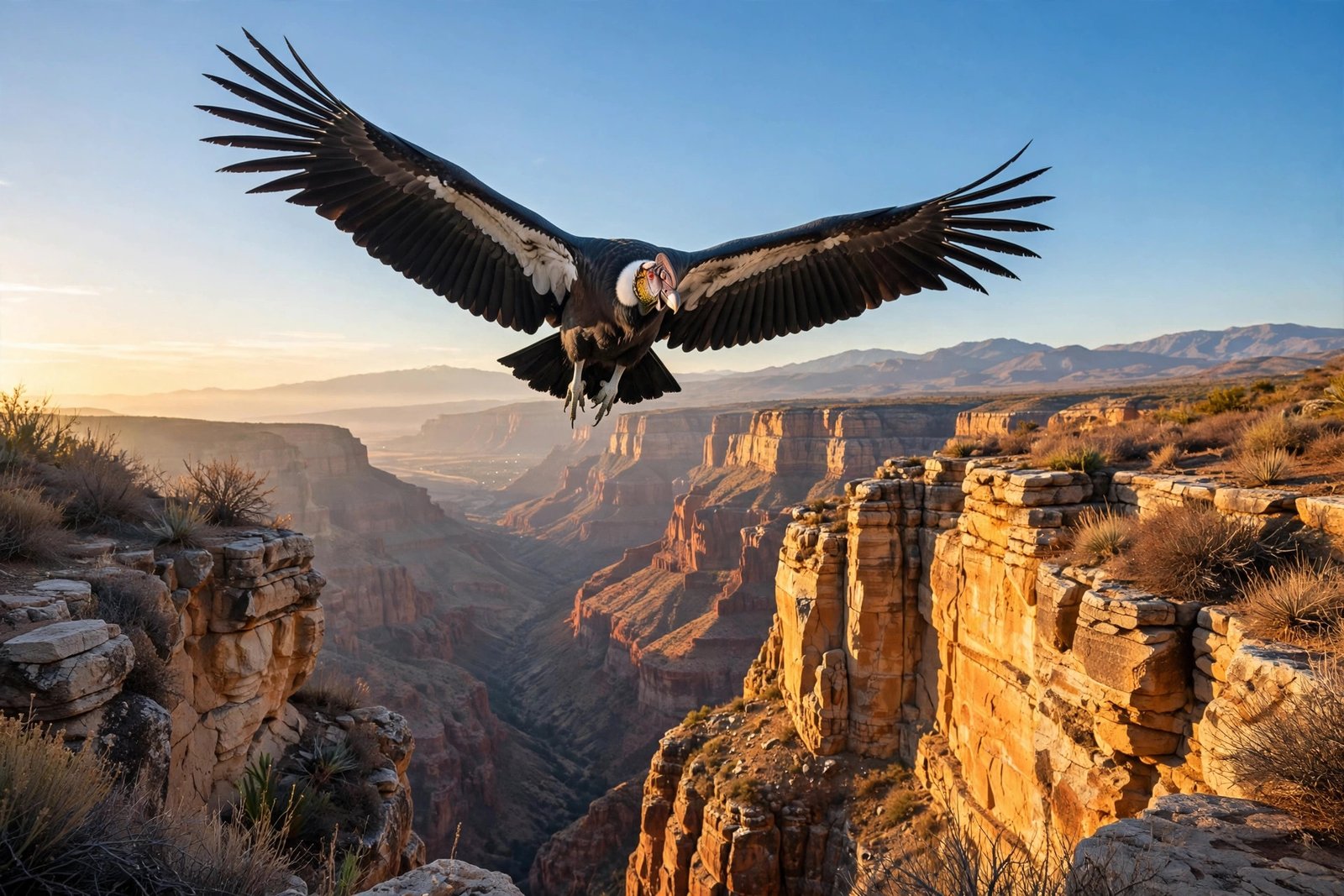
There is a moment, high over the cliffs of California or the rim of the Grand Canyon, when a shadow crosses the sun and the sky seems to fill with wings. The bird casting that shadow is the California condor, North America’s largest flying bird, with a wingspan that can stretch wider than a grown person is tall. It is a scavenger, a survivor from an ancient lineage, and for a time it came closer to vanishing from the Earth than almost any other bird on the continent. Today, more than six hundred condors are alive. That recovery did not happen by accident. It happened because people made a desperate decision, and then spent decades seeing it through.
As of December 31, 2025, the world population of California condors stood at 607 birds, with 392 flying free in the wild and the rest in captivity, according to the U.S. Fish and Wildlife Service’s 2025 annual population status report, published in February 2026. It was the first time the global population had passed 600 since the species neared extinction. That number is worth pausing over, because in 1982 only 22 California condors remained in the wild. The journey from 22 to 607 is one of the great conservation stories in American history, and it is still unfinished.
A Giant on the Edge
The California condor is a New World vulture, a bird built for soaring. It rides rising air currents for hours without flapping, scanning the ground below for carrion. Condors once ranged widely across western North America, from the Pacific coast inland, and their fossil history stretches far back into the continent’s past. By the twentieth century, however, that range had shrunk dramatically, and the birds that remained were concentrated in California.
Twenty-Two Birds in 1982
By 1982, the wild population had fallen to just 22 birds. That figure, reported by the U.S. Fish and Wildlife Service and by conservation organisations that have tracked the species for decades, is the stark starting point of the modern recovery story. Twenty-two birds, in the whole world, flying free. For a species that had once soared over much of the West, it was a number that left no room for error.
The condor had already been listed as endangered, and a recovery programme had been established in the late 1970s. But listing alone could not save a bird that was dying faster than it could reproduce. Condors do not reach breeding age until they are several years old, and a pair typically lays a single egg at a time, in a cliff cave or a hollow tree. Rebuilding a population from such a small base would take patience on a scale that conservation had rarely attempted. The question facing wildlife managers was not whether to act, but how far they were willing to go.
The Hardest Decision: Capture Them All
The answer was radical, and it was controversial. Rather than leave the last wild condors to their fate, the U.S. Fish and Wildlife Service and its partners decided to capture every remaining wild bird and bring the species into captivity. The last wild condor, a bird known as AC-9, was captured on April 19, 1987, at the Bitter Creek National Wildlife Refuge in California. With that capture, there were no California condors left flying free anywhere on Earth.
At that point, the total population, wild and captive combined, stood at 27 birds, housed at the San Diego Wild Animal Park and the Los Angeles Zoo. It is easy, from today’s vantage point, to call the decision a success. At the time, it was a gamble. Critics argued that a species kept only in cages was already, in a meaningful sense, extinct in the wild. Supporters argued that without the capture, there would soon be no condors at all, in cages or anywhere else. The gamble rested on a belief that captive breeding could work, and that the birds could one day be returned to the skies they had lost.
Captive Breeding: Puppets, Patience, and Eggs
Captive breeding turned out to be painstaking work, and it demanded ingenuity. Because condor pairs lay so few eggs, breeders used a technique in which an egg laid in captivity was removed, prompting the pair to lay again. The removed eggs were incubated, and the chicks were raised with hand puppets shaped like adult condors, so that the young birds would not imprint on humans. Genetic records were kept with extraordinary care, because with only 27 founders, every pairing mattered for the health of future generations.
Back to the Sky in 1992
In 1992, captive-bred California condors were released back into the wild in California, beginning a reintroduction effort that has continued ever since. Releases followed in Arizona in 1996, where birds were set free near the Grand Canyon, and later in Baja California, Mexico. Each release site brought its own lessons. Biologists tracked the birds with transmitters, monitored their health, provided supplementary food at feeding sites, and treated birds for lead exposure when blood tests showed dangerous levels.
The 2025 Count: 607 Birds
The U.S. Fish and Wildlife Service’s 2025 annual population status report, published in February 2026, gives the clearest recent picture of where the recovery stands. As of December 31, 2025, the total world population was 607 birds, up from 570 the previous year. Of those, 392 were flying free in the wild and 215 were in captivity. The wild birds were spread across several flocks: 216 in California, 98 in Arizona and Utah, 53 in Baja California, Mexico, and 25 in the Pacific Northwest experimental population. In 2025 alone, 16 wild chicks fledged and 46 captive-bred birds were released to the wild.
Those figures deserve context. A population of 607 is a triumph compared with 22, but it is still a small number for a species spread across a continent, and the condor remains listed as critically endangered. The wild population is not yet self-sustaining without intensive management. Birds are still monitored, still treated for lead poisoning, and still supplemented by captive releases. The recovery has moved the condor from the brink of extinction to a fragile foothold, and the difference between those two states is enormous, but the work is far from finished.
A Homecoming in the Redwoods
One of the most moving chapters of the recovery has unfolded in northern California, on the ancestral lands of the Yurok Tribe. The Yurok people call the condor prey-go-neesh, and tribal elders identified the bird as a priority for restoration years ago. In May 2022, the Northern California Condor Restoration Program, led by the Yurok Tribe’s Wildlife Department with Redwood National and State Parks and other partners, released its first condors back into the redwood country where the birds had long been absent.
Then, in March 2026, came a milestone that made headlines across the conservation world. Two condors on Yurok lands, named by the Tribe Ney-gem’ Ne-chween-kah, meaning She carries our prayers, and Hlow Hoo-let, meaning At last I fly, were observed nesting in a remote old-growth redwood tree. It was the first condor nesting in the Pacific Northwest in more than a century, and the first nest to result from the Yurok programme. Both birds were about seven years old, just reaching breeding age, and both had been released in the programme’s first year.
Honesty requires a coda to that joyful news. The nesting attempt ultimately did not produce a chick, as later reporting from the Cornell Lab’s Living Bird magazine confirmed. That disappointment does not erase the milestone. A pair of young condors choosing a nest site in ancient redwood forest, behaving as a breeding pair, shows that the habitat and the birds are ready for the next step, even if the first attempt did not succeed. Biologists and tribal wildlife staff expect the pair may try again, and more nesting pairs to form in the coming years. A first wild-hatched fledgling over Yurok skies now feels like a matter of when, not if.
Lead: The Threat That Will Not Go Away
If there is one shadow over the condor’s recovery, it is lead. Condors are scavengers, and when they feed on carcasses or gut piles left by hunters, they can ingest fragments of lead ammunition. Lead poisoning damages the nervous system and organs, and it can kill a bird outright or leave it too weak to survive in the wild. Field teams catch condors regularly for blood testing, and birds with dangerous lead levels are treated, sometimes with chelation therapy to draw lead from their bodies. It is skilled, expensive, and never-ending work.
California has taken the strongest action of any state. A statewide ban on lead ammunition for hunting took full effect on July 1, 2019, under Assembly Bill 711, making California the first state to ban lead ammunition in all hunting. Earlier steps had restricted lead ammunition within the condor’s range, but the statewide ban was the decisive move. Research since then has found that the bans and outreach to hunters have reduced condor lead exposure risk, even as condors ranging farther from release sites can still encounter lead in places where protections are weaker. That is why conservationists keep pressing for non-lead ammunition beyond California as well, and why hunter education remains a central part of the recovery programme.
The scale of the problem is sobering. Summaries of the recovery programme’s records report that, between 1992 and the end of 2025, 161 wild condors died of lead poisoning, accounting for about half of all condor deaths with a known cause. In 2025 alone, nine wild condors died from lead. Those numbers explain why biologists describe lead, not habitat alone, as the single greatest obstacle to a self-sustaining wild population. Until lead is out of the condor’s food supply, the species will keep needing rescue, treatment, and release, no matter how many birds are flying.
What It Takes to Keep Condors Flying
Condor recovery today is a daily operation, not a single event. Field crews track birds by satellite transmitter, check nests on remote cliffs, and respond when a bird shows signs of illness. Captive breeding centres carefully pair birds to protect genetic diversity. Feeding stations offer clean carcasses to reduce the chance that birds will scavenge contaminated remains. Veterinarians treat lead poisoning, and researchers study how far birds roam and where the risks lie. It is conservation as long-term care, and it depends on funding, partnerships, and public support year after year.
Why the Condor Matters
It is fair to ask why so much effort should go to a single species, a vulture that most Americans will never see in the wild. Part of the answer is ecological. Condors are nature’s cleanup crew, disposing of carcasses that would otherwise spread disease, and their presence signals a healthy landscape with room for large, wide-ranging wildlife. Part of the answer is cultural. For many Native American communities, including the Yurok, the condor is a sacred being tied to ceremony and balance, and its return is a restoration of heritage as much as of biology.
Frequently Asked Questions
How many California condors are left?
As of December 31, 2025, the world population was 607 California condors, with 392 flying free in the wild and 215 in captivity, according to the U.S. Fish and Wildlife Service’s 2025 annual population status report. That was up from 570 the previous year and marked the first time the population had passed 600 since the species neared extinction.
How did California condors almost go extinct?
The population declined through the twentieth century because of shooting, habitat change, and poisoning, above all lead poisoning from ammunition fragments in carcasses. By 1982 only 22 condors remained in the wild. In 1987, wildlife managers captured the last wild birds, leaving a total population of 27 birds in captivity at the San Diego Wild Animal Park and the Los Angeles Zoo.
When were condors released back into the wild?
Captive-bred condors were first released in California in 1992, followed by releases in Arizona in 1996 and later in Baja California, Mexico. The Northern California Condor Restoration Program, led by the Yurok Tribe, began releases in the redwood region in May 2022. In March 2026, a pair on Yurok lands nested for the first time in the Pacific Northwest in more than a century, though that nesting attempt did not produce a chick.
Why is lead ammunition still a threat to condors?
Condors scavenge carcasses and can swallow tiny fragments of lead ammunition left behind by hunters. Lead poisoning can kill condors or leave them too weak to survive, and it remains the leading known cause of death for wild condors. California banned lead ammunition for all hunting from July 1, 2019, but condors that range beyond protected areas can still encounter lead, so non-lead ammunition and hunter outreach remain essential.
Where can I see a California condor?
Wild condors can sometimes be seen soaring near the Grand Canyon, in central and southern California, and around Redwood National and State Parks, though sightings are never guaranteed and birds range widely. Captive condors can be seen at breeding facilities including the San Diego Zoo Safari Park and the Los Angeles Zoo. If you visit condor country, keep a respectful distance, never approach a nest, and follow all park guidance.
Sources for this article include the official recovery count and the first Pacific Northwest nesting report: U.S. Fish and Wildlife Service: 2025 California Condor Population Status, All About Birds: California Condors Nest in Pacific Northwest, and Audubon California: Lead Ammunition Ban Takes Effect.